
AMD Stock: Why Cathie Wood Keeps Selling While Analysts Stay Bullish

 Prefer us on Google
Cathie Wood's ARK Invest has been trimming its AMD position for several sessions running, and on September 1, that pattern continued with the sale of 7,450 shares across two of its funds, worth roughly $3.4 million based on AMD's closing price of $459.61 that day. On the very same day, ARK poured $31.6 million into Rocket Lab. That contrast, one of the market's most closely watched growth investors quietly stepping back from AMD while aggressively buying into a much smaller, more volatile space stock, is worth understanding on its own terms rather than reading as a simple bearish signal.
Wall Street's own view on AMD hasn't moved in the same direction. Analysts maintain a Strong Buy consensus on the stock, with an average price target implying meaningful upside from current levels. Reconciling one prominent investor's selling with a broadly bullish analyst community requires looking at what ARK's trades actually represent, rather than assuming they say something definitive about AMD's prospects.
What ARK Actually Sold, And What That Sale Actually Represents
The specific mechanics of ARK's AMD sale are worth being precise about. ARKQ sold 4,136 AMD shares and ARKX sold another 3,314 shares on September 1, a combined transaction worth approximately $3.4 million, according to TipRanks' reporting on ARK's daily disclosures. Set against ARK's total AMD holdings, this sale is small. The firm still holds roughly $160 million of AMD across its exchange traded funds, meaning the September 1 trade represented a modest trim rather than any kind of exit.
This distinction matters because ARK's daily trading disclosures get covered individually by financial media, which can make routine portfolio rebalancing look more dramatic in isolation than it actually is within the context of the fund's overall position. Selling roughly 2% of a $160 million holding is a materially different action than beginning to unwind a position, and the two get reported with similar-sounding headlines despite representing very different levels of conviction.

Why AMD's Own Run Explains The Trim Better Than Any Negative View
AMD stock has climbed approximately 115% year to date as of early September, according to TipRanks' coverage. A gain of that size, on a position ARK has held for a meaningful period, creates a straightforward incentive to realize some profit through routine rebalancing, independent of whether the firm's underlying view on AMD's business has changed at all. Funds that don't periodically trim outsized winners risk letting a single position grow to dominate the portfolio's overall risk profile, and ARK has a well documented pattern of taking gains off winning positions to redeploy capital into names it considers more beaten down.
That's precisely the dynamic playing out alongside the AMD sale. On the same day ARK trimmed AMD, the firm also sold roughly $26 million of Palantir, along with positions in Tempus AI and Shopify, according to Dealroom's reporting, while deploying that capital into Rocket Lab and Block. The pattern across all of these trades looks less like a bet against any specific company and more like a broader rotation: harvesting gains from names that have already run hard, and redeploying into names ARK views as oversold relative to their own growth narratives.
Why Rocket Lab Specifically Got The Capital
Understanding where ARK's AMD sale proceeds actually went adds useful context. ARK bought 420,602 Rocket Lab shares through ARKK, plus additional shares through ARKQ and ARKX, on September 1 alone, worth approximately $31.6 million, following an earlier $12.9 million purchase on August 31. Across those two sessions, ARK accumulated more than 700,000 Rocket Lab shares, with the buying continuing a pattern that saw the firm add more than 1 million Rocket Lab shares over the trailing month.
The timing of that buying lines up with a specific detail: Rocket Lab shares had fallen more than 58% from their May high at the time of ARK's purchases, and the stock extended a losing streak, slipping further even as ARK kept buying. Wood's approach here fits a recognizable pattern in her fund's history, adding aggressively to growth names during sharp pullbacks rather than waiting for confirmation that the decline has ended. Rocket Lab's own fundamentals gave ARK a specific reason to view the pullback as disconnected from the underlying business: second-quarter revenue rose 62% to a record $234 million, with backlog up 137% to $2.36 billion, and the company reaffirmed its fourth quarter 2026 target for delivering its Neutron rocket to the launch pad.
-- Price
What Wall Street's Analysts Actually Say About Both Stocks
This is where the contrast with ARK's trading becomes most interesting. Wall Street holds a Strong Buy consensus on both AMD and Rocket Lab, but the implied upside differs meaningfully between them. AMD's average price target sits at $647.19, implying roughly 41% upside from recent levels, according to TipRanks. Rocket Lab's average target of $110.60 implies a considerably larger 74% to 77% upside, depending on the specific snapshot cited.
That gap in implied upside offers a more charitable explanation for ARK's rotation than reading it as a bearish call on AMD specifically. If both stocks carry Strong Buy ratings but one offers a meaningfully larger analyst-implied return, a fund manager focused on maximizing growth exposure has a rational reason to shift some capital toward the name with more theoretical room to run, without that shift implying any loss of conviction in the stock being trimmed.
Why ARK's Own Track Record Is Worth Weighing Here
It's worth being clear eyed about how much weight ARK's trading activity should actually carry as a signal. The flagship Ark Innovation ETF's five year annualized return stood at negative 7.60% as of early September, compared with the S&P 500's 11.06% annualized return over the same period, according to Yahoo Finance's reporting. Over the decade through 2025, the fund destroyed nearly $5 billion in investor wealth on a dollar weighted basis, according to Morningstar analyst Amy Arnott's research, ranking it among the largest wealth destroyers in the fund industry despite periods of spectacular outperformance, including a 153% return in 2020.
This history doesn't mean ARK's current trades are wrong, but it's a relevant data point for anyone treating Cathie Wood's daily portfolio moves as a reliable directional signal on any individual stock. A fund with this volatility profile making a modest trim to a winning position is a different kind of information than a fund with a strong, consistent track record doing the same thing.
What This Actually Means For Evaluating AMD
None of ARK's activity changes AMD's own fundamentals. The company's underlying business performance, its data center and AI driven growth, and the Strong Buy consensus among analysts covering the stock exist independently of what any single fund does with its position on a given trading day.
What ARK's trades actually demonstrate is a portfolio manager taking measured profits from a name that's already delivered a 115% year to date gain, while redeploying a portion of that capital into a smaller, more volatile name trading well below its own highs, a decision more about relative opportunity and portfolio construction than about any negative view on AMD's prospects specifically.
Trade AMD Directly on WEEX Stock Spot 2.0
Whether AMD's 115% run and Wall Street's $647.19 average price target hold up, or ARK's rotation into Rocket Lab proves to be the smarter allocation, is a question that plays out over the coming quarters rather than in any single day's fund disclosure. For traders who want direct exposure to that outcome rather than just following the headlines, AMD is available on WEEX through Stock Spot 2.0, giving traders a way to access the AMDUSDT trading pair with USDT, starting from as little as 5 USDT, without needing to open a separate brokerage account.
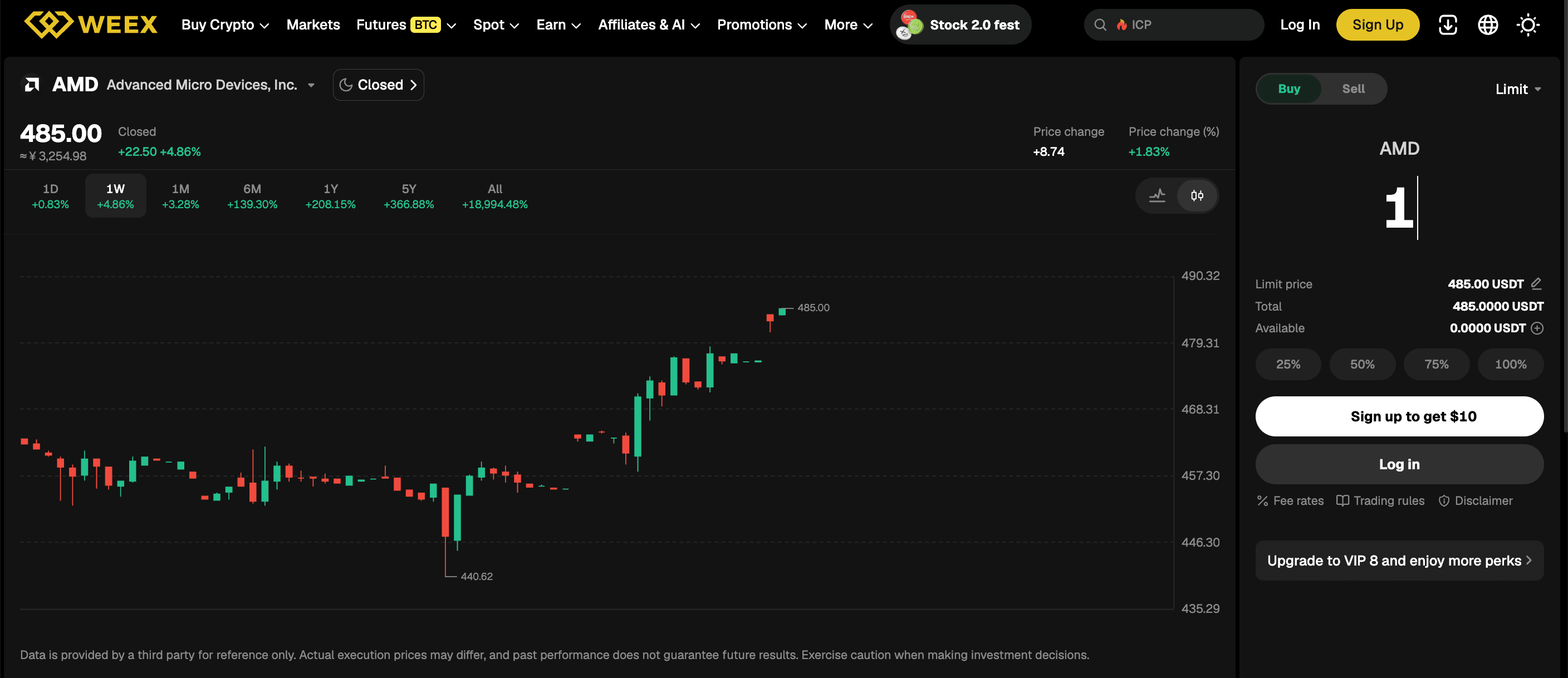
Source: WEEX Stock Spot 2.0, September 8, 2026.
This matters specifically for a stock like AMD, where large institutional trades like ARK's get reported and reacted to within hours: having a direct, low friction way to act on that same information, rather than waiting to open a traditional brokerage account, is what actually turns a piece of market news into a tradable position. AMDUSDT is live on WEEX now, letting traders position around AMD's next earnings report or any further disclosures from funds like ARK as they happen, on the same platform already used for spot and futures trading.
Conclusion
ARK's AMD sale on September 1 represents a modest trim, roughly 2% of its total AMD position, driven more by AMD's own 115% year to date gain and a rotation toward a name with larger implied upside than by any specific negative view on AMD's business. Wall Street's Strong Buy consensus on AMD hasn't moved alongside ARK's selling, and the fund's own volatile long-term track record is worth weighing before treating its daily trades as a reliable signal on any individual stock.
FAQ
1. How much AMD stock did Cathie Wood's ARK actually sell?
ARK sold 7,450 AMD shares across its ARKQ and ARKX funds on September 1, worth approximately $3.4 million, a modest trim against its total AMD holding of roughly $160 million.
2. Is ARK exiting its AMD position entirely?
No. The sale represents a small reduction, roughly 2% of ARK's total AMD holding, characterized by multiple outlets as routine portfolio rebalancing rather than an exit.
3. Why is ARK buying Rocket Lab while selling AMD?
ARK has bought more than 700,000 Rocket Lab shares over recent sessions as the stock trades over 58% below its May high, while Rocket Lab's average analyst price target implies larger upside (74-77%) than AMD's (41%).
4. What does Wall Street think of AMD stock right now?
Analysts maintain a Strong Buy consensus on AMD, with an average price target of $647.19, implying roughly 41% upside from recent levels.
5. Should ARK's trading activity be treated as a reliable signal on AMD?
It's worth weighing cautiously. ARK's flagship fund has posted a negative 7.60% five year annualized return compared to the S&P 500's 11.06% over the same period, a relevant context for evaluating how much weight to give its daily trades.
This content is provided for general informational purposes only and doesn't constitute financial, investment, legal, or tax advice. Any events, rewards, online promotions, or related information mentioned herein should not be considered a recommendation, solicitation, or invitation to purchase, sell, trade, or otherwise deal in any crypto assets. Crypto assets are highly volatile and may result in loss. The availability of WEEX services, products, and related events may vary by region. You are responsible for ensuring that your participation is in accordance with applicable local laws and regulations.
You may also like

AMD Stock Joins the $1 Trillion Club: What's Actually Driving the 5 Day Surge

NVDA Stock Sits Near Its High While Rivals Are Down 18-32%: What Explains the Gap
WEEX Stock Spot 2.0 Rewards Guide: Trade & Share $100K

AMD vs Nvidia After Q2 Earnings: Which Stock Is the Better Buy?

Bitget Resumes Withdrawals in Phases: Schedule in Vietnam Time and What to Check

Bitget Phased Withdrawal Restart: Schedule (UTC+8) and Checks for Taiwan Users
Taiwan's Travel Rule Starts in October: What Domestic Crypto Transfers Will Require
Germany's Crypto Tax Draft 2027: What the 50 Percent Substitute Assessment Means
Who Can Operate in Russia's Crypto Market from 5 October 2026
Self-Custody Wallets: When a Crypto Transfer Must Be Reported to Brazil's Coaf
Binance UAH Deadline: Fiat Trade UAH and USDT/UAH Changes on 28 September
Italian Crypto Tax Return 2026: Filing Deadline, Forms and Gains Rate
FTXF: Hanoi Police Seeks Victims to Report by September 30, 2026
XOF, XAF and CDF Are Now Available on WEEX P2P: What Users Need to Know
WEEX Close Position Guide: Flash Close, Limit Close and TP/SL
WEEX Futures Trading: What 400x Leverage Really Costs You
What Is Aleo (ALEO) Crypto, and Why Did Its Price Jump Up to 88%?
Best Crypto Exchange for Beginners 2026: What Actually Matters When Choosing One

Best Crypto Cold Wallet 2026: Top Picks Matched to How You Hold
Phantom Wallet vs MetaMask: What's the Difference

How to Connect Phantom Wallet to a Solana DApp
How to Install and Set Up Phantom Wallet
What Is Phantom Wallet? A Complete Guide to the Solana Wallet

What Is a White Label Crypto Exchange? A Complete Beginner's Guide
What Is Pons Crypto (PONS), and How to Trade PONS on WEEX?

Crypto Futures Trading Explained: One Real Trade, Start to Exit

What Is Blockchain Used For? 2026 Uses, Ranked by Real Money

How to Buy USDT with EUR via SEPA Bank Transfer on WEEX
How to Buy Bitcoin with EUR in Europe on WEEX
How to Buy Crypto in Europe with EUR on WEEX OTC
AMD Stock Joins the $1 Trillion Club: What's Actually Driving the 5 Day Surge
NVDA Stock Sits Near Its High While Rivals Are Down 18-32%: What Explains the Gap
WEEX Stock Spot 2.0 Rewards Guide: Trade & Share $100K
AMD vs Nvidia After Q2 Earnings: Which Stock Is the Better Buy?
Bitget Resumes Withdrawals in Phases: Schedule in Vietnam Time and What to Check
Bitget Phased Withdrawal Restart: Schedule (UTC+8) and Checks for Taiwan Users


