
What Is Aleo (ALEO) Crypto, and Why Did Its Price Jump Up to 88%?

 Prefer us on Google


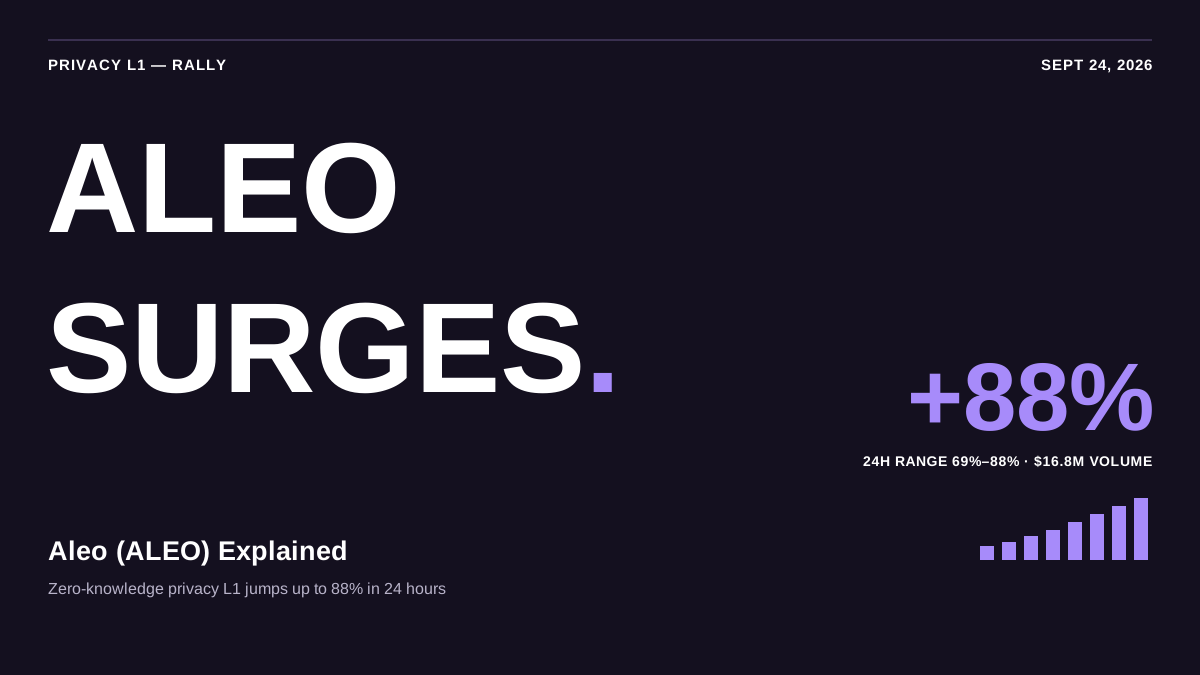
Aleo (ALEO) is a privacy-focused Layer 1 blockchain that lets developers build programmable applications whose sensitive inputs and transaction details can remain encrypted. ALEO’s September 24 rally was unusually large: different market-data providers measured gains ranging from roughly 69% to 88%, depending on their price index and cutoff time. The move came with a sharp increase in trading volume, but no single confirmed announcement fully explains it, making liquidity, speculative positioning, and renewed interest in privacy infrastructure the most credible combined explanation.
Our view is blunt: this was primarily a liquidity-driven repricing, not proof that Aleo’s adoption suddenly doubled overnight. Aleo has real technology, substantial funding and increasingly credible payment integrations, but traders should not confuse a one-day price explosion with a corresponding change in network fundamentals. The project deserves serious attention; the candle deserves skepticism.
The Snapshot
- Aleo (ALEO) is a Layer 1 blockchain built around programmable privacy and zero-knowledge proofs.
- Aleo’s mainnet launched on September 18, 2024.
- Its applications can combine private data with publicly verifiable computation.
- ALEO pays network fees, supports staking, rewards validators and provers, and may participate in governance.
- CoinMarketCap recorded ALEO at approximately $0.0294, up 68.95% over 24 hours, while other platforms measured gains of 75% to 88%.
- The conflicting percentages reflect different exchanges, reference prices and observation cutoffs.
- Circulating supply was approximately 1.44 billion ALEO against a reported maximum supply of 5 billion.
- WEEX supports both ALEO/USDT spot trading and ALEO/USDT perpetual futures.
- No verified ALEO-specific WEEX reward campaign or pair-specific fee discount was located at the article’s data cutoff.
What Is Aleo (ALEO) Crypto? Know About ALEO in 2 minutes
Aleo is a programmable Layer 1 blockchain designed to let people use decentralized applications without exposing all their financial and personal information to the public.
That distinction matters because most public blockchains are transparent by default. Anyone can inspect an address and potentially reconstruct its transaction history, balances, counterparties and interactions with applications. Pseudonymous addresses are not the same as genuinely private accounts.
Aleo approaches the problem with zero-knowledge cryptography. In simplified terms, a zero-knowledge proof allows one party to prove that a computation was performed correctly without revealing all the private information used in that computation.
For example, an Aleo application could theoretically allow a user to:
- Prove that they meet an age requirement without disclosing their birth date.
- Demonstrate that they have sufficient funds without revealing their complete balance.
- Process payroll without placing every employee’s salary on a public ledger.
- Send a stablecoin while keeping the sender, recipient and amount shielded.
- Prove compliance to an authorized auditor through controlled disclosure.
- Run a private game or auction whose hidden information still follows verifiable rules.
Aleo therefore is not merely a “privacy coin” in the narrow sense. It is infrastructure for building programmable applications that can use private state.
That puts it closer to a privacy-oriented application platform than to assets such as Monero, whose main identity centers on private currency transfers.
Who Created Aleo (ALEO)?
Aleo grew out of research into private smart contracts and the 2018 Zexe paper, which was co-authored by Aleo co-founder Howard Wu. The project’s genesis block was released in 2024, and the Aleo mainnet officially launched on September 18, 2024.
Publicly reported founders include:
- Howard Wu
- Michael Beller
- Collin Chin
- Raymond Chu
Aleo raised a $28 million Series A led by Andreessen Horowitz in 2021. In February 2022, it announced a $200 million Series B led by Kora Management and SoftBank Vision Fund 2.
Other participants included Tiger Global, Sea Capital, Samsung Next, Slow Ventures and Andreessen Horowitz. The Series B valued the company at approximately $1.45 billion. businesswire.com
The funding history gives Aleo more institutional credibility than a typical small-cap token. However, venture backing does not guarantee token performance, application adoption or an equitable relationship between network growth and token-holder value.
-- Price
How Does Aleo (ALEO) Work?
Aleo separates private computation from public verification.
Instead of requiring every validator to reproduce every part of a private computation, a user or application generates a cryptographic proof. Network participants then verify that proof and update the blockchain’s state without needing to see all the underlying private data.
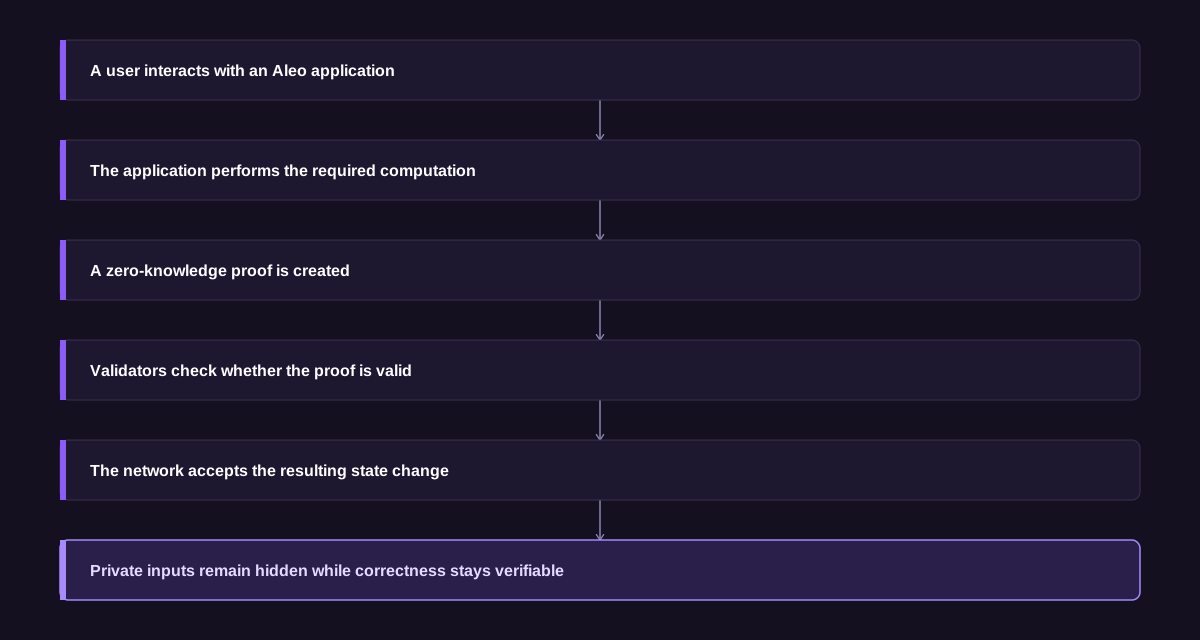
A simplified transaction flow looks like this:
- A user interacts with an Aleo application.
- The application performs the required computation.
- A zero-knowledge proof is created.
- Validators check whether the proof is valid.
- The network accepts the resulting state change.
- Private inputs can remain hidden while correctness remains verifiable.
This model can reduce unnecessary exposure of user data. It does not mean every Aleo interaction is automatically invisible under all circumstances, nor does it eliminate application-level security risks.
Privacy depends on how a specific application is designed, which state is public or private, how keys are managed and whether a user voluntarily discloses information.
Leo Programming Language
Aleo created Leo, a programming language designed for zero-knowledge applications.
Writing cryptographic circuits directly can be difficult and error-prone. Leo is intended to give developers a higher-level environment in which they can express application logic before compiling it into forms the Aleo network can prove and verify.
The aim is similar to what developer-friendly languages did for conventional smart contracts: reduce the specialist knowledge needed to create an application.
Leo does not make cryptography trivial. Developers still need to understand privacy boundaries, state management, access controls, proof costs and the consequences of placing information in public or private records.
snarkVM and snarkOS
Two frequently mentioned parts of the Aleo technology stack are snarkVM and snarkOS.
- snarkVM provides components used to execute and verify zero-knowledge programs.
- snarkOS relates to the network software through which nodes communicate and participate in Aleo.
For ordinary users, the distinction is less important than the result: Aleo attempts to combine programmable smart contracts with data confidentiality at the protocol level.
Aleo Records
Aleo uses records to represent private data and assets.
A record can contain ownership information and application-specific data. Records can be consumed and new records produced when a private program runs, while proofs demonstrate that the transition followed the application’s rules.
This record-oriented architecture is especially relevant to payments, credentials, games and applications in which showing the entire account state would defeat the purpose of using the system.
Is Aleo (ALEO) a Privacy Coin?
Calling ALEO a privacy coin is incomplete.
ALEO is the network’s native asset, but the broader project is a programmable privacy blockchain. The purpose is not limited to concealing transfers of the native token. Developers can build applications with private inputs, private state and selectively disclosed outputs.
A useful comparison is:
| Project category | Primary function | Programmability | Privacy scope |
|---|---|---|---|
| Traditional privacy coin | Private currency transfers | Usually limited | Payments and balances |
| Transparent smart-contract chain | General applications | High | Mostly public by default |
| Aleo (ALEO) | Private programmable applications | High | Application data, state and transfers |
| ZK rollup | Scale or verify activity anchored to another chain | High | Varies by design |
Aleo’s competitive proposition is therefore ambitious: it wants the flexibility of a smart-contract platform without requiring users to expose everything they do.
The challenge is that privacy systems create additional complexity. Proof generation, wallet compatibility, application design, performance and regulatory expectations can all slow adoption.
What Is Aleo (ALEO) Used For?
Aleo’s most credible use cases are those in which public verification is useful but full transparency is harmful.
Private Stablecoin Payments
Stablecoins are an obvious example. A business generally does not want competitors to inspect its payroll, supplier payments, treasury balances or customer flows.
Aleo and Circle launched USDCx on Aleo in December 2025. According to Aleo, USDCx is minted through Circle’s xReserve infrastructure and is backed 1:1 by native USDC deposited in the relevant xReserve contract.
Transaction details such as the sender, receiver and amount can remain encrypted, while the system preserves mechanisms for authorized disclosure.
Aleo also presents USAD as an encrypted stablecoin intended for private payments, payroll, decentralized finance and business transactions.
These integrations are more meaningful than a generic claim that privacy “could one day” be useful. They demonstrate that Aleo is focusing on a market with a concrete confidentiality problem.
Private Payroll and Business Payments
Transparent blockchains can reveal salaries, supplier relationships and treasury movements.
Aleo’s public/private state model allows an application to shield those details while retaining the option to provide view access to authorized parties. Its Request Finance partnership, for example, described the use of view keys for compliance and audit access.
Selective Identity Disclosure
A user may need to prove something about themselves without submitting a complete identity file to every application.
Potential examples include proving:
- Residency in an eligible jurisdiction.
- Membership in an approved group.
- Completion of identity verification.
- Possession of a required credential.
- Satisfaction of an age threshold.
The proof can answer the necessary question without exposing unrelated information.
Private Decentralized Finance
Public DeFi transactions can reveal positions, collateral, liquidation thresholds and trading strategies.
A privacy-preserving application could conceal sensitive position details while still proving that its collateral and settlement rules are satisfied. This may reduce information leakage, although it does not eliminate smart-contract, oracle or liquidity risk.
Gaming
Some games require hidden information. Public blockchains are poorly suited to mechanics in which everyone must be able to see every move, card or strategy.
Zero-knowledge proofs can let players demonstrate that an action followed the rules without revealing the hidden state that makes the game work.
Institutional and Public-Sector Payments
Aleo has also explored private stablecoin infrastructure for humanitarian payments, institutional wallets and cross-border financial systems.
This is promising, but partnerships and demonstrations must not be mistaken for mass adoption. Traders should look for measurable transaction activity, stablecoin supply, active applications and recurring users.
What Is the ALEO Token Used For?
The native ALEO token is described by the project as an access and coordination asset for the network.
Its main forms of token utility include:
Paying Transaction and Computation Fees
Users need ALEO to access blockspace and computational resources.
Programs with more complex proof or verification requirements may consume different resources than simple transfers. Network demand can therefore create token demand, although only if the applications attract real users.
Staking
ALEO holders can delegate tokens to validators. Validators participate in block production and verification, while delegators may receive a proportional share of rewards.
Aleo states that a validator needs one million Aleo Credits delegated to it before it can begin validating. How Aleo Works
Staking is not free yield. Rewards partly compensate participants for network security, operational costs and token emissions. If supply grows faster than demand, nominal token rewards may not translate into increased purchasing power.
Validator and Prover Rewards
Validators receive rewards for confirming transactions and producing blocks.
Provers contribute computing resources to proof-related work. The protocol uses ALEO rewards to encourage these participants to supply the infrastructure the network requires.
Network Governance
Aleo’s tokenomics documentation says ALEO holders may participate in decentralized governance after mainnet, including decisions about upgrades and protocol changes.
Users should distinguish intended governance from active, fully decentralized governance. The meaningful questions are whether proposals are on-chain, how voting power is distributed and which decisions token holders can actually change.
Spam Prevention
Network fees make it costly to flood Aleo with unlimited transactions or computational requests.
This is a basic but important token function: a scarce fee asset forces users and applications to attach an economic cost to network resource consumption.
Aleo (ALEO) Tokenomics: Circulating Supply, Total Supply, and Max Supply
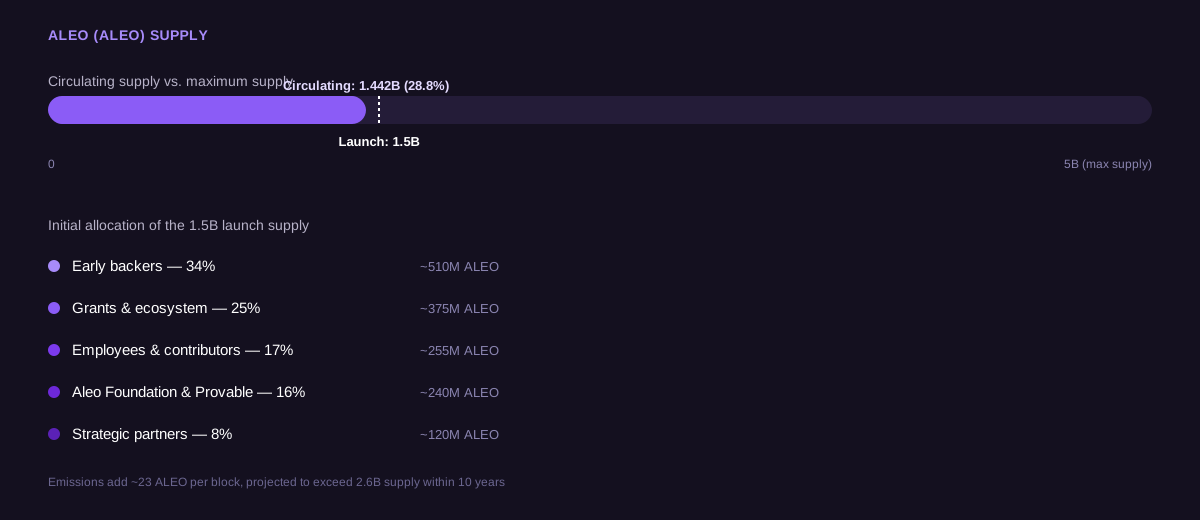
Aleo launched with an initial supply of 1.5 billion tokens.
The project’s published initial allocation was approximately:
| Allocation | Share | Approximate amount based on 1.5B launch supply |
|---|---|---|
| Early backers | 34% | 510 million ALEO |
| Grants, ecosystem contributors and education | 25% | 375 million ALEO |
| Employees and project contributors | 17% | 255 million ALEO |
| Aleo Foundation and Provable | 16% | 240 million ALEO |
| Strategic partners | 8% | 120 million ALEO |
Aleo’s documentation says validators receive a constant emission of 23 tokens per block. The project estimated that rewards could increase supply from 1.5 billion to more than 2.6 billion over the first ten years, while the annual emission rate declines from approximately 13.5% in year one to 1.6% in year ten. aleo.org
On September 24, 2026, CoinMarketCap reported:
- Circulating supply: approximately 1.442 billion ALEO
- Maximum supply: 5 billion ALEO
- Market capitalization: approximately $42.35 million
- 24-hour trading volume: approximately $16.84 million
Those figures were a live snapshot and can change.
Why Supply Growth Matters
Only about 28.8% of the reported five-billion maximum supply was circulating in that snapshot.
That does not mean the remaining supply will suddenly enter the market. It does mean that a valuation based only on current market capitalization can understate long-term dilution.
At a price of $0.0294:
- A 1.442-billion circulating supply implies a market cap near $42.4 million.
- A five-billion fully diluted supply implies a theoretical fully diluted valuation near $147 million.
The gap matters because token emissions, vesting releases and ecosystem distributions can create selling pressure.
Emission is not automatically bad. Networks need to compensate validators and fund adoption. It becomes a problem when newly issued supply consistently exceeds organic demand for fees, staking, applications and payments.
What Is Not Fully Established
The public tokenomics document explains allocations and protocol emissions, but traders still need a reliable, current release schedule showing:
- Remaining investor unlocks.
- Employee and contributor vesting.
- Foundation-controlled balances.
- Strategic partner releases.
- Ecosystem grant distributions.
- Changes introduced through governance.
Without a current unlock dashboard reconciled to on-chain data, precise claims about the next large ALEO unlock should be treated cautiously.
Why Did Aleo (ALEO) Price Jump Up to 88%? We Think There are 5 Reasons
There was no single verified announcement that adequately explained the entire move.
Instead, the rally appears to have reflected a combination of market structure, renewed narrative interest and speculative demand.
1. ALEO Started From a Depressed Price Base
Aleo entered September 2026 after a severe long-term decline.
Third-party historical data placed its September 2024 opening price above $3, with an early peak around $6.70 to $6.80. By August and September 2026, ALEO had traded close to $0.015.
That represents a decline of more than 99% from its initial peak.
When an asset has already collapsed to a small market capitalization, a relatively modest inflow of capital can produce a very large percentage move.
A rise from $0.0165 to $0.033 is approximately 100%, but the absolute difference is only about $0.0165 per token. Percentage headlines can therefore look more dramatic than the capital required to produce them.
2. Trading Volume Expanded Sharply
CoinGecko reported ALEO around $0.0305 with approximately $15.1 million in 24-hour trading volume, up 75.4% over the same period. CoinMarketCap reported a similar price but an increase of 68.95%.
Bybit’s reference page recorded approximately $16.22 million in volume and an 88.43% 24-hour move, with an intraday range from about $0.0166 to $0.0429. ALEO Market Cap & Chart Analysis
These discrepancies do not necessarily indicate an error. Providers aggregate different exchanges, apply different quality filters and use different cutoff times.
The consistent signal is not the exact percentage. It is that ALEO’s price and volume expanded unusually quickly.
3. Thin Liquidity Amplified the Move
Two days before the rally, CoinMarketCap’s automated analysis described ALEO as suffering from thin liquidity and a lack of positive catalysts.
Thin liquidity works in both directions. It can deepen a decline when buyers disappear, but it can also magnify a rally when aggressive demand suddenly reaches a shallow order book.
A price can jump across order-book gaps even without an enormous increase in total capital committed.
This is why a low-cap token can rise 70% or more and then give back a substantial part of the move quickly.
4. Aleo Has a Renewed Private-Payments Narrative
Aleo’s 2025–2026 integrations create a more convincing fundamental story than the project had immediately after mainnet.
Relevant developments include:
- USDCx launched with Circle xReserve infrastructure.
- USAD expanded Aleo’s private-stablecoin proposition.
- Ledger added support for shielded Aleo transactions.
- Request Finance explored private business payments.
- Aleo highlighted integrations with Google Cloud and institutional infrastructure providers.
- Private stablecoin demonstrations moved from theory to mainnet implementations.
Aleo’s official ecosystem directory now identifies wallets, stablecoins, decentralized finance applications, developer tools, explorers and bridges. Zero-knowledge by design
None of these developments occurred exclusively on September 24. They nevertheless give traders a narrative to revisit when privacy or stablecoin infrastructure regains attention.
5. Short-Term Speculation Probably Added Momentum
A near-vertical move often attracts breakout traders, momentum algorithms and leveraged positions.
Once the token cleared recent resistance, new buyers may have entered because the price was already rising. That feedback loop can continue until profit-taking or exhausted demand breaks it.
Without exchange-level liquidation and open-interest data covering the entire market, it would be irresponsible to claim that a short squeeze caused the rally. It remains a plausible contributing mechanism, not a confirmed fact.
ALEO Market Data Comparison
| Provider | Price snapshot | 24-hour change | 24-hour volume | Observation |
|---|---|---|---|---|
| CoinMarketCap | $0.02936 | +68.95% | $16.84M | Circulating supply reported at 1.442B |
| CoinGecko | $0.03049 | +75.40% | $15.09M | Seven-day gain reported at 115.30% |
| TradingView | $0.03270 | +84.37% | $11.21M | Aggregated market reference |
| Bybit price page | $0.03276 | +88.43% | $16.22M | Intraday range of $0.01656–$0.04287 |
Data was checked on September 24, 2026. Live prices changed during the research window, and each provider used its own aggregation and cutoff methodology. The sources did not provide one identical exact data timestamp.
The correct editorial conclusion is therefore that ALEO gained roughly 69% to 88% across major reference pages—not that one percentage is universally authoritative.
How Aleo (ALEO) Compares With Other Privacy Projects
| Project | Main focus | Architecture | Native privacy | Smart-contract scope |
|---|---|---|---|---|
| Aleo (ALEO) | Private programmable applications | Independent Layer 1 | Central design goal | Broad |
| Zcash (ZEC) | Private digital money | Independent blockchain | Shielded transfers | More limited |
| Monero (XMR) | Private payments | Independent blockchain | Default transaction privacy | Limited |
| Mina Protocol (MINA) | Succinct blockchain and ZK applications | Independent Layer 1 | Application-dependent | Broad |
| Aztec | Private applications and scaling | Ethereum-oriented ZK network | Central design goal | Broad |
| Secret Network (SCRT) | Privacy-preserving smart contracts | Cosmos ecosystem chain | Encrypted contract state | Broad |
Aleo’s strength is its coherent developer stack: a dedicated Layer 1, Leo language, zero-knowledge execution system and privacy-oriented application model.
Its weakness is the size of the challenge. Developer tools, wallets, liquidity and users must all mature together. A technically elegant chain with few active applications will not generate durable token demand.
Aleo (ALEO) Ecosystem and Major Applications
The Aleo ecosystem spans several categories.
Stablecoins
- USDCx
- USAD
These are strategically important because payments provide a clearer need for privacy than speculative token transfers alone.
Wallets and Custody
- Ledger
- FoxWallet
- Embedded-wallet infrastructure such as Dynamic
Ledger support is particularly relevant because private keys can remain on a hardware device while users authorize shielded transactions.
Decentralized Finance
- Arcane Finance
- Pondo liquid staking
- Other developing swap, liquidity and staking tools
Users should verify the exact application URL through Aleo’s official ecosystem directory. Privacy branding does not protect against phishing, malicious approvals or fake interfaces.
Bridges
Verulink is presented as a bridge connecting Aleo with assets from networks such as Ethereum.
Bridges add utility but also introduce additional contract, validator and custody risks. A bridge can be weaker than either blockchain it connects.
Explorers and Developer Infrastructure
- Provable Explorer
- AleoScan
- Google Cloud integrations
- Provable developer tooling
Explorers for a privacy network necessarily show less account-level information than a fully transparent chain. Users should not interpret limited visible data as proof that no activity occurred.
How to Store Aleo (ALEO)
Users need an Aleo-compatible wallet rather than assuming every Ethereum or Solana wallet supports the network.
Before transferring ALEO:
- Confirm that the wallet explicitly supports Aleo mainnet.
- Install it only through the project’s official website or verified app-store listing.
- Create and securely back up the recovery phrase.
- Never enter that phrase into a website or support conversation.
- Copy the receiving address directly from the wallet.
- Confirm that the exchange withdrawal network is Aleo.
- Send a small test transaction first.
- Wait for confirmation before moving the remaining balance.
Ledger support adds a hardware-wallet option for compatible shielded transactions, but hardware storage does not prevent every mistake. A user can still approve the wrong transaction, visit a phishing site or send assets over an unsupported network.
How to Trade Aleo (ALEO) on WEEX
WEEX currently provides both an ALEO/USDT spot market and an ALEO/USDT perpetual futures market. WEEX’s official spot page and futures page were accessible during the September 24, 2026 verification. If you are interested in Buy & Sell ALEO on WEEX, click here to jump!
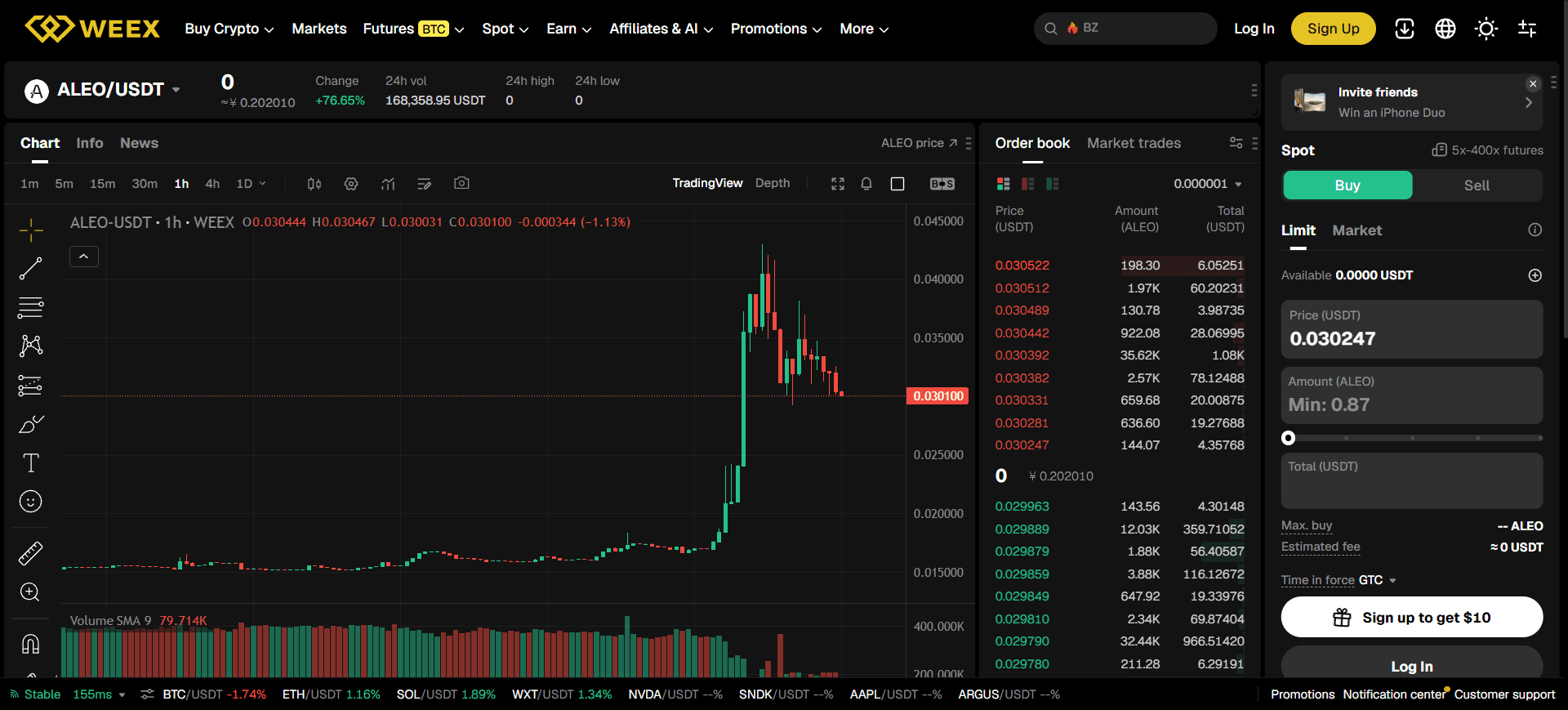
No active ALEO-specific reward campaign or pair-specific fee discount was located during the verification. Users should check the current WEEX Events and fee pages before trading because campaigns and fee tiers can change.
How to Buy Aleo (ALEO) on the WEEX Spot Market
- Create or sign in to a WEEX account.
- Complete any verification required for the relevant region and service.
- Deposit USDT or use an available purchase method to obtain USDT.
- Open the ALEO/USDT spot page.
- Choose a market order for immediate execution or a limit order to specify a maximum purchase price.
- Enter the amount of ALEO or USDT.
- Review the price, estimated quantity and applicable fee.
- Confirm the order.
- Check the Spot Account after execution.
A market order prioritizes execution but can suffer greater slippage during volatile periods. A limit order gives the trader price control but may not fill.
WEEX’s buying guide also confirms that ALEO can be obtained through the ALEO/USDT spot pair. WEEX
How to Trade Aleo (ALEO) Perpetual Futures
- Open the ALEO/USDT perpetual futures page.
- Transfer the required margin into the futures account.
- Select cross or isolated margin where available.
- Choose leverage conservatively.
- Set the order type and entry price.
- Decide whether the position is long or short.
- Define the invalidation level before submitting the trade.
- Add a stop-loss and, where appropriate, a take-profit order.
- Monitor the mark price, liquidation price and funding rate.
Perpetual futures do not provide ownership of the underlying ALEO tokens. They provide price exposure through a leveraged derivative.
That difference is especially important after a 70%–88% daily move. Wider price swings can move the liquidation price much faster than an inexperienced trader expects.
Spot or Futures?
| Objective | More relevant market | Main risk |
|---|---|---|
| Own and withdraw ALEO | Spot | Token price decline |
| Trade short-term direction | Futures | Leverage and liquidation |
| Avoid funding payments | Spot | Capital remains fully exposed |
| Hedge an existing position | Futures | Basis, funding and execution risk |
| Participate in Aleo applications | Spot plus compatible wallet | Network and application risk |
What Should Traders Watch After the Aleo (ALEO) Rally?
Trading Volume
A high-volume price move is generally more credible than a thin spike, but volume must remain elevated after the initial breakout.
If price remains high while volume collapses, the move may be losing participation.
Retests of the Breakout Area
After a vertical rally, the market often returns toward the breakout zone.
A controlled retest with declining sell volume may suggest stronger demand than an immediate collapse through the original range.
Funding Rates and Open Interest
If perpetual open interest expands while funding becomes strongly positive, late leveraged longs may be crowding into the trade.
If price falls while open interest remains high, liquidation risk can grow.
Stablecoin and Application Activity
Fundamental confirmation would include:
- Growth in USDCx or USAD supply.
- More active Aleo accounts.
- Higher application usage.
- Rising transaction-fee demand.
- Increasing validator participation.
- More recurring business-payment volume.
These indicators matter more to Aleo’s long-term value capture than social-media attention.
Token Emissions and Unlocks
Traders should monitor changes in circulating supply rather than focusing only on the five-billion maximum supply.
A growing network may absorb new emissions. A stagnant network may not.
Broader Privacy Regulation
Regulatory treatment of privacy technology remains a major variable.
Aleo emphasizes controlled disclosure and compliance-compatible privacy. That positioning may make it more usable for institutions than an architecture built only for unconditional opacity, but implementation and regulatory acceptance still matter.
Major Risks of Aleo (ALEO)
Extreme Historical Drawdown
ALEO remains dramatically below its early market price. A large one-day rally does not repair a decline exceeding 99% from its initial peak.
Dilution
Current circulating supply represents only part of the reported maximum supply. Protocol emissions and future distributions may increase sellable supply.
Adoption Risk
Aleo can have impressive cryptography without attracting enough users. Technology does not automatically produce sustainable demand.
Developer Complexity
Privacy applications require careful handling of proofs, records, keys and disclosure rules. Errors may be difficult to detect or reverse.
Liquidity Risk
The same market structure that helped ALEO rise quickly can accelerate a decline. Stop orders may execute far from their trigger price during disorderly trading.
Competition
Aleo competes with privacy coins, ZK application platforms, Ethereum privacy layers and enterprise payment systems.
Regulatory Risk
Privacy tools can satisfy legitimate business and personal needs, but regulators may scrutinize systems that reduce transaction visibility.
Bridge and Application Risk
Using ALEO in an application introduces risks beyond the base network, including contract vulnerabilities, bridge failures, malicious interfaces and compromised wallets.
Value-Capture Risk
An ecosystem can grow without the token price increasing proportionally. Traders must ask whether applications create recurring demand for ALEO or can minimize their exposure to it.
WEEX Editorial View: Aleo (ALEO) Has a Real Product Thesis, but the Rally Ran Ahead of the Evidence
Aleo is one of the few small-cap Layer 1 projects whose core proposition solves a genuine problem. Businesses cannot reasonably put payroll, customer payments and treasury activity on a permanently transparent ledger. Private stablecoins with selective disclosure are a credible answer, and Aleo’s Circle, Ledger and payments integrations make that thesis more than a whitepaper promise.
But the September rally still ran ahead of the evidence.
An 80% price increase does not prove that transaction demand, stablecoin supply or fee revenue grew by 80%. It proves that buyers overwhelmed the available liquidity. Until network usage confirms the price move, ALEO should be treated as a promising privacy infrastructure asset undergoing speculative repricing—not as a completed adoption success.
The smartest way to assess Aleo is to ignore the most dramatic candle and watch the quieter measurements: stablecoins issued, payments settled, developers retained, applications used, fees paid and supply entering circulation. If those numbers rise persistently, the rally may have anticipated real progress. If they do not, the market merely rediscovered an old narrative at a lower price.
Frequently Asked Questions
1. What Is Aleo (ALEO) Crypto?
Aleo is a Layer 1 blockchain for private, programmable applications. It uses zero-knowledge proofs so that a network can verify computations without exposing every underlying input or transaction detail.
2. Why Did Aleo (ALEO) Rise So Much?
The September 24 move combined rapidly increasing volume, thin prior liquidity, a depressed price base, momentum trading and renewed interest in Aleo’s private-payment ecosystem. No single verified announcement explains the full rally.
3. What Is the Maximum Supply of Aleo (ALEO)?
Major market-data services report a maximum supply of five billion ALEO. Approximately 1.44 billion were reported as circulating on September 24, 2026.
4. Can Aleo (ALEO) Be Staked?
Yes. ALEO can be delegated to validators, subject to the network’s staking rules. Rewards should be evaluated alongside token emissions, validator performance and any lock or withdrawal conditions.
5. Is Aleo (ALEO) Available on WEEX?
Yes. WEEX provides an ALEO/USDT spot market and an ALEO/USDT perpetual futures market. Availability and eligibility may vary by region.
Sources
- Aleo Network Foundation, “Introduction to Aleo Tokenomics,” September 16, 2024.
- Aleo Network Foundation, “Aleo Mainnet Is Here,” September 18, 2024.
- Aleo Network Foundation, “Aleo and Circle Launch USDCx Private Stablecoin,” December 8, 2025.
- Aleo Network Foundation, USDCx, USAD and Ecosystem pages, accessed September 24, 2026.
- Business Wire, “Aleo Raises $200M in Series B,” February 7, 2022.
- CoinMarketCap, Aleo market page, accessed September 24, 2026.
- CoinGecko, Aleo market page, accessed September 24, 2026.
- TradingView and Bybit, Aleo reference-price pages, accessed September 24, 2026.
- WEEX, ALEO/USDT spot, perpetual futures and buying-guide pages, accessed September 24, 2026.
This content is provided for general informational purposes only and doesn't constitute financial, investment, legal, or tax advice. Any events, rewards, online promotions, or related information mentioned herein should not be considered a recommendation, solicitation, or invitation to purchase, sell, trade, or otherwise deal in any crypto assets. Crypto assets are highly volatile and may result in loss. The availability of WEEX services, products, and related events may vary by region. You are responsible for ensuring that your participation is in accordance with applicable local laws and regulations.
You may also like

Self-Custody Wallets: When a Crypto Transfer Must Be Reported to Brazil's Coaf
Italian Crypto Tax Return 2026: Filing Deadline, Forms and Gains Rate
What Is Blockchain Technology? Follow One Transaction to See
What Is Pi Network? A Complete Beginner's Guide
NEAR Price Jumps 80% in a Week: What Confidential Intents Changed
PENGU Airdrop on WEEX: Get 10 USDT in PENGU Before October 6

Why Did the CLARITY Act Fail in the Senate, and What Happens Next for Crypto Regulation?
Airdrops This Week (September 17-23, 2026): Official Conditions and Safety Checks
Senate CLARITY Act Cloture Vote Today: Can Trump's Ethics Compromise Get 60 Votes?
USDC on Arc: What Circle's Mainnet Launch Changes for Holders
Oracle Stock Futures After Earnings: How Leverage Got Liquidated

MU Stock Reclaims $1,000 Again: What's Actually Different This Time
XST Coin Price Fell Over 40% for Two Straight Days: What That Pattern Actually Means
Is The US Becoming The Crypto Capital? Brad Garlinghouse's Bold Predictions Explained
GPT-6 Astra and Crypto: The AI Token Bid and the Cyber Risk
Nike Is Being Removed From the S&P 100: What a 12 Year Low Actually Means for the Stock
Lululemon Stock Crashes to an 8 Year Low Right Before Its New CEO Even Starts
PONS Robinhood Chain Token: What the Buyback Rally Rests On
Dell Stock Surges 9.4% After Smashing Earnings Estimates: What Drove the AI Server Beat

SQQQ Explained: Why the 3x Inverse Nasdaq ETF Bleeds Value
How Safe Are the Crypto Exchanges Pakistani Traders Actually Use? A Security Comparison
XST Coin Price Crosses Into Deep Capitulation Territory: What a 90%+ Decline Actually Signals
Crypto Futures Liquidation in Pakistan: How It Works and How to Manage Risk
XPL/USDT After the August 25 Unlock: Will Ecosystem Incentives Create Demand or Selling Pressure?
SPCX Stock Keeps Swinging Around Its $135 IPO Price : What the Lockup Schedule Still Ahead Actually Means
Best Futures Exchange in Pakistan for 2026? What Leverage, Liquidity, and Liquidation Risk Actually Require
Crypto P2P Trading in Pakistan: Which Exchange Has the Best PKR Marketplace in 2026
Best Crypto Exchange in Pakistan for 2026: What You Need to Know Before Choosing
How to Earn WXT Rewards with WEEX Trade to Earn S6 Event
Adobe Stock Jumps After BlackRock Raises Stake to Over 10%: What an $8.4 Billion Bet Actually Signals
Self-Custody Wallets: When a Crypto Transfer Must Be Reported to Brazil's Coaf
Italian Crypto Tax Return 2026: Filing Deadline, Forms and Gains Rate
What Is Blockchain Technology? Follow One Transaction to See
What Is Pi Network? A Complete Beginner's Guide
NEAR Price Jumps 80% in a Week: What Confidential Intents Changed
PENGU Airdrop on WEEX: Get 10 USDT in PENGU Before October 6


