
Saylor: The era of intelligence and digital assets needs a bill of rights

 Prefer us on Google


- Saylor projects a digital asset industry worth USD 100 trillion.
- Proposes a financial infrastructure available 24/7 for AI agents.
Michael Saylor argues that advancements in artificial intelligence will enable individuals and companies to produce much more, and therefore, they will need greater freedom to create, issue, custody, transfer, and use digital assets. The entrepreneur presented this vision on September 26, 2026, summarizing his remarks at a summit on technological freedom organized by the Bitcoin Policy Institute.
Saylor proposes establishing five fundamental rights for individuals and companies: to create assets and applications, issue them to finance activities, choose how to custody them, transfer them between individuals and providers, and use them to spend, invest, generate income, or access credit.
His proposal includes facilitating the financing of up to 10 million new businesses through tokens, with lower issuance costs and proportional disclosure requirements. He also suggests allowing issuers of digital dollars to compete through different yields and that banks and insurers should be able to incorporate BTC into their services.
In the case of banking, Saylor questions the 1,250% risk weighting contemplated by Basel rules for certain exposures to crypto assets. He believes that custodying bitcoin for clients, lending against it as collateral, and holding it on one's own balance sheet are different activities that should receive regulatory treatment commensurate with their risks.
Tokenization also plays a central role. Saylor suggests that owners should be able to move their assets between providers and compare custody and credit services. In his view, this possibility would increase users' bargaining power and force intermediaries to compete to retain them.
 Michael Saylor during the Freedom Technology Summit in Washington D.C., where he criticized the restrictions of the Clarity Act. Source: X
Regarding financial privacy, he proposes raising the reporting threshold for certain transactions. The USD 10,000 limit for cash transactions dates back to 1972 and, according to an estimate from the U.S. Government Accountability Office, would be equivalent to about USD 72,880 in 2023. He also suggests that identity verification processes could be reused among providers, with customer authorization.
For everyday payments, he considers the tax exemptions of USD 20 or USD 200 insufficient and proposes a higher threshold, adjusted for inflation. Additionally, he suggests adapting the financial infrastructure so that artificial intelligence agents can conduct transactions 24/7.
The proposal comes as the debate continues over how far the development of artificial intelligence should be allowed. Saylor proposes a different direction: instead of reducing the possibilities of new technologies, he argues that the United States should expand the capacity of individuals and companies to use them and create new products and businesses.
Digital intelligence will automate jobs, transform industries, and render established products obsolete. Prosperity will depend on our ability to create new companies and new opportunities at an even faster pace.
Michael Saylor, founder of Strategy.
This approach also explains his criticism of the CLARITY bill, as reported by CriptoNoticias. Saylor believes that the initiative places too much emphasis on restrictions and contrasts it with his proposal for a "bill of rights." His call is for the Securities and Exchange Commission, the Commodity Futures Trading Commission, the Treasury, and the White House to use their powers to reduce regulatory barriers.
Saylor projects that digital assets could become a USD 100 trillion industry. The magnitude of this expectation raises the debate that underpins his proposal: if artificial intelligence expands the capacity to create wealth, the rules regarding digital capital will determine how much of that capacity can be transformed into new companies, products, and markets.
-- Price
This content is provided for general informational purposes only and doesn't constitute financial, investment, legal, or tax advice. Any events, rewards, online promotions, or related information mentioned herein should not be considered a recommendation, solicitation, or invitation to purchase, sell, trade, or otherwise deal in any crypto assets. Crypto assets are highly volatile and may result in loss. The availability of WEEX services, products, and related events may vary by region. You are responsible for ensuring that your participation is in accordance with applicable local laws and regulations.
You may also like

Kaspa developer targets ownerless prediction market by end-2026

XRPL lending protocol gains validator support as vault vote advances

US card debt hits $1.29 trillion as Bitcoin loans expose a collateral divide

CryptoQuant: Bitcoin Analyst Sentiment Significantly Bearish, Index Drops to -1.8σ

How Much CPO Demand Will NVIDIA's Rubin Ultra Generate? Bernstein: Optical Value of Single Pod Increases Fivefold

Pump.fun Data Review: Why the Current Meme Market Has Become a 'Harvesting Game'?

As Protocols Move Back to the Mainnet, How Does Ethereum's Value Logic Change?

As Whales Embrace ETFs, Security Anxiety in the Crypto World is Spreading
How Much Revenue Can Anthropic Generate for Every $1 Spent on Computing Power?

WEEX 11.11 Shopping Fest: Buy BTC and Unlock Up to 888 USDT in Rewards

Bitget UEX Daily Report | Inflation Surprises and Pressures US Stocks; Nvidia Falls Over 5%; Gold Drops Below $4100 (November 11, 2026)

How Much Net Buying Power Will ETH Lose When Bitmine Stops Buying?
LlamaRisk Proposes to Narrow Aave V3 Core Collateral Asset Range, Involving $1.33 Billion in Collateral

Algorithmic Trading and Cryptocurrencies: How Do Robots React to Volatility?

Cardano’s police evidence system could bring 1.5 million annual transactions

Confidence at Zero! Goldman Sachs Interprets Hedge Fund Positions: 'Surrender Liquidation', Largest Loss Since the Pandemic

47% Top Tax Rate Approaches: Seven Tax Reduction Strategies for Australian Crypto Investors
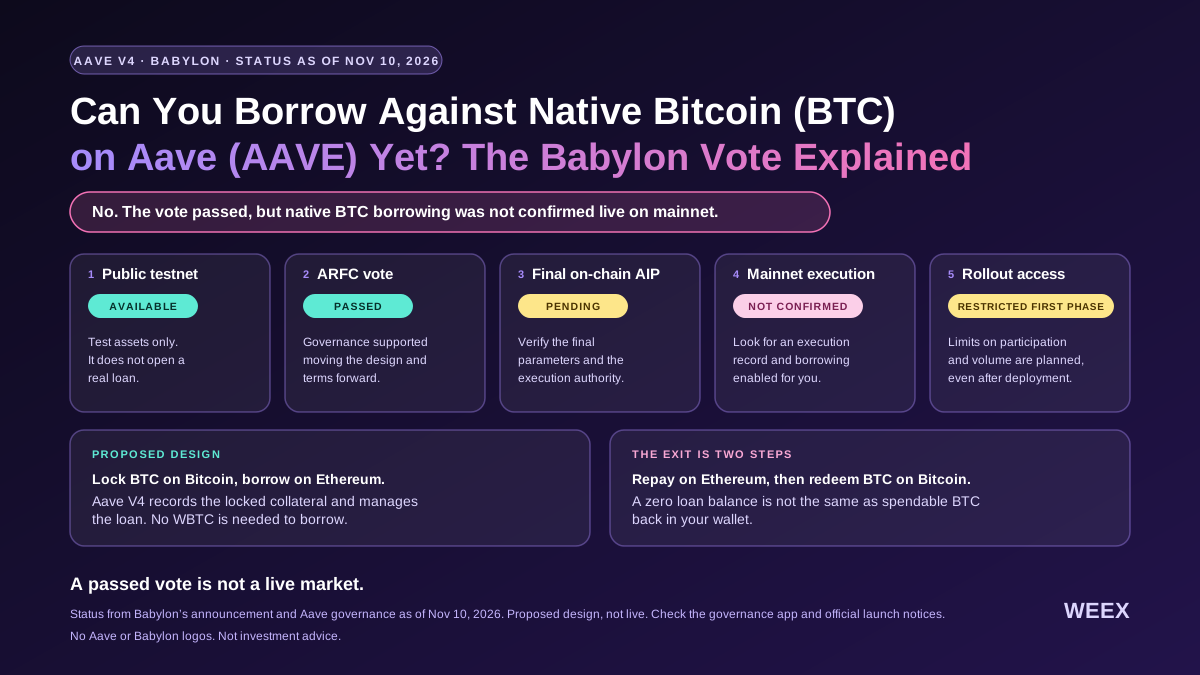
Can You Borrow Against Native Bitcoin (BTC) on Aave (AAVE) Yet? The Babylon Vote Explained
Can you borrow against native Bitcoin on Aave yet? See what the Babylon vote approved, what still needs to launch, and how BTC liquidation would work.

PIEVERSE Price Up Nearly 80% in a Week: Futures Activity, the November 14 Unlock and What Is Confirmed
PIEVERSE rose about 79% in seven days with futures volume far above spot. See what is confirmed about the November 14 unlock and the WEEX Lucky Eggs campaign.

Hong Kong Approves Crypto Asset Reporting Rules - Fintech World

NVDA Stock Falls 4.3% After Board Opens Investigation: What Is Confirmed and What Is Not
NVDA closed at $178.67 on November 9, 2026, down about 4.3%, after Nvidia’s board confirmed an independent investigation. Other claims come from media reports. WEEX’s Lucky Eggs campaign runs until November 25.

Chainalysis Report: Why Did Western Europe Withstand the Global Crypto Market Chill?

Four Security Strategies from the Wallet Theft Incident

Global Outage: Your Cryptos Are Not Disappearing

Did Strategy buy Bitcoin? Saylor reignites speculation

A New Chapter in the History of Rug Pulls in Crypto

From Binance Incubator to Nasdaq: Injective's Eight Years

tBTC Cross-Chain Bridge Resumes On-Chain Operations, Threshold Network Confirms Adequate Reserves
FinCEN Withdraws Proposed Crypto Travel Rule Expansion in Separate November Move

Finnish Startup Uses Heat from Bitcoin Miners to Heat 30 Homes
Kaspa developer targets ownerless prediction market by end-2026
XRPL lending protocol gains validator support as vault vote advances
US card debt hits $1.29 trillion as Bitcoin loans expose a collateral divide
CryptoQuant: Bitcoin Analyst Sentiment Significantly Bearish, Index Drops to -1.8σ
How Much CPO Demand Will NVIDIA's Rubin Ultra Generate? Bernstein: Optical Value of Single Pod Increases Fivefold
Pump.fun Data Review: Why the Current Meme Market Has Become a 'Harvesting Game'?
Latest articles


Latest coin listings on WEEX


