
WEEX Futures Trading: What 400x Leverage Really Costs You

 Prefer us on Google


WEEX futures trading lets you open USDT-margined perpetual positions on BTC and ETH with up to 400x leverage, a cap WEEX introduced on February 21, 2025. Leverage changes how much margin a position needs, but it does not change the fee, which is charged on the full position size. This guide explains how WEEX leverage works, what it costs at 10x, 100x and 400x, how cross and isolated margin differ, and how to set up a first trade without handing most of your margin to fees.
How WEEX Futures Trading Works
A WEEX perpetual contract tracks an asset's price without an expiry date. You post USDT as margin, choose a direction with Open Long or Open Short, and your profit or loss follows the full notional value of the position, not just the margin you put up.
Three things drive the result of every trade:
- Notional value: margin × leverage. $100 at 20x controls a $2,000 position.
- Fees: as of September 2026, WEEX charges 0.02% for maker orders and 0.08% for taker orders on futures, calculated on notional value. The exact formula is in WEEX's futures fee calculation guide.
- Funding: perpetuals settle funding between longs and shorts every eight hours (00:00, 08:00 and 16:00 UTC). It is a payment between traders rather than an exchange fee, but it still adds to or subtracts from your P&L.
The BTC-USDT pair is the usual starting point because it has the deepest book and the highest leverage cap. You can see the live contract, funding countdown and order panel on the WEEX BTC-USDT perpetual page.
WEEX Leverage: What 10x, 100x and 400x Actually Mean
Most leverage explainers stop at "higher leverage, higher risk." A more useful approach is to put numbers on two things: how far price can move before your margin is gone, and how much of that margin fees eat.
Distance to wipe-out. Before maintenance margin is accounted for, a position loses 100% of its margin when price moves roughly 1 ÷ leverage against it. Liquidation arrives a little earlier, because the exchange closes positions before margin reaches zero.
- 10x: about a 10% adverse move
- 50x: about 2%
- 100x: about 1%
- 400x: about 0.25%
BTC moving 0.25% within a few minutes happens all the time. At 400x, normal market noise is enough to liquidate you.
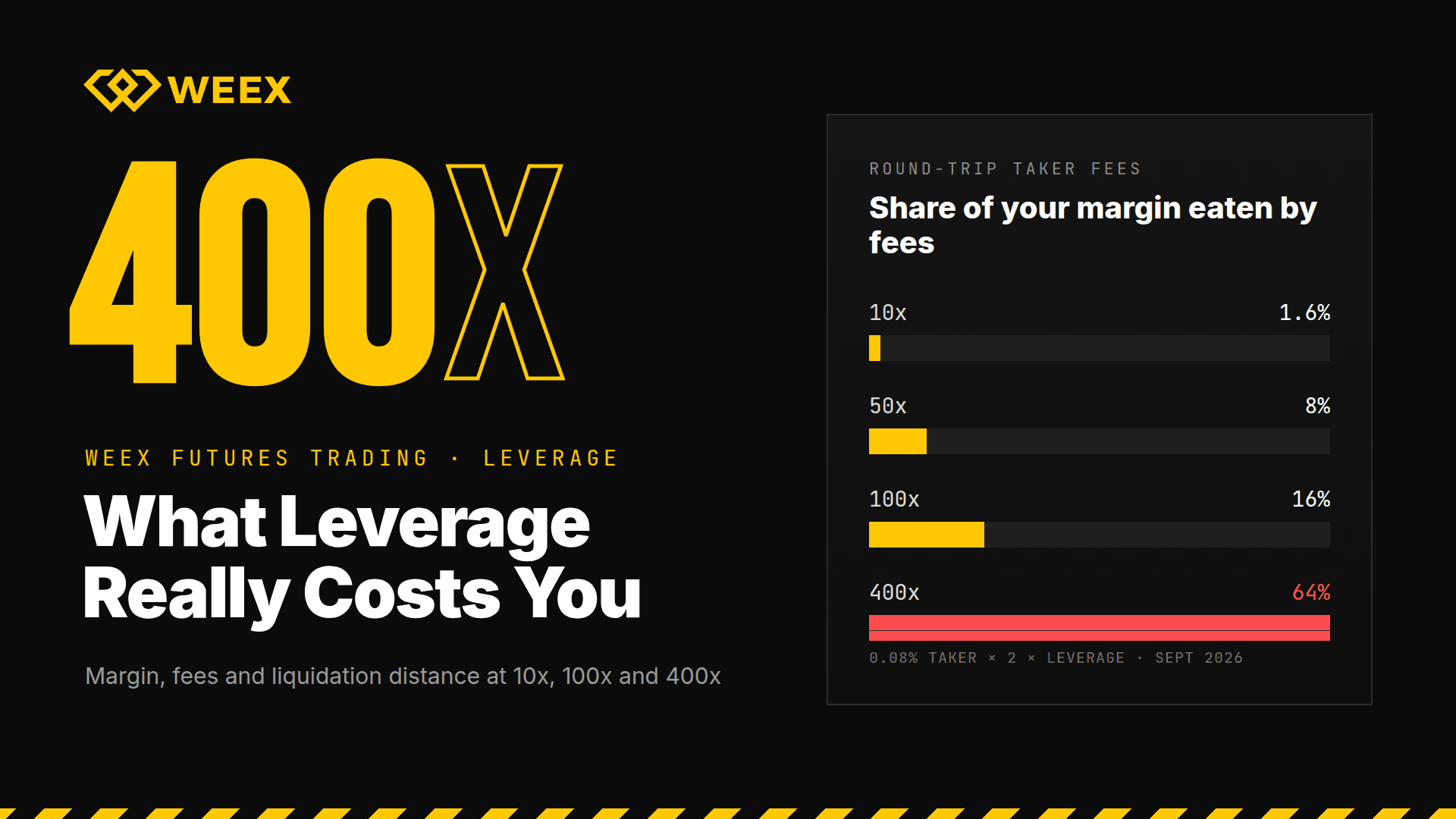
Fees as a share of your margin. This part gets missed most often. Because fees are charged on notional value, a round trip using market orders (taker in, taker out) costs 2 × 0.08% × leverage, expressed as a share of your margin:
- 10x: 1.6% of margin
- 50x: 8% of margin
- 100x: 16% of margin
- 400x: 64% of margin
Take $100 of margin at 400x. That is a $40,000 position, the taker fee is $32 to open and another $32 to close, and the trade has to earn $64 before it breaks even. The same round trip with maker orders at 0.02% costs $16 in total. Once you go above roughly 50x, how your orders fill matters about as much as which direction you pick.
The takeaway: 400x on WEEX is a tool for very short, precise, limit-order trades on BTC and ETH. For most traders, most of the time, 3x to 20x leaves room to be wrong without being liquidated.
Cross Margin vs. Isolated Margin on WEEX
WEEX offers two margin modes, and the choice decides how much of your account a single bad trade can reach.
Isolated margin gives each position its own margin. If the trade is liquidated, the loss is capped at the margin assigned to that position. It suits high-leverage trades, experimental entries, and anyone who wants every position's risk fixed in advance.
Cross margin shares all available USDT in your futures account across positions. This lowers the chance of liquidation because the whole balance supports the trade, but a losing position can draw on that whole balance. It fits hedged books and experienced traders who watch total account exposure.
In practice, new WEEX futures traders should use isolated margin until they have a written rule for when and how to add margin. Cross margin's larger buffer can hide a problem until it has grown too big to fix cheaply.
-- Price
How to Set Leverage and Open Your First WEEX Futures Trade
- Transfer USDT from your spot account to your futures account.
- Open a contract such as BTC-USDT and choose Isolated or Cross margin in the order panel.
- Tap the leverage indicator and set a level. Start low. The maximum shown depends on the pair and on position size.
- Choose an order type. Limit orders that rest on the book pay the 0.02% maker rate. Market orders pay the 0.08% taker rate.
- Enter size, then set take-profit and stop-loss before submitting. WEEX lets you attach TP/SL to the position so the exit is planned before you enter.
- Click Open Long or Open Short, then check the estimated liquidation price in the Positions tab.
Before risking real funds, you can run the same steps on WEEX demo futures on BTC/SUSDT. New accounts receive 50,000 in demo funds for BTC and ETH futures, which is enough to see how liquidation, funding and fees behave at different leverage levels without paying for the lessons.
What Experienced WEEX Futures Traders Watch
- Leverage is set per position, but risk is set per account. Ten isolated positions at 20x can still add up to a bigger bet than you intended.
- Stops set too close at high leverage. At 100x, a stop 0.5% away uses half your margin even when it works exactly as planned.
- Funding on multi-day holds. A 0.01% rate paid three times a day comes to roughly 11% a year on notional value. That matters for swing positions, even if it's irrelevant to scalps.
- Slippage during fast moves. Market orders and triggered stops fill at the best available price, which can be worse than the level you set when the book thins out.
FAQ
1. What is the maximum leverage on WEEX futures?
WEEX raised the maximum leverage on BTC and ETH futures to 400x on February 21, 2025, according to its official leverage announcement. Other pairs have lower caps, and the maximum available also falls as position size grows.
2. Does higher leverage increase WEEX futures fees?
Indirectly, yes. The fee rate stays at 0.02% maker or 0.08% taker, but it applies to notional value. Higher leverage means a bigger notional position for the same margin, so fees take a larger share of that margin.
3. Is cross or isolated margin better for beginners on WEEX?
Isolated margin is usually safer for beginners, because a liquidation can only take the margin assigned to that one position. Cross margin shares your whole futures balance and needs closer monitoring.
4. Can I practice WEEX futures trading without real money?
Yes. WEEX demo futures give new users 50,000 in demo funds for BTC and ETH futures, and more can be requested under WEEX's demo rules.
Where WEEX Futures Trading Fits
WEEX futures trading is built for traders who want flexible leverage, from low multiples up to 400x on BTC and ETH, together with a clear 0.02% / 0.08% fee schedule and a free demo environment. How you use that leverage matters more than how much is available. Pick the margin mode first, work out what fees will take at your chosen leverage, set the stop before you enter, and practice in demo until you know your liquidation price before you place the order.
Risk Warning
Futures trading is high risk. Crypto prices are volatile, and leveraged positions can lose all of the margin committed to them within minutes. Liquidation can occur before your stop-loss executes during fast markets, and slippage, funding payments and fees can turn a correct directional view into a loss. Cross margin can expose your entire futures balance to a single position. Only trade with funds you can afford to lose, and make sure you understand the liquidation mechanics before using high leverage.
This content is provided for general informational purposes only and doesn't constitute financial, investment, legal, or tax advice. Any events, rewards, online promotions, or related information mentioned herein should not be considered a recommendation, solicitation, or invitation to purchase, sell, trade, or otherwise deal in any crypto assets. Crypto assets are highly volatile and may result in loss. The availability of WEEX services, products, and related events may vary by region. You are responsible for ensuring that your participation is in accordance with applicable local laws and regulations.
You may also like

Is Hyperliquid Safe? Risks You Should Know Before You Trade

What Is Hyperliquid? A Complete Guide to the Perpetuals Exchange
What Is Pi Network? A Complete Beginner's Guide
What Is a Funding Rate? How Perpetual Futures Charge Longs and Shorts
Lighter (LIT) Futures: Cross vs Isolated Margin on a 17% Range
XRP Futures: How to Long or Short XRP After the Clarity Act Vote
What Is ZCAT and Is It Worth Buying? Anonymous Cat (ZCAT) Guide for 2026

MU Stock Reclaims $1,000 Again: What's Actually Different This Time
GPT-6 Astra and Crypto: The AI Token Bid and the Cyber Risk
StonkFun Just Became Solana's Hottest Launchpad: STONK Surges 250% to Prove It

What Is Tangem Wallet? A Complete Beginner's Guide
AAPL Under Ternus: What Apple's CEO Change Means for Traders
PONS Robinhood Chain Token: What the Buyback Rally Rests On
Cathie Wood’s $50 Million Crypto Stock Bet Explained: What Did ARK Invest Buy?
BISCOTTI Crypto: Robot Dog Token Behind Emblem Vault's Debut
Is CyberLeek (CYBERLEEK) Safe? Price Crash and Key Token Risks Explained

CyberLeek Price Prediction 2026: Can CYBERLEEK Recover After the Crash?
Is Crypto Legal in Pakistan? PVARA Rules Traders Must Know

NVIDIA (NVDA) Earnings Date: When Q2 FY2027 Reports and What to Watch
JazzCash P2P Trading: Merchant Vetting, Payment Limits, and the Hidden Account Freeze Risk
Plasma Released 88.89 Million XPL Tokens Today—Why the Allocation Matters
Choosing a Crypto Exchange in Pakistan Before the Sept 5 Deadline

XST Coin Price Prediction: What Happens to AI Narrative Tokens After the Initial Hype Fades
Pakistan Crypto Exchange Comparison: Which Platform Works Best for PKR Traders in 2026
JPMorgan Says Buy the Chip Dip but Morgan Stanley Says Sell: What the SOXL Analyst Disagreement Actually Means
How to Call a Crypto Exchange API Without Getting Blocked
What Is a Crypto Exchange API and Which Permissions to Enable
Broadcom (AVGO) Earnings Date: September 2, 2026 (Confirmed) — Japan Time and What to Watch
XSolut Company: What Is the Team Behind XST Coin and What Do They Actually Disclose
Stock Market News Today: Why Bonds Are Setting the Tape
Is Hyperliquid Safe? Risks You Should Know Before You Trade
What Is Hyperliquid? A Complete Guide to the Perpetuals Exchange
What Is Pi Network? A Complete Beginner's Guide
What Is a Funding Rate? How Perpetual Futures Charge Longs and Shorts
Lighter (LIT) Futures: Cross vs Isolated Margin on a 17% Range
XRP Futures: How to Long or Short XRP After the Clarity Act Vote


