
What are Smart Contracts?

 Prefer us on Google
Intro to Smart Contracts
Smart contracts are self-executing agreements written in code and deployed on a blockchain. They automatically enforce the terms of an agreement between parties when predefined conditions are met, removing the need for intermediaries. By automating transactions, smart contracts enhance efficiency, reduce costs, and increase transparency and trust across a variety of industries. These intelligent contracts represent a fundamental shift in digital agreement design and execution.
Before the advent of smart contracts, it was difficult to create decentralized systems where multiple parties could transact without relying on a central authority. Platforms like Uber and Airbnb, for instance, depend on a central entity to manage transactions and enforce rules between users and service providers.
With the emergence of blockchain technology, smart contracts offer a more secure, efficient, and trustless way to execute agreements. They enable direct peer-to-peer transactions, opening the door to a new generation of decentralized applications.
This article explores what smart contracts are, how they work, their benefits and limitations, and the transformative impact they are having across numerous sectors.
What Are Smart Contracts?
A smart contract is a self-executing program stored on a blockchain that runs automatically when specific conditions are satisfied. Unlike traditional contracts, which rely on legal language and third-party enforcement, smart contracts operate based on code.
A useful analogy is a vending machine: you insert payment, and the machine automatically dispenses the product. Similarly, smart transactions eliminate manual intervention and reduce the need for intermediaries.
Because they reside on a decentralized blockchain, smart contracts are transparent, tamper-resistant, and immutable once deployed. This ensures reliability and security across various use cases.
The History and Evolution of Smart Contracts
The term "smart contract" was coined in 1994 by computer scientist and legal scholar Nick Szabo, who also conceptualized "Bit Gold" in 1998—a precursor to Bitcoin. He envisioned computerized protocols that could execute contract terms automatically, inspired by electronic systems like point-of-sale terminals.
In a 1996 paper, Szabo defined a smart contract as:
"a set of promises, specified in digital form, including the protocols within which the parties perform on the other promises."
He accurately predicted that financial instruments such as derivatives and securities could be standardized and traded efficiently via automated systems.
While some have speculated that Szabo might be Bitcoin’s anonymous creator, Satoshi Nakamoto, he has denied this. Nevertheless, his work laid the theoretical foundation for smart contracts long before blockchain technology existed.
How Do Smart Contracts Work?
Smart contracts operate using simple "if-then" logic. They are triggered by specific events—such as a payment, a date, or an input from an external data source (via "oracles").
Once deployed on a blockchain, the contract is distributed across the network. Each node validates the conditions and execution, ensuring consensus and transparency. When the conditions are met, the contract automatically performs the agreed-upon actions.
Although Ethereum popularized smart contracts, many other blockchains—including Solana, Cardano, Polkadot, and Tezos—now support them. Developers write smart contracts in programming languages such as Solidity, Plutus, and Michelson. Many projects also rely on smart contract templates to accelerate development and improve security.
This automation enables more efficient and secure processes in areas like finance, real estate, and supply chain management.
Pros and Cons of Smart Contracts
Pros
- Automation & Efficiency: Self-executing contracts save time and reduce manual effort.
- Cost Reduction: Removing intermediaries lowers transaction fees.
- Transparency & Trust: Terms and executions are visible and verifiable by all parties.
- Security: Cryptographic encryption and decentralization help prevent fraud and tampering.
Cons
- Rigidity: Contracts are only as good as their code. They lack flexibility for unplanned scenarios or subjective interpretations.
- Difficulty Updating: Fixing bugs or changing terms requires broad consensus and is often complex.
- Dependence on Oracles: Many contracts need external data, which must be reliably supplied—introducing potential complexity and points of failure.
Use Cases of Smart Contracts
Smart contracts are already transforming industries by enabling trustless automation and reducing operational costs. Many people also explore how to make money with smart contracts through yield farming, NFT minting, and decentralized app (dApp) development.
- Mortgages Automating verification, payment schedules, and fund disbursement speeds up processes and reduces the need for banks or lawyers.
- Digital Identity Individuals can control and share personal data securely without intermediaries. Estonia’s blockchain-based digital ID system is a leading example.
- Supply Chain Every step of a product’s journey can be recorded on a blockchain, increasing traceability and reducing fraud.
- Bank Bot Smart Contracts Automated banking agents powered by smart contracts can handle loans, payments, and compliance checks without human intervention, streamlining financial operations.
- DeFi and Etherions Core Smart Contracts Embedded Many decentralized finance platforms rely on highly optimized smart contract systems like Etherions core smart contracts embedded in their architecture to ensure security and high-performance transactions.
Challenges and the Road Ahead
Despite their potential, smart contracts are not without risks. The infamous DAO hack in 2016, where millions in ETH were stolen due to a code vulnerability, highlighted the importance of security audits and careful design.
Because smart contracts are immutable, errors can be costly. Today, many projects rely on professional third-party audits to minimize risks.
Still, the technology is young and evolving. As tools and best practices improve, smart contracts are expected to gain broader adoption.
Conclusion
Smart contracts represent a major shift in how agreements are made and executed. By replacing intermediaries with transparent and automated code, they reduce cost and build trust between parties.
While challenges around security, flexibility, and real-world data integration remain, the potential applications are vast and transformative. From intelligent contracts in governance to automated bank bot smart contracts in finance, the technology is paving the way for a more efficient digital economy.
The technology is still developing, and wider acceptance appears inevitable as blockchain ecosystems mature and more industries recognize the benefits of decentralized, self-executing contracts.
Further Reading
Disclaimer: The opinions expressed in this article are for informational purposes only. This article does not constitute an endorsement of any of the products and services discussed or investment, financial, or trading advice. Qualified professionals should be consulted prior to making financial decisions.
This content is provided for general informational purposes only and doesn't constitute financial, investment, legal, or tax advice. Any events, rewards, online promotions, or related information mentioned herein should not be considered a recommendation, solicitation, or invitation to purchase, sell, trade, or otherwise deal in any crypto assets. Crypto assets are highly volatile and may result in loss. The availability of WEEX services, products, and related events may vary by region. You are responsible for ensuring that your participation is in accordance with applicable local laws and regulations.
You may also like

Who Can Operate in Russia's Crypto Market from 5 October 2026

Self-Custody Wallets: When a Crypto Transfer Must Be Reported to Brazil's Coaf
Binance UAH Deadline: Fiat Trade UAH and USDT/UAH Changes on 28 September

Italian Crypto Tax Return 2026: Filing Deadline, Forms and Gains Rate
FTXF: Hanoi Police Seeks Victims to Report by September 30, 2026
XOF, XAF and CDF Are Now Available on WEEX P2P: What Users Need to Know
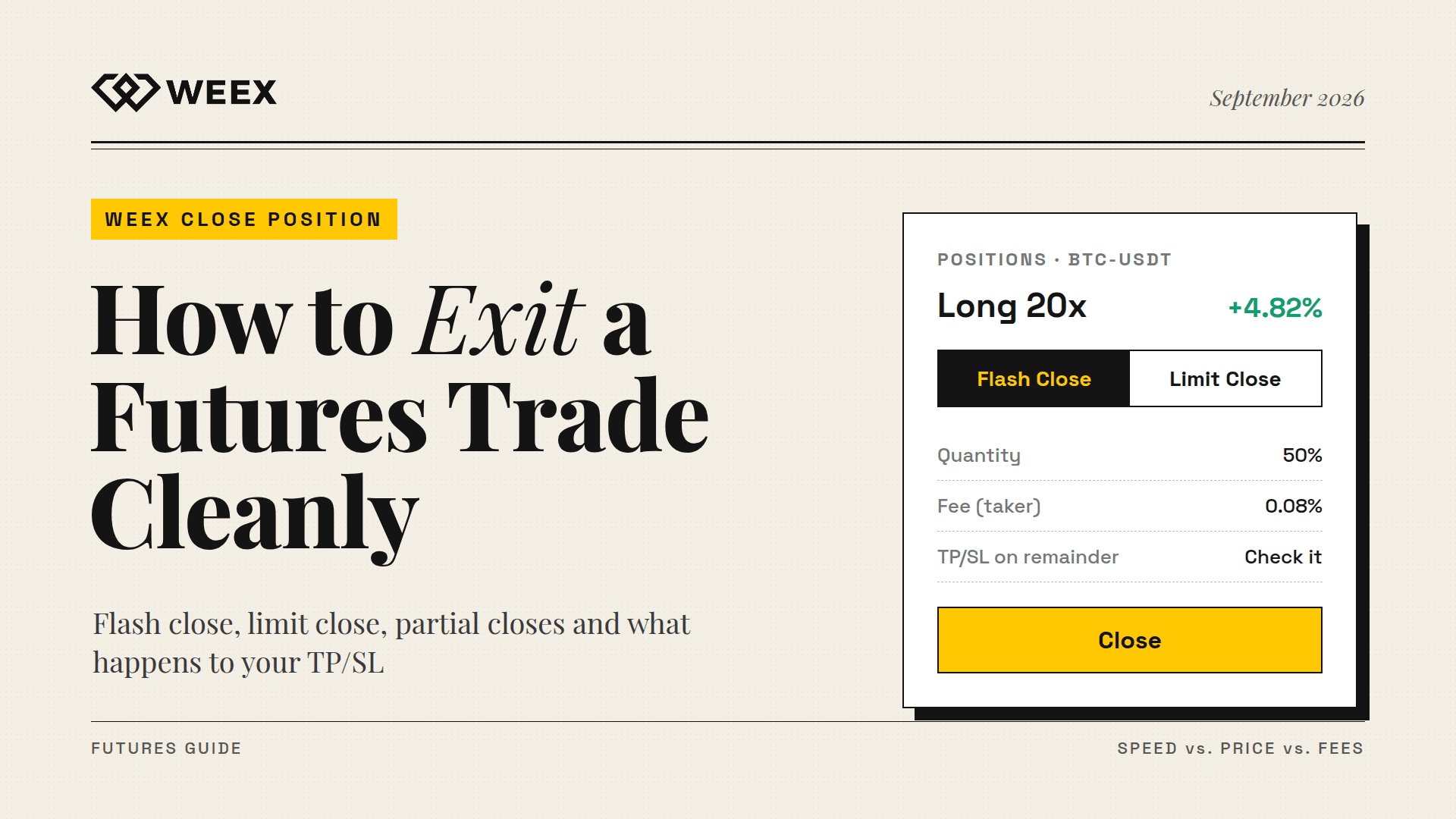
WEEX Close Position Guide: Flash Close, Limit Close and TP/SL
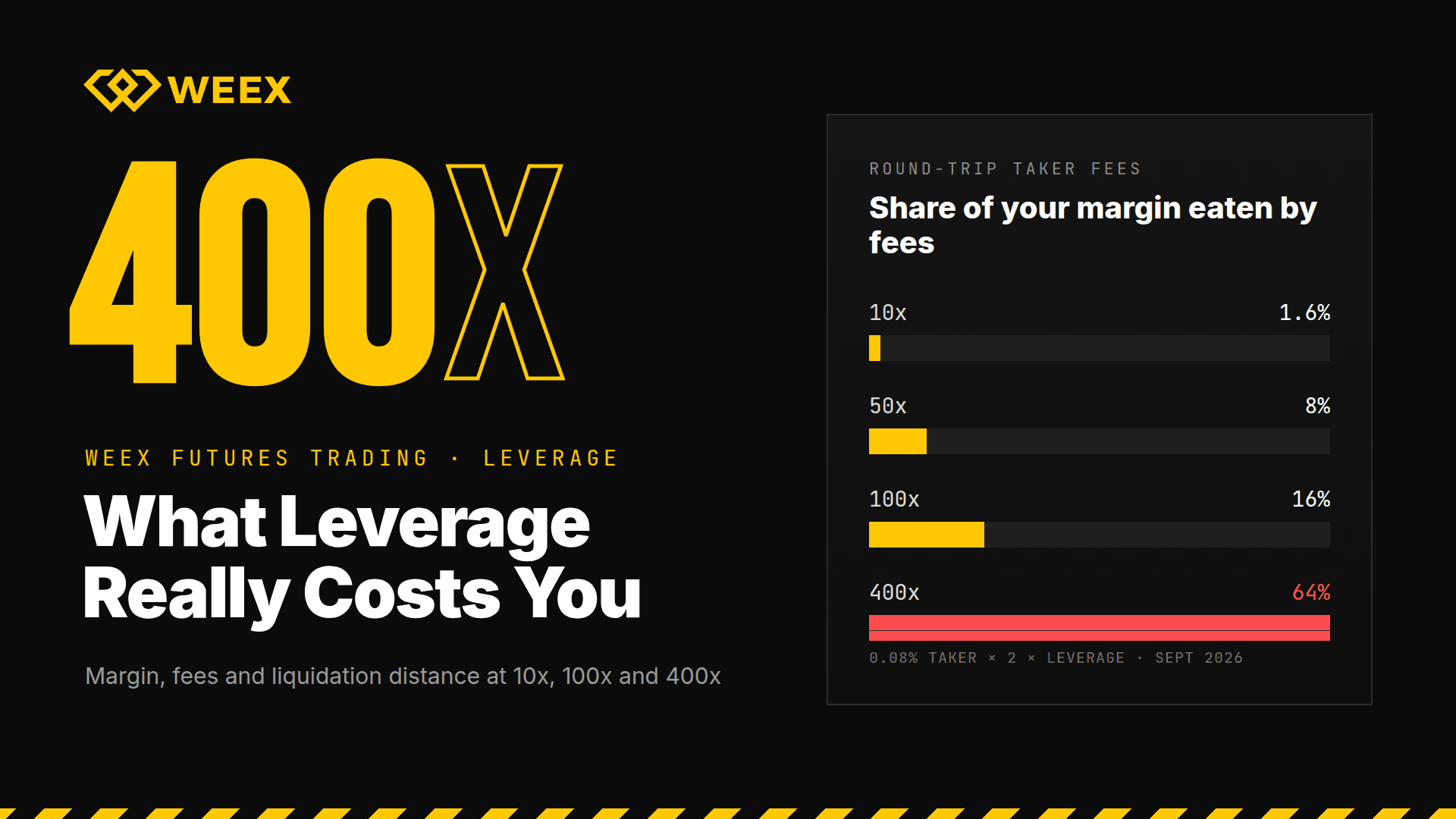
WEEX Futures Trading: What 400x Leverage Really Costs You
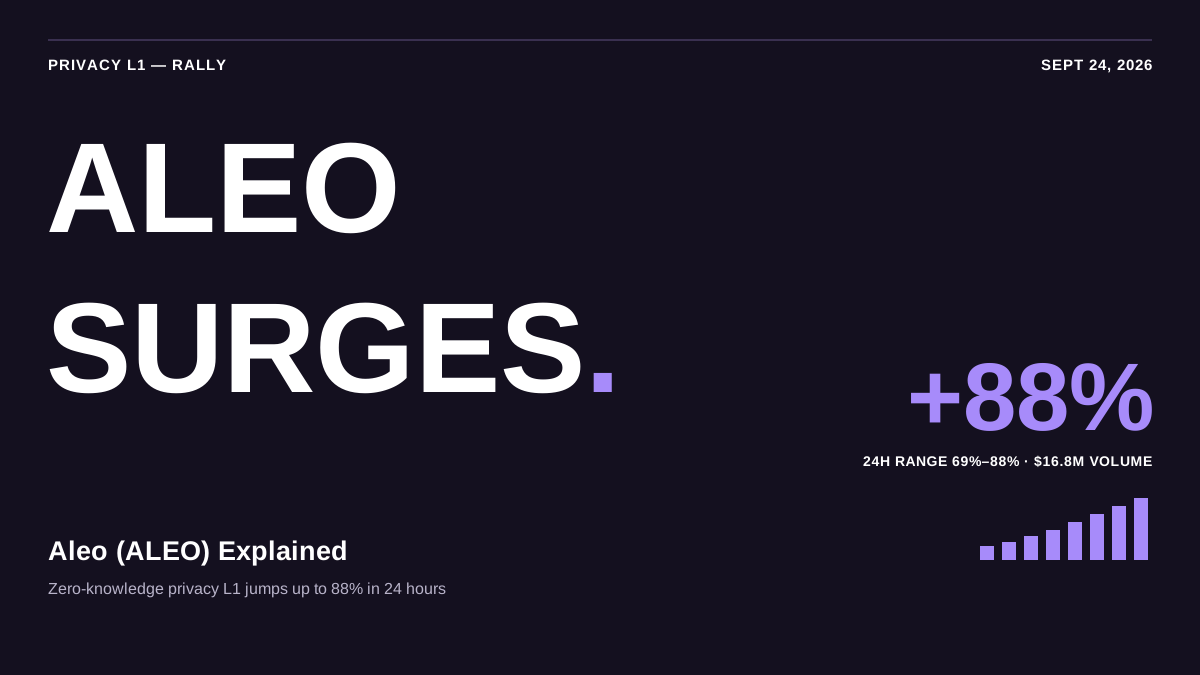
What Is Aleo (ALEO) Crypto, and Why Did Its Price Jump Up to 88%?
Best Crypto Exchange for Beginners 2026: What Actually Matters When Choosing One

Best Crypto Cold Wallet 2026: Top Picks Matched to How You Hold
Phantom Wallet vs MetaMask: What's the Difference
How to Connect Phantom Wallet to a Solana DApp
How to Install and Set Up Phantom Wallet
What Is Phantom Wallet? A Complete Guide to the Solana Wallet
What Is a White Label Crypto Exchange? A Complete Beginner's Guide
What Is Pons Crypto (PONS), and How to Trade PONS on WEEX?
Crypto Futures Trading Explained: One Real Trade, Start to Exit
What Is Blockchain Used For? 2026 Uses, Ranked by Real Money
How to Buy USDT with EUR via SEPA Bank Transfer on WEEX
How to Buy Bitcoin with EUR in Europe on WEEX
How to Buy Crypto in Europe with EUR on WEEX OTC
How to Buy Crypto in Vietnam with VND on WEEX OTC
How to Buy USDT in Vietnam with VND via MoMo or Bank Account
INTC Stock Surged 14%: Intel Only Has Enough Chips for Half Its Clients
Is Hyperliquid Safe? Risks You Should Know Before You Trade
Hyperliquid vs Centralized Exchanges: What's the Difference?
SPCX Stock Has a September 22 Catalyst: Here's Why Today's Starship Launch Matters
AMD Stock Joins the $1 Trillion Club: What's Actually Driving the 5 Day Surge

How to Trade on Hyperliquid: A Step-by-Step Guide
Who Can Operate in Russia's Crypto Market from 5 October 2026
Self-Custody Wallets: When a Crypto Transfer Must Be Reported to Brazil's Coaf
Binance UAH Deadline: Fiat Trade UAH and USDT/UAH Changes on 28 September
Italian Crypto Tax Return 2026: Filing Deadline, Forms and Gains Rate
FTXF: Hanoi Police Seeks Victims to Report by September 30, 2026
XOF, XAF and CDF Are Now Available on WEEX P2P: What Users Need to Know


