
Polkadot Launches Stablecoin 'dotUSD' Under DAO Governance with USDT Issuance and US Treasury Seed Funding

 Prefer us on Google


Polkadot Launches Stablecoin 'dotUSD'
Polkadot launched its new native stablecoin 'dotUSD' on its mainnet on October 8, 2026 (Thursday), under the management of the on-chain decentralized governance system "OpenGov."
dotUSD is live on Polkadot. Today a handful of companies issue and control most of the world's stablecoins worth more than $250B. Like banks, they decide who can hold them and who can't. dotUSD is based on a different premise. It has no issuing company and no single point of control. The DOT DAO governs it through OpenGov. Polkadot now has a stablecoin that belongs to its network.
--- Polkadot (@Polkadot) October 8, 2026
The launch of dotUSD was officially approved in the Polkadot OpenGov referendum 1944, gathering overwhelming support of approximately 98.4%, with about 4.3 million DOT votes in favor.
To secure initial liquidity for the project, funding is being drawn from the Polkadot treasury (financial fund). The initial plan allocated a total of $5 million (approximately 790 million yen) for the issuance of dotUSD and liquidity pools, with $2.5 million each. However, due to subsequent amendments, this was reduced to $1.5 million (approximately 237 million yen) each, resulting in a total of $3 million (approximately 470 million yen) in U.S. Treasury bonds and funds being utilized as seed capital.
The Polkadot Community Foundation, which submitted this proposal, has indicated that it will strictly maintain a managerial role and will not be involved in the issuance, operation, or custody of the tokens.
Initial Phase Reality: Contradictions and Dependencies with Tether's USDT
While dotUSD claims to have "no issuing entity," there are contradictions and concerns regarding its design and reality in the initial launch phase.
Under the current mechanism, users can mint (issue) dotUSD at a 1:1 ratio with USDT issued by Tether until the supply cap is reached. USDT is a representative dollar-pegged token that is centrally managed, which is the very model that Polkadot has previously warned against as "to be avoided."
Furthermore, each dotUSD issued in the first phase represents a claim against 1 USDT held as reserves. Therefore, if Tether freezes the wallet holding the reserves, the backing assets of dotUSD would also be at risk.
In recent years, Tether has frequently blacklisted addresses and frozen wallets, and legal troubles and lawsuits have been reported, leading to the view that dependence on centralized stablecoins is a "double-edged sword."
Outlook for Phase 2 Aiming for Complete Decentralization
The current operation backed by USDT is positioned as a bridge until a fully decentralized system is established.
In the upcoming Phase 2, vaults backed by DOT, price oracles, stabilization pools, liquidation functions, and redemption mechanisms are expected to be implemented in the system. This plan aims to completely eliminate USDT from the reserve assets and transition to a design of autonomous collateralized debt based on models like Liquity.
The exact release date for Phase 2 has not yet been determined, but this initiative, which has garnered attention since co-founder Gavin Wood mentioned it, continues to attract market interest regarding whether it can truly evolve into a unique decentralized stablecoin.
-- Price
This content is provided for general informational purposes only and doesn't constitute financial, investment, legal, or tax advice. Any events, rewards, online promotions, or related information mentioned herein should not be considered a recommendation, solicitation, or invitation to purchase, sell, trade, or otherwise deal in any crypto assets. Crypto assets are highly volatile and may result in loss. The availability of WEEX services, products, and related events may vary by region. You are responsible for ensuring that your participation is in accordance with applicable local laws and regulations.
You may also like

Polkadot Community Foundation Proposal Launches DOT-Collateralized Stablecoin dotUSD

Crypto VC funding: Félix lands $200M, Cari raises $32.5M

CDP Stablecoin Protocol Ebisu Announces Shutdown, No EBISU Token Issuance

Suspected April Fool's joke, Liquity claims it has been acquired by Circle, causing the price to rise over 10%

Why Pronostyx Is Building Prediction Markets for Questions the Big Platforms Ignore

Former Cointelegraph CEO Joins Phase as Co-Founder and CEO
Alta raises $47.5M for blockchain backed by crypto skeptic Jack Zhang

Decrypt Becomes First News Publisher to Offer Perps Trading, Powered by Solana's Phoenix

How Far Can AI Trading Go Amid the Anti-Data Center Wave? It Depends on GPU Leasing Prices
XRPL lending protocol gains validator support as vault vote advances

Tech Veteran: Anthropic IPO Will Be the Peak of AI Market in US Stocks, Will 'Aggressively Buy Chinese AI' If Conditions Allow

Moody's Projects Global Credit Deterioration by 2027 and Warns of the Impact of Rates and AI

CPI Higher Than Expected in the U.S.: What It Means for Investors

EWY ETF Volatility: Semiconductor Concentration, Rebound, and Fund-Flow Risks

AI Agents Do More Than Just Place Orders: The Next Entrepreneurial Opportunity Lies in Matching and Trust
Exodus Reports $8.3M Quarterly Loss as Wallet Platform Expands Payments Business

USAR Stock: Rare-Earth Commercialization, Quarterly Losses, and Funding Risks

Hims & Hers (HIMS) Falls After Earnings: Margins, Subscribers, and Guidance

IWM ETF Outlook: Small-Cap Rebound, Fund Positioning, and Credit Risk

SOXL Sell-Off and Rebound: 3x Leverage, Fund Flows, and Semiconductor Risk

Something strange is happening with Bitcoin. It is neither digital gold nor a tech company for Wall Street

TQQQ Outlook: Triple-Leverage Swings, Rebound Potential, and Decay Risk

US card debt hits $1.29 trillion as Bitcoin loans expose a collateral divide
QQQ Outlook: Tech Sell-Off, Rebound, and Nvidia Earnings

FTX’s former Anthropic stake could now be worth over $30 billion

Former Polychain President Launches Venture to Create a Tradable Index for U.S. Housing Prices

How Much CPO Demand Will NVIDIA's Rubin Ultra Generate? Bernstein: Optical Value of Single Pod Increases Fivefold
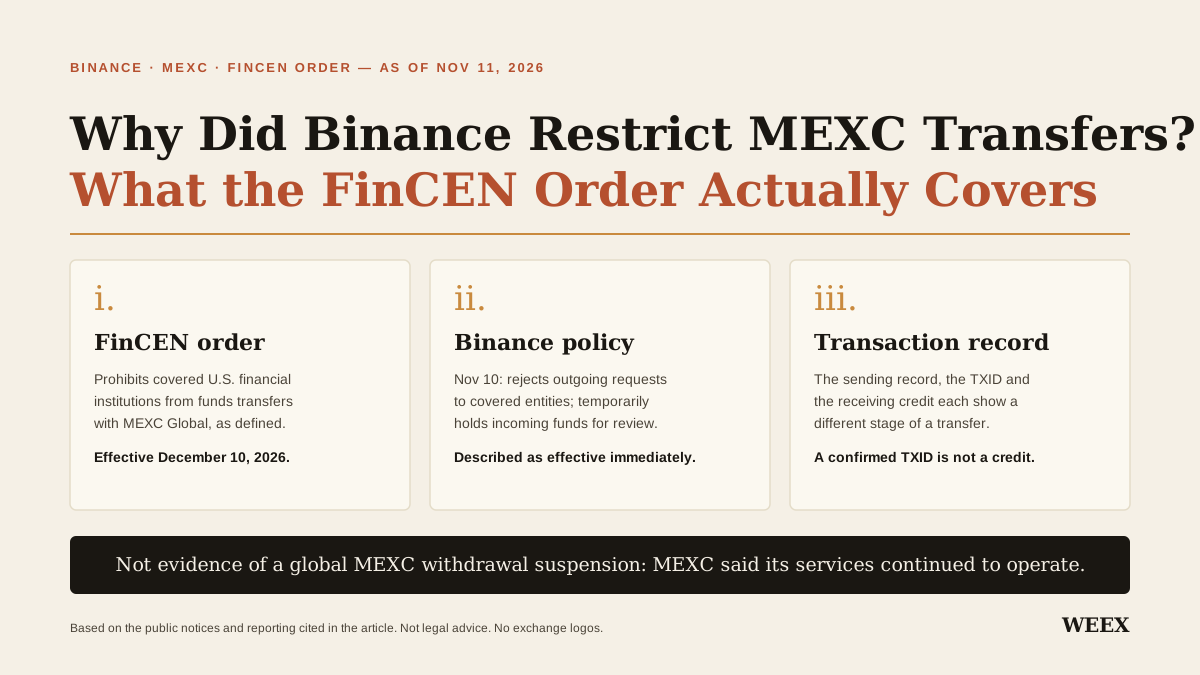
Why Did Binance Restrict MEXC Transfers? What the FinCEN Order Actually Covers
Find out why Binance restricted MEXC transfers, when the FinCEN order takes effect, and what to check if your crypto deposit is held for review.
Why Did Binance Restrict MEXC Transfers? What the FinCEN Order Actually Covers
Find out why Binance restricted MEXC transfers, when the FinCEN order takes effect, and what to check if your crypto deposit is held for review.
Pump.fun Data Review: Why the Current Meme Market Has Become a 'Harvesting Game'?
Polkadot Community Foundation Proposal Launches DOT-Collateralized Stablecoin dotUSD
Crypto VC funding: Félix lands $200M, Cari raises $32.5M
CDP Stablecoin Protocol Ebisu Announces Shutdown, No EBISU Token Issuance
Suspected April Fool's joke, Liquity claims it has been acquired by Circle, causing the price to rise over 10%
Why Pronostyx Is Building Prediction Markets for Questions the Big Platforms Ignore
Former Cointelegraph CEO Joins Phase as Co-Founder and CEO
Latest articles


Latest coin listings on WEEX


