
Why Did Binance Restrict MEXC Transfers? What the FinCEN Order Actually Covers

 Prefer us on Google


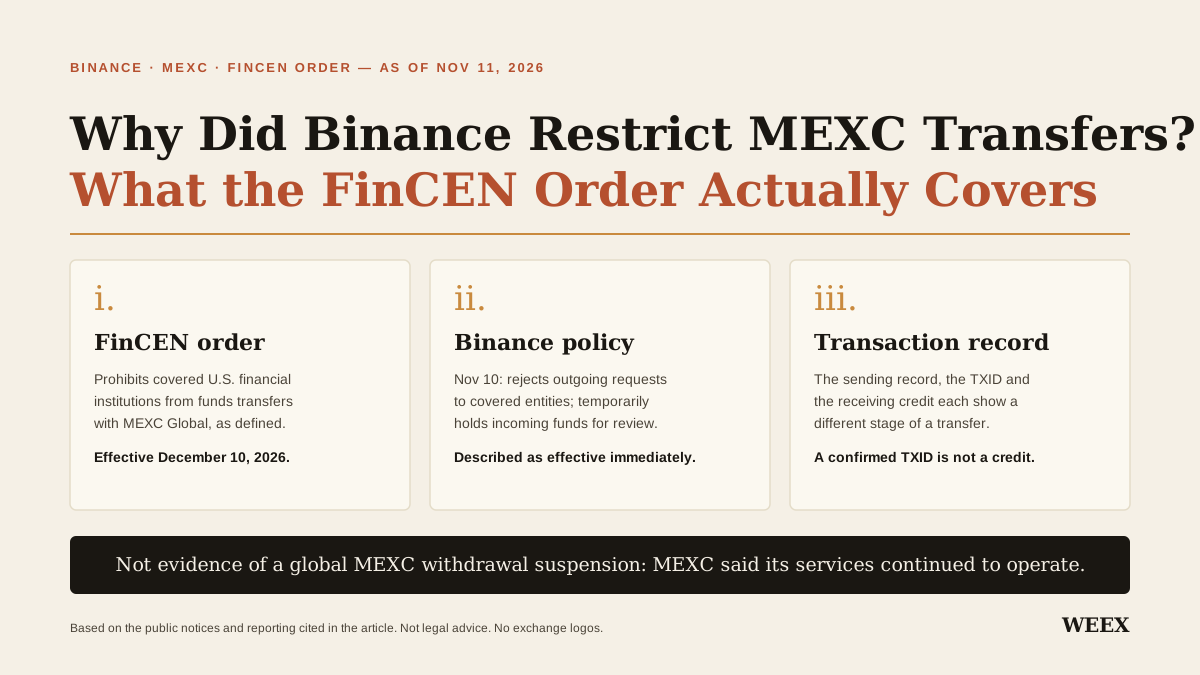
Binance restricted MEXC-related transfers after FinCEN issued an order concerning fund transfers involving MEXC Global. For users, the immediate consequence is specific: Binance said it would reject outgoing transfers to the entities named in its notice and temporarily withhold incoming funds from them for review. MEXC separately said its platform was operating normally. These statements describe different parts of a transfer and can both be true.
The most useful question is therefore “Which platform has the transfer, and what stage has it reached?” A rejected withdrawal request, an on-chain transaction, and a deposit held for review each leave a different record. Knowing which one you have will tell you more than a general headline about whether MEXC withdrawals are working.
Key Takeaways
- Binance announced transfer restrictions involving MEXC and related entities on November 10, 2026. It cited a recent order from the U.S. Financial Crimes Enforcement Network (FinCEN).
- Transfer direction matters. Binance said it would reject outgoing requests to covered entities. Funds it receives from those entities would be temporarily held for compliance review.
- The two measures have different dates and scopes. Binance said its platform restrictions applied immediately. The FinCEN order takes effect on December 10, 2026, and applies to covered U.S. financial institutions.
- This is not evidence of a global MEXC withdrawal suspension. MEXC said its own services continued to operate. A withdrawal can leave the sending platform without being credited by the receiving platform.
What Happened Between FinCEN, Binance, and MEXC?
The timeline separates the regulator’s action from the exchanges’ responses. The date FinCEN announced the order, the date Binance announced its own restrictions, and the date the order takes effect are not interchangeable.
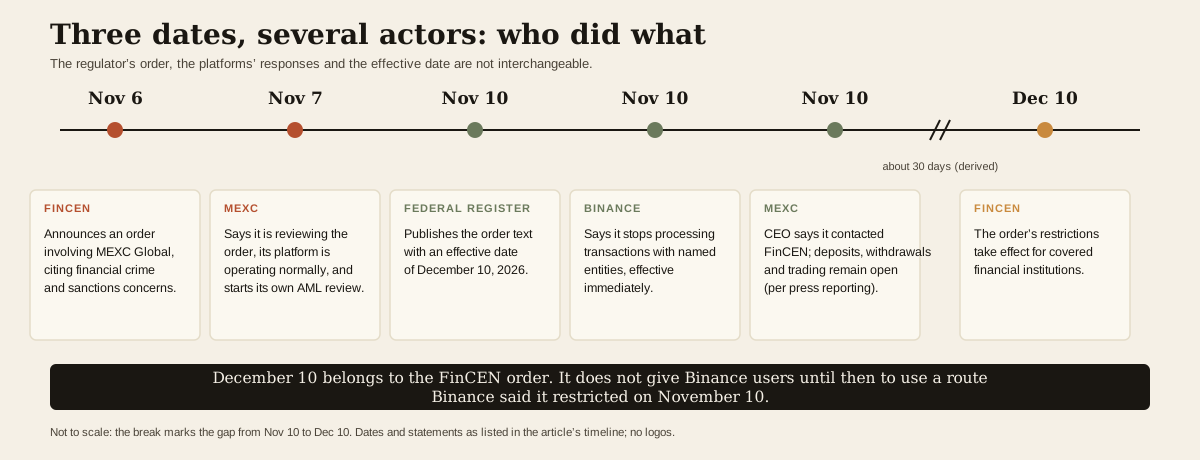
| Date | Who acted | What happened |
|---|---|---|
| November 6, 2026 | FinCEN | The agency announced an order involving MEXC Global, citing financial crime and sanctions-evasion concerns. |
| November 7, 2026 | MEXC | In a public statement, MEXC said it was reviewing the order, that its platform was operating normally, and that it had begun an independent review of its anti-money-laundering and sanctions controls. |
| November 10, 2026 | Federal Register | The published text of the FinCEN order set an effective date of December 10, 2026. |
| November 10, 2026 | Binance | Binance announced that it would stop processing transactions involving the entities named in its notice. Its public update described the restrictions as effective immediately. |
| November 10, 2026 | MEXC | CEO Vugar Usi said the exchange had established contact with FinCEN and that deposits, withdrawals, and trading remained operational, according to reporting on his update. |
| December 10, 2026 | FinCEN | The order’s restrictions are scheduled to take effect for covered financial institutions. |
The difference between the November and December dates matters if you were planning a transfer. The later effective date applies to the FinCEN order. It does not give Binance users until December 10 to use a route that Binance said it had already restricted. Likewise, Binance’s November notice does not change the federal order’s effective date.
What Does the FinCEN Order Actually Cover?
FinCEN’s order prohibits covered U.S. financial institutions from sending or receiving funds to or from MEXC Global as defined in the order. That definition covers relevant MEXC entities operating outside the United States and successor entities. The order’s definition of funds transfers includes convertible virtual currency, so its scope is not limited to conventional bank wires.
Binance, meanwhile, published a platform notice listing MEXC Global and related entities. It told users not to transact with the covered entities through Binance, whether directly or indirectly. Binance cited FinCEN’s action as the reason for its measures, but the two documents answer different questions: the order sets obligations for covered institutions; Binance’s notice tells users what Binance says it will do with affected transfers.
Neither document announces a worldwide shutdown of MEXC. The order addresses how covered institutions handle funds transfers. It does not say that every MEXC account, market, or withdrawal route worldwide has stopped working. Similarly, MEXC’s statement that its services were operating does not establish that another platform will accept a transfer from it.
-- Price
Can You Transfer Crypto From Binance to MEXC or From MEXC to Binance?
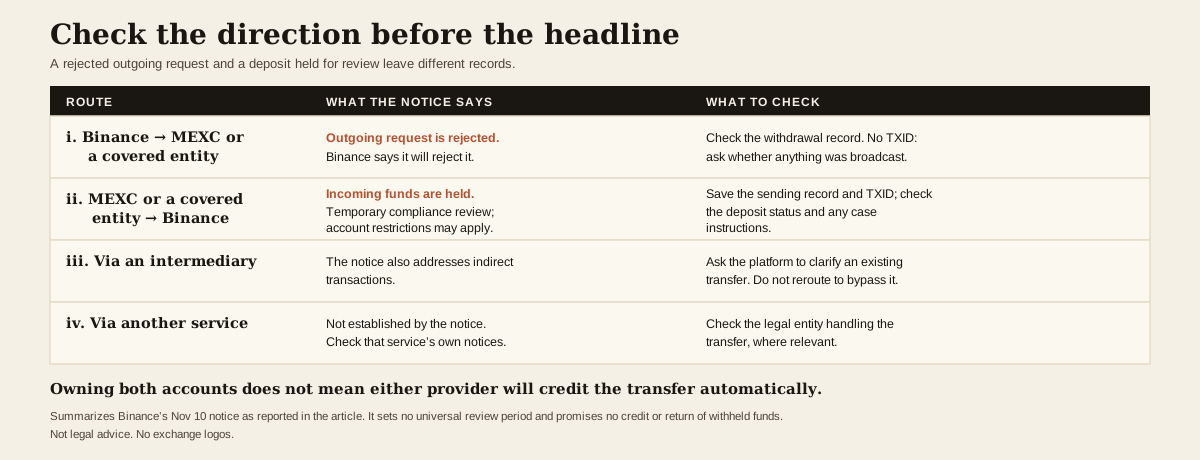
The November 10 coverage of Binance’s notice describes two different outcomes: Binance says it will reject outgoing requests to covered entities and review incoming funds linked to those entities. That distinction matters because a rejected outgoing request may never reach the blockchain, whereas an incoming transfer can reach a deposit address without appearing in the user’s available balance.
| Transfer direction or status | What the notice says or what the record shows | What to check |
|---|---|---|
| Binance → MEXC or an entity covered by the notice | Binance says it will reject the outgoing transfer request. | Check the withdrawal record. If there is no transaction ID, ask the sending platform whether anything was broadcast. |
| MEXC or a covered entity → Binance | Binance says received funds will be temporarily withheld for compliance review. Account or service restrictions may also apply. | Save the sending record and transaction ID, then check the receiving platform’s deposit status and any case instructions. |
| A transfer involving an intermediary | Binance’s notice also addresses indirect transactions. An intermediate wallet does not establish that the route is permitted. | Ask the relevant platform for clarification on the existing transfer. Do not reroute it to try to bypass the restriction. |
| A transfer involving another service | Binance’s notice does not establish how that service will handle the same route. | Check the service’s own notices and, where relevant, the legal entity handling the transfer. |
The same distinction applies even if both accounts belong to you. An on-chain transfer can move between addresses connected to different service providers, each with its own processing obligations and account controls. Owning both accounts does not mean either provider will credit the transfer automatically.
What Should You Check If a Transfer Is Already Pending?
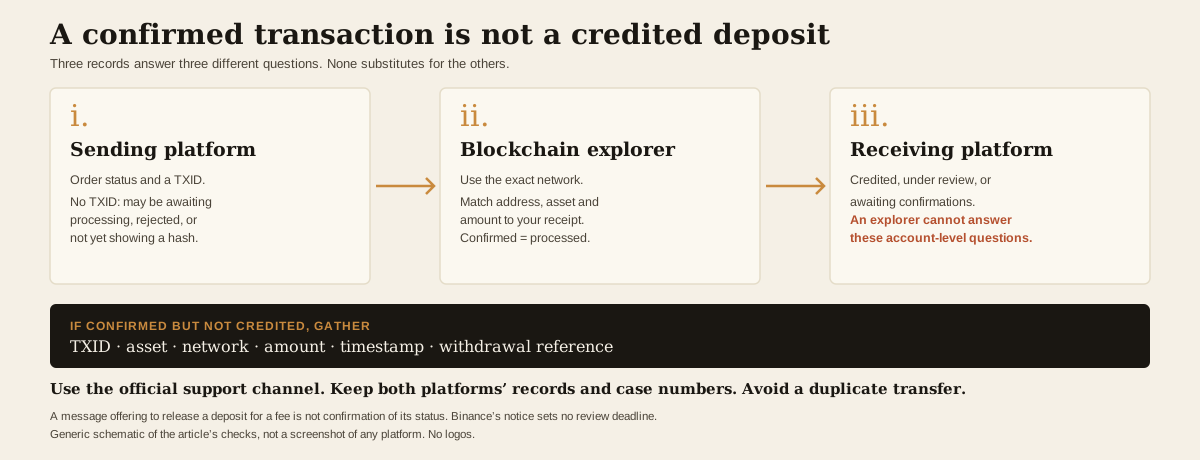
Start with the sending platform’s transaction history. Look for the order status and a transaction ID, often called a TXID or transaction hash. A withdrawal request without a TXID may still be awaiting processing, may have been rejected, or may not yet have a hash displayed. Ask the sending platform whether the transfer was broadcast before assuming it is on its way or submitting another request.
If you have a TXID, check it on the explorer for the exact network used. Verify that the destination address, asset, and amount match your receipt. A confirmed transaction shows that the blockchain processed the transfer. It does not show that the receiving exchange has credited it, cleared a review, or made the balance available to withdraw. A blockchain explorer cannot answer those account-level questions.
If the transaction is confirmed but the deposit is not credited, gather the TXID, asset, network, amount, timestamp, and withdrawal reference. Contact the receiving platform through its official support channel and ask whether the deposit is awaiting confirmations, under review, or affected by another issue. If the sending and receiving platforms report different statuses, keep both records and support case numbers. Avoid submitting a duplicate transfer while the original status is unresolved.
Binance’s notice does not specify a universal review period or guarantee that withheld funds will be credited or returned. If support requests documentation, follow the instructions in the official case. A message from an unverified account offering to release the deposit for a fee is not confirmation of the transfer’s status.
Did MEXC Suspend Withdrawals Worldwide?
The notices reviewed as of November 11, 2026, do not establish a worldwide MEXC withdrawal suspension. MEXC said its platform was operating, while Binance announced restrictions on transactions involving MEXC and related entities. The distinction is between the status of an exchange’s own withdrawal function and whether a particular destination will accept and credit the funds.
Consider a user who sees “completed” on the sending platform. That status may refer to the outgoing transaction. If the receiving exchange has not credited the deposit, the user still does not have an available balance there. Conversely, a platform can reject a transfer request before it broadcasts a transaction. Both situations can feel like a withdrawal problem to the user, but the next step differs: check the sending record for a rejection and the receiving account for a confirmed transfer that has not been credited.
MEXC’s statement describes its own operations at the time of its update. It is not a guarantee that every asset, network, destination, or account will work. When checking a particular route, verify the latest notices for both endpoints.
Editorial View
The practical lesson is to separate regulatory scope, platform policy, and transaction status. The FinCEN order tells covered institutions which transfers are subject to its prohibition and when that prohibition takes effect. Binance’s notice describes its own handling of affected transfers. The transaction record tells you whether a particular payment was broadcast, confirmed, or credited. None of those records can substitute for the others.
For anyone following the story, the next meaningful updates would be a change to the order, a revised platform notice, or clearer instructions for handling funds already under review. Until then, the most precise description is a restriction on affected transfer routes, not a finding that all MEXC withdrawals have stopped.
FAQ
1. Why Did Binance Restrict Transfers Involving MEXC?
Binance cited FinCEN’s action involving MEXC Global. Its November 10 notice said outgoing transfer requests to the covered entities would be rejected and incoming funds from those entities would be temporarily held for review.
2. When Does the MEXC FinCEN Order Take Effect?
The Federal Register lists December 10, 2026, as the effective date. Binance separately announced its platform restrictions on November 10 and said they applied immediately.
3. Does a Confirmed Transaction Mean Binance Will Credit My Deposit?
No. Blockchain confirmation means the transaction was processed on the network. The receiving platform can still withhold the deposit from your available balance while it reviews the transfer.
4. Will a Deposit Held for Review Be Returned Automatically?
Binance did not announce an automatic return or a fixed review deadline in the notice. Keep the TXID and transfer receipt, and check the case through official support.
5. Is This a Global Ban on MEXC Withdrawals?
The FinCEN order applies to covered financial institutions and defined transfers involving MEXC Global. Binance’s notice applies to affected transactions through its platform. Neither establishes that MEXC withdrawals have been suspended worldwide.
This content is provided for general informational purposes only and doesn't constitute financial, investment, legal, or tax advice. Any events, rewards, online promotions, or related information mentioned herein should not be considered a recommendation, solicitation, or invitation to purchase, sell, trade, or otherwise deal in any crypto assets. Crypto assets are highly volatile and may result in loss. The availability of WEEX services, products, and related events may vary by region. You are responsible for ensuring that your participation is in accordance with applicable local laws and regulations.
You may also like

Bitcoin Scam on Shaadi.com, User Solicited for a $500 Deposit
Why Did Binance Restrict MEXC Transfers? What the FinCEN Order Actually Covers
Find out why Binance restricted MEXC transfers, when the FinCEN order takes effect, and what to check if your crypto deposit is held for review.

Head of Turkey's Banking Regulator Requests Resignation as Fund Scandal Investigation Expands

NVIDIA Scandal Shakes the Internet! How Should Cryptocurrency Be Divided After a Divorce with a Tech Tycoon?

Crypto ATM Fees: How Much Bitcoin (BTC) Do You Get for $100?
See how much Bitcoin $100 buys at a crypto ATM. Compare two sample quotes, calculate the all-in cost, and learn which fees not to count twice.

NEAR AI Discloses SGLang Security Incident and Revokes Exposed API Keys

Cash App Founder Bob Lee's Killer Sentenced to 16 Years to Life in Prison

New York Judge Rejects Novig Injunction, State Gambling Laws Apply to Its Market

Arcus Loses $2.23 Million Due to Accounting Flaw, Fully Reimbursed

Miami-Dade To Accept Bitcoin For Property Taxes
Cardano’s police evidence system could bring 1.5 million annual transactions

Coinbase, Kalshi, and Kraken Support CFTC in Court Dispute Over Perpetual Stock Contracts

Unauthorized Access to Gnosis Pay's Old Card System Leads to Customer Data Breach

Westpac's Cryptocurrency Payment Limit (A$10,000): What Changes on December 1, 2026

Meta Releases Muse Ember Model, Supporting 1 Million Token Context

Blockchain.com Adds Trading API for Institutional Crypto Execution

LNbits disables hosted Bitcoin services with no restart timeline

MEXC CEO Establishes Communication with FinCEN and Receives Confirmation

Trump Warns AI Company CEOs of Criminal Prosecution

Solana publishes 11 startup ideas spanning AI and housing futures

China unifies blockchain and AI filings as two old systems close
Zcash Wallet Zodl Launches Self-Hosted Server Integration OHTTP
Bitcoin traders face an eight-hour blind spot as Deribit prepares to delay key market data

Perpetual Futures Enter U.S. Stock Market Amid Wall Street Lawsuits

Circle Says It Froze $1.1B in USDC Linked to Binance Hack Investigation
After the US elections, Galaxy sees reduced chances for major crypto legislation
Ripple’s XRP Ledger developers propose fix for loan repayment rounding issues
Overview of Cryptocurrency Asset Regulation Series (13): Switzerland, Banking Licenses, Stablecoins, and On-Chain Securities

French Man Sentenced to 5 Years in Prison for Stealing 1 Billion HLG Tokens

Chainalysis Begins Restoring Screening Services After Disclosing Exposed Password Hashes
Bitcoin Scam on Shaadi.com, User Solicited for a $500 Deposit
Why Did Binance Restrict MEXC Transfers? What the FinCEN Order Actually Covers
Find out why Binance restricted MEXC transfers, when the FinCEN order takes effect, and what to check if your crypto deposit is held for review.
Head of Turkey's Banking Regulator Requests Resignation as Fund Scandal Investigation Expands
NVIDIA Scandal Shakes the Internet! How Should Cryptocurrency Be Divided After a Divorce with a Tech Tycoon?
Crypto ATM Fees: How Much Bitcoin (BTC) Do You Get for $100?
See how much Bitcoin $100 buys at a crypto ATM. Compare two sample quotes, calculate the all-in cost, and learn which fees not to count twice.
NEAR AI Discloses SGLang Security Incident and Revokes Exposed API Keys
Latest articles


Latest coin listings on WEEX


