
NEAR AI Discloses SGLang Security Incident and Revokes Exposed API Keys

 Prefer us on Google


TL;DR: NEAR AI has published a security incident report involving an SGLang vulnerability in legacy deployments. The company says it revoked exposed credentials and addressed the issue, while acknowledging that some requests could have been observed. Its findings distinguish confirmed exposure from data it has no evidence was accessed.
A security disclosure from NEAR AI highlights a familiar danger in the expanding AI-agent industry: sophisticated applications can inherit serious problems from the infrastructure they run on.
In a November 9 incident report, the organization described an SGLang remote-code-execution vulnerability affecting legacy deployment infrastructure. The investigation identified roughly 100 user details and 18 agents in the affected context, with two Cloud API keys exposed and subsequently revoked.
The company said there was no evidence that stored Private Chat content had been compromised. It also cautioned that some requests made on November 8 could potentially have been observed. Those are not contradictory statements: investigators may find no evidence of one category of access while being unable to rule out another.
The problem was in the service stack
AI applications are assembled from multiple components: model servers, request routers, authentication systems, logging and the user-facing product. SGLang is part of the infrastructure used to serve language models. A flaw at that level can create opportunities for attackers before a user ever interacts with an onchain wallet or signs a transaction.
Remote-code-execution issues can be particularly serious because they may allow an attacker to run unauthorized instructions in the affected environment. The scope of what follows depends on the privileges, network access and data available to that environment.
For readers, this means the incident should not be conflated with a vulnerability in the NEAR blockchain consensus rules or a general compromise of all NEAR wallets. The report concerns particular AI-serving infrastructure and its potential exposures.
What NEAR AI says it did
According to the published account, the team investigated affected deployments, revoked the two exposed API keys, remediated the vulnerability and notified impacted parties. Those are necessary containment steps, though the effectiveness of remediation depends on whether other pathways remain open and whether credentials are rotated wherever they were used.
The report's numerical counts also need careful interpretation. Approximately 100 user details and 18 agents do not mean 100 users lost funds or that every associated request was read. Exposure, confirmed access and financial loss are separate findings that should not be collapsed into one sensational claim.
Why crypto and AI security overlap
Crypto firms are integrating AI into development, support, trading and operational workflows. An AI tool may eventually handle private business information even when it cannot directly sign onchain transactions. That raises the value of conventional safeguards: isolating services, limiting credentials, monitoring access and maintaining incident-response plans.
The broader institutional push toward blockchain infrastructure, including the NYSE's tokenized-securities plans, depends on more than smart-contract security. Offchain services must also be robust. A well-audited ledger cannot compensate for a compromised application server.
Likewise, rising institutional attention to crypto assets, which NewsBTC tracks through developments such as Ether ETF flows, makes operational controls increasingly consequential. These links are contextual rather than a claim that those products were involved in this incident.
-- Price
What users should do
Affected users should rely on NEAR AI's direct notifications and published guidance. Where they have used credentials in related services, reviewing access permissions and rotating keys is prudent. Users should not assume that ordinary NEAR wallet keys have been exposed simply because the company reported an infrastructure flaw.
The most important follow-up is a clear technical postmortem explaining affected versions, root cause and validation of the fixes. For companies building AI agents around finance, the episode is a reminder that infrastructure security and candid disclosure are both part of earning trust.
Written by the News Desk and edited by Samuel Rae.
This content is provided for general informational purposes only and doesn't constitute financial, investment, legal, or tax advice. Any events, rewards, online promotions, or related information mentioned herein should not be considered a recommendation, solicitation, or invitation to purchase, sell, trade, or otherwise deal in any crypto assets. Crypto assets are highly volatile and may result in loss. The availability of WEEX services, products, and related events may vary by region. You are responsible for ensuring that your participation is in accordance with applicable local laws and regulations.
You may also like

AI Agents Do More Than Just Place Orders: The Next Entrepreneurial Opportunity Lies in Matching and Trust

NVIDIA Scandal Shakes the Internet! How Should Cryptocurrency Be Divided After a Divorce with a Tech Tycoon?

Bundesbank President Says Economic Recovery Faster Than Expected, Structural Reforms Needed

Immutable Chain's Transition to OP Stack: What Changes for Users
Ledger CEO faces backlash after saying everybody will be hacked at some point

WEEX 11.11 Shopping Fest: Buy BTC and Unlock Up to 888 USDT in Rewards

The Art of Trading: How They Profit from Arbitraging USDE Stocks

VARA Is Not a Panacea: Dubai's Crypto Payments Still Depend on the Central Bank

a16z Frontier Partner: Agents Should Rebuild Uber-like Transaction Networks
Poland's Parliament Votes 240-202 To Let Officials Freeze Crypto Before Court Review

WEEX P2P now supports ILS, BHD, OMR & QAR —Merchant Recruitment Now Open

Cryptocurrency Security Checklist: Four Lessons from Phemex Safety Hub Vol. 05–08
Ondo Claims $4B in Tokenized Assets as RWA Market Gains Institutional Depth

DTCC Launches Tokenization Service: What Can Investors Actually Do?

The catch in recovering a hacked crypto wallet: the thief may still have a key

Bitcoin Remains Strong: Why $76,000 is the Level That Matters Now
Peter Schiff Criticizes Strategy's Bitcoin Purchases

iPhone Attack Kit 'DarkSword' Suspected of Being Misused for Cryptocurrency Theft, Bitquery Identifies Approximately $4.06 Million in Stolen Funds

Financial and Political Crisis in Paraguay: How the Ueno Bank Explosion Triggered the President's Resignation

OpenAI Releases National Community Covenant and Computing Park Policy Blueprint

GitBook Security Incident Review, Attack Targeting Trade.xyz

Post-Quantum Era Consensus Layer Divergence: Ethereum Maintains Decentralization, Monad Prioritizes Speed

The Ghost Behind the Screen: Unveiling the Secret World of North Korean Hackers Lazarus

Bitcoin Miners Turn to AI: Escaping the Crypto Cycle, but Entering New Turbulence
Decoding Variational: How a No-Order-Book Exchange Became the Dragon Behind Hyperliquid?
Creators Speak | The Biggest Risk in the Crypto Industry is Thinking It's Safe
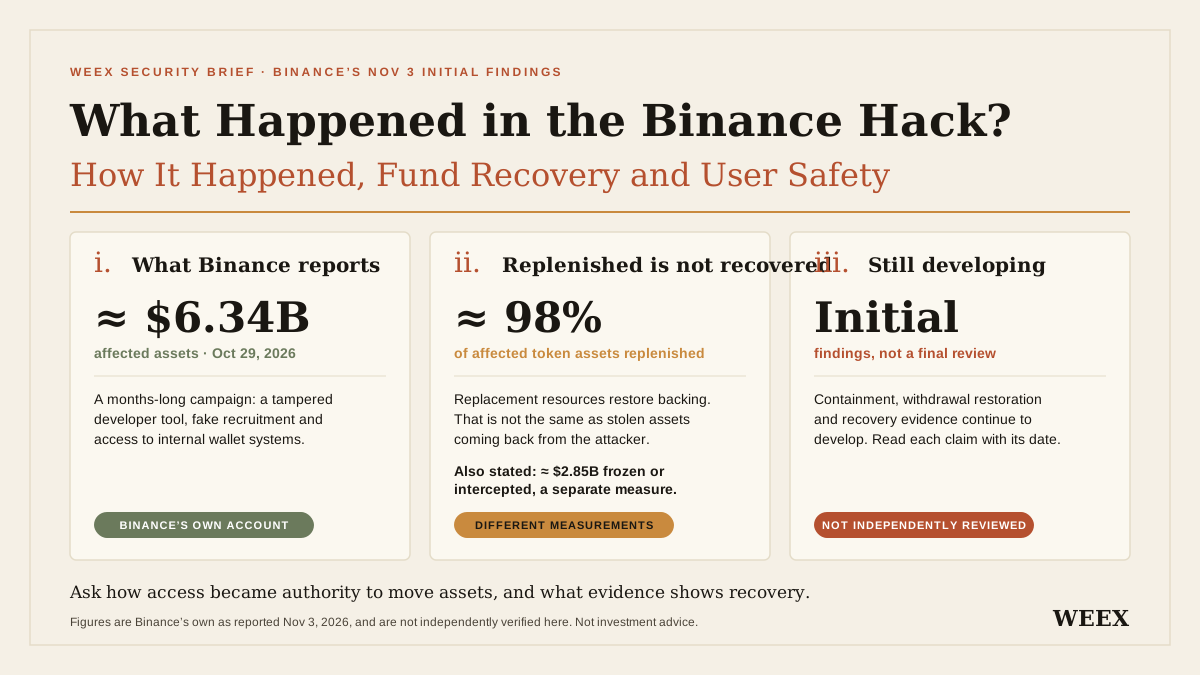
What Happened in the Binance Hack? How It Happened, Fund Recovery and User Safety
What happened in the Binance hack? Review the attack timeline, latest fund replenishment, recovery limits and practical steps to protect your account.

Who really controls a crypto project? Inside the SEC’s new guidance

Reflections After the Binance Heist: Who Should We Trust with Our Crypto Assets?
Solana study finds wider spreads outside aggregators at five of six sampled pools
AI Agents Do More Than Just Place Orders: The Next Entrepreneurial Opportunity Lies in Matching and Trust
NVIDIA Scandal Shakes the Internet! How Should Cryptocurrency Be Divided After a Divorce with a Tech Tycoon?
Bundesbank President Says Economic Recovery Faster Than Expected, Structural Reforms Needed
Immutable Chain's Transition to OP Stack: What Changes for Users
Ledger CEO faces backlash after saying everybody will be hacked at some point
WEEX 11.11 Shopping Fest: Buy BTC and Unlock Up to 888 USDT in Rewards
Latest articles




Latest coin listings on WEEX


