
Immutable Chain's Transition to OP Stack: What Changes for Users

 Prefer us on Google


Key Points: Immutable has announced plans to transition the Immutable Chain from its custom Geth fork to an OP Stack-based Ethereum rollup around mid-2027. According to the project, the chain will maintain its state and chain ID, meaning accounts, balances, contracts, and approvals are expected to be carried over with little to no action required from nearly all users. The announced changes include a new bridge design, anticipated increases in transaction costs, and that native withdrawals to Ethereum will take approximately seven days. These plans are set as of November 11, 2026, and the confirmed migration schedule and final user procedures have yet to be published.
What Did Immutable Announce?
Immutable's engineering announcement on November 6, 2026, indicates changes to the chain's underlying software and payment architecture. The announcement states that the Immutable Chain will transition from a custom Geth fork to an OP Stack-based chain. The project aims to maintain the same state and chain ID, reduce block time from two seconds to one second, and utilize Ethereum for data availability and proof-based bridging. The target timeframe is mid-2027, with prior notice given before a temporary halt in block generation.
Timing is crucial. This is a future roadmap, not an upgrade that users can confirm has already been completed today. Until the project announces a specific migration period, wallets may continue to display the existing chain and bridges. It is advisable to avoid following any third-party "migration" links that request immediate asset transfers based solely on this announcement. The official post indicates that the transition itself will require little to no action from nearly all users and developers.
This announcement pertains to the Immutable Chain, which serves as the infrastructure for games and applications. It does not imply that all in-game assets, marketplace listings, and exchange deposit methods will function identically during the transition. Such downstream services may issue their own operational notices once the schedule is confirmed.
What Does "Same State and Chain ID" Mean for Wallets?
The state includes the account balances and contract storage of the chain at a given point in time. Maintaining the state means that the migration is designed to continue these records on the upgraded chain. Maintaining the chain ID means that the network identifier used by wallets and applications is expected to remain the same. Immutable states that accounts, balances, contracts, and approvals will carry over unchanged, which supports the claim that "nearly all users will require no action."
This is different from a token swap where holders are asked to exchange one asset for another through a claim page. The official post does not mention any requirements for large-scale token redemptions or sending IMX to a new address. It also does not guarantee that all wallet interfaces will be updated at exactly the same time. Even if the underlying balances are correctly carried over, users may experience old apps, RPC errors, or indexer delays during the transition.
The practical step for users is to record their current wallet address and important transaction identifiers before the announced disruptions and wait for official status updates. This will make it easier to distinguish between display issues and actual state discrepancies. There is no need to share seed phrases or sign unexpected transactions. Messages claiming that these actions are necessary for this upgrade should be treated as unverified until confirmed through Immutable's official channels.
Why Transition to OP Stack?
Immutable states that this transition will allow the chain to become an Ethereum rollup, making it easier to implement ecosystem-wide upgrades and security patches. It also describes a bridge that can verify withdrawals against state commitments posted to Ethereum. The intent expressed is about conservatism and the relationship between the chain and Ethereum, and it does not prove that all applications will become cheaper or faster for users.
Block time is one of the measurable changes in the plan. From two seconds to one second. One-second block generation can update the on-chain state more frequently, but the end-to-end experience for users also depends on wallets, game servers, RPC providers, marketplaces, and bridges. Faster blocks do not mean that withdrawals to Ethereum will be confirmed in one second. The bridge has an independent verification process, and the project anticipates that the time for native withdrawals will increase.
The announcement states that it will begin with permissioned fault-proof and then introduce validity proof. These stages indicate the intended technical path. It should not be stated that future proof systems are already deployed on the Immutable Chain. Users and developers should review the migration documents when the project publishes them and reassess the architecture once the new bridge is operational.
-- Price
What Changes for Withdrawals and Bridges?
The most direct impact on users from the announcement is the timing of native withdrawals. Immutable estimates that withdrawals via the new native rollup bridge will take about seven days. This is significantly longer than many users currently perceive with the existing bridge, which is important for those needing funds on Ethereum by a specific date. The seven-day estimate does not guarantee an exact completion time, especially during launches or network outages.
Immutable mentions that a faster liquidity bridge may continue to handle most withdrawals. Such services may offer different routes but could incur additional fees, liquidity caps, and provider risks. Fast bridges and native withdrawals are not interchangeable in terms of security models or costs. Before choosing a bridge, confirm who provides liquidity, how transfers will be completed, what happens if the provider goes down, and what the final landing asset will be.
The project also states that transaction costs are expected to rise slightly. The announcement does not publish a stable user-specific fee schedule. Games adopting sponsored transactions may absorb fees, while other applications may pass them on to users. High-volume users may notice smaller changes in unit costs more than casual players. Appropriate comparisons should be based on the gas fees and application fees that become available after migration, rather than general claims that the new stack is cheaper or more expensive for all activities.
What Should Game Developers and Infrastructure Providers Confirm?
Immutable states that since contracts and states will carry over, most developers will require no action. However, before the planned chain halt, applications should audit their dependencies. RPC endpoints, indexers, bridge APIs, event listeners, confirmation prerequisites, and messaging related to withdrawals are parts that may be affected by this change, even if the smart contracts themselves remain deployed. Developers should read the migration documents for applications and infrastructure providers linked to the project and conduct tests against available environments.
Games that grant credits to players after deposits should define what events constitute confirmation within their risk tolerance. Marketplaces should verify whether balance displays, listing statuses, and payment flows remain synchronized after disruptions. Indexers may need to handle stopping and resuming without duplicating events. These are implementation challenges and do not indicate that the announced migration will fail. They are necessary confirmations to achieve the intended continuity in production applications.
The official post also states that Immutable's current public testnet for gaming use is scheduled to be deprecated by the end of 2026. This is on a different schedule than the mainnet migration target. Teams using the testnet should not assume that the 2027 mainnet date is the only deadline but should check the project's latest developer guidance.
View the cryptocurrency market
How Should Users Prepare While Avoiding Premature Actions?
The first valid action is to organize information. Bookmark Immutable's official announcements and status channels, distinguishing between confirmed dates and planned targets. Announcements indicating block numbers, maintenance windows, and bridge procedures are easier to act on than social media posts that merely repeat "2027 migration."
Next, as the target period approaches, inspect ongoing activities. If players need to withdraw to Ethereum for time-sensitive payments, they should consider the announced bridge changes and downtime well in advance of the deadline. If a game is conducting time-constrained events, its operators should publicly announce their own plans regarding deposits, withdrawals, and in-game transactions during disruptions.
Third, avoid speculative migration transactions. Since Immutable states that balances and approvals will carry over, requests to send assets to unknown contracts do not align with current user guidance. While new official instructions may come later, both the project and the applications involved should be verified. Do not rely solely on direct messages or paid search ads for signature requests in wallets.
Fourth, check approvals after migration. "Approvals will carry over" means that previously granted permissions are expected to be retained. This is useful for application continuity, but it also means that old permissions will not disappear just because the chain software has changed. Reviewing valid allowances and revoking those that are no longer needed is a separate wallet management task to be performed.
Frequently Asked Questions (FAQ)
Do IMX Holders Need to Swap Tokens Immediately?
The official announcement explains the continuity of state and balances and states that nearly all users will require no action. It does not instruct holders to perform a token swap immediately. If specific application instructions are issued later, verify them against official notifications.
Will the Chain Be Assigned a New Chain ID?
Immutable states that it will maintain the same chain ID after the migration. While wallet providers may update their technical settings, the project does not require a new network identifier according to the plans presented.
Will All Withdrawals Take Seven Days?
Immutable's estimate pertains to native withdrawals via the planned rollup bridge. A faster liquidity bridge may provide alternative options with different fees and risks. The exact conditions will vary based on the routes available after migration.
Is the Mid-2027 Timeline Confirmed?
No. The project aims for mid-2027 and will provide prior notice once the schedule is confirmed. Articles published at this time should be treated as goals rather than reserved maintenance windows.
This content is provided for general informational purposes only and doesn't constitute financial, investment, legal, or tax advice. Any events, rewards, online promotions, or related information mentioned herein should not be considered a recommendation, solicitation, or invitation to purchase, sell, trade, or otherwise deal in any crypto assets. Crypto assets are highly volatile and may result in loss. The availability of WEEX services, products, and related events may vary by region. You are responsible for ensuring that your participation is in accordance with applicable local laws and regulations.
You may also like
NVIDIA Scandal Shakes the Internet! How Should Cryptocurrency Be Divided After a Divorce with a Tech Tycoon?

Bundesbank President Says Economic Recovery Faster Than Expected, Structural Reforms Needed
Ledger CEO faces backlash after saying everybody will be hacked at some point

WEEX 11.11 Shopping Fest: Buy BTC and Unlock Up to 888 USDT in Rewards

NEAR AI Discloses SGLang Security Incident and Revokes Exposed API Keys
The Art of Trading: How They Profit from Arbitraging USDE Stocks
VARA Is Not a Panacea: Dubai's Crypto Payments Still Depend on the Central Bank

a16z Frontier Partner: Agents Should Rebuild Uber-like Transaction Networks
Poland's Parliament Votes 240-202 To Let Officials Freeze Crypto Before Court Review
WEEX P2P now supports ILS, BHD, OMR & QAR —Merchant Recruitment Now Open
Cryptocurrency Security Checklist: Four Lessons from Phemex Safety Hub Vol. 05–08
Ondo Claims $4B in Tokenized Assets as RWA Market Gains Institutional Depth

DTCC Launches Tokenization Service: What Can Investors Actually Do?

The catch in recovering a hacked crypto wallet: the thief may still have a key

Bitcoin Remains Strong: Why $76,000 is the Level That Matters Now
Peter Schiff Criticizes Strategy's Bitcoin Purchases

iPhone Attack Kit 'DarkSword' Suspected of Being Misused for Cryptocurrency Theft, Bitquery Identifies Approximately $4.06 Million in Stolen Funds

Financial and Political Crisis in Paraguay: How the Ueno Bank Explosion Triggered the President's Resignation

OpenAI Releases National Community Covenant and Computing Park Policy Blueprint

GitBook Security Incident Review, Attack Targeting Trade.xyz

Post-Quantum Era Consensus Layer Divergence: Ethereum Maintains Decentralization, Monad Prioritizes Speed

The Ghost Behind the Screen: Unveiling the Secret World of North Korean Hackers Lazarus
Bitcoin Miners Turn to AI: Escaping the Crypto Cycle, but Entering New Turbulence
Decoding Variational: How a No-Order-Book Exchange Became the Dragon Behind Hyperliquid?
Creators Speak | The Biggest Risk in the Crypto Industry is Thinking It's Safe
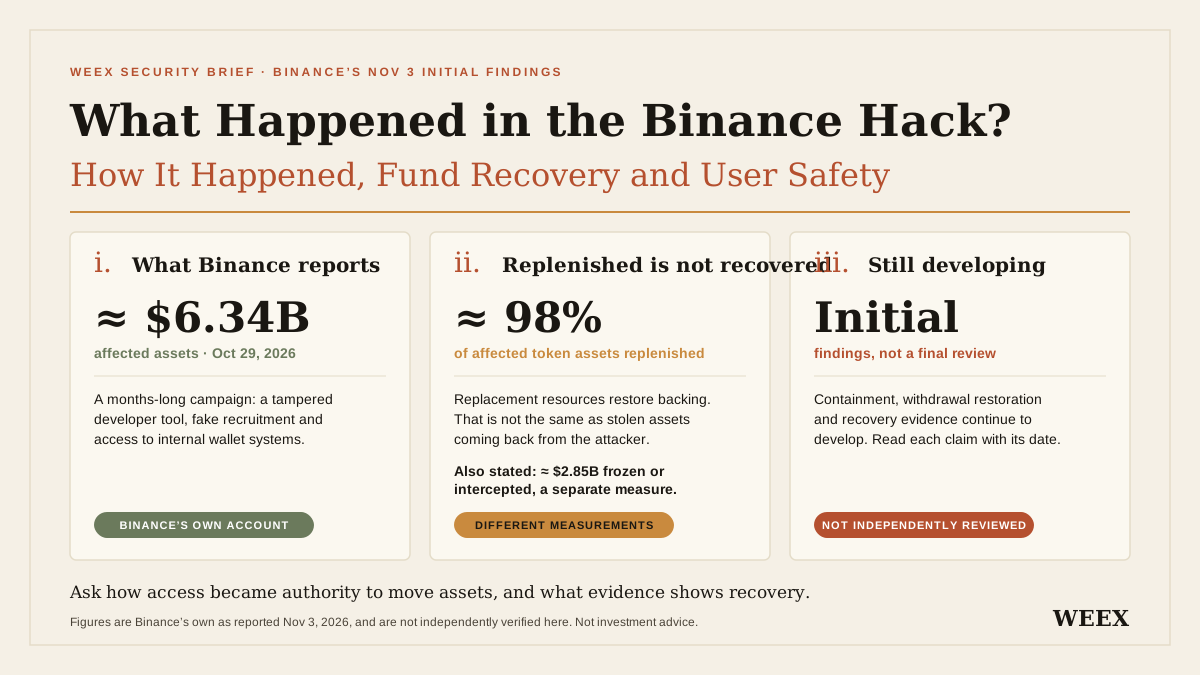
What Happened in the Binance Hack? How It Happened, Fund Recovery and User Safety
What happened in the Binance hack? Review the attack timeline, latest fund replenishment, recovery limits and practical steps to protect your account.

Who really controls a crypto project? Inside the SEC’s new guidance

Reflections After the Binance Heist: Who Should We Trust with Our Crypto Assets?
Solana study finds wider spreads outside aggregators at five of six sampled pools

Is it theft or fraud when the coins in the wallet remain but are changed to multi-signature by someone else?
NVIDIA Scandal Shakes the Internet! How Should Cryptocurrency Be Divided After a Divorce with a Tech Tycoon?
Bundesbank President Says Economic Recovery Faster Than Expected, Structural Reforms Needed
Ledger CEO faces backlash after saying everybody will be hacked at some point
WEEX 11.11 Shopping Fest: Buy BTC and Unlock Up to 888 USDT in Rewards
NEAR AI Discloses SGLang Security Incident and Revokes Exposed API Keys
The Art of Trading: How They Profit from Arbitraging USDE Stocks
Latest articles


Latest coin listings on WEEX


