
Circle Says It Froze $1.1B in USDC Linked to Binance Hack Investigation

 Prefer us on Google


TL;DR: Circle says it froze roughly $1.1 billion in USDC connected with the reported Binance exploit while working with law enforcement. The stablecoin issuer stresses that a wallet freeze does not decide asset ownership or whether funds should ultimately be forfeited.
The response to the enormous reported Binance breach has exposed a difficult but essential distinction in digital finance: tracking money is not the same thing as freezing it, and freezing it is not the same thing as recovering it for a victim.
In a November 5 statement, Circle said it had frozen approximately $1.1 billion in USDC associated with the incident, in coordination with law enforcement. It described an attack involving more than $6 billion in digital assets, while emphasising that the investigation and identification of relevant funds remain ongoing.
Why USDC can be frozen when Bitcoin cannot
USDC is issued by a company that operates an administratively controlled token system. Under certain legal processes, the issuer can freeze specified addresses so tokens cannot move in or out. Bitcoin, by contrast, does not have an issuer with an equivalent global address-freezing switch. That difference can matter enormously in the first minutes after an attack.
But it also raises governance questions. Who is authorised to request a freeze? What evidence is required? How quickly can an incorrect restriction be lifted? Circle says it acts on valid legal process and does not decide for itself whether a crime occurred, whether a wallet's owner committed an offence or who is entitled to the assets. Those questions belong to law enforcement and the courts.
This makes it important not to count frozen funds as already returned to customers. A frozen balance may remain subject to lengthy investigations, ownership disputes and judicial decisions. The amount is an intervention figure, not a completed reimbursement total.
The race between cross-chain transfers and enforcement
Modern crypto breaches move across bridges, exchanges, token pairs and custody services. Attackers may split assets among many addresses and convert one token into another to make intervention harder. Defenders need analytics capable of tracing flows across those boundaries, along with responsive institutions that can take action where legal powers exist.
An earlier NewsBTC report on Aave freezing new tBTC activity illustrated how different controls can be used to reduce exposure within a protocol. Circle's move is not the same kind of action, but both show why the ability to intervene is a design choice with trade-offs.
For investigators, the key issue is coordination. An address identified in one jurisdiction may be connected to a stablecoin issuer or exchange in another. Delays can give attackers more time to swap tokens and fragment holdings. Moving quickly is therefore useful, but speed cannot replace careful identification and due process.
What is still unknown
The full scope of the incident, ultimate recoveries and allocation of any frozen funds will require additional verified disclosures. Blockchain traces alone can also create false impressions when commentators assign an address to a person without sufficiently strong evidence. Circle's account is an issuer's report of its own intervention, not an independently completed forensic audit of every transfer.
The development offers a lesson beyond this incident. Dollar stablecoins can provide rapid payment settlement and targeted interdiction, yet their compliance controls concentrate important operational powers in issuers. Users, institutions and regulators need to understand both sides of that bargain.
This article was written by the News Desk and edited by Samuel Rae.
-- Price
This content is provided for general informational purposes only and doesn't constitute financial, investment, legal, or tax advice. Any events, rewards, online promotions, or related information mentioned herein should not be considered a recommendation, solicitation, or invitation to purchase, sell, trade, or otherwise deal in any crypto assets. Crypto assets are highly volatile and may result in loss. The availability of WEEX services, products, and related events may vary by region. You are responsible for ensuring that your participation is in accordance with applicable local laws and regulations.
You may also like

Decrypt Becomes First News Publisher to Offer Perps Trading, Powered by Solana's Phoenix

Bitcoin Scam on Shaadi.com, User Solicited for a $500 Deposit

Ignas: HYPE and AVAX Face Value Capture Challenges

CPI Higher Than Expected in the U.S.: What It Means for Investors

Bloomberg analyst warns BTC, Nasdaq, commodities may face year-end declines
Barclays Increases Stake in BlackRock Bitcoin ETF by 48% in Q3, Citigroup Establishes $119 Million FBTC Position

Something strange is happening with Bitcoin. It is neither digital gold nor a tech company for Wall Street

US card debt hits $1.29 trillion as Bitcoin loans expose a collateral divide

CryptoQuant: Bitcoin Analyst Sentiment Significantly Bearish, Index Drops to -1.8σ

CoinShares Survey Shows Fund Managers' Digital Asset Allocation Rises to 1.3%

From Sidechains to zk-Rollups: Tacit Chain Aims to Redefine Payments with Default Privacy

Treasury Discusses Bitcoin Acquisition Pathways, Government Holdings Undergo Second Round of Review

Trump Still Interested in Increasing Bitcoin Holdings Amid Legal Hurdles

LNbits Security Patch Released After Bitcoin Wallet Theft

Deutsche Bank launches crypto custody for Bitcoin, Ethereum, stablecoins
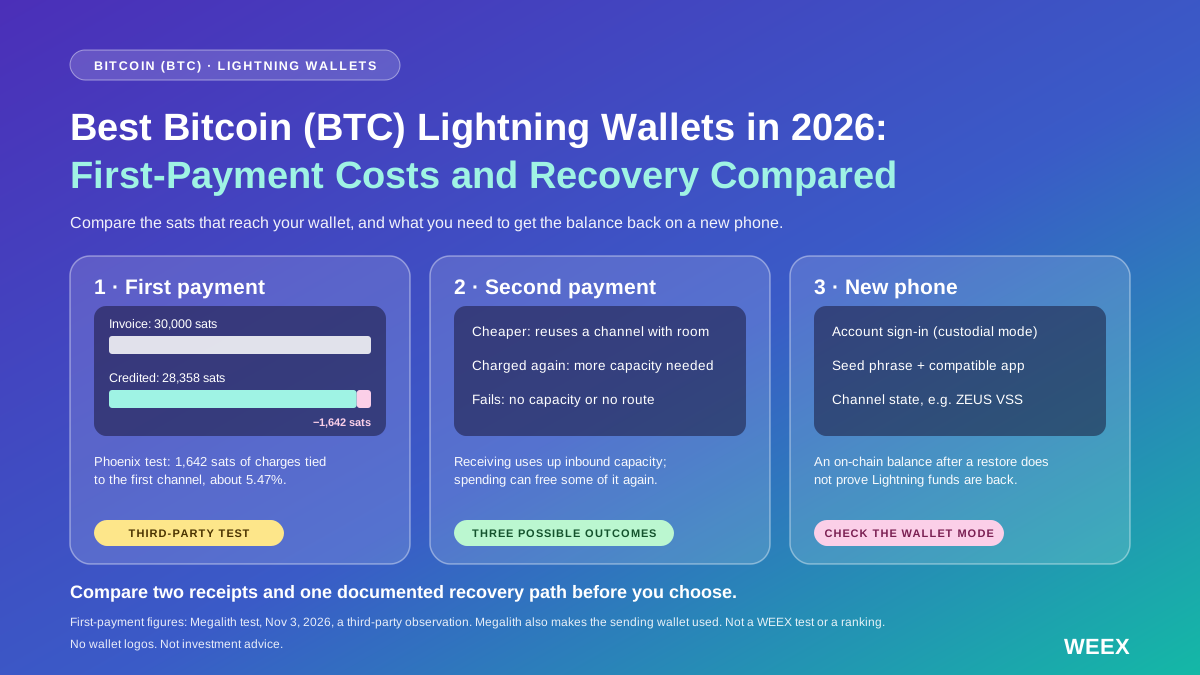
Best Bitcoin (BTC) Lightning Wallets in 2026: First-Payment Costs and Recovery Compared
Key Takeaways Lightning Network wallets enable fast and cost-effective Bitcoin transactions by using off-chain channels. A variety of…

SEC Enforcement Actions Decrease by 23.7% to 348 in Fiscal Year 2026

BlackRock Loses $1.735 Billion in Cryptocurrency Funds

Ethereum’s Joseph Lubin explains why ETH could rival Bitcoin and gold

BitGo Posts $44M Quarterly Profit as Platform Assets Grow, But Adjusted EBITDA Stays Negative
Bitcoin: A Thief Sentenced in China for Memorizing a Seed Phrase

Bitcoin loses status as main risk asset amid stock market lag

Crypto ATM Fees: How Much Bitcoin (BTC) Do You Get for $100?
See how much Bitcoin $100 buys at a crypto ATM. Compare two sample quotes, calculate the all-in cost, and learn which fees not to count twice.

WEEX 11.11 Shopping Fest: Buy BTC and Unlock Up to 888 USDT in Rewards

WEEX Exclusive:CPI Exceeds Expectations, Three Major Indexes and Bitcoin Lower | WEEX Daily Market Brief (November 11, 2026)
October CPI rose 0.4% month over month, above expectations. Bond yields climbed, and the three major indexes all closed lower. Bitcoin briefly fell below $73,000. CoreWeave’s third-quarter revenue beat expectations. TSMC’s October revenue was strong. The bond market is closed on November 11; watch for Rumble’s earnings report.

CPI Exceeds Expectations, Three Major Indexes and Bitcoin Lower | WEEX Daily Market Brief (November 11, 2026)
October CPI rose 0.4% month over month, above expectations. Bond yields climbed, and the three major indexes all closed lower. Bitcoin briefly fell below $73,000. CoreWeave’s third-quarter revenue beat expectations. TSMC’s October revenue was strong. The bond market is closed on November 11; watch for Rumble’s earnings report.

24X Expands Collaboration with Standard Chartered Bank to Support Bitcoin and Ethereum Trading
Robinhood's Latest Earnings Report Tells You All You Need to Know About the Future of Crypto. These 2 Numbers Really Stood Out.
Bitcoin Spot ETF Sees Net Outflow of $95.0012 Million Yesterday, Continuing for 4 Days

From Shorting Stablecoins to Building Chains: The Shift of Airwallex Founder Jack Zhang and the Battle for Payment Settlement Layers
Decrypt Becomes First News Publisher to Offer Perps Trading, Powered by Solana's Phoenix
Bitcoin Scam on Shaadi.com, User Solicited for a $500 Deposit
Ignas: HYPE and AVAX Face Value Capture Challenges
CPI Higher Than Expected in the U.S.: What It Means for Investors
Bloomberg analyst warns BTC, Nasdaq, commodities may face year-end declines
Barclays Increases Stake in BlackRock Bitcoin ETF by 48% in Q3, Citigroup Establishes $119 Million FBTC Position
Latest articles





Latest coin listings on WEEX


