
Best Bitcoin (BTC) Lightning Wallets in 2026: First-Payment Costs and Recovery Compared

 Prefer us on Google

Key Takeaways
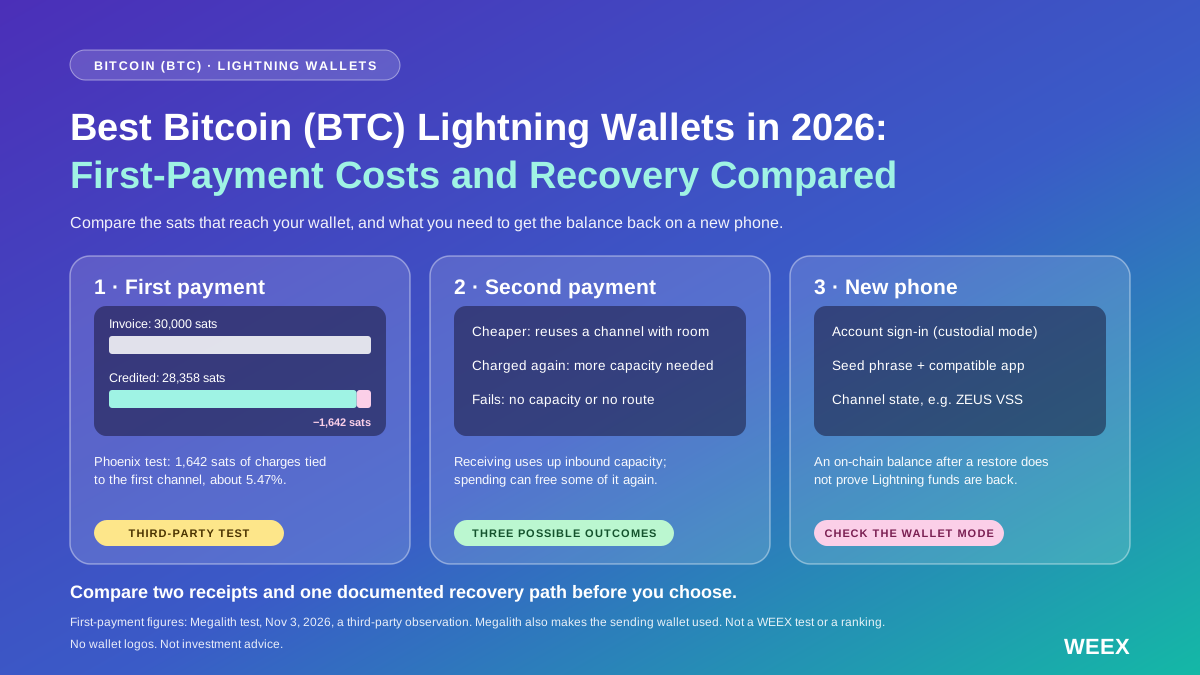
- Compare the sats that reach your wallet. The first payment may trigger a channel or liquidity charge that the second payment does not.
- Check the exact wallet mode. Wallet of Satoshi’s custodial and self-custody modes have different recovery paths. ZEUS’s LDK Node has its own channel backup requirements.
- A recovery phrase does not always restore an active Lightning balance on its own. You may also need a compatible app, a channel-state backup, or access to a provider account.
- The published test cited here is a third-party observation. The equal-amount comparison below is a test plan, not a claim that WEEX performed those transfers or restored the wallets.
The best Bitcoin Lightning wallet for you depends on two things a feature list rarely shows together: how much of your first payment you keep and what you need to recover the balance if your phone is lost. Phoenix illustrates the trade-off of a self-custody wallet that manages channels for you. Wallet of Satoshi shows why custody mode matters even within a single app. ZEUS’s LDK Node shows what changes when you operate a Lightning node on your phone.
For occasional small payments, a channel setup charge can matter more than a low advertised sending fee. For repeat use, the more consequential question may be whether you can recover the balance without the original device. A wallet can do well on one measure and poorly on the other.
Compare Lightning Wallet Fees and Recovery by Wallet Mode
The Lightning Network routes Bitcoin payments through payment channels. Some wallets manage those channels for you; others let you run a node or use a different underlying system that connects to Lightning. The app name alone does not tell you how receiving fees or recovery work. Compare the exact mode available on your device and in your region.
| Wallet and mode | What can affect the first receipt? | What can change on the second receipt? | What to verify before switching phones |
|---|---|---|---|
| Phoenix — self-custody | Insufficient inbound capacity can trigger a channel or liquidity operation with fees. | If there is enough inbound capacity left, the second receipt may not need another capacity adjustment. | Back up the recovery phrase and follow the Phoenix restore process. Verify the recovered balance before retiring the old device. |
| Wallet of Satoshi — custodial, where offered | The provider’s disclosure lists no incoming Lightning fee in this mode. The sender may still pay routing fees. | No user-managed channel to open. Check the amount credited and distinguish Lightning receipts from other top-up methods. | Confirm the provider’s account recovery process and access to the required sign-in method. |
| Wallet of Satoshi — Spark self-custody | The provider lists no platform-specific fee for receiving Lightning payments, but underlying infrastructure fees can reduce the amount received. | Check the actual credit on both payments. The lack of a personal channel setup step does not guarantee an identical or zero cost. | Use the recovery phrase with a compatible Spark recovery implementation. A standard Bitcoin wallet may not recreate the balance. |
| ZEUS — LDK Node | A fresh setup may need inbound capacity. An advance channel purchase can create a cost before the first invoice is paid. | The next payment can use the same channel if it has enough receiving capacity and a route is available. | Keep the seed phrase and verify access to the Versioned Storage Service (VSS) holding the Lightning channel state. |
ACINQ’s Phoenix documentation on channel management explains why an incoming payment can incur an on-chain cost when more capacity is needed. The Wallet of Satoshi disclosure distinguishes its two custody modes and their receiving fee rules. The ZEUS documentation on channel options distinguishes capacity bought in advance from capacity added when a payment arrives. These are published product rules, not quotes for a specific payment.
Why Can the First Lightning Payment Cost More Than the Second?
A Lightning channel needs room on the receiving side. That room is called inbound liquidity. If your wallet has no channel, or if the channels it can use lack sufficient inbound capacity, the wallet may need a channel or a capacity adjustment before it can receive the payment. Depending on the wallet, you might pay for that capacity up front, see the charge deducted from your receipt, or see the payment fail if the wallet cannot arrange capacity under its rules.
A second payment can reuse an existing channel if enough inbound capacity remains. But a successful first payment does not guarantee the next one will go through under the same terms. Receiving generally uses up inbound capacity, while spending can free some of it again. A second invoice of the same size can therefore cost less, incur another charge, or fail. That is precisely why both receipts belong in a wallet comparison.
What a Published First-Payment Test Actually Shows
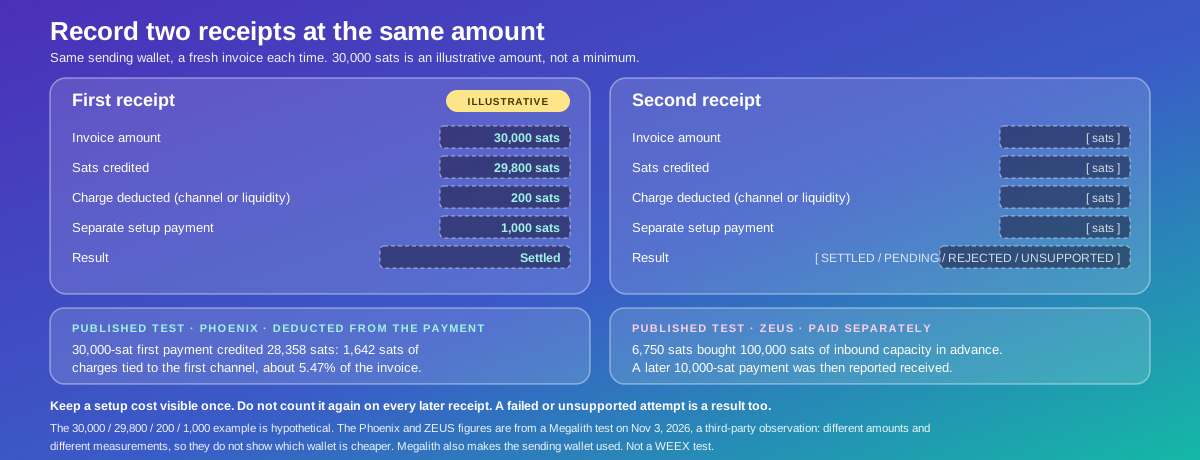
In a Megalith test on November 3, 2026, a 30,000-sat first payment to Phoenix credited 28,358 sats. The testers reported 1,642 sats in charges tied to the first channel, about 5.47% of the invoice amount. They separately paid 6,750 sats to buy 100,000 sats of inbound channel capacity for ZEUS, then reported receiving a 10,000-sat payment through that channel.
Those are different measurements. The Phoenix charge was deducted from a payment. The ZEUS charge bought capacity in advance and would be missed by looking only at the credited invoice. The amounts also differ, so the test cannot establish which wallet would be cheaper for two identical payments. Megalith discloses that its team also makes the sending wallet used in the test. The useful takeaway is the distinction between a deduction from your receipt and a setup expense paid separately.
How to Compare Two Lightning Receipts at the Same Amount
Use the same sending wallet and create two fresh invoices of the same amount in each receiving wallet. 30,000 sats is an illustrative test amount, not a universal minimum. If a wallet does not accept that amount or asks you to buy more capacity than you want, record the limitation. A failed payment or unsupported amount is a result; it should not disappear from the comparison.
| Record | First receipt | Second receipt |
|---|---|---|
| Starting conditions | App version, custody mode, existing channels, and any capacity purchased before testing | Whether the first payment opened or resized a channel; whether you spent any sats in between |
| Payment | Invoice amount, sats credited, and any fee shown on the sending side | Same fields, using a fresh invoice for the same amount |
| Extra cost | Separate setup or liquidity payment, if any | Any additional fee to add capacity |
| Result | Settled, pending, rejected, or unsupported | Settled, pending, rejected, or unsupported |
If the wallet receives 29,800 sats on a 30,000-sat invoice and you paid 1,000 sats separately for setup, the first receipt involved 200 sats deducted plus 1,000 sats paid separately, before any sender routing fee. Those are illustrative numbers. If the same setup supports many later payments, keep that first expense visible but don’t count it again on every receipt. This lets you compare the cost of receiving once with the cost of using the wallet regularly.
-- Price
How Do You Recover a Lightning Wallet on a New Phone?
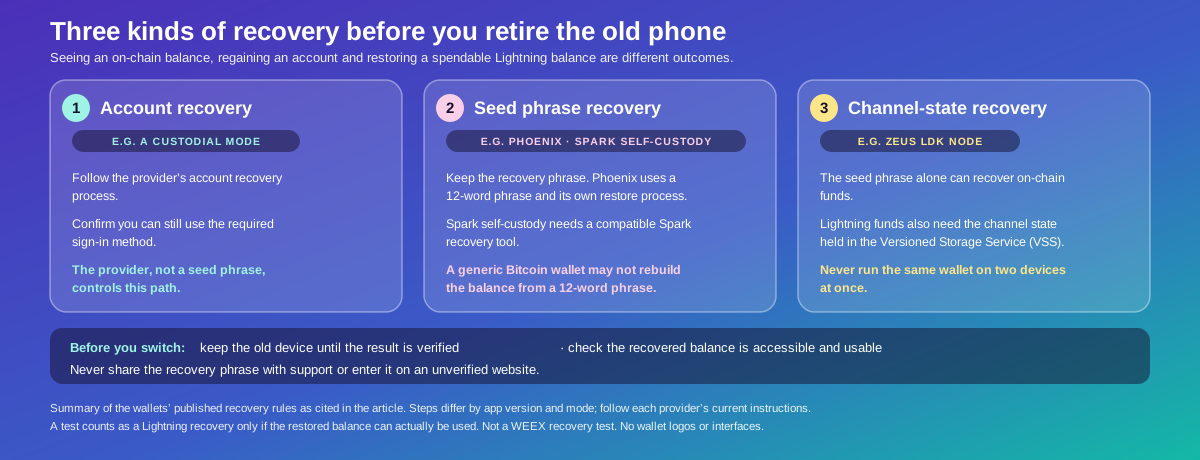
First identify what actually needs to be recovered. Seeing an on-chain BTC balance, regaining access to an account, and restoring a spendable Lightning balance are different outcomes. A test counts as a Lightning recovery only if the recovered balance is accessible and usable through the documented method.
Phoenix’s official repository identifies its 12-word recovery phrase as the backup users must keep. For Wallet of Satoshi’s self-custody mode, the provider’s recovery instructions specify a compatible Spark wallet or recovery tool. A generic Bitcoin wallet cannot be assumed to restore that balance just because it accepts a 12-word phrase.
The distinction is especially clear in ZEUS’s LDK Node recovery guide. The seed phrase alone can recover on-chain funds, but restoring Lightning funds also requires the channel state stored in VSS. ZEUS warns against using the same LDK Node wallet on two devices at once. For a planned migration, follow the provider’s instructions for stopping the old instance before restoring the new one. Keep the old device available until you have verified the result, and never share your recovery phrase with support or enter it into an unverified website.
Can You Send Lightning Bitcoin (BTC) to an Exchange Deposit Address?
A Lightning invoice and a Bitcoin mainnet address are different payment instructions. An exchange can support on-chain BTC deposits without accepting Lightning deposits. A BTC trading pair does not establish which deposit networks are available.
Before transferring, check the receiving service’s current network options, minimum amount, and destination format. The WEEX deposit and withdrawal guide explains where to check these details. Use a Lightning invoice only when both the sending and receiving services explicitly support that payment route. If the receiving service provides only a Bitcoin mainnet address, check whether your wallet offers an on-chain send or swap and review its separate cost before proceeding.
WEEX Editorial View
For a small spending wallet, we would compare two receipts and one documented recovery path before making a choice. If the first payment is expensive but the second reuses the same capacity, the setup may make more sense for repeat payments than for a single transfer. If the fee is low but you cannot explain how to recover the balance without your phone, you still have an unanswered question that matters more than the ranking.
FAQ
1. What Is the Best Bitcoin Lightning Wallet for Beginners?
Start with a wallet mode that clearly shows the expected receipt and explains how to recover access on a new phone. Managed channels reduce setup work but may come with liquidity costs. A custodial mode can simplify account recovery but gives the provider control over the funds. Check local availability and the current terms before choosing.
2. Are Incoming Lightning Payments Free?
Not always. A wallet may charge nothing for an incoming payment that fits available capacity, while a first payment that requires a channel or liquidity adjustment can cost more. The sender may also pay routing fees separately.
3. Why Did I Receive Fewer Sats Than the Invoice Amount?
Check the transaction details for a channel-opening, liquidity, or infrastructure charge. Compare the invoice amount with the amount credited, and record any separately paid setup costs. A fee paid by the sender does not automatically mean the receiver’s balance was reduced.
4. Can a 12-Word Recovery Phrase Restore My Lightning Balance?
It depends on the wallet mode. Some wallets require a compatible recovery app or additional Lightning channel data. An on-chain balance appearing after a restore does not prove that your Lightning funds have been recovered.
This content is provided for general informational purposes only and doesn't constitute financial, investment, legal, or tax advice. Any events, rewards, online promotions, or related information mentioned herein should not be considered a recommendation, solicitation, or invitation to purchase, sell, trade, or otherwise deal in any crypto assets. Crypto assets are highly volatile and may result in loss. The availability of WEEX services, products, and related events may vary by region. You are responsible for ensuring that your participation is in accordance with applicable local laws and regulations.
You may also like
Bitcoin Scam on Shaadi.com, User Solicited for a $500 Deposit

Ignas: HYPE and AVAX Face Value Capture Challenges

CPI Higher Than Expected in the U.S.: What It Means for Investors

Bloomberg analyst warns BTC, Nasdaq, commodities may face year-end declines
Barclays Increases Stake in BlackRock Bitcoin ETF by 48% in Q3, Citigroup Establishes $119 Million FBTC Position

Something strange is happening with Bitcoin. It is neither digital gold nor a tech company for Wall Street

US card debt hits $1.29 trillion as Bitcoin loans expose a collateral divide

CryptoQuant: Bitcoin Analyst Sentiment Significantly Bearish, Index Drops to -1.8σ

CoinShares Survey Shows Fund Managers' Digital Asset Allocation Rises to 1.3%

From Sidechains to zk-Rollups: Tacit Chain Aims to Redefine Payments with Default Privacy

Treasury Discusses Bitcoin Acquisition Pathways, Government Holdings Undergo Second Round of Review

Trump Still Interested in Increasing Bitcoin Holdings Amid Legal Hurdles
LNbits Security Patch Released After Bitcoin Wallet Theft

Deutsche Bank launches crypto custody for Bitcoin, Ethereum, stablecoins

SEC Enforcement Actions Decrease by 23.7% to 348 in Fiscal Year 2026

BlackRock Loses $1.735 Billion in Cryptocurrency Funds

Ethereum’s Joseph Lubin explains why ETH could rival Bitcoin and gold

BitGo Posts $44M Quarterly Profit as Platform Assets Grow, But Adjusted EBITDA Stays Negative
Bitcoin: A Thief Sentenced in China for Memorizing a Seed Phrase

Bitcoin loses status as main risk asset amid stock market lag
Crypto ATM Fees: How Much Bitcoin (BTC) Do You Get for $100?
See how much Bitcoin $100 buys at a crypto ATM. Compare two sample quotes, calculate the all-in cost, and learn which fees not to count twice.

WEEX 11.11 Shopping Fest: Buy BTC and Unlock Up to 888 USDT in Rewards

WEEX Exclusive:CPI Exceeds Expectations, Three Major Indexes and Bitcoin Lower | WEEX Daily Market Brief (November 11, 2026)
October CPI rose 0.4% month over month, above expectations. Bond yields climbed, and the three major indexes all closed lower. Bitcoin briefly fell below $73,000. CoreWeave’s third-quarter revenue beat expectations. TSMC’s October revenue was strong. The bond market is closed on November 11; watch for Rumble’s earnings report.

CPI Exceeds Expectations, Three Major Indexes and Bitcoin Lower | WEEX Daily Market Brief (November 11, 2026)
October CPI rose 0.4% month over month, above expectations. Bond yields climbed, and the three major indexes all closed lower. Bitcoin briefly fell below $73,000. CoreWeave’s third-quarter revenue beat expectations. TSMC’s October revenue was strong. The bond market is closed on November 11; watch for Rumble’s earnings report.
24X Expands Collaboration with Standard Chartered Bank to Support Bitcoin and Ethereum Trading
Robinhood's Latest Earnings Report Tells You All You Need to Know About the Future of Crypto. These 2 Numbers Really Stood Out.
Bitcoin Spot ETF Sees Net Outflow of $95.0012 Million Yesterday, Continuing for 4 Days

From Shorting Stablecoins to Building Chains: The Shift of Airwallex Founder Jack Zhang and the Battle for Payment Settlement Layers

Stablecoins: French People Stock Up on Self-Custody According to Chainalysis

Wirex Integrates Aurora Intents to Provide Cross-Chain Deposit Functionality
Bitcoin Scam on Shaadi.com, User Solicited for a $500 Deposit
Ignas: HYPE and AVAX Face Value Capture Challenges
CPI Higher Than Expected in the U.S.: What It Means for Investors
Bloomberg analyst warns BTC, Nasdaq, commodities may face year-end declines
Barclays Increases Stake in BlackRock Bitcoin ETF by 48% in Q3, Citigroup Establishes $119 Million FBTC Position
Something strange is happening with Bitcoin. It is neither digital gold nor a tech company for Wall Street
Latest articles





Latest coin listings on WEEX


