
Alta raises $47.5M for blockchain backed by crypto skeptic Jack Zhang

 Prefer us on Google
Blockchain startup Alta has raised $47.5 million in a Series A funding round led by Index Ventures to develop payment infrastructure for banks and financial institutions, bringing its total funding to $80 million.
Summary
- Alta raised $47.5 million in a Series A funding round led by Index Ventures, bringing its total funding to $80 million as it develops blockchain infrastructure for banks and financial institutions.
- Alta is developing a Layer 1 blockchain with built in privacy and compliance features that allow financial institutions to control transactions and protect sensitive customer information.
- Airwallex plans to integrate its global payments infrastructure with Alta, potentially connecting stablecoin transactions to local payment networks across 200 countries and 90 currencies.
- Alta enters a market where established payment companies, including Stripe, are developing blockchain networks to support stablecoin settlements and international transfers.
According to the company's November 10 announcement, the latest round included participation from GV, formerly Google Ventures, Blackbird Ventures, Square Peg, and Capital49, a venture capital firm established by the founders of payments company Airwallex.
The funding follows an earlier $32.5 million seed round backed primarily by Airwallex, whose cofounder and CEO Jack Zhang helped establish Alta despite previously questioning the usefulness of cryptocurrencies and stablecoins.
Alta, formerly known as Metal, is developing its own Layer 1 blockchain with built-in privacy and compliance features designed to help financial institutions transfer money and other assets across borders.
Airwallex CEO Jack Zhang previously questioned crypto's usefulness
Zhang's involvement in Alta comes after years of publicly questioning whether cryptocurrencies offered meaningful advantages over existing financial technology.
In a June 2025 LinkedIn post, Zhang said he had not seen a meaningful real-world use case for cryptocurrencies despite the technology having existed for approximately 15 years.
"Crypto is an area I've never been able to understand. After 15 years, I still haven't seen a single use case where crypto has meaningfully helped solve a real problem (apart from some emerging markets in Africa and Latam). Lots of people got wealthy because they bought crypto, i get it. Crypto is more like a religion than technology," Zhang said at the time.
He maintained a similar position on stablecoins as recently as March 2026, arguing that Airwallex could already move money faster and more cheaply using its existing payment infrastructure.
His position appears to have changed as Airwallex began exploring blockchain technology to support international payments and growing customer demand for stablecoins.
Forbes reported in October that Zhang had been considering establishing a blockchain company earlier this year when he met Loong Wang through a mutual friend. The two eventually agreed to start a venture together.
Zhang is now listed as an Alta cofounder alongside Wang, who serves as CEO, and Catherine Porter, a former Meta executive who worked on the company's abandoned cryptocurrency initiative.
Airwallex has since become both an investor and an early design partner for Alta, with plans to connect its global payments infrastructure to the new blockchain.
The collaboration is expected to support stablecoin deposits and withdrawals alongside access to local payment networks across 200 countries and 90 currencies.
"With the rise of agentic banking and programmable payments, stablecoins are becoming an important vector for settlement," Zhang said in the funding announcement.
Alta blockchain targets privacy and compliance for banks
Alta is developing a blockchain that allows financial institutions to process transactions while maintaining controls over sensitive information and the parties they transact with.
Its architecture uses recursive zero-knowledge cryptography, which the company says can verify compliance requirements without publicly exposing transaction balances, customer identities, or internal policies.
Wang told Fortune that existing blockchain networks, including those already used for financial transactions, lack the combination of privacy and regulatory controls required by major financial institutions.
"We often say we wouldn't have built an L-1 if we didn't have to," Wang said.
One feature would allow institutions to reject unwanted transfers from external wallet addresses, addressing a limitation of public blockchains where users can receive tokens without approving the sender.
Alta's first planned product will focus on helping businesses reduce the money they must hold in prefunded accounts to support international transactions.
The company estimates that approximately $4 trillion is tied up in such accounts globally.
Its proposed system would allow businesses to access funds when needed, conduct foreign exchange transactions, and move unused balances into yield-bearing tokenized assets.
Alta plans to use its latest financing to develop the blockchain, establish additional institutional partnerships, and expand its engineering and compliance teams.
Payment companies are building their own blockchain networks
Alta enters a market where established payments companies are already developing blockchain infrastructure for international transfers and corporate finance.
Stripe and crypto investment firm Paradigm launched the Tempo mainnet in March, introducing a Layer 1 network designed for stablecoin payments and transactions between AI agents.
Tempo subsequently integrated Morpho lending in May, giving businesses access to decentralized lending markets through the payments network.
Institutional adoption has extended to existing public blockchains. In September, U.S. Bank completed a cross-border stablecoin payment between its North American and European operations using Stellar.
Alta CEO Wang previously founded Republic Protocol, later renamed Ren, which was acquired by Sam Bankman-Fried's Alameda Research in 2021.
He subsequently established QDX, a company focused on quantum computing applications in drug discovery, before returning to blockchain development.
Alta currently employs approximately 25 people across San Francisco and Melbourne. The company has not disclosed its valuation following the latest financing.
This content is provided for general informational purposes only and doesn't constitute financial, investment, legal, or tax advice. Any events, rewards, online promotions, or related information mentioned herein should not be considered a recommendation, solicitation, or invitation to purchase, sell, trade, or otherwise deal in any crypto assets. Crypto assets are highly volatile and may result in loss. The availability of WEEX services, products, and related events may vary by region. You are responsible for ensuring that your participation is in accordance with applicable local laws and regulations.
You may also like

Decrypt Becomes First News Publisher to Offer Perps Trading, Powered by Solana's Phoenix
How Far Can AI Trading Go Amid the Anti-Data Center Wave? It Depends on GPU Leasing Prices

XRPL lending protocol gains validator support as vault vote advances

Tech Veteran: Anthropic IPO Will Be the Peak of AI Market in US Stocks, Will 'Aggressively Buy Chinese AI' If Conditions Allow

Moody's Projects Global Credit Deterioration by 2027 and Warns of the Impact of Rates and AI

CPI Higher Than Expected in the U.S.: What It Means for Investors

EWY ETF Volatility: Semiconductor Concentration, Rebound, and Fund-Flow Risks

AI Agents Do More Than Just Place Orders: The Next Entrepreneurial Opportunity Lies in Matching and Trust

Exodus Reports $8.3M Quarterly Loss as Wallet Platform Expands Payments Business

USAR Stock: Rare-Earth Commercialization, Quarterly Losses, and Funding Risks

Hims & Hers (HIMS) Falls After Earnings: Margins, Subscribers, and Guidance

IWM ETF Outlook: Small-Cap Rebound, Fund Positioning, and Credit Risk

SOXL Sell-Off and Rebound: 3x Leverage, Fund Flows, and Semiconductor Risk

Something strange is happening with Bitcoin. It is neither digital gold nor a tech company for Wall Street

TQQQ Outlook: Triple-Leverage Swings, Rebound Potential, and Decay Risk

US card debt hits $1.29 trillion as Bitcoin loans expose a collateral divide
QQQ Outlook: Tech Sell-Off, Rebound, and Nvidia Earnings

FTX’s former Anthropic stake could now be worth over $30 billion

Former Polychain President Launches Venture to Create a Tradable Index for U.S. Housing Prices

How Much CPO Demand Will NVIDIA's Rubin Ultra Generate? Bernstein: Optical Value of Single Pod Increases Fivefold
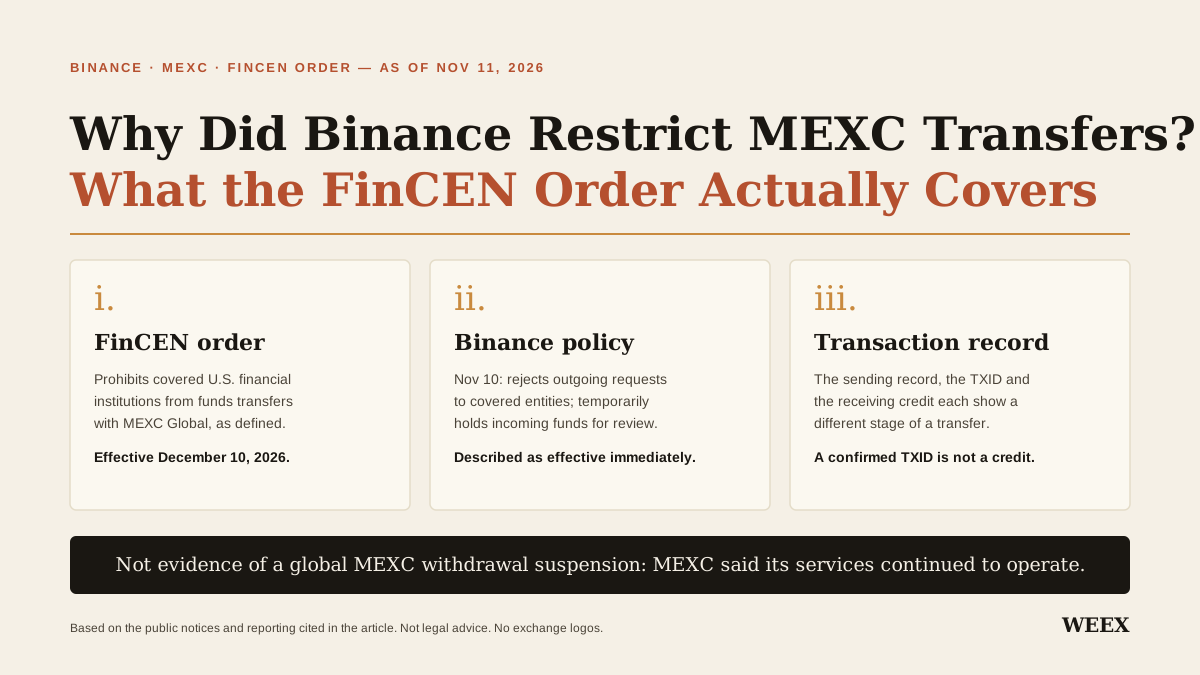
Why Did Binance Restrict MEXC Transfers? What the FinCEN Order Actually Covers
Find out why Binance restricted MEXC transfers, when the FinCEN order takes effect, and what to check if your crypto deposit is held for review.
Why Did Binance Restrict MEXC Transfers? What the FinCEN Order Actually Covers
Find out why Binance restricted MEXC transfers, when the FinCEN order takes effect, and what to check if your crypto deposit is held for review.
Pump.fun Data Review: Why the Current Meme Market Has Become a 'Harvesting Game'?

As Protocols Move Back to the Mainnet, How Does Ethereum's Value Logic Change?

What Is Elysium Crypto? The Hyperliquid Layer 2, Gas Fees, and Token Confusion Explained
Learn what Elysium is, why it uses HYPE for gas, how KNTQ buybacks are designed, and how to distinguish bridge TVL from actual DeFi activity.

From Sidechains to zk-Rollups: Tacit Chain Aims to Redefine Payments with Default Privacy
Booz Allen Switches to NVIDIA's Nemotron Large Model

Deutsche Bank launches crypto custody for Bitcoin, Ethereum, stablecoins
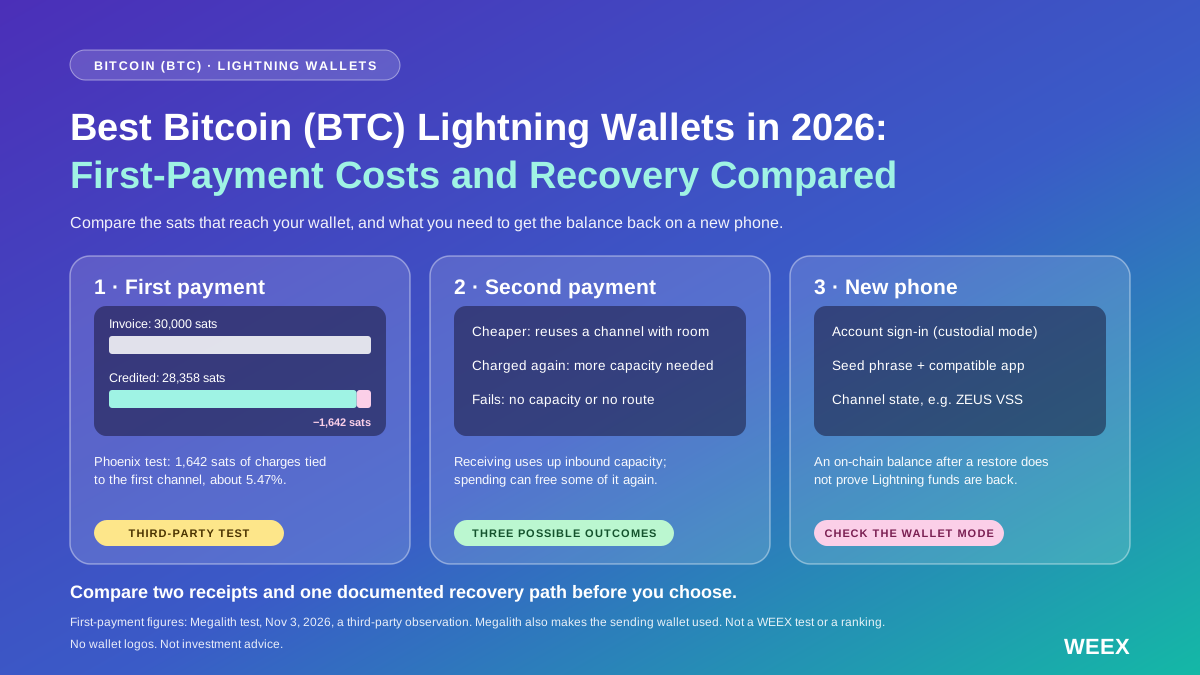
Best Bitcoin (BTC) Lightning Wallets in 2026: First-Payment Costs and Recovery Compared
Key Takeaways Lightning Network wallets enable fast and cost-effective Bitcoin transactions by using off-chain channels. A variety of…

Banqi Partners with MiniMax, OSL, and Animoca Brands to Host VIP Connects, Focusing on AI and Payment Integration
Decrypt Becomes First News Publisher to Offer Perps Trading, Powered by Solana's Phoenix
How Far Can AI Trading Go Amid the Anti-Data Center Wave? It Depends on GPU Leasing Prices
XRPL lending protocol gains validator support as vault vote advances
Tech Veteran: Anthropic IPO Will Be the Peak of AI Market in US Stocks, Will 'Aggressively Buy Chinese AI' If Conditions Allow
Moody's Projects Global Credit Deterioration by 2027 and Warns of the Impact of Rates and AI
CPI Higher Than Expected in the U.S.: What It Means for Investors
Latest articles


Latest coin listings on WEEX


