
Acala and Karura Propose to Sunset on February 10, 2027, Most Early Polkadot Parachains Are 'Difficult Brothers'

 Prefer us on Google



On November 11, the Acala team officially submitted the on-chain governance proposal Referendum #195, proposing an orderly shutdown (sunset) of the Acala network on Polkadot. At the same time, its sister chain Karura on Kusama also initiated the corresponding Referendum #137. If both votes pass, the two chains will stop block production on February 10, 2027, ending nearly seven years of operation. In an open letter to the community, the team clearly stated that the reason is the persistent lack of liquidity depth in the DeFi ecosystem of Polkadot and Kusama, further dispersed by the multi-parachain structure, with operating costs exceeding revenues, making continued maintenance unsustainable.
According to the proposal, if approved, users must withdraw external assets, including DOT, KSM, and USDT, USDC, etc., that entered through cross-chain bridges, by February 10, 2027. Liquid staking products have an earlier deadline: LDOT bound to validators must begin unlocking by December 16, 2026, ordinary LDOT must apply for unbinding by January 12, 2027, and LKSM must complete unbinding by February 2, 2027. The native tokens ACA and KAR cannot be withdrawn across chains and will remain permanently on their respective chains. The team promises to continue operating collators, RPC nodes, and maintain valid coretime before the deadlines to ensure smooth exit channels; after the deadlines, they will do their best to return remaining external assets to the corresponding addresses on the Polkadot or Kusama Asset Hub, but no full guarantee will be made, and the external assets in the treasury are planned to be donated to the corresponding relay chain treasury. The voting is still ongoing and is a signal vote, with the final execution depending on the holders' willingness.
Looking back at the five winners of the first Polkadot parachain auction in 2021—Acala, Moonbeam, Astar, Parallel Finance, and Clover—most have now effectively exited or fallen into stagnation. Moonbeam officially stopped block production around July 31, 2026, and migrated its token GLMR to Base; Parallel Finance has gradually shut down its products on Polkadot and Kusama after experiencing security incidents, and its on-chain infrastructure is no longer operating normally, requiring users to manually check balances through legacy interfaces; Clover has also transformed or left its original parachain identity. Currently, among the first auction winners, Astar is the only one actively maintaining and continuously upgrading its runtime.
The core goal of Polkadot's inception was to address the challenges of scalability, interoperability, and security that the blockchain ecosystem faced at the time. Single chains like Ethereum had bottlenecks in throughput, cross-chain relied on centralized bridges or complex relays, and security was difficult to guarantee uniformly. However, over time, the high barriers and capital lock-in brought by the auction model, fragmented ecological liquidity, and intensified external competition have made it difficult for many parachains to form a market with sufficient depth. Now Polkadot has shifted to the Agile Coretime model, selling block space in a more flexible manner and promoting architectural upgrades like JAM, but the successive exits of early flagship projects have prompted the outside world to re-examine the challenges of this multi-chain vision in practice.
-- Price
This content is provided for general informational purposes only and doesn't constitute financial, investment, legal, or tax advice. Any events, rewards, online promotions, or related information mentioned herein should not be considered a recommendation, solicitation, or invitation to purchase, sell, trade, or otherwise deal in any crypto assets. Crypto assets are highly volatile and may result in loss. The availability of WEEX services, products, and related events may vary by region. You are responsible for ensuring that your participation is in accordance with applicable local laws and regulations.
You may also like

Acala and Karura Plan to Cease Operations on February 10, 2027

Shiba Inu Profile Update: Kusama Changes Bio and Sparks Community
Expectations Rise for Kusama Announcement in Shiba Inu Community
Claims of Connection Between Shytoshi Kusama and Charlie Lee Unverified
Shiba Inu's Official Account Shares Third-Party Meme Tokens

Former Cointelegraph CEO Joins Phase as Co-Founder and CEO
Alta raises $47.5M for blockchain backed by crypto skeptic Jack Zhang

Decrypt Becomes First News Publisher to Offer Perps Trading, Powered by Solana's Phoenix
How Far Can AI Trading Go Amid the Anti-Data Center Wave? It Depends on GPU Leasing Prices
XRPL lending protocol gains validator support as vault vote advances

Tech Veteran: Anthropic IPO Will Be the Peak of AI Market in US Stocks, Will 'Aggressively Buy Chinese AI' If Conditions Allow

Moody's Projects Global Credit Deterioration by 2027 and Warns of the Impact of Rates and AI

CPI Higher Than Expected in the U.S.: What It Means for Investors

EWY ETF Volatility: Semiconductor Concentration, Rebound, and Fund-Flow Risks

AI Agents Do More Than Just Place Orders: The Next Entrepreneurial Opportunity Lies in Matching and Trust

Exodus Reports $8.3M Quarterly Loss as Wallet Platform Expands Payments Business
USAR Stock: Rare-Earth Commercialization, Quarterly Losses, and Funding Risks

Hims & Hers (HIMS) Falls After Earnings: Margins, Subscribers, and Guidance

IWM ETF Outlook: Small-Cap Rebound, Fund Positioning, and Credit Risk
SOXL Sell-Off and Rebound: 3x Leverage, Fund Flows, and Semiconductor Risk

Something strange is happening with Bitcoin. It is neither digital gold nor a tech company for Wall Street

TQQQ Outlook: Triple-Leverage Swings, Rebound Potential, and Decay Risk

US card debt hits $1.29 trillion as Bitcoin loans expose a collateral divide
QQQ Outlook: Tech Sell-Off, Rebound, and Nvidia Earnings

FTX’s former Anthropic stake could now be worth over $30 billion

Former Polychain President Launches Venture to Create a Tradable Index for U.S. Housing Prices
How Much CPO Demand Will NVIDIA's Rubin Ultra Generate? Bernstein: Optical Value of Single Pod Increases Fivefold
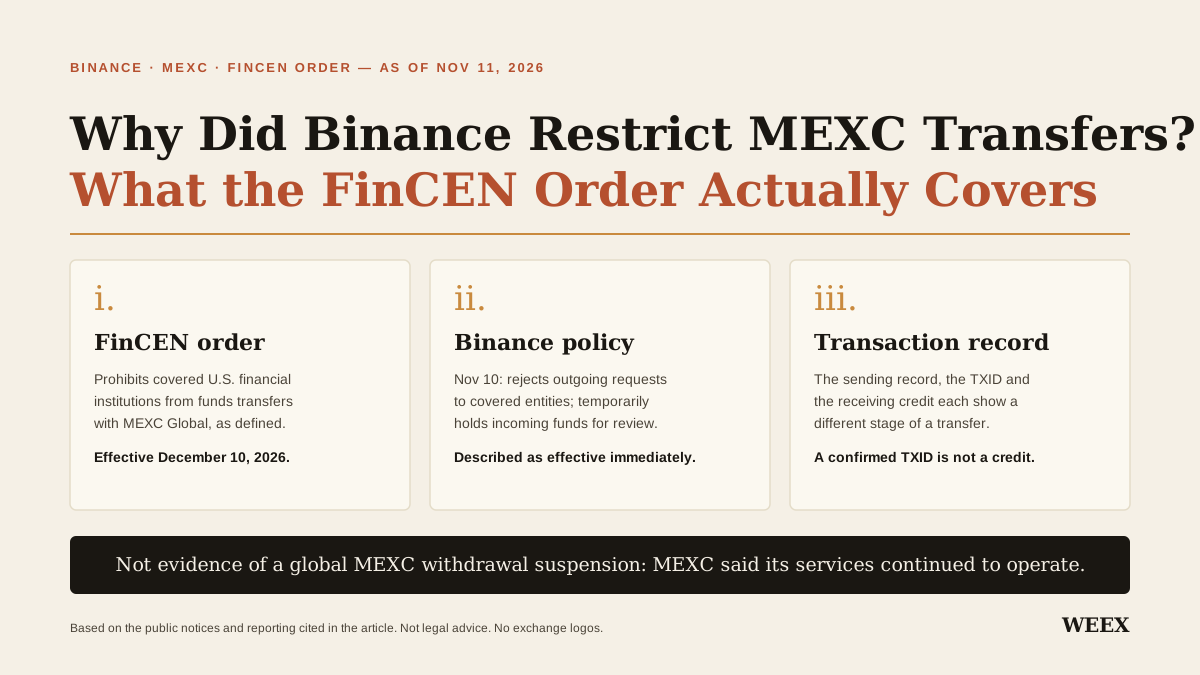
Why Did Binance Restrict MEXC Transfers? What the FinCEN Order Actually Covers
Find out why Binance restricted MEXC transfers, when the FinCEN order takes effect, and what to check if your crypto deposit is held for review.
Why Did Binance Restrict MEXC Transfers? What the FinCEN Order Actually Covers
Find out why Binance restricted MEXC transfers, when the FinCEN order takes effect, and what to check if your crypto deposit is held for review.
Pump.fun Data Review: Why the Current Meme Market Has Become a 'Harvesting Game'?
Acala and Karura Plan to Cease Operations on February 10, 2027
Shiba Inu Profile Update: Kusama Changes Bio and Sparks Community
Expectations Rise for Kusama Announcement in Shiba Inu Community
Claims of Connection Between Shytoshi Kusama and Charlie Lee Unverified
Shiba Inu's Official Account Shares Third-Party Meme Tokens
Former Cointelegraph CEO Joins Phase as Co-Founder and CEO
Latest articles


Latest coin listings on WEEX


