
Pi Network rolls out 4 developer updates ahead of November summit

 Prefer us on Google


Pi Network has released four updates covering app development, token tracking, AI-assisted software packaging, and identity verification ahead of its Nov. 17--19 Ecosystem Summit.
Summary
- Developers can manage app settings through a redesigned portal with a dedicated configuration section.
- Pi BlockExplorer now displays historical prices for Launchpad Testnet tokens, including SLICE against Test-Pi.
- SoloHost's new AI skill helps developers prepare existing applications for distribution through Pi Desktop.
- PiVerify has added face uniqueness and further liveness checks for businesses using its identity services.
Pi Network's Oct. 29 announcement describes changes for developers building Pi applications, software publishers using SoloHost and businesses seeking identity checks for their customers.
The release follows its first Ecosystem Summit announcement, which outlined three days of online presentations, application demonstrations and discussions with developers. New platform announcements and details of another hackathon are scheduled for the event.
Pi Network reorganizes app setup for developers
Inside the Developer Portal, a dedicated App Configuration section has replaced the previous onboarding checklist. Developers can manage domains, API keys, app wallets, and privacy information from the same area.
Navigation now provides clearer routes to services including Pi Sign-In, Ecosystem Listing, PiNet and the Pi Ad Network, according to the team.
The changes build on a September developer release that introduced local storage for selected Pi Browser applications, access to app-specific staking data and file-sharing functions.
For approved applications, local storage lets preferences and session information remain on a user's device. Pi said the data stays off its servers, although it remains tied to the particular account and device and does not automatically follow users across devices.
The September release placed documentation on a single Pi-owned domain, bringing together resources previously spread across SDK documentation, a community guide and GitHub. Its guidance covers registration, sandbox development, authentication, payments, and preparing an application for Mainnet.
SoloHost adds AI-assisted app packaging
For developers bringing existing software to Pi Desktop, the new SoloHost skill accepts a public Docker image and helps prepare the files needed to submit an application.
Supported coding assistants include Claude Code, Cursor, and Codex. After asking which capabilities the application needs, the assistant generates and validates two configuration files, according to Pi.
The packaging feature follows Desktop 0.6.4, which removed the need to configure a home router when accessing supported SoloHost applications remotely.
In its Oct. 22 release notes, Pi explained that users can reach applications running on their computers through Pi Browser on their phones. Remote access remains optional, and existing users can select "Reconnect" to move to the new connection method.
The desktop release introduced checks on application access to files and networks. Pi said checks run when software is published, before installation, and whenever it starts, helping restrict access to unrelated computer files, other applications, and Pi Node data.
Launchpad price charts cover Testnet assets
Pi BlockExplorer's price-history feature covers Launchpad Testnet tokens such as SLICE, with values shown against Test-Pi. Public access does not require a Pi account or Pi Browser.
The team explicitly states that these experimental tokens "will never go on Mainnet." Future Mainnet tokens are expected to appear in the same interface once that functionality is released.
Under the Launchpad model described in the announcement, Pi proceeds from token launches go into a liquidity pool paired with the ecosystem token, rather than being collected by the issuing project.
Pi's October summit announcement reports more than 300 Mainnet applications, alongside over 420,000 Nodes and 18.1 million fully KYC-verified users.
As crypto.news previously examined, the app count does not establish how many people regularly use each product or complete payments. The latest developer announcement provides no active-developer total or comparable series showing app growth.
-- Price
PiVerify expands checks for outside businesses
PiVerify's new face uniqueness checks are designed to help businesses detect potentially duplicate identities. Further liveness checks allow clients to request verification after a customer's initial identity check.
According to the team, third-party businesses pay in Pi to use the service, which draws on verification technology developed for the network's KYC system.
The Oct. 29 announcement does not specify how participating businesses handle biometric records, how long information is retained, or which customer data they receive.
During November's summit, Pi plans to present company and community applications, demonstrate developer tools and hold discussions between builders and the Core Team. Its event announcement says hackathon details will be introduced during the sessions.
This content is provided for general informational purposes only and doesn't constitute financial, investment, legal, or tax advice. Any events, rewards, online promotions, or related information mentioned herein should not be considered a recommendation, solicitation, or invitation to purchase, sell, trade, or otherwise deal in any crypto assets. Crypto assets are highly volatile and may result in loss. The availability of WEEX services, products, and related events may vary by region. You are responsible for ensuring that your participation is in accordance with applicable local laws and regulations.
You may also like
Hedera Council adds Apex Group, servicer of $3.5T in assets
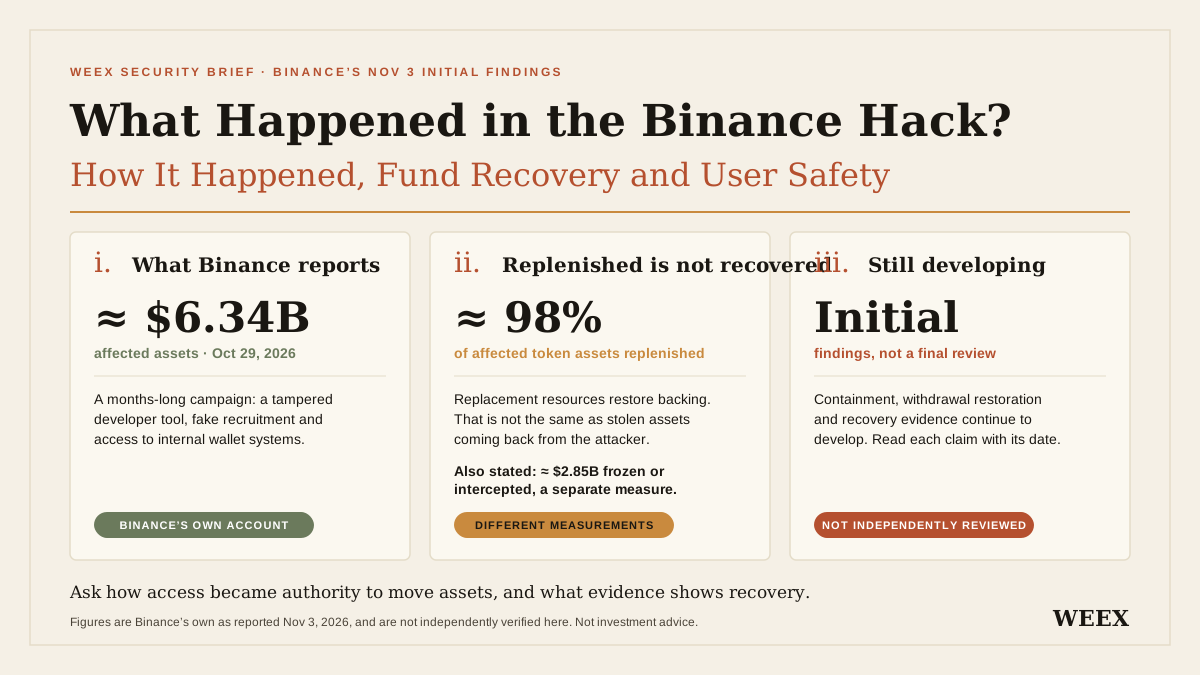
What Happened in the Binance Hack? How It Happened, Fund Recovery and User Safety
What happened in the Binance hack? Review the attack timeline, latest fund replenishment, recovery limits and practical steps to protect your account.

Tata Power Plans to Sign Agreement with Four States Allowing Power Prices to Be Linked to Coal Costs

AI Agents Do More Than Just Place Orders: The Next Entrepreneurial Opportunity Lies in Matching and Trust

NVIDIA Scandal Shakes the Internet! How Should Cryptocurrency Be Divided After a Divorce with a Tech Tycoon?

Bundesbank President Says Economic Recovery Faster Than Expected, Structural Reforms Needed

Immutable Chain's Transition to OP Stack: What Changes for Users
Ledger CEO faces backlash after saying everybody will be hacked at some point

WEEX 11.11 Shopping Fest: Buy BTC and Unlock Up to 888 USDT in Rewards

NEAR AI Discloses SGLang Security Incident and Revokes Exposed API Keys

The Art of Trading: How They Profit from Arbitraging USDE Stocks

VARA Is Not a Panacea: Dubai's Crypto Payments Still Depend on the Central Bank

a16z Frontier Partner: Agents Should Rebuild Uber-like Transaction Networks
Poland's Parliament Votes 240-202 To Let Officials Freeze Crypto Before Court Review

WEEX P2P now supports ILS, BHD, OMR & QAR —Merchant Recruitment Now Open

Cryptocurrency Security Checklist: Four Lessons from Phemex Safety Hub Vol. 05–08
Ondo Claims $4B in Tokenized Assets as RWA Market Gains Institutional Depth

DTCC Launches Tokenization Service: What Can Investors Actually Do?

The catch in recovering a hacked crypto wallet: the thief may still have a key

Bitcoin Remains Strong: Why $76,000 is the Level That Matters Now
Peter Schiff Criticizes Strategy's Bitcoin Purchases
iPhone Attack Kit 'DarkSword' Suspected of Being Misused for Cryptocurrency Theft, Bitquery Identifies Approximately $4.06 Million in Stolen Funds

Financial and Political Crisis in Paraguay: How the Ueno Bank Explosion Triggered the President's Resignation

OpenAI Releases National Community Covenant and Computing Park Policy Blueprint

GitBook Security Incident Review, Attack Targeting Trade.xyz

Post-Quantum Era Consensus Layer Divergence: Ethereum Maintains Decentralization, Monad Prioritizes Speed

The Ghost Behind the Screen: Unveiling the Secret World of North Korean Hackers Lazarus
Bitcoin Miners Turn to AI: Escaping the Crypto Cycle, but Entering New Turbulence
Decoding Variational: How a No-Order-Book Exchange Became the Dragon Behind Hyperliquid?
Creators Speak | The Biggest Risk in the Crypto Industry is Thinking It's Safe
Hedera Council adds Apex Group, servicer of $3.5T in assets
What Happened in the Binance Hack? How It Happened, Fund Recovery and User Safety
What happened in the Binance hack? Review the attack timeline, latest fund replenishment, recovery limits and practical steps to protect your account.
Tata Power Plans to Sign Agreement with Four States Allowing Power Prices to Be Linked to Coal Costs
AI Agents Do More Than Just Place Orders: The Next Entrepreneurial Opportunity Lies in Matching and Trust
NVIDIA Scandal Shakes the Internet! How Should Cryptocurrency Be Divided After a Divorce with a Tech Tycoon?
Bundesbank President Says Economic Recovery Faster Than Expected, Structural Reforms Needed
Latest articles





Latest coin listings on WEEX


