
Philippines SEC Flags dYdX and Six Crypto Platforms as Unauthorized

 Prefer us on Google


Key Takeaways:
- The Philippine SEC has flagged dYdX and six other crypto platforms for unauthorized operations.
- Promoters of these platforms risk fines of up to 5 million Philippine pesos or up to 21 years in prison.
- The SEC’s crackdown reflects a shift to stricter enforcement on crypto activities without authorization.
- Several major crypto exchanges, including Binance, have faced access restrictions in the Philippines.
- Compliant firms like PDAX are continuing to offer new crypto products.
WEEX Crypto News, 2026-04-21 15:41:12
SEC’s Alert on Unauthorized Crypto Platforms
The Philippine Securities and Exchange Commission (SEC) has issued a stern warning regarding investments in certain crypto platforms, identifying dYdX, Aevo, gTrade, Pacifica, Orderly, Deriv, and Ostium as entities operating without legal authorization. These platforms, alleged by the SEC to offer investment opportunities promising returns, are not registered under the country’s crypto-asset service provider (CASP) framework. This regulatory framework mandates firms to obtain necessary licenses and comply with capital and operational standards. Violators of these regulations can face severe penalties, including fines up to 5 million Philippine pesos (approximately $89,000) and imprisonment for up to 21 years, underscoring the legal risks tied to unauthorized crypto activities.
Increasing Scrutiny of Crypto Operations
Philippine regulators are heightening scrutiny on the crypto sector, transitioning from mere warnings to enacting more restrictive measures. December 2025 witnessed a robust regulatory move with Coinbase and Gemini being blocked due to non-compliance concerns regarding licensing. This is part of a broader effort to safeguard Filipino investors from the risks posed by unregistered crypto entities. Digital platforms found in violation face removal orders which include directives for app stores to eliminate non-compliant trading apps from consumer devices.
Global Exchanges in Regulatory Crosshairs
The stance on unauthorized crypto operations has been unwavering, expanding to major exchanges like OKX, Bybit, KuCoin, and Kraken by August 2025, each flagged for offering services without the requisite registration. The SEC warns that these activities could significantly endanger investor interests, highlighting that even prominent exchanges are not immune to regulatory scrutiny if found lacking authorization. The Philippine regulatory environment is increasingly challenging for operators, pushing exchanges to align closely with compliance standards or face operational barriers.
-- Price
Compliant Entities Innovate Amid Crackdown
Amid the stringent regulatory environment, entities adhering to the CASP framework continue to innovate. In 2025, PDAX collaborated with Toku to introduce stablecoin salary payouts, showcasing a compliant effort to merge digital assets into practical financial solutions. Furthermore, digital bank GoTyme’s partnership with Alpaca demonstrates ongoing developments, allowing Filipinos to engage with digital currencies securely within its application. These actions by compliant firms highlight a dual landscape where regulation fosters innovation, provided entities conform to legal expectations.
Frequently Asked Questions
What penalties do unauthorized crypto platforms face in the Philippines?
Unauthorized platforms face severe penalties under Philippine securities law, including fines up to 5 million Philippine pesos and imprisonment for up to 21 years.
Why did the Philippine SEC flag dYdX and other platforms?
The SEC flagged these platforms due to their lack of registration and authorization to offer investments under the CASP framework, posing risks to investors.
How is the regulatory environment changing for crypto operations in the Philippines?
The regulatory environment is shifting towards stricter enforcement, transitioning from warnings to access restrictions for non-compliant platforms.
Are compliant crypto firms still able to operate in the Philippines?
Yes, compliant firms like PDAX and GoTyme are continuing to offer innovative crypto products, showcasing how adherence to regulations can facilitate operations.
What implications does the crackdown have for major crypto exchanges?
Major exchanges face challenges if they operate without authorization, as seen with Binance, OKX, Bybit, KuCoin, and Kraken, reflecting heightened regulatory scrutiny.
This content is provided for general informational purposes only and doesn't constitute financial, investment, legal, or tax advice. Any events, rewards, online promotions, or related information mentioned herein should not be considered a recommendation, solicitation, or invitation to purchase, sell, trade, or otherwise deal in any crypto assets. Crypto assets are highly volatile and may result in loss. The availability of WEEX services, products, and related events may vary by region. You are responsible for ensuring that your participation is in accordance with applicable local laws and regulations.
You may also like

Rates Down 25%, Buybacks Up 7%, Will Derive's 'Price-for-Volume' Market Pay Off?

Connecticut Attorney General Issues Crypto Warning, Investors Lose $200,000
The Philippines SEC issues an investor warning, reminding the public not to invest in unregistered cryptocurrency trading platforms

The rivers and lakes are no more, Li Lin returns
How Far Can AI Trading Go Amid the Anti-Data Center Wave? It Depends on GPU Leasing Prices
XRPL lending protocol gains validator support as vault vote advances
Tech Veteran: Anthropic IPO Will Be the Peak of AI Market in US Stocks, Will 'Aggressively Buy Chinese AI' If Conditions Allow

Moody's Projects Global Credit Deterioration by 2027 and Warns of the Impact of Rates and AI

CPI Higher Than Expected in the U.S.: What It Means for Investors

EWY ETF Volatility: Semiconductor Concentration, Rebound, and Fund-Flow Risks

AI Agents Do More Than Just Place Orders: The Next Entrepreneurial Opportunity Lies in Matching and Trust

Exodus Reports $8.3M Quarterly Loss as Wallet Platform Expands Payments Business

USAR Stock: Rare-Earth Commercialization, Quarterly Losses, and Funding Risks

Hims & Hers (HIMS) Falls After Earnings: Margins, Subscribers, and Guidance

IWM ETF Outlook: Small-Cap Rebound, Fund Positioning, and Credit Risk
SOXL Sell-Off and Rebound: 3x Leverage, Fund Flows, and Semiconductor Risk

Something strange is happening with Bitcoin. It is neither digital gold nor a tech company for Wall Street

TQQQ Outlook: Triple-Leverage Swings, Rebound Potential, and Decay Risk

US card debt hits $1.29 trillion as Bitcoin loans expose a collateral divide
QQQ Outlook: Tech Sell-Off, Rebound, and Nvidia Earnings

FTX’s former Anthropic stake could now be worth over $30 billion

Former Polychain President Launches Venture to Create a Tradable Index for U.S. Housing Prices
How Much CPO Demand Will NVIDIA's Rubin Ultra Generate? Bernstein: Optical Value of Single Pod Increases Fivefold
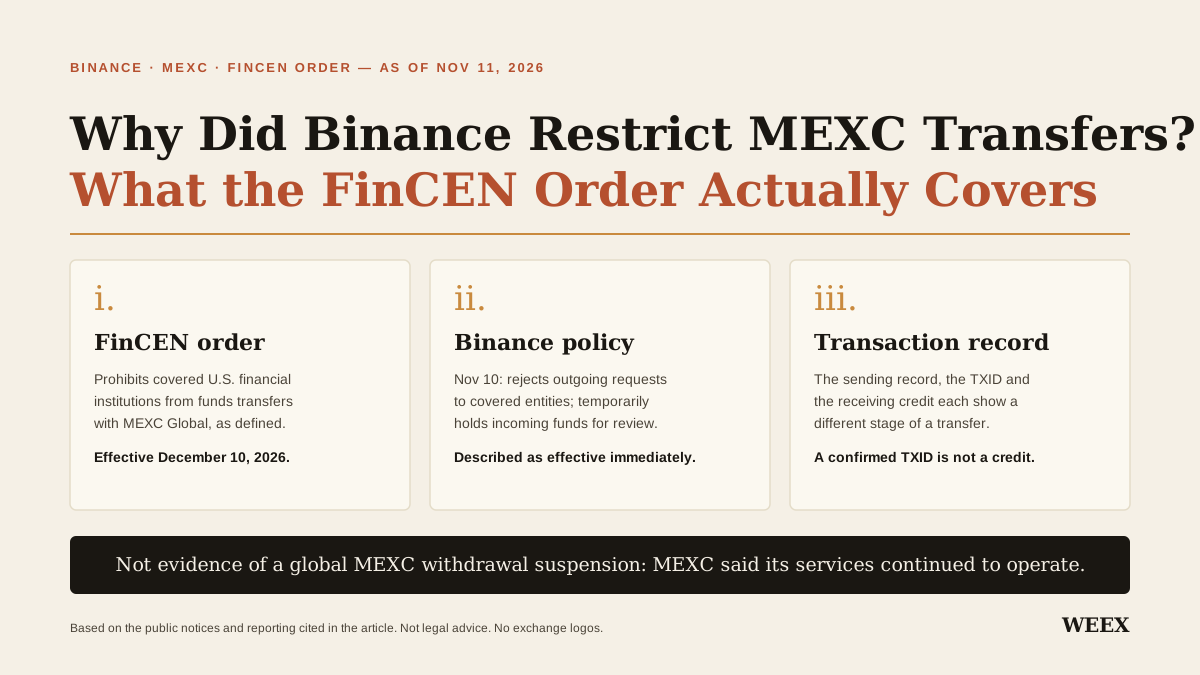
Why Did Binance Restrict MEXC Transfers? What the FinCEN Order Actually Covers
Find out why Binance restricted MEXC transfers, when the FinCEN order takes effect, and what to check if your crypto deposit is held for review.
Why Did Binance Restrict MEXC Transfers? What the FinCEN Order Actually Covers
Find out why Binance restricted MEXC transfers, when the FinCEN order takes effect, and what to check if your crypto deposit is held for review.
Pump.fun Data Review: Why the Current Meme Market Has Become a 'Harvesting Game'?

As Protocols Move Back to the Mainnet, How Does Ethereum's Value Logic Change?

What Is Elysium Crypto? The Hyperliquid Layer 2, Gas Fees, and Token Confusion Explained
Learn what Elysium is, why it uses HYPE for gas, how KNTQ buybacks are designed, and how to distinguish bridge TVL from actual DeFi activity.

From Sidechains to zk-Rollups: Tacit Chain Aims to Redefine Payments with Default Privacy
Booz Allen Switches to NVIDIA's Nemotron Large Model
Rates Down 25%, Buybacks Up 7%, Will Derive's 'Price-for-Volume' Market Pay Off?
Connecticut Attorney General Issues Crypto Warning, Investors Lose $200,000
The Philippines SEC issues an investor warning, reminding the public not to invest in unregistered cryptocurrency trading platforms
The rivers and lakes are no more, Li Lin returns
How Far Can AI Trading Go Amid the Anti-Data Center Wave? It Depends on GPU Leasing Prices
XRPL lending protocol gains validator support as vault vote advances
Latest articles



Latest coin listings on WEEX


