
Mozilla Adds Ad Blocking to Firefox for iOS, Excluding Search Ads

 Prefer us on Google


Mozilla launches an optional ad blocker in Firefox for iOS, covering advertising networks and trackers, but excluding search engine ads and sponsored content, amid an advertising war and the rise of AI.
Limited Blocking: The feature uses a list based on EasyList and covers third-party ads, trackers, and pop-ups, but does not block Google and Bing ads in search results.**
Gradual Rollout: The tool comes enabled by default and is being gradually rolled out to Firefox users on iOS.**
Context of War: The blocking adds to the dispute against Chrome and AI advertising, according to a report from Adblock Plus.**
Mozilla announced on Monday that Firefox for iOS will incorporate an optional ad blocker, a feature currently in experimental phase and being progressively distributed among users. The tool, which is disabled by default, uses a filter list based on EasyList to block ads before they load in the browser, as reported by the organization through its official channels.
The blocking will cover third-party advertising networks, advertising-related trackers, ads served by the websites themselves, as well as pop-ups and overlays. However, Mozilla made it clear that it will not block ads appearing in search engine results like Google and Bing, nor the sponsored content displayed on the Firefox homepage or in the New Tab page, The Register indicated.
This limitation has generated some controversy, especially since a substantial portion of Mozilla's revenue comes from Google, as mentioned in The Register's report. Although the company claims that search ads are not technically blocked due to limitations of the current filter list, the decision to exclude them has raised eyebrows in the user community that expected a more comprehensive solution.
The company explained in its FAQs that "Firefox blocks many third-party ads and advertising infrastructure, but not all ads can be blocked," adding that "some websites serve ads in ways that are not covered by the current filter list." This statement acknowledges that users may find the tool less effective than alternatives like Wipr, Ghostery, or other dedicated ad-blocking solutions.
The blocker is activated with just a toggle in the app, which represents an advantage in terms of convenience for iPhone and iPad users who prefer to avoid complex settings. With this measure, Mozilla joins a trend already adopted by other browsers for iOS, such as Brave, which boasts integrated privacy services and ad-blocking features.
Mozilla's move comes at a time when the battle for ad blocking in the mobile ecosystem has intensified, especially with Google Chrome's attempts to hinder the functioning of these extensions. The Register highlighted that Chrome's crackdown on ad blockers, known as Manifest V3, is already available in beta, prompting many users to seek alternatives like Firefox, which has gained millions of new users according to EU browser choice regulations.
However, Mozilla's implementation is not pioneering in the sector, and while it offers an integrated option that simplifies the user's life, its limited scope may disappoint those expecting more robust protection. According to The Register's analysis, the lack of blocking in search results not only responds to technical issues but also protects a key revenue source for the organization, given that Google pays to be the default search engine in Firefox.
Mozilla's decision also raises questions about the future of ad blocking in browsers, especially in a context where artificial intelligence is beginning to revolutionize the advertising industry. A report from Adblock Plus published on the same day warned that advertising in conversational AI systems is likely on the way, changing how ads are delivered and making them harder for users to recognize.
The Adblock Plus report, cited by The Register, notes that ads generated by conversational AI can be created on the fly, posing a technical challenge for traditional blockers based on static filter lists. This scenario could render tools like the new Firefox functionality for iOS obsolete quickly, even before they achieve mass adoption among users.
Mozilla, for its part, has not commented on how it plans to tackle this new wave of smart advertising, but its bet on a list based on EasyList suggests that its approach is conservative and reactive. The EasyList is one of the most widely used lists in the world, but its constant updating depends on the community and changes in advertising techniques.
The Register's report concludes that Mozilla's foray into iOS ad blocking seems like a remnant of a kinder era in the relationship between users and digital advertising. Privacy advocates are concerned that the next battleground will not be against banners or pop-ups, but against ads that adapt to the context of a conversation, which will require much more sophisticated solutions.
Despite these limitations, Mozilla's initiative reinforces its commitment to user privacy and autonomy, values that have been central to its history as a non-profit organization. With this launch, Firefox positions itself as a serious option for those seeking a mobile browser that respects their browsing experience.
The community of developers and cryptocurrency and technology users has reacted with moderate enthusiasm, recognizing the step as positive but insufficient. In specialized forums, several users highlight that the native integration of the blocker in Firefox for iOS is an advancement compared to browsers like Safari, which requires third-party extensions to achieve similar results.
On the other hand, critics point out that Mozilla's coexistence with Google, its main funder, limits its ability to make radically independent decisions. The fact that ads in Google search results are exempt seems to show that the organization is unwilling to bite the hand that feeds it, although technically there are ways to block them.
Meanwhile, the advertising industry continues to evolve, and with the arrival of conversational AI, blocking solutions will need to reinvent themselves. Mozilla has taken the first step in the iOS arena, but the future of ad blocking seems to depend on companies' ability to adapt to emerging advertising technologies that blur the line between content and promotion.
The report also highlights that, despite Chrome's efforts to close its extension platform, ad blocking is still alive and well, driven by user demand. In this sense, Mozilla's decision to implement this feature on iOS is a sign that tech companies are listening to consumers' privacy needs, even if they do so amid ongoing trade tensions.
-- Price
This content is provided for general informational purposes only and doesn't constitute financial, investment, legal, or tax advice. Any events, rewards, online promotions, or related information mentioned herein should not be considered a recommendation, solicitation, or invitation to purchase, sell, trade, or otherwise deal in any crypto assets. Crypto assets are highly volatile and may result in loss. The availability of WEEX services, products, and related events may vary by region. You are responsible for ensuring that your participation is in accordance with applicable local laws and regulations.
You may also like

Hedera Council adds Apex Group, servicer of $3.5T in assets
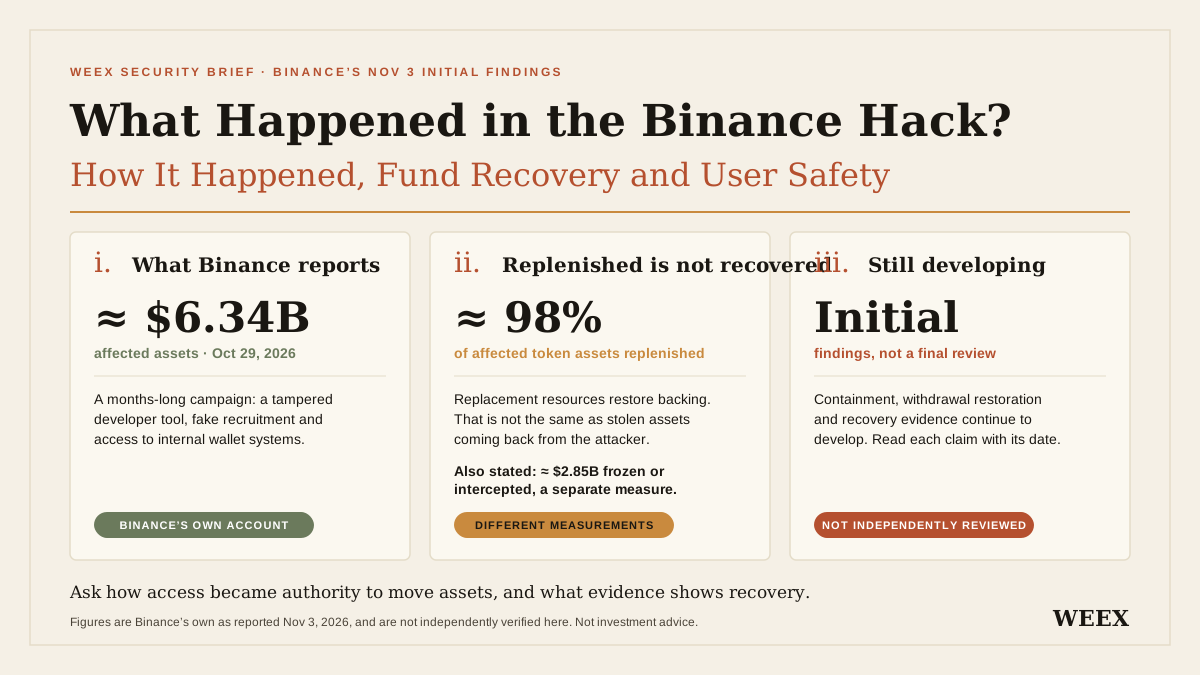
What Happened in the Binance Hack? How It Happened, Fund Recovery and User Safety
What happened in the Binance hack? Review the attack timeline, latest fund replenishment, recovery limits and practical steps to protect your account.

Tata Power Plans to Sign Agreement with Four States Allowing Power Prices to Be Linked to Coal Costs

AI Agents Do More Than Just Place Orders: The Next Entrepreneurial Opportunity Lies in Matching and Trust

NVIDIA Scandal Shakes the Internet! How Should Cryptocurrency Be Divided After a Divorce with a Tech Tycoon?

Bundesbank President Says Economic Recovery Faster Than Expected, Structural Reforms Needed

Immutable Chain's Transition to OP Stack: What Changes for Users
Ledger CEO faces backlash after saying everybody will be hacked at some point

WEEX 11.11 Shopping Fest: Buy BTC and Unlock Up to 888 USDT in Rewards

NEAR AI Discloses SGLang Security Incident and Revokes Exposed API Keys

The Art of Trading: How They Profit from Arbitraging USDE Stocks

VARA Is Not a Panacea: Dubai's Crypto Payments Still Depend on the Central Bank

a16z Frontier Partner: Agents Should Rebuild Uber-like Transaction Networks

Poland's Parliament Votes 240-202 To Let Officials Freeze Crypto Before Court Review

WEEX P2P now supports ILS, BHD, OMR & QAR —Merchant Recruitment Now Open

Cryptocurrency Security Checklist: Four Lessons from Phemex Safety Hub Vol. 05–08

Ondo Claims $4B in Tokenized Assets as RWA Market Gains Institutional Depth

DTCC Launches Tokenization Service: What Can Investors Actually Do?

The catch in recovering a hacked crypto wallet: the thief may still have a key

Bitcoin Remains Strong: Why $76,000 is the Level That Matters Now
Peter Schiff Criticizes Strategy's Bitcoin Purchases

iPhone Attack Kit 'DarkSword' Suspected of Being Misused for Cryptocurrency Theft, Bitquery Identifies Approximately $4.06 Million in Stolen Funds

Financial and Political Crisis in Paraguay: How the Ueno Bank Explosion Triggered the President's Resignation

OpenAI Releases National Community Covenant and Computing Park Policy Blueprint

GitBook Security Incident Review, Attack Targeting Trade.xyz

Post-Quantum Era Consensus Layer Divergence: Ethereum Maintains Decentralization, Monad Prioritizes Speed

The Ghost Behind the Screen: Unveiling the Secret World of North Korean Hackers Lazarus

Bitcoin Miners Turn to AI: Escaping the Crypto Cycle, but Entering New Turbulence
Decoding Variational: How a No-Order-Book Exchange Became the Dragon Behind Hyperliquid?

Creators Speak | The Biggest Risk in the Crypto Industry is Thinking It's Safe
Hedera Council adds Apex Group, servicer of $3.5T in assets
What Happened in the Binance Hack? How It Happened, Fund Recovery and User Safety
What happened in the Binance hack? Review the attack timeline, latest fund replenishment, recovery limits and practical steps to protect your account.
Tata Power Plans to Sign Agreement with Four States Allowing Power Prices to Be Linked to Coal Costs
AI Agents Do More Than Just Place Orders: The Next Entrepreneurial Opportunity Lies in Matching and Trust
NVIDIA Scandal Shakes the Internet! How Should Cryptocurrency Be Divided After a Divorce with a Tech Tycoon?
Bundesbank President Says Economic Recovery Faster Than Expected, Structural Reforms Needed
Latest articles





Latest coin listings on WEEX


