
Management Before Capital: The Need for Agent-Specific Accounts

 Prefer us on Google




AI trading systems may be able to generate ideas. However, this does not mean they should have unlimited access to the underlying assets.
With AI, analyzing information, comparing scenarios, and converting suggested actions into trading themes has become easier. However, the most important question may not be how much an AI system can do, but how much it is allowed to do.
Persuasive recommendations and permission to trade are two different things. Placing orders and moving assets are also separate matters. Treating these as a single broad grant of access places undue emphasis on the AI's ability to make all decisions correctly.
A better starting principle is control before capital: defining the boundaries of authority before determining the funds available to the agent (if any).
Separating Ideas and Authority
Consider three possible roles for an AI trading agent. "Observe" involves reading information and explaining potential setups; "Propose" prepares actions for human review; and "Execute" places orders within pre-set rules.
Each role carries different risks. The agent does not need permission to explain themes. Full access to the account is not necessary to test limited strategies. Moreover, the ability to place orders does not justify the ability to transfer or withdraw assets.
These distinctions may sound fundamental, but they can easily be overlooked if the conversation focuses on what AI can do rather than what should be permitted.
Why Consider Agent-Specific Accounts?
As a design concept, agent-specific accounts can create boundaries between AI-driven activities and the user's broader holdings. Instead of assuming the agent operates on everything the user owns, the system starts from a narrower question: what resources and authority are needed for this specific task?
That boundary only makes sense if enforced operationally. A different label on the interface is not sufficient. The operational questions are crucial:
- Can users limit the capital available to the agent?
- Can the agent's actions be restricted to specific tasks?
- Which actions require human approval?
- Can access be temporarily suspended or revoked?
- Can users see what the agent has proposed, attempted, and completed?
These are questions that product design must answer, not claims about existing Phemex functionalities.
Good Management Should Not Depend on a Perfect Model
AI agents may act based on outdated information, misunderstand instructions, or encounter conditions that were not accounted for during design. Even a sound trading theme can become inappropriate if the premises change.
That is why explaining risks does not replace boundaries on authority. "Agents know their limits" is weaker than a system where those limits are explicit and enforceable.
Human oversight is important for the same reason. An agent may help a person evaluate opportunities, but the person should understand what authority is granted and when to intervene. Sometimes the correct output is a recommendation to "wait," sometimes it is a request for approval, and sometimes it is to do nothing.
-- Price
Principles Before Products
Agent-specific accounts are one way to think about safer AI-assisted trading. Their value completely depends on the details of how separation works, what authorities exist, how restrictions are enforced, and what happens if problems arise.
These details should be validated before someone presents this concept as a product feature.
At this point, this discussion is broader than any feature announcement: AI's capabilities should not imply unlimited asset authority. The stronger the agent becomes, the more clearly its management scope needs to be defined.
This content is provided for general informational purposes only and doesn't constitute financial, investment, legal, or tax advice. Any events, rewards, online promotions, or related information mentioned herein should not be considered a recommendation, solicitation, or invitation to purchase, sell, trade, or otherwise deal in any crypto assets. Crypto assets are highly volatile and may result in loss. The availability of WEEX services, products, and related events may vary by region. You are responsible for ensuring that your participation is in accordance with applicable local laws and regulations.
You may also like

White House Warns House Democrats That Investigative Actions May Constitute Crimes

Bitcoin Scam on Shaadi.com, User Solicited for a $500 Deposit
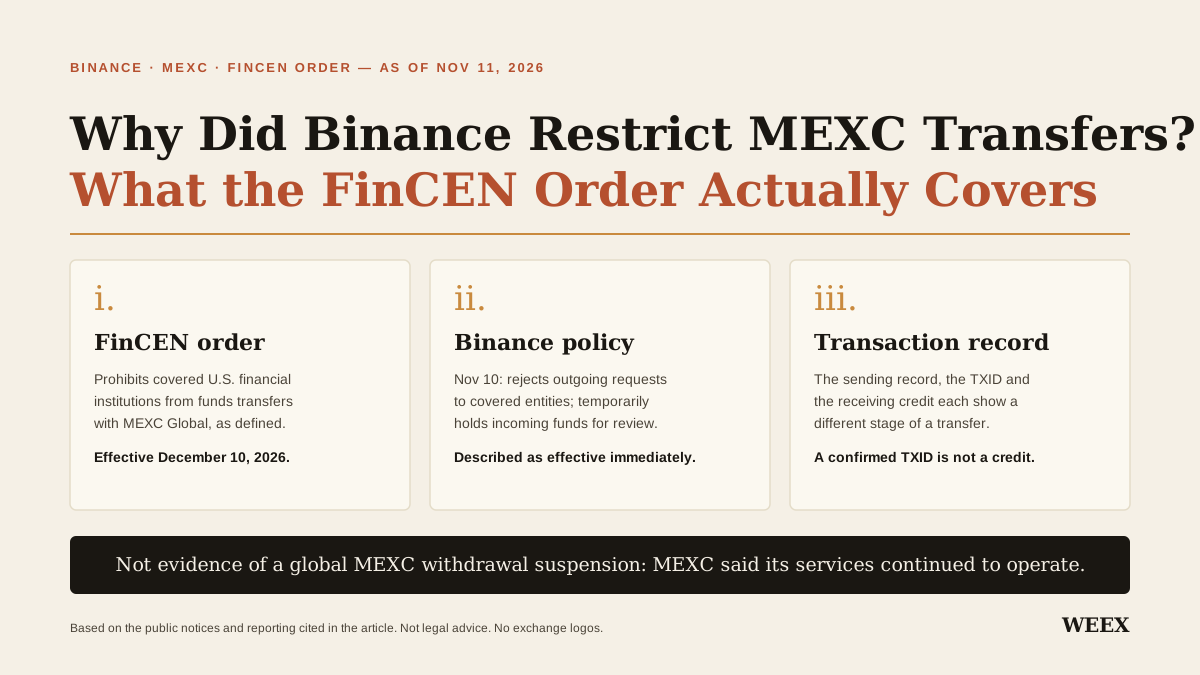
Why Did Binance Restrict MEXC Transfers? What the FinCEN Order Actually Covers
Find out why Binance restricted MEXC transfers, when the FinCEN order takes effect, and what to check if your crypto deposit is held for review.
Why Did Binance Restrict MEXC Transfers? What the FinCEN Order Actually Covers
Find out why Binance restricted MEXC transfers, when the FinCEN order takes effect, and what to check if your crypto deposit is held for review.

Head of Turkey's Banking Regulator Requests Resignation as Fund Scandal Investigation Expands

NVIDIA Scandal Shakes the Internet! How Should Cryptocurrency Be Divided After a Divorce with a Tech Tycoon?

Crypto ATM Fees: How Much Bitcoin (BTC) Do You Get for $100?
See how much Bitcoin $100 buys at a crypto ATM. Compare two sample quotes, calculate the all-in cost, and learn which fees not to count twice.

NEAR AI Discloses SGLang Security Incident and Revokes Exposed API Keys

Cash App Founder Bob Lee's Killer Sentenced to 16 Years to Life in Prison

New York Judge Rejects Novig Injunction, State Gambling Laws Apply to Its Market

Arcus Loses $2.23 Million Due to Accounting Flaw, Fully Reimbursed

Miami-Dade To Accept Bitcoin For Property Taxes
Cardano’s police evidence system could bring 1.5 million annual transactions
Coinbase, Kalshi, and Kraken Support CFTC in Court Dispute Over Perpetual Stock Contracts

Unauthorized Access to Gnosis Pay's Old Card System Leads to Customer Data Breach

Westpac's Cryptocurrency Payment Limit (A$10,000): What Changes on December 1, 2026

Meta Releases Muse Ember Model, Supporting 1 Million Token Context

Blockchain.com Adds Trading API for Institutional Crypto Execution

LNbits disables hosted Bitcoin services with no restart timeline

MEXC CEO Establishes Communication with FinCEN and Receives Confirmation

Trump Warns AI Company CEOs of Criminal Prosecution

Solana publishes 11 startup ideas spanning AI and housing futures

China unifies blockchain and AI filings as two old systems close
Zcash Wallet Zodl Launches Self-Hosted Server Integration OHTTP
Bitcoin traders face an eight-hour blind spot as Deribit prepares to delay key market data

Perpetual Futures Enter U.S. Stock Market Amid Wall Street Lawsuits

Circle Says It Froze $1.1B in USDC Linked to Binance Hack Investigation
After the US elections, Galaxy sees reduced chances for major crypto legislation
Ripple’s XRP Ledger developers propose fix for loan repayment rounding issues
Overview of Cryptocurrency Asset Regulation Series (13): Switzerland, Banking Licenses, Stablecoins, and On-Chain Securities
White House Warns House Democrats That Investigative Actions May Constitute Crimes
Bitcoin Scam on Shaadi.com, User Solicited for a $500 Deposit
Why Did Binance Restrict MEXC Transfers? What the FinCEN Order Actually Covers
Find out why Binance restricted MEXC transfers, when the FinCEN order takes effect, and what to check if your crypto deposit is held for review.
Why Did Binance Restrict MEXC Transfers? What the FinCEN Order Actually Covers
Find out why Binance restricted MEXC transfers, when the FinCEN order takes effect, and what to check if your crypto deposit is held for review.
Head of Turkey's Banking Regulator Requests Resignation as Fund Scandal Investigation Expands
NVIDIA Scandal Shakes the Internet! How Should Cryptocurrency Be Divided After a Divorce with a Tech Tycoon?
Latest articles


Latest coin listings on WEEX


