
Ika-Based Wallet Expands for AI Agents

 Prefer us on Google


human.tech has expanded the Ika network-based wallet protocol into a distributed signature infrastructure for AI agents and decentralized applications. The plan is to provide the wallet not as a service managed by a specific entity, but as a protocol that combines distributed signatures and authority control.
In a press release on the 24th, human.tech introduced Wallet-as-a-Protocol (WaaP) in connection with Ika's 'Squid Mode'. The WaaP official site explains that Squid accounts sign using a 2PC-MPC method in conjunction with the Ika network.
2PC-MPC divides the signing authority into two parts, preventing either side from independently approving transactions. In the WaaP structure, the signing keys are shared between the WaaP infrastructure and Ika's distributed validator network. This design ensures that no agent or single server holds the entire key.
The focus of this announcement is more on the authority management issues of AI agents rather than the competition among general wallet services. The official document from human.tech states that AI agents should be designed not to directly hold private keys or raw API keys. Agents transact through the WaaP wallet, and critical actions are processed with verified human approval within pre-set authority limits.
The human.tech document describes this structure as △Delegated Custody △Credential Separation △Human Approval △Scope-Limited Authority. The aim is to reduce the risk of fund movement that may occur when agents perform payments, API calls, or automation tasks. It emphasizes that restrictions are enforced at the protocol level rather than through policy documents.
The combination of Ika and human.tech is not a newly emerging one-time partnership. Both parties announced the initial unveiling of WaaP on October 22, 2025, stating their intention to move wallet signing and access control to a distributed network. At that time, Ika presented a 2PC-MPC signing layer, while human.tech proposed wallet infrastructure to replace the fees, lock-in, and fragmentation issues of the existing Wallet-as-a-Service (WaaS).
WaaS is typically a model where companies provide user wallet creation and management features as a service. In contrast, WaaP aims for a protocol-based infrastructure where multiple entities share the responsibilities of signing and access control rather than a single entity fully managing the wallet. As the cases of AI agents handling funds and authority increase, this control structure becomes more critical.
There are discrepancies in the figures. The official document from human.tech presented over 43 million credentials issued, more than 2 million verified humans, and over $500 million (approximately 6.925 billion KRW) in protected assets as of August 7. In contrast, the redistributed press release mentioned 51 million credentials, 2.1 million accounts, and $512 million (approximately 7.091 billion KRW) in protected assets.
The criteria for the increased figures and the timing of changes have not been confirmed in separate documents. At the article stage, it is necessary to distinguish between the figures from the official document and those from the redistributed press release. Even if the operational metrics are rapidly changing services, it is difficult to juxtapose them as the same figures if the reference date and calculation methods differ.
The support chain notation also differs slightly. The WaaP official site mentions EVM, Stellar, and SUI under the multi-chain support section. The redistributed press release listed EVM, SUI, and Solana.
Ika has a history of separately announcing a bridging-less asset control layer for Solana. However, the product page for the public wallet protocol and the wording in the press release are not entirely the same. Further announcements are needed to clarify how the Solana support range is implemented within the WaaP product.
For Korean readers, this matter can be seen as a branch of AI agent payment infrastructure. Our publication previously reported that the way agents handle payments and authority is emerging as a separate experimental axis in the crypto industry through Algorand's x402 settlement increase and Rain AI payment alliance launch .
This announcement is a case that places wallet authority and signing structure at the forefront of that trend. While x402 or the agent payment alliance focused on payment messages and settlement procedures, WaaP addresses how agents receive and limit access to funds. It is closer to a control mechanism before the execution of payments.
Public reactions have been confirmed mainly through project accounts and adjacent communities. The WaaP and human.tech accounts have repeatedly disseminated the 2PC-MPC structure and agent wallet messages. Independent media's in-depth verification or large-scale developer adoption metrics have not been revealed within this confirmation scope.
human.tech emphasizes that AI agents do not directly hold private keys and act within human approval and scope-limited authority as the core message. The key question moving forward is whether the expanded narrative of the press release translates into actual usage, security verification, and product implementation across supported chains.
-- Price
This content is provided for general informational purposes only and doesn't constitute financial, investment, legal, or tax advice. Any events, rewards, online promotions, or related information mentioned herein should not be considered a recommendation, solicitation, or invitation to purchase, sell, trade, or otherwise deal in any crypto assets. Crypto assets are highly volatile and may result in loss. The availability of WEEX services, products, and related events may vary by region. You are responsible for ensuring that your participation is in accordance with applicable local laws and regulations.
You may also like
Hedera Council adds Apex Group, servicer of $3.5T in assets
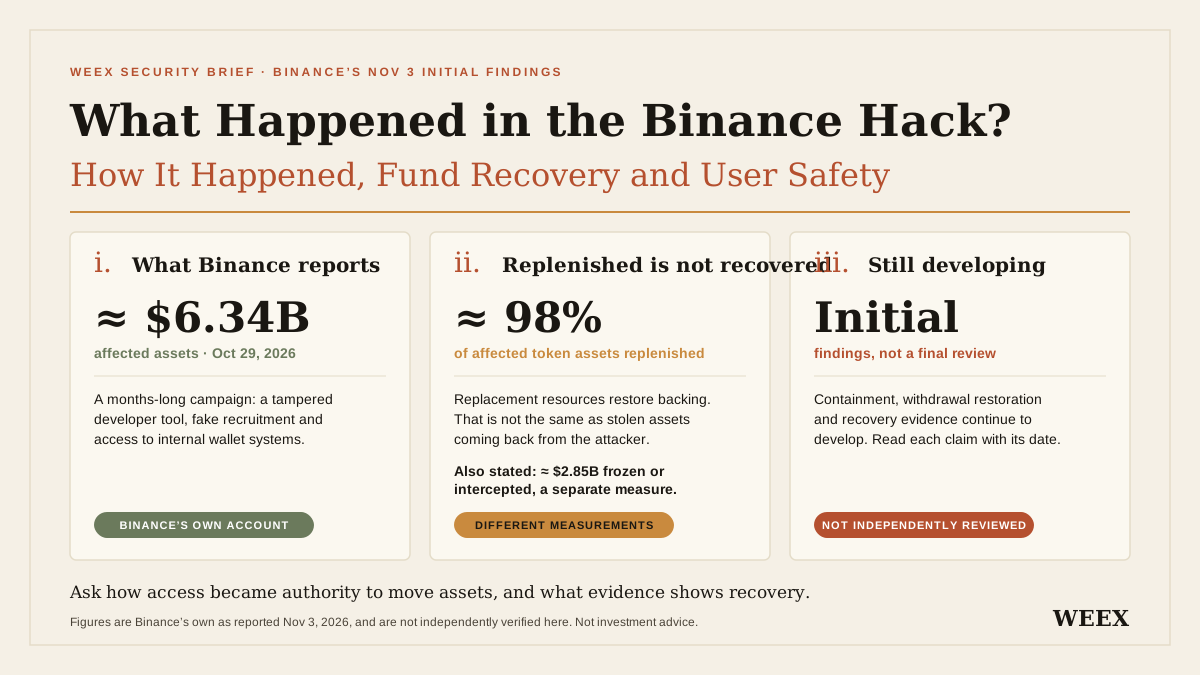
What Happened in the Binance Hack? How It Happened, Fund Recovery and User Safety
What happened in the Binance hack? Review the attack timeline, latest fund replenishment, recovery limits and practical steps to protect your account.

Tata Power Plans to Sign Agreement with Four States Allowing Power Prices to Be Linked to Coal Costs

AI Agents Do More Than Just Place Orders: The Next Entrepreneurial Opportunity Lies in Matching and Trust
NVIDIA Scandal Shakes the Internet! How Should Cryptocurrency Be Divided After a Divorce with a Tech Tycoon?
Bundesbank President Says Economic Recovery Faster Than Expected, Structural Reforms Needed

Immutable Chain's Transition to OP Stack: What Changes for Users
Ledger CEO faces backlash after saying everybody will be hacked at some point

WEEX 11.11 Shopping Fest: Buy BTC and Unlock Up to 888 USDT in Rewards

NEAR AI Discloses SGLang Security Incident and Revokes Exposed API Keys

The Art of Trading: How They Profit from Arbitraging USDE Stocks
VARA Is Not a Panacea: Dubai's Crypto Payments Still Depend on the Central Bank

a16z Frontier Partner: Agents Should Rebuild Uber-like Transaction Networks
Poland's Parliament Votes 240-202 To Let Officials Freeze Crypto Before Court Review
WEEX P2P now supports ILS, BHD, OMR & QAR —Merchant Recruitment Now Open

Cryptocurrency Security Checklist: Four Lessons from Phemex Safety Hub Vol. 05–08
Ondo Claims $4B in Tokenized Assets as RWA Market Gains Institutional Depth

DTCC Launches Tokenization Service: What Can Investors Actually Do?

The catch in recovering a hacked crypto wallet: the thief may still have a key

Bitcoin Remains Strong: Why $76,000 is the Level That Matters Now
Peter Schiff Criticizes Strategy's Bitcoin Purchases

iPhone Attack Kit 'DarkSword' Suspected of Being Misused for Cryptocurrency Theft, Bitquery Identifies Approximately $4.06 Million in Stolen Funds
Financial and Political Crisis in Paraguay: How the Ueno Bank Explosion Triggered the President's Resignation

OpenAI Releases National Community Covenant and Computing Park Policy Blueprint
GitBook Security Incident Review, Attack Targeting Trade.xyz

Post-Quantum Era Consensus Layer Divergence: Ethereum Maintains Decentralization, Monad Prioritizes Speed

The Ghost Behind the Screen: Unveiling the Secret World of North Korean Hackers Lazarus
Bitcoin Miners Turn to AI: Escaping the Crypto Cycle, but Entering New Turbulence
Decoding Variational: How a No-Order-Book Exchange Became the Dragon Behind Hyperliquid?
Creators Speak | The Biggest Risk in the Crypto Industry is Thinking It's Safe
Hedera Council adds Apex Group, servicer of $3.5T in assets
What Happened in the Binance Hack? How It Happened, Fund Recovery and User Safety
What happened in the Binance hack? Review the attack timeline, latest fund replenishment, recovery limits and practical steps to protect your account.
Tata Power Plans to Sign Agreement with Four States Allowing Power Prices to Be Linked to Coal Costs
AI Agents Do More Than Just Place Orders: The Next Entrepreneurial Opportunity Lies in Matching and Trust
NVIDIA Scandal Shakes the Internet! How Should Cryptocurrency Be Divided After a Divorce with a Tech Tycoon?
Bundesbank President Says Economic Recovery Faster Than Expected, Structural Reforms Needed
Latest articles





Latest coin listings on WEEX


