
Experts Assess the Risk of Hacking Crypto Wallets Using AI

 Prefer us on Google


- A researcher from the Ethereum Foundation suggested that AI could hack crypto wallets before quantum computers do.
- Incrypted's editorial team gathered expert opinions on the likelihood of this.
- They noted that while hacking cryptography through AI has not yet been proven, blockchains need a transition plan to more secure cryptographic mechanisms in advance.
Cybersecurity and blockchain industry experts have assessed the risk of hacking crypto wallets due to a potential breakthrough in mathematical research using artificial intelligence. The discussion intensified after Ethereum Foundation researcher Justin Drake stated that AI could threaten cryptographic protection before quantum computers and urged investors to prepare for a "bunker mode."
Vitalik Buterin agreed on the need to consider such risks while urging not to panic. Incrypted's editorial team asked experts how realistic such a scenario is and how the blockchain industry can prepare for it.
How Could AI Potentially Hack Crypto Wallets?
Drake warned about the possibility of new mathematical methods emerging that would allow attackers to recover private keys based on public ones. This would jeopardize digital signatures that confirm a user's right to manage crypto assets.
Specifically, this concerns ECDSA, which is used by Bitcoin and Ethereum, among others:
"This is the foundation on which both Bitcoin and Ethereum protocols are built. That foundation confirms during a transaction that you, as a user, have the funds you intend to spend in that transaction. The potential (though still rather hypothetical) vulnerability is that an attacker could impersonate the user and spend the user's money," explained Andriy Sobol, co-founder of LTV Protocol, in a comment to Incrypted.
Hacken's Offensive Security Services Director Grzegorz Trawiński emphasized that this is not about ordinary password cracking or accelerating existing attacks. Such a scenario would require a significant breakthrough in cryptanalysis that would violate the mathematical assumptions on which digital signatures are based.
Sobol pointed out the results of mathematical research from OpenAI. According to him, the company published a large array of results from a new model in various fields of mathematics, but among them, there were few materials directly related to cryptography.
"The hypothesis is that OpenAI achieved no less impressive results but simply did not publish them," Sobol explained, noting that the lack of public results could indicate either a lack of significant discoveries or a reluctance to disclose potential vulnerabilities to address issues.
He noted that this was also pointed out by Tezos co-founder Arthur Brightman, who drew a parallel with the Manhattan Project, when scientists suddenly stopped publishing nuclear fission research.
A tell from the Manhattan Project was that scientists who had been publishing about nuclear fission suddenly stopped publishing. As Justin points out here, the lack of cryptographic results in OpenAI's mathematical breakthrough could itself be a tell. Evidence against it would be if they published a few improvements that aren't massive breakthroughs. --- Arthur B. (@ArthurB) October 7, 2026
Should We Protect Crypto Assets Now?
To protect their assets, Drake urged frequent transfers of crypto assets to new wallets whose public keys have not yet been revealed.
At the same time, Trawiński believes that there is currently insufficient evidence for an immediate transition to new wallets or key rotation after each transaction. According to him, a practical attack on the ECDSA algorithm has not yet been demonstrated:
"It is important to distinguish between the seriousness of a hypothetical event and the evidence of its likelihood. A practical hack would have extremely serious consequences, but that does not mean it is inevitable in the near future."
Quantus Network founder Yuvy Lightman noted that the threats from AI and quantum computers are interconnected. In his opinion, AI can both enhance and undermine cryptography. He emphasized the importance of cryptographic flexibility—the ability to quickly update algorithms in the face of new threats.
Lightman separately pointed out quantum computing. According to him, if the American company IonQ, which produces hardware and software for quantum computing, is not exaggerating its technological progress, the resources needed to hack ECDSA quantum memory could become available as early as 2027.
In the event of such a breakthrough, Lightman believes blockchain projects will split into two groups: those without post-quantum protection and those with it in some form. Capital, according to Lightman, may move from the former to the latter, and some investors may leave the crypto market altogether.
Trawiński, for his part, urged preparation for potential threats but not to treat them as an already existing incident. Among the priorities, he mentioned assessing cryptographic dependencies, determining the degree of exposure of public keys, and developing plans to transition to other algorithms.
He stated that premature migration could also create additional risks—from permission configuration errors to loss of access to funds. Therefore, decisions about large-scale transitions should be based on compelling evidence of a cryptanalytic breakthrough, not just alarming forecasts.
Andriy Sobol assessed the likelihood of hacking the cryptographic foundations on which various blockchains are built in the coming years as "low, but not zero."
"Therefore, all blockchain protocols should consider potential recovery mechanisms that could serve as a way to exit a catastrophic situation with minimal losses."
-- Price
This content is provided for general informational purposes only and doesn't constitute financial, investment, legal, or tax advice. Any events, rewards, online promotions, or related information mentioned herein should not be considered a recommendation, solicitation, or invitation to purchase, sell, trade, or otherwise deal in any crypto assets. Crypto assets are highly volatile and may result in loss. The availability of WEEX services, products, and related events may vary by region. You are responsible for ensuring that your participation is in accordance with applicable local laws and regulations.
You may also like
Panoramic Research Report: Is the Crypto World Ready to Face Quantum Attacks?
Anchorage Digital Bank Launches Tokenized Uranium Custody Service

Kraken parent plans regulated Hyperliquid perps

Price Forecast for Chainlink (LINK) for 2023–2031

71.9% of Top 100 Tokens Are Dead: How Long Does a Cryptocurrency Survive?

Billionaire Tim Draper is suspected of selling 150.84 bitcoins

Like the legendary 30x El Dorado Mastiff, what is the x402 Protocol?
Ripple and SBI Team Up for RLUSD Stablecoin Launch in Japan by Early 2026
Latest Crypto Market Snapshot as of August 22, 2025 BTC Soars to $115,250.00 ETH Hits $4,450.75 XRP Climbs…

TQQQ Outlook: Triple-Leverage Swings, Rebound Potential, and Decay Risk

US card debt hits $1.29 trillion as Bitcoin loans expose a collateral divide

QQQ Outlook: Tech Sell-Off, Rebound, and Nvidia Earnings

FTX’s former Anthropic stake could now be worth over $30 billion

Former Polychain President Launches Venture to Create a Tradable Index for U.S. Housing Prices

How Much CPO Demand Will NVIDIA's Rubin Ultra Generate? Bernstein: Optical Value of Single Pod Increases Fivefold

Why Did Binance Restrict MEXC Transfers? What the FinCEN Order Actually Covers
Find out why Binance restricted MEXC transfers, when the FinCEN order takes effect, and what to check if your crypto deposit is held for review.
Why Did Binance Restrict MEXC Transfers? What the FinCEN Order Actually Covers
Find out why Binance restricted MEXC transfers, when the FinCEN order takes effect, and what to check if your crypto deposit is held for review.

Pump.fun Data Review: Why the Current Meme Market Has Become a 'Harvesting Game'?

As Protocols Move Back to the Mainnet, How Does Ethereum's Value Logic Change?

What Is Elysium Crypto? The Hyperliquid Layer 2, Gas Fees, and Token Confusion Explained
Learn what Elysium is, why it uses HYPE for gas, how KNTQ buybacks are designed, and how to distinguish bridge TVL from actual DeFi activity.

From Sidechains to zk-Rollups: Tacit Chain Aims to Redefine Payments with Default Privacy

Booz Allen Switches to NVIDIA's Nemotron Large Model

Deutsche Bank launches crypto custody for Bitcoin, Ethereum, stablecoins
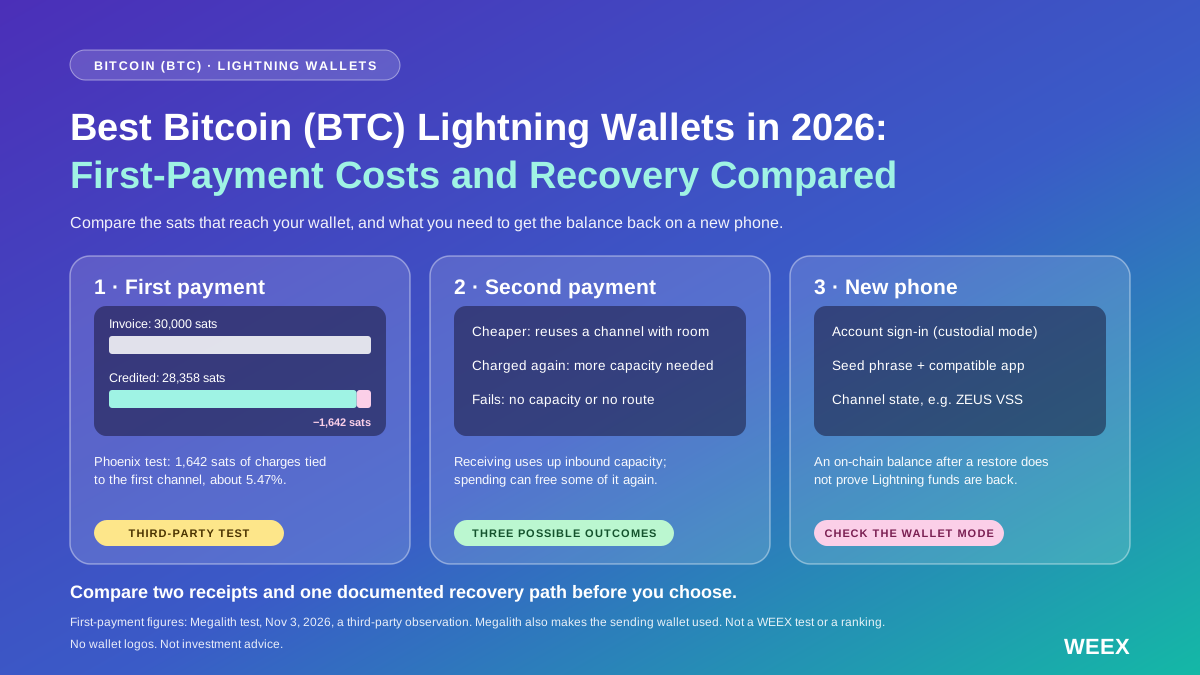
Best Bitcoin (BTC) Lightning Wallets in 2026: First-Payment Costs and Recovery Compared
Key Takeaways Lightning Network wallets enable fast and cost-effective Bitcoin transactions by using off-chain channels. A variety of…

Banqi Partners with MiniMax, OSL, and Animoca Brands to Host VIP Connects, Focusing on AI and Payment Integration

Former Employee Sues Ethereum Foundation, Claims Retaliatory Dismissal After Protesting 'Seppuku' Clause

Midterm Election Risks Disrupt Helix AI Infrastructure Project, Increasing Uncertainty for Samsung Investments

NVIDIA Scandal Shakes the Internet! How Should Cryptocurrency Be Divided After a Divorce with a Tech Tycoon?

Financial Services Agency Discusses DeFi Regulation and Risks of Stablecoin Redemptions
Ethereum’s Joseph Lubin explains why ETH could rival Bitcoin and gold

As Whales Embrace ETFs, Security Anxiety in the Crypto World is Spreading
Panoramic Research Report: Is the Crypto World Ready to Face Quantum Attacks?
Anchorage Digital Bank Launches Tokenized Uranium Custody Service
Kraken parent plans regulated Hyperliquid perps
Price Forecast for Chainlink (LINK) for 2023–2031
71.9% of Top 100 Tokens Are Dead: How Long Does a Cryptocurrency Survive?
Billionaire Tim Draper is suspected of selling 150.84 bitcoins
Latest articles


Latest coin listings on WEEX


