
Brazil Launches 'Maya Veil Operation' to Combat Money Laundering Network of 87 Shell Companies

 Prefer us on Google


On July 10, the Federal Police of Brazil launched the "Maya Veil Operation," executing nine search and seizure warrants in São Paulo, Ribeirão Preto, Porto Alegre, and Canoas to dismantle a money laundering network involving 87 shell companies. These companies masqueraded as legitimate business entities but were actually used to transfer illegal gambling funds. Investigations revealed that cryptocurrencies were primarily used for cross-border fund transfers within this money laundering network. Criminals received illegal gambling revenues through shell companies, converted the funds into crypto assets, and then transferred them abroad, exploiting the rapid nature of digital assets to evade traditional financial regulations. The Federal Police of Brazil stated that those involved could face charges of money laundering, tax evasion, and participation in organized crime, although the scale of the funds involved and the amount of seized assets have not yet been disclosed. This operation was supported by intelligence from the Brazilian Ministry of Finance and gambling regulatory authorities. Data shows that Brazil's legal gambling market is substantial, contributing approximately $869 million in tax revenue in the first four months of 2026, while the illegal gambling market is estimated to account for about half of the overall gambling transaction volume. Notably, just five days before the "Maya Veil Operation," the Federal Police of Brazil also dismantled a cryptocurrency money laundering network linked to the largest criminal organization, PCC, involving approximately $2 billion in fund flows.
-- Price
This content is provided for general informational purposes only and doesn't constitute financial, investment, legal, or tax advice. Any events, rewards, online promotions, or related information mentioned herein should not be considered a recommendation, solicitation, or invitation to purchase, sell, trade, or otherwise deal in any crypto assets. Crypto assets are highly volatile and may result in loss. The availability of WEEX services, products, and related events may vary by region. You are responsible for ensuring that your participation is in accordance with applicable local laws and regulations.
You may also like

Petrobras Reports US$ 10 Billion Profit, But Pays Less Dividends Than Rivals

Oil Industry Profits: The Impact of Geopolitics on the Giants' Cash Flow

Brazilian Police Break Up Drug Trafficking Network, Nine Arrested

Turkey charges 504 suspects in $1 billion crypto money laundering case

Security Alert: 30 malicious npm packages disguised as trading bot repositories, targeting the theft of developer keys and mnemonic phrases

Asset management company Baillie Gifford, in collaboration with BNY, launched an on-chain fixed income tokenized fund, deploying on both ETH and Solana chains

A New York judge has suspended the lawsuit over the ownership of 39,000 Bitcoin wallets, with a friend of the court hearing scheduled for July

Supply chain attacks affect PyPI/npm/crates.io, with over 34 malicious packages targeting cryptocurrency and AI developers
FTX’s former Anthropic stake could now be worth over $30 billion
Former Polychain President Launches Venture to Create a Tradable Index for U.S. Housing Prices

How Much CPO Demand Will NVIDIA's Rubin Ultra Generate? Bernstein: Optical Value of Single Pod Increases Fivefold
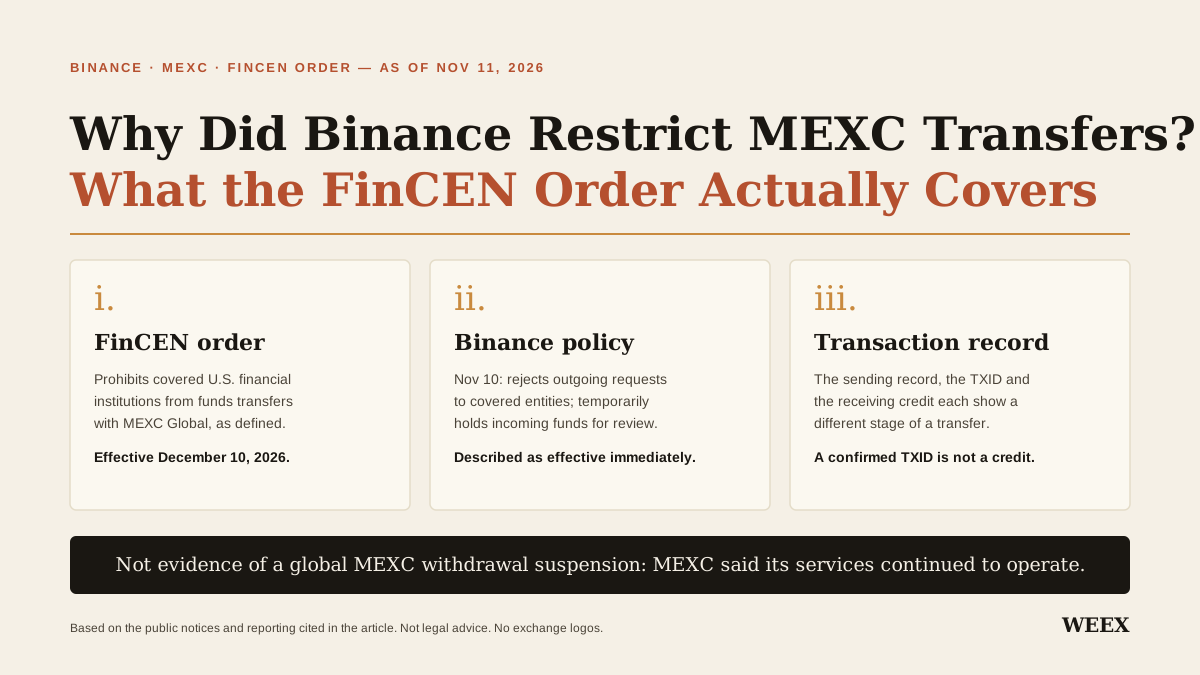
Why Did Binance Restrict MEXC Transfers? What the FinCEN Order Actually Covers
Find out why Binance restricted MEXC transfers, when the FinCEN order takes effect, and what to check if your crypto deposit is held for review.
Why Did Binance Restrict MEXC Transfers? What the FinCEN Order Actually Covers
Find out why Binance restricted MEXC transfers, when the FinCEN order takes effect, and what to check if your crypto deposit is held for review.

Pump.fun Data Review: Why the Current Meme Market Has Become a 'Harvesting Game'?

As Protocols Move Back to the Mainnet, How Does Ethereum's Value Logic Change?

What Is Elysium Crypto? The Hyperliquid Layer 2, Gas Fees, and Token Confusion Explained
Learn what Elysium is, why it uses HYPE for gas, how KNTQ buybacks are designed, and how to distinguish bridge TVL from actual DeFi activity.

From Sidechains to zk-Rollups: Tacit Chain Aims to Redefine Payments with Default Privacy

Booz Allen Switches to NVIDIA's Nemotron Large Model

Deutsche Bank launches crypto custody for Bitcoin, Ethereum, stablecoins

Best Bitcoin (BTC) Lightning Wallets in 2026: First-Payment Costs and Recovery Compared
Key Takeaways Lightning Network wallets enable fast and cost-effective Bitcoin transactions by using off-chain channels. A variety of…

Banqi Partners with MiniMax, OSL, and Animoca Brands to Host VIP Connects, Focusing on AI and Payment Integration

Former Employee Sues Ethereum Foundation, Claims Retaliatory Dismissal After Protesting 'Seppuku' Clause
Midterm Election Risks Disrupt Helix AI Infrastructure Project, Increasing Uncertainty for Samsung Investments

NVIDIA Scandal Shakes the Internet! How Should Cryptocurrency Be Divided After a Divorce with a Tech Tycoon?

Financial Services Agency Discusses DeFi Regulation and Risks of Stablecoin Redemptions

Ethereum’s Joseph Lubin explains why ETH could rival Bitcoin and gold

As Whales Embrace ETFs, Security Anxiety in the Crypto World is Spreading

Chainalysis: The Shadow Market Behind China's AI Model "Distillation Tide" Bypassing U.S. Export Controls
How Much Revenue Can Anthropic Generate for Every $1 Spent on Computing Power?

Rocket Lab’s 100th Launch: What It Means for RKLB After Q3 Earnings
Rocket Lab’s 100th launch, The Mountain God Rises, is planned no earlier than November 14, 2026 for iQPS. It follows Q3 earnings and a sharp RKLB rally, but the launch is not confirmed as the cause.
Petrobras Reports US$ 10 Billion Profit, But Pays Less Dividends Than Rivals
Oil Industry Profits: The Impact of Geopolitics on the Giants' Cash Flow
Brazilian Police Break Up Drug Trafficking Network, Nine Arrested
Turkey charges 504 suspects in $1 billion crypto money laundering case
Security Alert: 30 malicious npm packages disguised as trading bot repositories, targeting the theft of developer keys and mnemonic phrases
Asset management company Baillie Gifford, in collaboration with BNY, launched an on-chain fixed income tokenized fund, deploying on both ETH and Solana chains
Latest articles


Latest coin listings on WEEX


