
Bitcoin Mining Stocks Plunge 35%. VanEck Claims Investors Made a Mistake

 Prefer us on Google


The October sell-off has severely impacted companies mining Bitcoin that are expanding operations in the artificial intelligence infrastructure sector. Their stocks have lost an average of 35%, but according to VanEck, the scale of the decline does not reflect the health of the businesses or the value of their assets. Investment managers describe the situation as a market anomaly rather than a collapse of the business model based on servicing AI data centers.
At the center of the dispute are companies like Hut 8 and Core Scientific, which utilize their energy resources and infrastructure to service the growing market for AI-related computing. However, investors have begun to treat them similarly to much more indebted computing power providers, fearing financing issues across the entire sector.
Mining Stocks Under Pressure from AI Financing Concerns
According to VanEck's analysis, the October sell-off affected companies with different business models. Investors treated energy infrastructure providers for data centers and operators renting out GPU computing power as one asset category. As a result, the financial troubles of some companies translated into a sell-off of the stocks of others.
Particularly significant were concerns regarding the costs of financing AI infrastructure. Cloud service providers, also referred to as neoclouds, must incur huge expenses to purchase graphics processors and expand data centers. High debt costs can limit their profitability, and the deterioration of sentiment towards this group of companies has also impacted firms supplying them with space and energy.
Additional pressure has come from macroeconomic factors. VanEck points to a higher-than-expected reading of the U.S. CPI for September and uncertainty ahead of the upcoming midterm elections in the U.S. In such an environment, investors have reduced exposure to risky assets, failing to sufficiently distinguish between individual business models.
Energy More Important than Processor Availability
A key argument from VanEck concerns the limited availability of electricity. In the firm's view, it is the connection capacity and access to power, rather than the demand for graphics processors, that remain the most significant constraint on the development of AI infrastructure. Bitcoin mines have a significant advantage in this regard: they possess land, energy infrastructure, and access to power that can be utilized in data centers.
In its June 2026 analysis regarding the valuation of Bitcoin mines as AI infrastructure, VanEck noted that access to energy and the execution of contracted projects are becoming the primary criteria for assessing these companies. Simply having ambitious development plans is not enough—secured power, signed contracts, and the ability to timely launch facilities are of utmost importance.
In its September commentary on the Bitcoin market, VanEck emphasized that limited energy availability could hinder the development of computing infrastructure. Companies that already have connected power thus have a significant competitive advantage.
Signed Contracts Remain an Important Argument
VanEck emphasizes that despite the nervousness in the market, there have been no cancellations of signed infrastructure lease agreements. This is an important distinction: concerns primarily revolve around companies' ability to raise capital and finance subsequent stages of development, rather than confirmed withdrawals of clients from existing contracts.
In the manager's view, long-term contracts provide companies with predictable cash flows that may justify higher valuations than suggested by the October sell-off. This particularly applies to so-called powered shell providers (PSP), which are companies providing clients with prepared facilities, access to energy, and infrastructure, without the need to supply all computing power themselves.
However, this does not mean that the risk has disappeared. The execution of projects requires significant expenditures, and financing issues, construction delays, or difficulties in activating contracted power can negatively impact company results. A signed contract does not automatically guarantee that the investment will be completed on schedule. It is also worth noting that the traditional Bitcoin mining model is also facing cost pressure and revenue volatility, which we analyzed more broadly in our material.
However, VanEck believes that the October sell-off may have excessively lowered the valuations of companies that already have access to energy and long-term contracts. For the market, this means a return to the fundamental question: are investors valuing the actual fundamentals of the businesses, or primarily concerns related to financing the entire AI boom?
-- Price
This content is provided for general informational purposes only and doesn't constitute financial, investment, legal, or tax advice. Any events, rewards, online promotions, or related information mentioned herein should not be considered a recommendation, solicitation, or invitation to purchase, sell, trade, or otherwise deal in any crypto assets. Crypto assets are highly volatile and may result in loss. The availability of WEEX services, products, and related events may vary by region. You are responsible for ensuring that your participation is in accordance with applicable local laws and regulations.
You may also like

Israel Discount Bank to Open Bitcoin and Ethereum Trading in App Starting November 26

Israel Discount Bank to Open Bitcoin and Ethereum Trading in App from November 26

Thousands of Bitcoin nodes gave anonymous strangers a pass around security limits

Bitcoin Core Addresses Three Security Vulnerabilities in October

Peter Brent: The Yield on 30-Year U.S. Bonds May Reach 7%

Glassnode reports stablecoin supply fell by 14.2 billion

10x Research: Bitcoin's One-Year Return After Midterm Elections is 53.9%

Decrypt Becomes First News Publisher to Offer Perps Trading, Powered by Solana's Phoenix
Bitcoin Scam on Shaadi.com, User Solicited for a $500 Deposit

Ignas: HYPE and AVAX Face Value Capture Challenges

CPI Higher Than Expected in the U.S.: What It Means for Investors

Bloomberg analyst warns BTC, Nasdaq, commodities may face year-end declines

Barclays Increases Stake in BlackRock Bitcoin ETF by 48% in Q3, Citigroup Establishes $119 Million FBTC Position

Something strange is happening with Bitcoin. It is neither digital gold nor a tech company for Wall Street

US card debt hits $1.29 trillion as Bitcoin loans expose a collateral divide

CryptoQuant: Bitcoin Analyst Sentiment Significantly Bearish, Index Drops to -1.8σ

CoinShares Survey Shows Fund Managers' Digital Asset Allocation Rises to 1.3%

From Sidechains to zk-Rollups: Tacit Chain Aims to Redefine Payments with Default Privacy

Treasury Discusses Bitcoin Acquisition Pathways, Government Holdings Undergo Second Round of Review

Trump Still Interested in Increasing Bitcoin Holdings Amid Legal Hurdles

LNbits Security Patch Released After Bitcoin Wallet Theft

Deutsche Bank launches crypto custody for Bitcoin, Ethereum, stablecoins
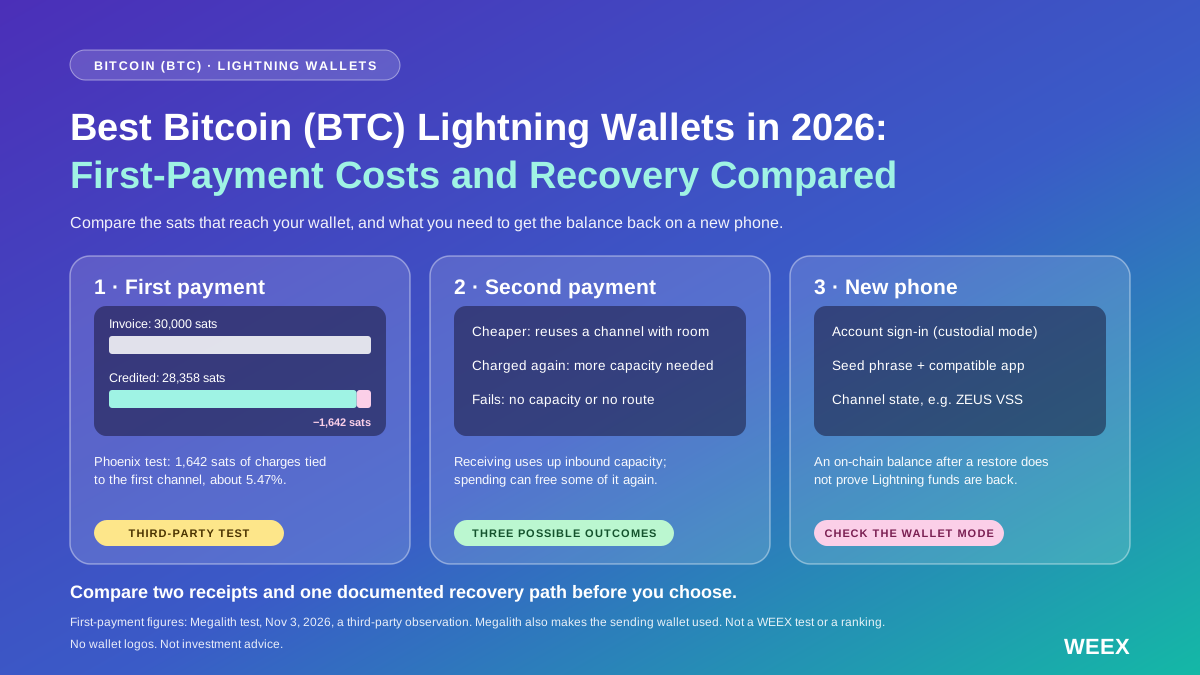
Best Bitcoin (BTC) Lightning Wallets in 2026: First-Payment Costs and Recovery Compared
Key Takeaways Lightning Network wallets enable fast and cost-effective Bitcoin transactions by using off-chain channels. A variety of…

SEC Enforcement Actions Decrease by 23.7% to 348 in Fiscal Year 2026
BlackRock Loses $1.735 Billion in Cryptocurrency Funds

Ethereum’s Joseph Lubin explains why ETH could rival Bitcoin and gold

BitGo Posts $44M Quarterly Profit as Platform Assets Grow, But Adjusted EBITDA Stays Negative
Bitcoin: A Thief Sentenced in China for Memorizing a Seed Phrase

Bitcoin loses status as main risk asset amid stock market lag

Crypto ATM Fees: How Much Bitcoin (BTC) Do You Get for $100?
See how much Bitcoin $100 buys at a crypto ATM. Compare two sample quotes, calculate the all-in cost, and learn which fees not to count twice.
Israel Discount Bank to Open Bitcoin and Ethereum Trading in App Starting November 26
Israel Discount Bank to Open Bitcoin and Ethereum Trading in App from November 26
Thousands of Bitcoin nodes gave anonymous strangers a pass around security limits
Bitcoin Core Addresses Three Security Vulnerabilities in October
Peter Brent: The Yield on 30-Year U.S. Bonds May Reach 7%
Glassnode reports stablecoin supply fell by 14.2 billion
Latest articles





Latest coin listings on WEEX


