
Are Stablecoins Really "Stable"? Considering Redemption, Settlement, and Revenue Structures ("So That's How It Is Blockchain Ep.15" Yoshihiko Uchida, Yuya Sakai, Shinya Otsuga)

 Prefer us on Google

In this podcast, Yoshihiko Uchida, who has a background in banking supervision at the Bank of Japan and the Financial Services Agency and currently teaches blockchain at Shunan University, Yuya Sakai, a founder of a gourmet app who has combined Web2 services with blockchain to build a Web3 business, and Shinya Otsuga, deputy editor-in-chief of the crypto media "New Economy," introduce what you need to know about blockchain today.
In this 15th episode, continuing from the previous one, we discussed the second part of "Existing Finance × Blockchain," focusing on "stablecoins" used as a means of payment, following our previous discussions on "transactions and transfers" and "credit."
First, we confirmed that in Japan, "stablecoins" are not a legal term in themselves, but those linked to the value of legal tender are categorized as "electronic payment means" under the Payment Services Act. We organized the differences in backing assets, management methods, and refund procedures in the event of bankruptcy, focusing on the first type, which is scheduled for redemption at par in legal tender, and the third type, which corresponds to specific trust beneficiary rights and is designed to isolate bankruptcy through trust property, including bank deposits and short-term government bonds with maturities of three months or less.
We also delved into the issue of whether "it really returns at face value," discussing how even if redemption at face value is planned, the market value of held government bonds may decline due to rising interest rates, the fees at redemption, and the fact that while the issuance limit for JPYC is 1 million yen per transaction, this same limit does not directly apply to transfers between wallets. We touched on the example of the algorithmic stablecoin "TerraUSD (UST)" losing its peg to the US dollar and crashing along with its related token "LUNA," confirming that "stable" does not always mean that the value is guaranteed to be at face value.
Furthermore, we confirmed that the outstanding balance of yen-denominated stablecoins at the time of recording is only a small part of the approximately $300 billion total worldwide. We considered whether yen stablecoins are truly necessary, noting that credit card fees are also costs associated with "middlemen" who handle merchant screening and refunds in cases of fraud, and that in low-interest Japan, the revenue from backing asset management is limited, making it difficult for issuers to establish a viable revenue structure.
In episodes 13 to 18, we will explore the basics of existing finance and the potential for integration with blockchain.
The next episode, the 16th, is scheduled to be released on September 7, 2026. We will continue to discuss stablecoins, explaining the ideal "gaps" between existing finance and the Web3 industry.
-- Price
This content is provided for general informational purposes only and doesn't constitute financial, investment, legal, or tax advice. Any events, rewards, online promotions, or related information mentioned herein should not be considered a recommendation, solicitation, or invitation to purchase, sell, trade, or otherwise deal in any crypto assets. Crypto assets are highly volatile and may result in loss. The availability of WEEX services, products, and related events may vary by region. You are responsible for ensuring that your participation is in accordance with applicable local laws and regulations.
You may also like

BIS: Bank rate hikes cut stablecoin growth by 3 points

Hu Zhewens Sues Jump Trading and Zhang Yongfeng for At Least $500 Million

Hu Zhewens Sues Jump Trading and Zhang Yongfeng for at Least $500 Million

Trust in Stablecoins: The Key to Maintaining Fixed Prices

Analysis of the Causes of Stablecoin Depegging

What is PayFi and how stablecoins are replacing wire transfers

Caixin: It is reported that Chinese regulators are reviewing Jane Street's trading behavior in the Chinese ETF market
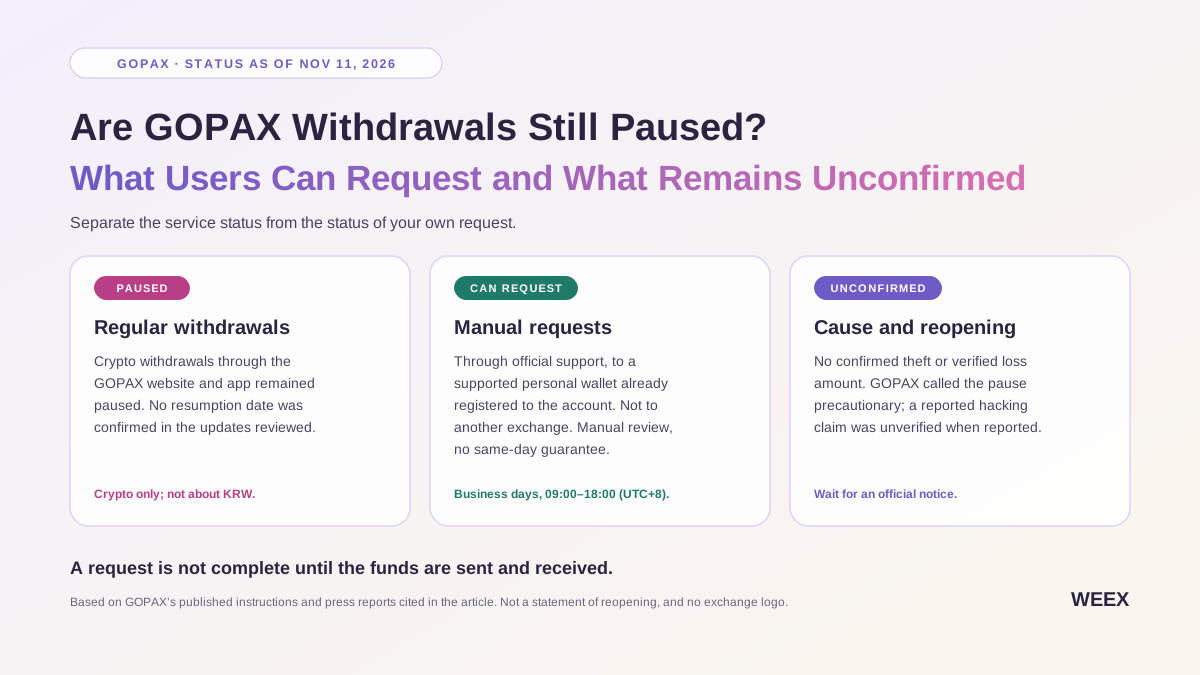
Are GOPAX Withdrawals Still Paused? What Users Can Request and What Remains Unconfirmed
Check the latest GOPAX withdrawal status, which wallets qualify for manual requests, and how to tell whether your crypto withdrawal has been sent.
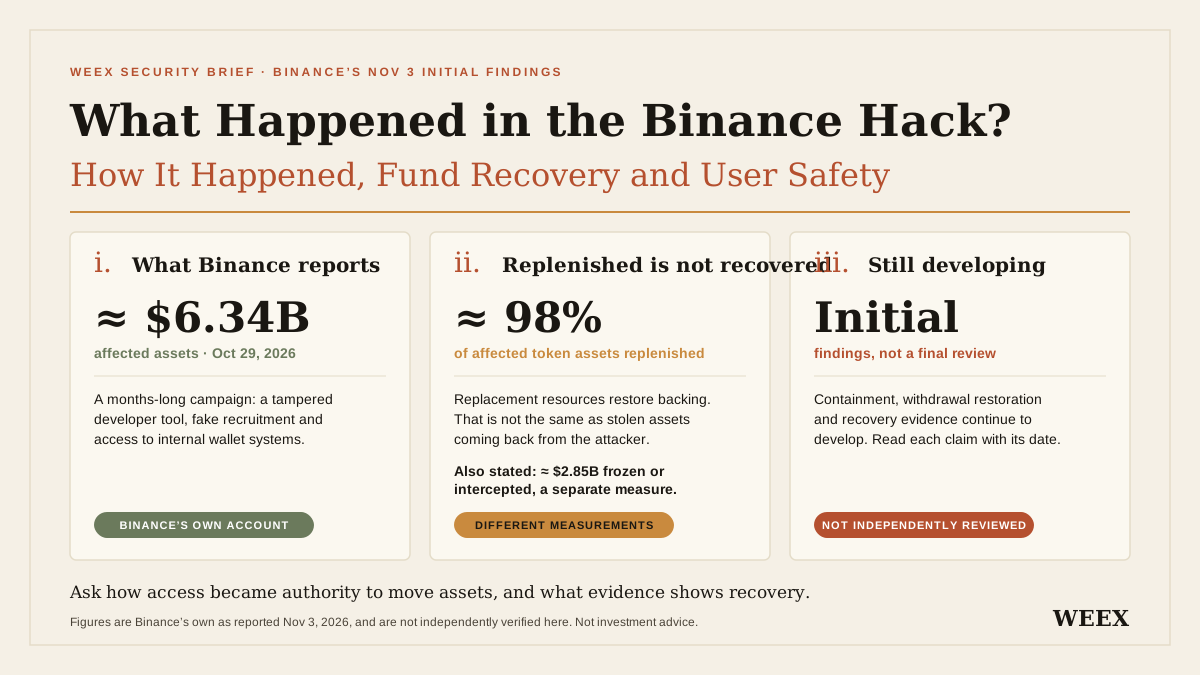
What Happened in the Binance Hack? How It Happened, Fund Recovery and User Safety
What happened in the Binance hack? Review the attack timeline, latest fund replenishment, recovery limits and practical steps to protect your account.

Hoskinson says he cannot run Cardano like a CEO. Who is accountable for its growth?

Why Pronostyx Is Building Prediction Markets for Questions the Big Platforms Ignore

Former Cointelegraph CEO Joins Phase as Co-Founder and CEO
Alta raises $47.5M for blockchain backed by crypto skeptic Jack Zhang

Decrypt Becomes First News Publisher to Offer Perps Trading, Powered by Solana's Phoenix

How Far Can AI Trading Go Amid the Anti-Data Center Wave? It Depends on GPU Leasing Prices
XRPL lending protocol gains validator support as vault vote advances
Tech Veteran: Anthropic IPO Will Be the Peak of AI Market in US Stocks, Will 'Aggressively Buy Chinese AI' If Conditions Allow

Moody's Projects Global Credit Deterioration by 2027 and Warns of the Impact of Rates and AI

CPI Higher Than Expected in the U.S.: What It Means for Investors
EWY ETF Volatility: Semiconductor Concentration, Rebound, and Fund-Flow Risks

AI Agents Do More Than Just Place Orders: The Next Entrepreneurial Opportunity Lies in Matching and Trust
Exodus Reports $8.3M Quarterly Loss as Wallet Platform Expands Payments Business

USAR Stock: Rare-Earth Commercialization, Quarterly Losses, and Funding Risks

Hims & Hers (HIMS) Falls After Earnings: Margins, Subscribers, and Guidance

IWM ETF Outlook: Small-Cap Rebound, Fund Positioning, and Credit Risk

SOXL Sell-Off and Rebound: 3x Leverage, Fund Flows, and Semiconductor Risk

Something strange is happening with Bitcoin. It is neither digital gold nor a tech company for Wall Street

TQQQ Outlook: Triple-Leverage Swings, Rebound Potential, and Decay Risk

US card debt hits $1.29 trillion as Bitcoin loans expose a collateral divide
QQQ Outlook: Tech Sell-Off, Rebound, and Nvidia Earnings
BIS: Bank rate hikes cut stablecoin growth by 3 points
Hu Zhewens Sues Jump Trading and Zhang Yongfeng for At Least $500 Million
Hu Zhewens Sues Jump Trading and Zhang Yongfeng for at Least $500 Million
Trust in Stablecoins: The Key to Maintaining Fixed Prices
Analysis of the Causes of Stablecoin Depegging
What is PayFi and how stablecoins are replacing wire transfers
Latest articles



Latest coin listings on WEEX


