
AI: The Next Billion Crypto Users Will Not Be Human

 Prefer us on Google


One billion clients, zero ID cards. While the sector is still waiting for the promised mainstream adoption in every cycle, another clientele has started paying without being invited. According to Keyrock, AI agents processed around 176 million on-chain transactions between May 2025 and April 2026, almost all in USDC (98.6%) and for just a few cents each. We dismantled the payment rail itself on August 25. Let's change the scale and look at the usage, because the key figure is contained in a Gartner projection with twelve zeros.
Key points of this article:
- AI agents processed 176 million on-chain transactions between May 2025 and April 2026, mainly in USDC.
- Gartner projected that by 2028, 90% of B2B purchases will be managed by AI agents, representing $15 trillion.
AI Agents, These 480,000 Clients Paying 30 Cents Without Discussion
Coinbase has its own finer counter. Its x402 protocol, which allows an agent to pay for a service at the moment it calls for it, counted over 480,000 agents in its April balance. Earlier this year, Coinbase already claimed 165 million payments for a total of $50 million, CoinDesk reminded on August 23. Average basket: about thirty cents. Almost all transactions are conducted in USDC, Circle's stablecoin, primarily on Base, Coinbase's layer 2. No one buys shoes at this price. These agents settle API calls (a request sent to an online service), data, computation, or a model inference.
The dollar volume, however, remains microscopic. Over thirty days in July, x402 moved $24 million, about what Visa processes in a minute. And Lincoln Murr, head of AI products at Coinbase, admits that between 25% and 30% of transactions likely come from users inflating public rankings rather than buyers needing the service. He compares the period to the "Napster/LimeWire era" of agent payments. We know how that ended for LimeWire.
Stablecoins vs. Credit Cards, Each Their Rail and Each Their Client
Don't put away your Visa just yet. Stephanie Cohen, Cloudflare's strategy director, summarizes the upcoming division of labor. "Stablecoins are particularly suited for the type of transactions we expect from AI agents initially, essentially a lot of very small high-frequency payments for API calls, data, inference, and content." Bryce Ferguson, head of Turnkey, is more blunt. "Autonomous agents don't strictly need crypto wallets," he says, before clarifying that the card will be used for "old-fashioned purchases, a pair of shoes or groceries," while crypto remains "a far better rail for buying a single API call or a single piece of data."
Mastercard holds the same view, of course. "Agent commerce will be a multi-rail environment," states Sapan Mandloi, executive vice president of the group, who sees stablecoins as "complementary to existing payment systems, not a replacement." The dividing line thus falls around a dollar per transaction, where the 2% to 4% acceptance fees of a card eat up all the interest in the purchase.
$15 Trillion, the Gartner Projection That Changes the Scale of AI Agents
The Gartner firm predicted as early as October 2025 that 90% of B2B purchases would be intermediated by AI agents by 2028, amounting to over $15 trillion in B2B spending passing through exchanges between agents. Twenty-four million in July, we smile. Except that the forecast is about the ordering party and not the channel. Tomorrow, it will no longer be a human in front of a payment form, and it is precisely this client that crypto rails have already begun to serve.
The bottleneck today is not in demand. "Setting up the wallet remains a huge friction point," Murr acknowledges. Cloudflare, MoonPay, or Circle are therefore multiplying capped-budget wallets, approved seller lists, and human validation for sensitive actions, all of which Cohen calls safeguards, "which makes this autonomy possible." Even Arthur Hayes, co-founder of BitMEX, announced on August 18 on X that he is coming out of retirement to launch, with Flop Labs, "the currency of agentic economy," with an airdrop promised for the fourth quarter.
The unit of measurement is changing, from active addresses to machines that consume. Matt Hougan, at Bitwise, sees agents multiplying blockchain transaction volumes by 10 to 100, automating what no human would do by hand rather than recruiting new humans. For Base, for Tempo (Stripe's chain), and for stablecoin issuers, the client to conquer has neither ID nor patience, and charges by the millisecond. Coinbase has understood this even in its Base Batches accelerator, which only retains ten AI agent startups for its next promotion, with applications closing on September 9.
-- Price
This content is provided for general informational purposes only and doesn't constitute financial, investment, legal, or tax advice. Any events, rewards, online promotions, or related information mentioned herein should not be considered a recommendation, solicitation, or invitation to purchase, sell, trade, or otherwise deal in any crypto assets. Crypto assets are highly volatile and may result in loss. The availability of WEEX services, products, and related events may vary by region. You are responsible for ensuring that your participation is in accordance with applicable local laws and regulations.
You may also like

LimeWire Takes Over Cookie3, InfoFi 2.0 Development Begins

Follow the Money: Corporate Segment Lull, Kaiko's $57 Million Round, and Several M&A Deals

BabyDoge Acquires LimeWire File Sharing Platform

The Next Billion Customers Will Be AI: Stablecoins Disrupting the Market

Thousands of Bitcoin nodes gave anonymous strangers a pass around security limits

Hedera Council adds Apex Group, servicer of $3.5T in assets

Kaspa developer targets ownerless prediction market by end-2026
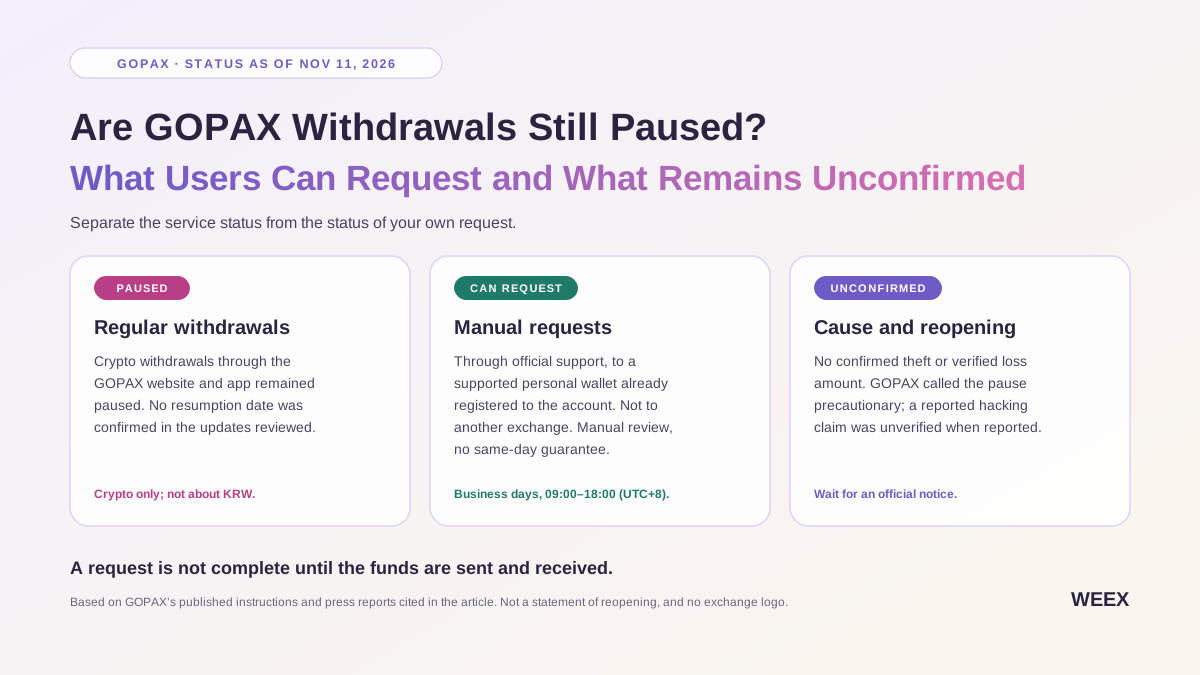
Are GOPAX Withdrawals Still Paused? What Users Can Request and What Remains Unconfirmed
Check the latest GOPAX withdrawal status, which wallets qualify for manual requests, and how to tell whether your crypto withdrawal has been sent.
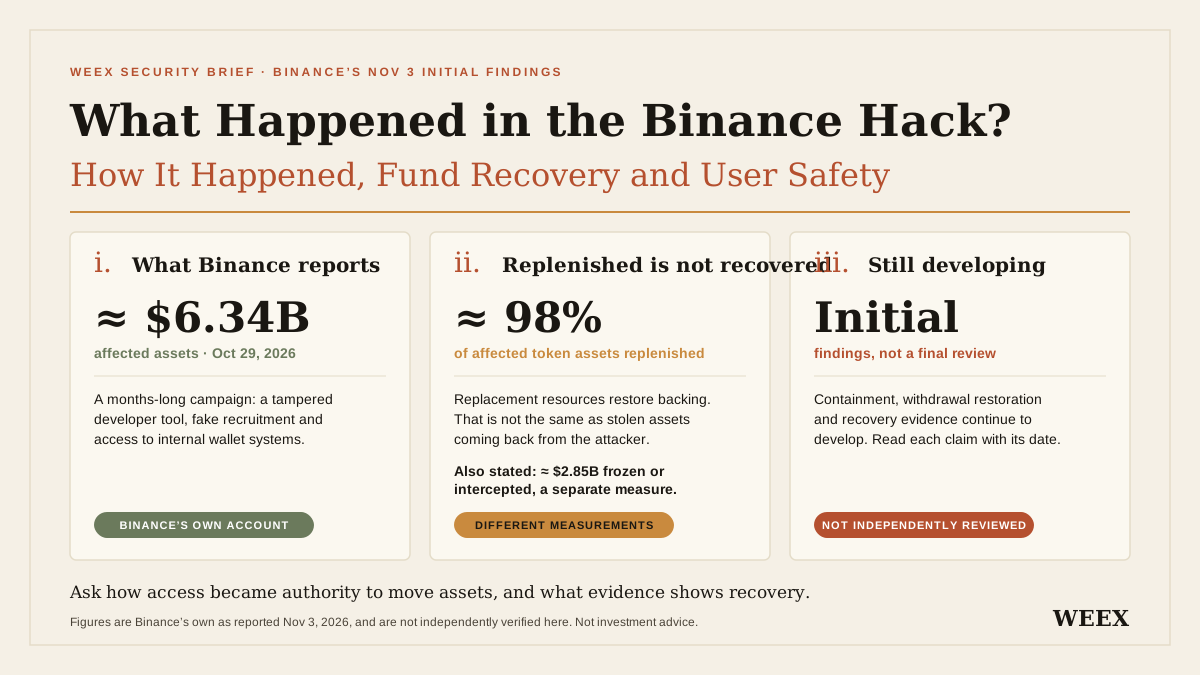
What Happened in the Binance Hack? How It Happened, Fund Recovery and User Safety
What happened in the Binance hack? Review the attack timeline, latest fund replenishment, recovery limits and practical steps to protect your account.

Hoskinson says he cannot run Cardano like a CEO. Who is accountable for its growth?
Why Pronostyx Is Building Prediction Markets for Questions the Big Platforms Ignore

Former Cointelegraph CEO Joins Phase as Co-Founder and CEO

Alta raises $47.5M for blockchain backed by crypto skeptic Jack Zhang

U.S. Mortgage Rates Surge After Four Weeks of Decline

Decrypt Becomes First News Publisher to Offer Perps Trading, Powered by Solana's Phoenix

How Far Can AI Trading Go Amid the Anti-Data Center Wave? It Depends on GPU Leasing Prices
XRPL lending protocol gains validator support as vault vote advances

Tech Veteran: Anthropic IPO Will Be the Peak of AI Market in US Stocks, Will 'Aggressively Buy Chinese AI' If Conditions Allow

Moody's Projects Global Credit Deterioration by 2027 and Warns of the Impact of Rates and AI

CPI Higher Than Expected in the U.S.: What It Means for Investors

EWY ETF Volatility: Semiconductor Concentration, Rebound, and Fund-Flow Risks

AI Agents Do More Than Just Place Orders: The Next Entrepreneurial Opportunity Lies in Matching and Trust
Exodus Reports $8.3M Quarterly Loss as Wallet Platform Expands Payments Business

USAR Stock: Rare-Earth Commercialization, Quarterly Losses, and Funding Risks

Hims & Hers (HIMS) Falls After Earnings: Margins, Subscribers, and Guidance

IWM ETF Outlook: Small-Cap Rebound, Fund Positioning, and Credit Risk

SOXL Sell-Off and Rebound: 3x Leverage, Fund Flows, and Semiconductor Risk

Something strange is happening with Bitcoin. It is neither digital gold nor a tech company for Wall Street

TQQQ Outlook: Triple-Leverage Swings, Rebound Potential, and Decay Risk

US card debt hits $1.29 trillion as Bitcoin loans expose a collateral divide
LimeWire Takes Over Cookie3, InfoFi 2.0 Development Begins
Follow the Money: Corporate Segment Lull, Kaiko's $57 Million Round, and Several M&A Deals
BabyDoge Acquires LimeWire File Sharing Platform
The Next Billion Customers Will Be AI: Stablecoins Disrupting the Market
Thousands of Bitcoin nodes gave anonymous strangers a pass around security limits
Hedera Council adds Apex Group, servicer of $3.5T in assets
Latest articles


Latest coin listings on WEEX


