
A 7 year Ledger bug lets attackers rebuild a private key from five signatures in seconds

 Prefer us on Google


Zilliqa has suspended native transactions after discovering that roughly five affected signatures from the same private key may provide enough information to reconstruct that key, creating a recovery problem that an ordinary transfer cannot safely solve.
The vulnerability is confined to Schnorr signatures generated for native, non-EVM transactions through the Zilliqa Ledger app, according to the network's security disclosure. Zilliqa said every version of the app released between 2019 and 2026 contained the flaw.
Zilliqa said it detected on-chain activity consistent with active exploitation on July 19 and confirmed the root cause on July 21. The disclosure did not identify affected addresses or quantify any losses.
Public signatures can expose the private key
The flaw occurred while the Ledger app generated the ephemeral nonce required for each native Zilliqa signature. The signing routine generated 40 bytes of randomness and reduced the result modulo the secp256k1 curve order, but then copied the wrong 32-byte range into the nonce buffer.
That operation retained eight zero-padding bytes while discarding eight bytes of actual entropy, fixing the nonce's highest 64 bits at zero and leaving each value below 2^192^.
Zilliqa said an attacker can combine approximately five affected signatures produced by the same private key and use lattice-reduction techniques to reconstruct that key within seconds on commodity hardware.
Any account that has broadcast approximately five or more native transactions signed through the Zilliqa Ledger app should therefore be considered compromised, according to Zilliqa. The weakened signatures remain permanently available on-chain, so updating the app cannot remove the information already exposed. Affected private keys must ultimately be retired.
Zilliqa credited KuCoin with reporting the incident and helping confirm the vulnerability. According to the disclosure, the exchange recovered affected private keys using publicly available signatures and assisted in tracing the problem to the app's nonce-generation code.
A normal rescue transfer could be front-run
Moving assets to a new address once native transactions resume carries another risk. An attacker who has already reconstructed the private key can also sign a valid transaction and attempt to front-run the legitimate holder's transfer.
This leaves Zilliqa balancing two requirements before reopening native activity: allowing legitimate users to migrate their assets while preventing attackers with the same signing authority from winning the transaction race.
The network said it was finalizing a coordinated remediation plan and advised anyone who has signed native Zilliqa transactions with a Ledger device to await official instructions before taking action.
Zilliqa suspended native, non-EVM transactions as a protective measure after identifying the vulnerability. The project said the pause halted further draining of affected accounts.
At publication time, Zilliqa had not announced a reopening date or published its final migration procedure through its official channels.
A corrected version of the Ledger app is being prepared in coordination with Ledger and will restore full-width nonce generation. The update can prevent future signatures from exposing the same information, but it cannot secure keys compromised by signatures already recorded on-chain. Zilliqa said release details would be announced separately.
EVM and official SDK signing paths are unaffected
The disclosure does not describe a compromise of Ledger hardware generally. Zilliqa attributed the vulnerability to its Ledger app's implementation of native transaction signing.
Zilliqa said EVM transactions are unaffected. The nonce-generation paths used by its official zilliqa-js, gozilliqa-sdk, and pyzil software development kits also fall outside the disclosed vulnerability.
-- Price
This content is provided for general informational purposes only and doesn't constitute financial, investment, legal, or tax advice. Any events, rewards, online promotions, or related information mentioned herein should not be considered a recommendation, solicitation, or invitation to purchase, sell, trade, or otherwise deal in any crypto assets. Crypto assets are highly volatile and may result in loss. The availability of WEEX services, products, and related events may vary by region. You are responsible for ensuring that your participation is in accordance with applicable local laws and regulations.
You may also like
Hedera Council adds Apex Group, servicer of $3.5T in assets
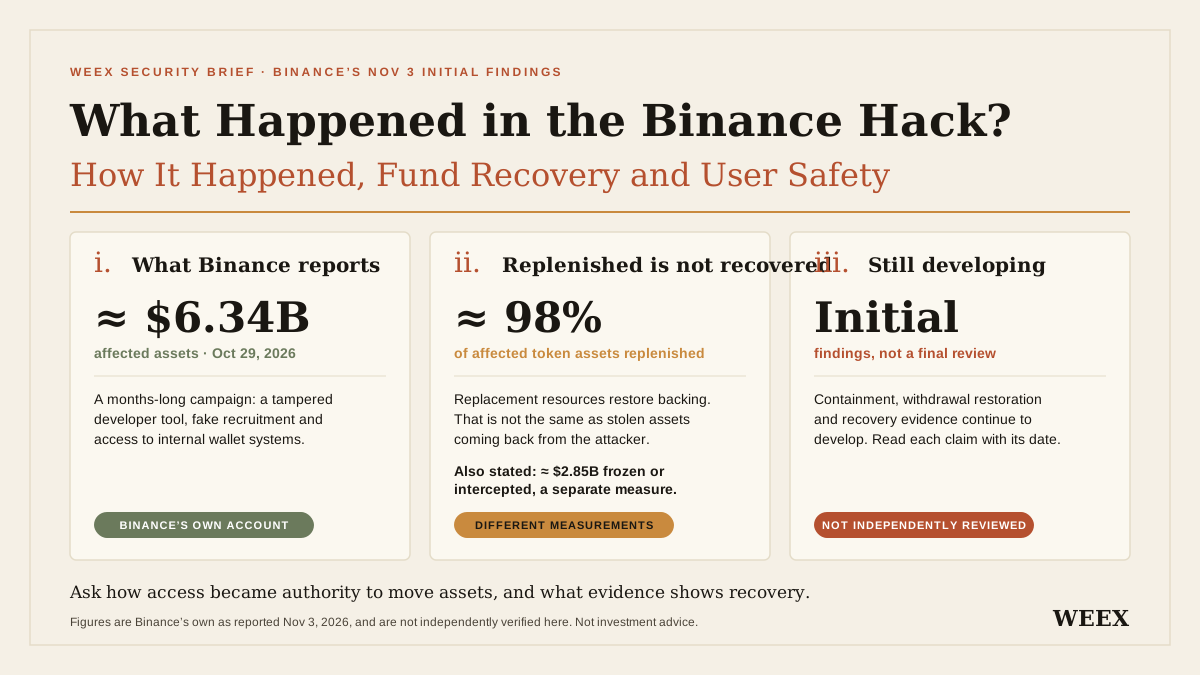
What Happened in the Binance Hack? How It Happened, Fund Recovery and User Safety
What happened in the Binance hack? Review the attack timeline, latest fund replenishment, recovery limits and practical steps to protect your account.
Tata Power Plans to Sign Agreement with Four States Allowing Power Prices to Be Linked to Coal Costs

AI Agents Do More Than Just Place Orders: The Next Entrepreneurial Opportunity Lies in Matching and Trust

NVIDIA Scandal Shakes the Internet! How Should Cryptocurrency Be Divided After a Divorce with a Tech Tycoon?

Bundesbank President Says Economic Recovery Faster Than Expected, Structural Reforms Needed

Immutable Chain's Transition to OP Stack: What Changes for Users
Ledger CEO faces backlash after saying everybody will be hacked at some point

WEEX 11.11 Shopping Fest: Buy BTC and Unlock Up to 888 USDT in Rewards

NEAR AI Discloses SGLang Security Incident and Revokes Exposed API Keys

The Art of Trading: How They Profit from Arbitraging USDE Stocks
VARA Is Not a Panacea: Dubai's Crypto Payments Still Depend on the Central Bank

a16z Frontier Partner: Agents Should Rebuild Uber-like Transaction Networks
Poland's Parliament Votes 240-202 To Let Officials Freeze Crypto Before Court Review

WEEX P2P now supports ILS, BHD, OMR & QAR —Merchant Recruitment Now Open
Cryptocurrency Security Checklist: Four Lessons from Phemex Safety Hub Vol. 05–08
Ondo Claims $4B in Tokenized Assets as RWA Market Gains Institutional Depth

DTCC Launches Tokenization Service: What Can Investors Actually Do?

The catch in recovering a hacked crypto wallet: the thief may still have a key

Bitcoin Remains Strong: Why $76,000 is the Level That Matters Now
Peter Schiff Criticizes Strategy's Bitcoin Purchases
iPhone Attack Kit 'DarkSword' Suspected of Being Misused for Cryptocurrency Theft, Bitquery Identifies Approximately $4.06 Million in Stolen Funds
Financial and Political Crisis in Paraguay: How the Ueno Bank Explosion Triggered the President's Resignation

OpenAI Releases National Community Covenant and Computing Park Policy Blueprint

GitBook Security Incident Review, Attack Targeting Trade.xyz

Post-Quantum Era Consensus Layer Divergence: Ethereum Maintains Decentralization, Monad Prioritizes Speed

The Ghost Behind the Screen: Unveiling the Secret World of North Korean Hackers Lazarus
Bitcoin Miners Turn to AI: Escaping the Crypto Cycle, but Entering New Turbulence
Decoding Variational: How a No-Order-Book Exchange Became the Dragon Behind Hyperliquid?
Creators Speak | The Biggest Risk in the Crypto Industry is Thinking It's Safe
Hedera Council adds Apex Group, servicer of $3.5T in assets
What Happened in the Binance Hack? How It Happened, Fund Recovery and User Safety
What happened in the Binance hack? Review the attack timeline, latest fund replenishment, recovery limits and practical steps to protect your account.
Tata Power Plans to Sign Agreement with Four States Allowing Power Prices to Be Linked to Coal Costs
AI Agents Do More Than Just Place Orders: The Next Entrepreneurial Opportunity Lies in Matching and Trust
NVIDIA Scandal Shakes the Internet! How Should Cryptocurrency Be Divided After a Divorce with a Tech Tycoon?
Bundesbank President Says Economic Recovery Faster Than Expected, Structural Reforms Needed
Latest articles





Latest coin listings on WEEX


