
Digital Asset Basic Law Government Proposal to Be Released This Month: How Will Regulations on Coin Issuance and Listing Change?

 Prefer us on Google


Differentiated regulations by service... Complex calculations for exchange business expansion
Existing listed coins will also be reviewed... Spot ETFs require additional legislation
Industry: "Delays in legislation disrupt business... The scope of allowances must be expedited"
[Block Media Reporter Oh Su-hwan] The government proposal for the Digital Asset Basic Law, which encompasses the regulatory framework for the entire digital asset (virtual asset) industry, is expected to be released this month. The government proposal is anticipated to include regulations governing the entire market, from operator licensing and registration to coin issuance and disclosure, listing review, and management and redemption of stablecoin reserve assets.
According to political circles on the 9th, the Financial Services Commission is conducting final preparations, including consultations with related agencies. Once the authorities finalize the framework of the bill, it will be proposed in the form of a member-sponsored bill. Yoon Dong-soo, chairman of the National Assembly's Political Affairs Committee, recently expressed a willingness for swift processing, expecting submission in November. The Financial Services Commission is also considering merging the existing member-sponsored bills pending in the National Assembly.
Although the government proposal has not yet been submitted to the National Assembly, the direction can be somewhat gauged from the drafts and policy plans released by the financial authorities so far. The financial authorities created a draft in early November last year and reported the 'Key Contents of the Digital Asset Basic Law' to the then ruling Democratic Party's Digital Asset Task Force (TF) in December. Since the financial authorities have stated that there are no significant changes from the existing draft, it is highly likely that the government proposal will maintain this framework.
Introduction of Licensing System and Pre-Issuance Review by Sector
The most significant changes are expected in the regulation of operators. Currently, virtual asset operators conduct business after reporting under the Specific Financial Information Act, but this system is focused on anti-money laundering, limiting its ability to manage the scope and soundness of operations. This is why the Financial Services Commission has identified the regulation of operator entry and business activities as a core task since the early stages of legislative discussions.
The draft from last year proposed dividing the digital asset industry into trading, brokerage, custody, and management, with capital requirements set for each business unit. Recently, it has been reported that the government proposal will include changing the entry regulation for exchanges from a reporting system to a licensing system, according to political circles and financial authorities.
As the sectors become more finely divided, the required licenses will differ depending on whether the same coin is being stored, managed, or lent. Whether exchanges expand their business directly or partner with specialized firms will depend on the sector design. Since the classification of sectors varies among member-sponsored bills, the extent to which the government proposal will be detailed is expected to be a point of contention in the merger review.
In the area of coin issuance, the Financial Services Commission has been considering the introduction of a disclosure system. The draft from last year included provisions for issuers to submit a white paper to the Financial Services Commission for approval before soliciting investors, with penalties for false statements or omissions of important information. It also included provisions for a legal association to oversee issuance and distribution disclosures. If such content is reflected in the government proposal, pre-review will take place from the issuance stage.
While the disclosure and legal burdens on issuers will increase, investors will be able to verify changes in token supply, reducing information asymmetry.
Listing reviews are also likely to shift from the autonomy of exchanges to the realm of law. The Financial Services Commission has announced its intention to publicly regulate listing standards and procedures. If the maintenance review and termination of trading support are included in the law, not only newly listed coins but also existing coins may be subject to review, making it difficult for projects with poor disclosures to maintain their listings. User protection measures are also expected to be strengthened.
The draft from last year included provisions for applying capital market law-level penalties for unfair trading practices. However, with recent hacking incidents at digital asset exchanges, there is also a possibility that the government proposal will include strengthening operators' liability for user damages.
Stablecoins: Reserve Assets and Redemption Are Key
Since stablecoins are linked to the value of fiat currencies and effectively serve as a means of payment, the focus of regulation will likely be on whether they can properly return money. The financial authorities stated in their economic growth strategy in January this year that they would include licensing systems, reserve asset management standards, and redemption guarantees in the basic law.
The key content report presented to the TF at that time proposed managing reserve assets with high liquidity, such as government bonds and deposits, and requiring that amounts exceeding the issuance balance be entrusted to management institutions like banks, while prohibiting interest payments to holders to distinguish them from deposits. The plan to institutionalize the issuance and distribution system of stablecoins was reaffirmed in the presidential work report in July.
The member-sponsored bills related to stablecoins submitted to the National Assembly also focus on licensing systems, reserve assets, and redemption obligations, indicating no disagreement on the major direction. Therefore, when the government proposal is released, discussions in the National Assembly are expected to focus on adjusting detailed criteria such as capital requirements and redemption deadlines.
How to handle the domestic distribution of overseas-issued stablecoins is also a challenge.
Spot ETFs Are at the 'Groundwork' Stage
The introduction of spot exchange-traded funds (ETFs) is also intertwined with discussions on the basic law. The government plans to allow spot ETFs through amendments to the Capital Markets Act and has stated that it will support the legislative process for related amendments in this year's economic growth strategy.
However, for ETFs to actually be launched, asset management companies must first be able to purchase Bitcoin and other assets and securely store them. Since the requirements for digital asset operators, such as custodial licenses, will be determined in the basic law, the timing of the introduction of spot ETFs will also vary depending on the legislative speed of the two laws.
A domestic exchange official stated, "As the market conditions for digital assets have worsened and the enactment of the basic law has been delayed, we are facing difficulties in promoting new businesses and expanding business areas," adding, "The basic law must be enacted as soon as possible to revitalize the market and lay the foundation for industry growth. He further stated, "Specific regulatory standards and the scope of business allowances must be clarified to enable the industry to pursue new businesses and expand investments."
-- Price
This content is provided for general informational purposes only and doesn't constitute financial, investment, legal, or tax advice. Any events, rewards, online promotions, or related information mentioned herein should not be considered a recommendation, solicitation, or invitation to purchase, sell, trade, or otherwise deal in any crypto assets. Crypto assets are highly volatile and may result in loss. The availability of WEEX services, products, and related events may vary by region. You are responsible for ensuring that your participation is in accordance with applicable local laws and regulations.
You may also like

Decrypt Becomes First News Publisher to Offer Perps Trading, Powered by Solana's Phoenix

Bitcoin Scam on Shaadi.com, User Solicited for a $500 Deposit

Ignas: HYPE and AVAX Face Value Capture Challenges

CPI Higher Than Expected in the U.S.: What It Means for Investors

Bloomberg analyst warns BTC, Nasdaq, commodities may face year-end declines

Barclays Increases Stake in BlackRock Bitcoin ETF by 48% in Q3, Citigroup Establishes $119 Million FBTC Position

Something strange is happening with Bitcoin. It is neither digital gold nor a tech company for Wall Street

US card debt hits $1.29 trillion as Bitcoin loans expose a collateral divide

CryptoQuant: Bitcoin Analyst Sentiment Significantly Bearish, Index Drops to -1.8σ

CoinShares Survey Shows Fund Managers' Digital Asset Allocation Rises to 1.3%

From Sidechains to zk-Rollups: Tacit Chain Aims to Redefine Payments with Default Privacy

Treasury Discusses Bitcoin Acquisition Pathways, Government Holdings Undergo Second Round of Review

Trump Still Interested in Increasing Bitcoin Holdings Amid Legal Hurdles

LNbits Security Patch Released After Bitcoin Wallet Theft

Deutsche Bank launches crypto custody for Bitcoin, Ethereum, stablecoins
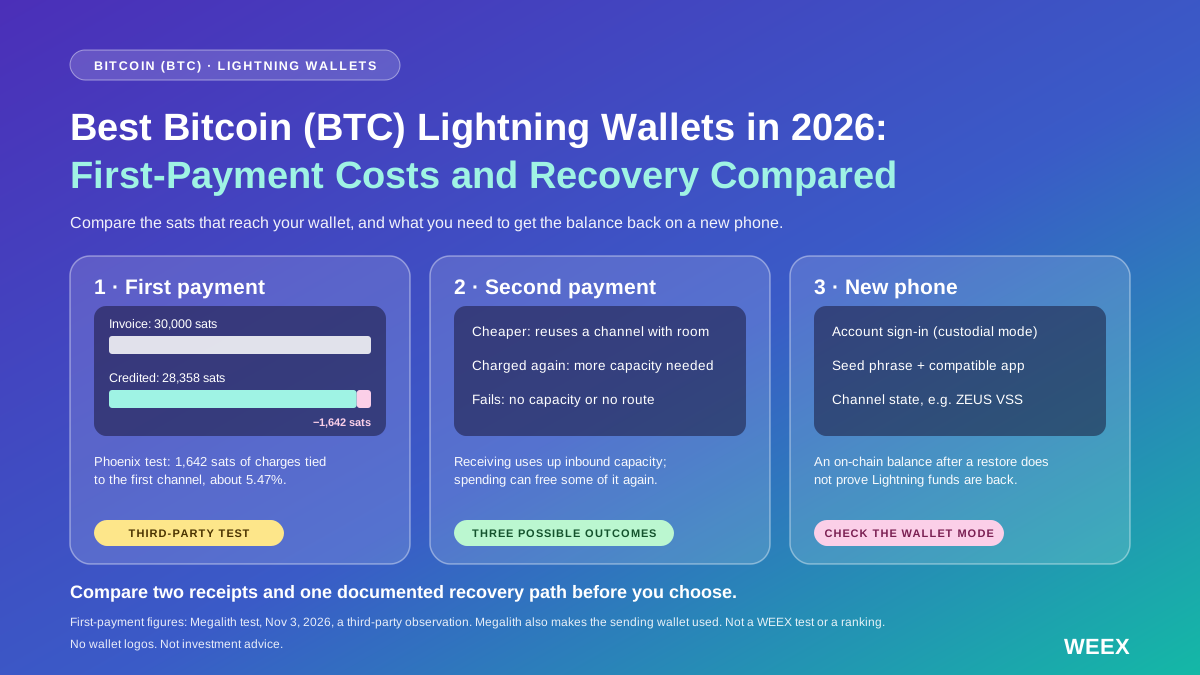
Best Bitcoin (BTC) Lightning Wallets in 2026: First-Payment Costs and Recovery Compared
Key Takeaways Lightning Network wallets enable fast and cost-effective Bitcoin transactions by using off-chain channels. A variety of…

SEC Enforcement Actions Decrease by 23.7% to 348 in Fiscal Year 2026

BlackRock Loses $1.735 Billion in Cryptocurrency Funds

Ethereum’s Joseph Lubin explains why ETH could rival Bitcoin and gold

BitGo Posts $44M Quarterly Profit as Platform Assets Grow, But Adjusted EBITDA Stays Negative
Bitcoin: A Thief Sentenced in China for Memorizing a Seed Phrase

Bitcoin loses status as main risk asset amid stock market lag

Crypto ATM Fees: How Much Bitcoin (BTC) Do You Get for $100?
See how much Bitcoin $100 buys at a crypto ATM. Compare two sample quotes, calculate the all-in cost, and learn which fees not to count twice.

WEEX 11.11 Shopping Fest: Buy BTC and Unlock Up to 888 USDT in Rewards

WEEX Exclusive:CPI Exceeds Expectations, Three Major Indexes and Bitcoin Lower | WEEX Daily Market Brief (November 11, 2026)
October CPI rose 0.4% month over month, above expectations. Bond yields climbed, and the three major indexes all closed lower. Bitcoin briefly fell below $73,000. CoreWeave’s third-quarter revenue beat expectations. TSMC’s October revenue was strong. The bond market is closed on November 11; watch for Rumble’s earnings report.

CPI Exceeds Expectations, Three Major Indexes and Bitcoin Lower | WEEX Daily Market Brief (November 11, 2026)
October CPI rose 0.4% month over month, above expectations. Bond yields climbed, and the three major indexes all closed lower. Bitcoin briefly fell below $73,000. CoreWeave’s third-quarter revenue beat expectations. TSMC’s October revenue was strong. The bond market is closed on November 11; watch for Rumble’s earnings report.

24X Expands Collaboration with Standard Chartered Bank to Support Bitcoin and Ethereum Trading
Robinhood's Latest Earnings Report Tells You All You Need to Know About the Future of Crypto. These 2 Numbers Really Stood Out.
Bitcoin Spot ETF Sees Net Outflow of $95.0012 Million Yesterday, Continuing for 4 Days

From Shorting Stablecoins to Building Chains: The Shift of Airwallex Founder Jack Zhang and the Battle for Payment Settlement Layers
Decrypt Becomes First News Publisher to Offer Perps Trading, Powered by Solana's Phoenix
Bitcoin Scam on Shaadi.com, User Solicited for a $500 Deposit
Ignas: HYPE and AVAX Face Value Capture Challenges
CPI Higher Than Expected in the U.S.: What It Means for Investors
Bloomberg analyst warns BTC, Nasdaq, commodities may face year-end declines
Barclays Increases Stake in BlackRock Bitcoin ETF by 48% in Q3, Citigroup Establishes $119 Million FBTC Position
Latest articles





Latest coin listings on WEEX


