
Cryptocurrency Transfers Abroad: New Rules for Citizens and Businesses Starting September 1, 2026

 Prefer us on Google


Starting September 1, 2026, cryptocurrency transfers abroad will be available to Russian citizens in two main formats: to their own wallets outside the country and to non-residents for the payment of goods or services. The Bank of Russia emphasizes that alongside this new opportunity, the requirements for currency control and anti-money laundering rules will remain in place. The basic restrictions are already clear: the transfer must comply with the permitted format, and business operations must be supported by documents for the authorized bank.
This is an important step for the market: cryptocurrency is gaining a clearer role in cross-border transactions. Digital money can be used not only as an investment asset but also as a payment instrument in foreign economic operations, provided the transaction meets the established requirements.
Citizens Will Be Allowed to Send Digital Currency to Foreign Wallets
The new regime should not be confused with a regular bank transfer. A money transfer through a bank and sending a digital asset via blockchain are fundamentally different operations, even if in both cases the funds leave Russia.
A citizen will be able to transfer cryptocurrency to their wallet opened abroad. Payment to a foreign seller is also allowed if goods or services are purchased from a non-resident. This can be Bitcoin, Ethereum, Litecoin, or another digital asset. When choosing, one should consider not only the name of the coin but also the network fee, confirmation speed, liquidity, and support from the necessary wallet, exchange, or service. The mere possibility of transfer does not negate the verification of the source of funds and the economic rationale for the operation.
The regulator emphasizes that control will remain. While previously a cross-border bank transaction went through traditional financial infrastructure, including SWIFT, now part of the settlements may move to the digital realm. However, this does not mean a free regime without documents and checks.
How to Transfer Cryptocurrency Abroad
There are several methods for transferring, each suitable for its own task:
- Centralized exchange: convenient if you need to buy an asset, store it in an account, and send it to an external wallet.
- P2P platform: helps find a counterparty for buying or selling cryptocurrency but requires particularly careful verification of the transaction terms.
- Exchange: suitable for quick exchanges, while it is important to check the rate, fee, and service rules in advance.
- Direct transfer between wallets: the simplest option if the cryptocurrency is already with the sender and the recipient's address is known.
The basic sequence looks like this:
- Create or prepare a wallet that can be used abroad and keep access to the seed phrase or keys.
- Choose cryptocurrency considering the fee, network speed, liquidity, and support from necessary services.
- Verify the recipient's address and transfer network: an error in the network or address can lead to loss of funds.
- Send a small test amount if the transfer is large or the address is used for the first time.
- Conduct the main transfer and wait for confirmation of the transaction in the blockchain or in the service interface.
Fees and Withdrawal of Cryptocurrency to Fiat Abroad
The fee depends on the method of transfer. In a direct transfer between wallets, the network fee plays a major role. On exchanges, withdrawal fees, trading operations, or conversion fees may apply. In P2P and exchanges, costs are often already included in the rate, so the final price may differ from the visible fee.
If you need to obtain fiat currency abroad, the process usually goes as follows:
- Transfer cryptocurrency to an exchange, P2P platform, exchange office, or another service that supports the sale of the asset.
- Choose a method for receiving fiat money: bank transfer, card, local payment system, or cash if such an option is available in the chosen service.
- Sell cryptocurrency at a suitable rate and check the final amount considering fees and spreads.
- Receive fiat and keep confirmations of the transaction for possible verification of the source of funds.
-- Price
Advantages, Risks, and Choosing a Service
International cryptocurrency transfers have obvious advantages:
- Speed: the transfer can be faster than a traditional bank payment.
- Independence from banking channels: the operation goes through blockchain or crypto service.
- Accessibility: both sender and receiver only need to have a suitable wallet or account on the service.
However, there are also weaknesses that are important to consider in advance:
- Volatility: the asset's value may change before the exchange or settlement is completed.
- Fees: in overloaded networks and with certain services, costs can significantly increase.
- Risk of blocking: the exchange, P2P platform, or exchange office may request confirmation of the source of funds.
- Legal consequences: the transfer must comply with currency and anti-money laundering regulations.
- Loss of access: losing the seed phrase, keys, or access to the account can deprive the owner of funds.
- Fraud: the risk is especially high in transactions with unfamiliar counterparties and dubious exchanges.
A reliable service should be chosen based on several criteria: reputation, user reviews, clear fees, support, security measures, as well as licenses or registration where applicable. Before a large transfer, it is wise to test the service with a small amount.
External Trade Will Gain an Additional Channel for Settlements
For importers and exporters, a key change is related to foreign trade contracts. Participants in foreign economic activity will be able to use digital currencies and stablecoins for settlements with foreign counterparties.
This option is particularly important against the backdrop of restrictions faced by international payments through traditional banking channels. Sanctions related to Russia's invasion of Ukraine have intensified pressure on cross-border settlements, prompting businesses to seek alternative tools for fulfilling contracts.
At the same time, digital assets do not become a way to circumvent control. Companies will have to confirm transactions with authorized banks. The documents will need to disclose:
- Participants in the transaction.
- The value of the operation.
- The basis for the payment.
- Other parameters for currency and anti-money laundering control.
What Assets Can Be Used for Settlements
In business transactions, digital settlements can refer to various instruments. For quick comparison, they can be conveniently divided by type:
- Cryptocurrencies: Bitcoin, Ethereum, Litecoin. Used for direct transfers between wallets, but speed and fees depend on the chosen network.
- Stablecoins: Tether, USDC. Suitable for settlements where it is important to be tied to fiat currency and have a clearer payment amount.
- Tokens tied to fiat currencies: used if supported by the wallet, exchange, or other service through which the settlement occurs.
- Assets of public blockchains: can be used if the participants in the transaction, the bank, and the regulator understand the network, amount, and basis of the operation.
The currency of the obligation under the contract is of particular importance. The price can be expressed in Russian rubles, US dollars, or another settlement unit, but the operation itself must be clear to the bank and the regulator. If the counterparty is located, for example, in the United States or another jurisdiction, this does not relieve the obligation to confirm the legality and economic content of the payment.
The detailed requirements for documents and procedures will be established in a regulatory act of the Bank of Russia. It should specify how residents and non-residents present supporting documents to authorized banks during currency transactions.
A draft of such a document has already undergone an assessment of regulatory impact. This means that the very possibility of cross-border settlements using digital assets will be provided for by law, but practical application will depend on subordinate regulations.
For businesses, this is a fundamental point. Paying for a contract with cryptocurrency will not be sufficient; the transaction must be conducted in such a way that the bank has documents confirming its legality, value, and connection to the actual delivery of goods or services.
The New Regime Is Not Related to the Digital Ruble
As of September 1, rules regulating the circulation of cryptocurrencies in the Russian market will come into effect. The Bank of Russia previously noted that transactions through intermediaries could be conducted by both qualified and unqualified investors, but additional restrictions will apply to the latter.
This regime should not be mixed with the digital ruble. The digital ruble is the national digital form of the Russian currency and operates on the platform of the Bank of Russia. Cryptocurrencies belong to a different category of digital assets and operate under their own rules.
In the end, this is not about a complete transition of foreign trade to cryptocurrencies, but about the emergence of another legal instrument for international settlements. From September 1, 2026, it will be applicable to citizens and businesses, but only if the requirements of currency control and anti-money laundering legislation are met.
This content is provided for general informational purposes only and doesn't constitute financial, investment, legal, or tax advice. Any events, rewards, online promotions, or related information mentioned herein should not be considered a recommendation, solicitation, or invitation to purchase, sell, trade, or otherwise deal in any crypto assets. Crypto assets are highly volatile and may result in loss. The availability of WEEX services, products, and related events may vary by region. You are responsible for ensuring that your participation is in accordance with applicable local laws and regulations.
You may also like

Peter Brent: The Yield on 30-Year U.S. Bonds May Reach 7%

Glassnode reports stablecoin supply fell by 14.2 billion

10x Research: Bitcoin's One-Year Return After Midterm Elections is 53.9%

Decrypt Becomes First News Publisher to Offer Perps Trading, Powered by Solana's Phoenix

Bitcoin Scam on Shaadi.com, User Solicited for a $500 Deposit

Ignas: HYPE and AVAX Face Value Capture Challenges

CPI Higher Than Expected in the U.S.: What It Means for Investors

Bloomberg analyst warns BTC, Nasdaq, commodities may face year-end declines
Barclays Increases Stake in BlackRock Bitcoin ETF by 48% in Q3, Citigroup Establishes $119 Million FBTC Position

Something strange is happening with Bitcoin. It is neither digital gold nor a tech company for Wall Street

US card debt hits $1.29 trillion as Bitcoin loans expose a collateral divide

CryptoQuant: Bitcoin Analyst Sentiment Significantly Bearish, Index Drops to -1.8σ

CoinShares Survey Shows Fund Managers' Digital Asset Allocation Rises to 1.3%

From Sidechains to zk-Rollups: Tacit Chain Aims to Redefine Payments with Default Privacy

Treasury Discusses Bitcoin Acquisition Pathways, Government Holdings Undergo Second Round of Review

Trump Still Interested in Increasing Bitcoin Holdings Amid Legal Hurdles

LNbits Security Patch Released After Bitcoin Wallet Theft

Deutsche Bank launches crypto custody for Bitcoin, Ethereum, stablecoins
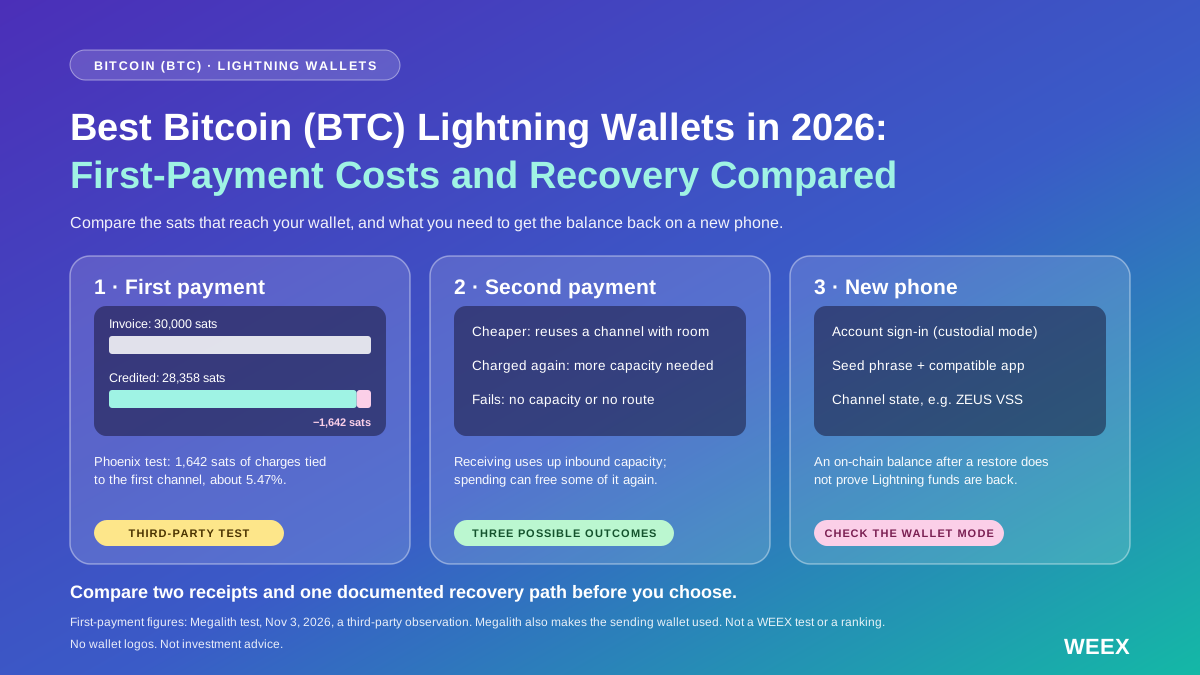
Best Bitcoin (BTC) Lightning Wallets in 2026: First-Payment Costs and Recovery Compared
Key Takeaways Lightning Network wallets enable fast and cost-effective Bitcoin transactions by using off-chain channels. A variety of…

SEC Enforcement Actions Decrease by 23.7% to 348 in Fiscal Year 2026
BlackRock Loses $1.735 Billion in Cryptocurrency Funds

Ethereum’s Joseph Lubin explains why ETH could rival Bitcoin and gold

BitGo Posts $44M Quarterly Profit as Platform Assets Grow, But Adjusted EBITDA Stays Negative
Bitcoin: A Thief Sentenced in China for Memorizing a Seed Phrase

Bitcoin loses status as main risk asset amid stock market lag
Crypto ATM Fees: How Much Bitcoin (BTC) Do You Get for $100?
See how much Bitcoin $100 buys at a crypto ATM. Compare two sample quotes, calculate the all-in cost, and learn which fees not to count twice.

WEEX 11.11 Shopping Fest: Buy BTC and Unlock Up to 888 USDT in Rewards

WEEX Exclusive:CPI Exceeds Expectations, Three Major Indexes and Bitcoin Lower | WEEX Daily Market Brief (November 11, 2026)
October CPI rose 0.4% month over month, above expectations. Bond yields climbed, and the three major indexes all closed lower. Bitcoin briefly fell below $73,000. CoreWeave’s third-quarter revenue beat expectations. TSMC’s October revenue was strong. The bond market is closed on November 11; watch for Rumble’s earnings report.

CPI Exceeds Expectations, Three Major Indexes and Bitcoin Lower | WEEX Daily Market Brief (November 11, 2026)
October CPI rose 0.4% month over month, above expectations. Bond yields climbed, and the three major indexes all closed lower. Bitcoin briefly fell below $73,000. CoreWeave’s third-quarter revenue beat expectations. TSMC’s October revenue was strong. The bond market is closed on November 11; watch for Rumble’s earnings report.

24X Expands Collaboration with Standard Chartered Bank to Support Bitcoin and Ethereum Trading
Peter Brent: The Yield on 30-Year U.S. Bonds May Reach 7%
Glassnode reports stablecoin supply fell by 14.2 billion
10x Research: Bitcoin's One-Year Return After Midterm Elections is 53.9%
Decrypt Becomes First News Publisher to Offer Perps Trading, Powered by Solana's Phoenix
Bitcoin Scam on Shaadi.com, User Solicited for a $500 Deposit
Ignas: HYPE and AVAX Face Value Capture Challenges
Latest articles





Latest coin listings on WEEX


