
Could Elon Musk be Satoshi Nakamoto? Researcher finds linguistic coincidences but no evidence

 Prefer us on Google


- The author of the post suggested that Elon Musk could be the creator of Bitcoin, Satoshi Nakamoto.
- To support this, he used stylometry — the analysis of linguistic features of texts.
- The researcher compared Nakamoto's correspondence and posts with public materials from 65 well-known members of the Bitcoin community.
- At the same time, the author acknowledged that the results do not confirm the identity of Bitcoin's creator.
The author of the post on X under the pseudonym yellow proposed the theory that Elon Musk could be the creator of Bitcoin, Satoshi Nakamoto. To verify this, he used Grok and stylometric analysis, comparing Nakamoto's linguistic features with texts from 65 well-known participants in the cryptocurrency industry.
I used Grok Bot and stylometry (measuring someone's writing fingerprint) to check Satoshi Nakamoto's writing against 65 well-known Bitcoiners. 2.4 million words later, one name stood out that I didn't expect: Elon Musk. The case, the hints — the science. https://t.co/cFUfgnS2s2 --- yellow.🍌🍞 (@ICOffenderII) November 5, 2026
The author claims that after analyzing a large dataset, he found several coincidences with Musk's writing style, but emphasizes that this is merely a hypothesis and not proof of his involvement in the creation of the first cryptocurrency.
What connects Musk to the early history of Bitcoin
One of the main arguments the author cites is the history of the payment company X.com, which Musk founded in 1999. After merging with Confinity in 2000, it became part of PayPal. According to co-founder Luke Nosek, the initial goal of the team was to create a global currency independent of the influence of banks and governments.
<
>, — Nosek noted during a speech at the World Economic Forum in 2019.
He explained that PayPal became too centralized and dependent on large financial institutions.
The theorist suggests that this unfinished idea may have influenced Musk's subsequent work. He pays particular attention to 2008: at that time, Tesla and SpaceX were experiencing serious financial difficulties, and the global economy was in crisis. It was during this period that Satoshi Nakamoto published the technical document for Bitcoin, leaving a newspaper headline about another bank bailout in the first block of the network.
Satoshi Nakamoto: who created Bitcoin and why the identity remains a mystery?
08.10.2024
Read
Another argument concerns Musk's technical skills. He has previously spoken about his programming experience in C++, assembly language, and working with hardware. Bitcoin was also written in C++.
Additionally, researcher Robert Graham characterized Nakamoto's code as the work of a programmer who had experience developing software for Windows and Unix.
What the text analysis showed and why it is insufficient
A separate part of the study was dedicated to stylometry — a method that determines the authorship of texts based on characteristic linguistic habits. For comparison, about 62,000 words from Nakamoto's letters and messages, Musk's posts on X, his materials for Tesla, and other available texts were used. The control group consisted of cryptographers, early Bitcoin developers, and other well-known community members.
Among the identified features, the author mentioned:
- the phrase "order of magnitude": it was regularly used by both Nakamoto and Musk;
- the word "bloody": both authors used this characteristic British English expression;
- double spaces after periods: in Nakamoto's texts, they occurred in 95.3% of cases;
- British spelling: in Satoshi's texts, the share of British variants of spelling was about 33%, while among other authors from cryptographic mailing lists, it was 13%.
However, the results of the comparison using Burrows' Delta method did not allow for establishing the author. Musk's texts on X received a score of 1.04, while Nick Szabo's was 1.32, and Adam Back's was 1.13.
The New York Times stated that Satoshi Nakamoto is Adam Back
08.04.2026
Read
At the same time, the researcher noted that comparing social media posts with letters and messages on forums is difficult due to the difference in genres. None of the candidates demonstrated a sufficiently close match with Satoshi to confirm authorship.
The material also mentions indirect hints: Musk's jokes about Nakamoto's identity, publications about Bitcoin, the name X.com, and the name of his son X Æ A-12. The author connects them with the theory but acknowledges that each of these episodes could be a coincidence or a joke.
Among other assumptions is the possible coincidence of Musk's and Nakamoto's locations in the Los Angeles area in January 2009. However, this argument also does not establish the identity of Bitcoin's creator.
Musk himself denied being Satoshi Nakamoto in 2017. In a post, he noted that several years ago he received a portion of Bitcoin from a friend but does not know where it is now.
The author of the research emphasizes that stylometry cannot confirm or refute his involvement. The only convincing evidence could be a cryptographically signed transaction from addresses associated with early Bitcoin mining.
It is worth noting that the identity of Bitcoin's creator has been repeatedly attempted to be established by journalists, researchers, and documentarians, but none of the versions have gained general recognition. In particular:
- in the HBO film "Digital Money: The Bitcoin Mystery," which premiered on October 9, 2024, the authors named Bitcoin Core developer Peter Todd as a likely Satoshi Nakamoto, but he denied it;
- earlier, director Cullen Hoback claimed that his film would reveal the identity of Bitcoin's creator, and prior to that, among possible candidates, Len Sassaman was mentioned;
- in April 2026, the documentary "In Search of Satoshi" presented another hypothesis: the pseudonym likely belonged to not one person but a duo.
-- Price
This content is provided for general informational purposes only and doesn't constitute financial, investment, legal, or tax advice. Any events, rewards, online promotions, or related information mentioned herein should not be considered a recommendation, solicitation, or invitation to purchase, sell, trade, or otherwise deal in any crypto assets. Crypto assets are highly volatile and may result in loss. The availability of WEEX services, products, and related events may vary by region. You are responsible for ensuring that your participation is in accordance with applicable local laws and regulations.
You may also like
Israel Discount Bank to Open Bitcoin and Ethereum Trading in App Starting November 26

Israel Discount Bank to Open Bitcoin and Ethereum Trading in App from November 26

Thousands of Bitcoin nodes gave anonymous strangers a pass around security limits
Bitcoin Core Addresses Three Security Vulnerabilities in October
Peter Brent: The Yield on 30-Year U.S. Bonds May Reach 7%
Glassnode reports stablecoin supply fell by 14.2 billion

10x Research: Bitcoin's One-Year Return After Midterm Elections is 53.9%

Decrypt Becomes First News Publisher to Offer Perps Trading, Powered by Solana's Phoenix
Bitcoin Scam on Shaadi.com, User Solicited for a $500 Deposit

Ignas: HYPE and AVAX Face Value Capture Challenges

CPI Higher Than Expected in the U.S.: What It Means for Investors

Bloomberg analyst warns BTC, Nasdaq, commodities may face year-end declines
Barclays Increases Stake in BlackRock Bitcoin ETF by 48% in Q3, Citigroup Establishes $119 Million FBTC Position

Something strange is happening with Bitcoin. It is neither digital gold nor a tech company for Wall Street

US card debt hits $1.29 trillion as Bitcoin loans expose a collateral divide
CryptoQuant: Bitcoin Analyst Sentiment Significantly Bearish, Index Drops to -1.8σ

CoinShares Survey Shows Fund Managers' Digital Asset Allocation Rises to 1.3%

From Sidechains to zk-Rollups: Tacit Chain Aims to Redefine Payments with Default Privacy

Treasury Discusses Bitcoin Acquisition Pathways, Government Holdings Undergo Second Round of Review

Trump Still Interested in Increasing Bitcoin Holdings Amid Legal Hurdles
LNbits Security Patch Released After Bitcoin Wallet Theft

Deutsche Bank launches crypto custody for Bitcoin, Ethereum, stablecoins
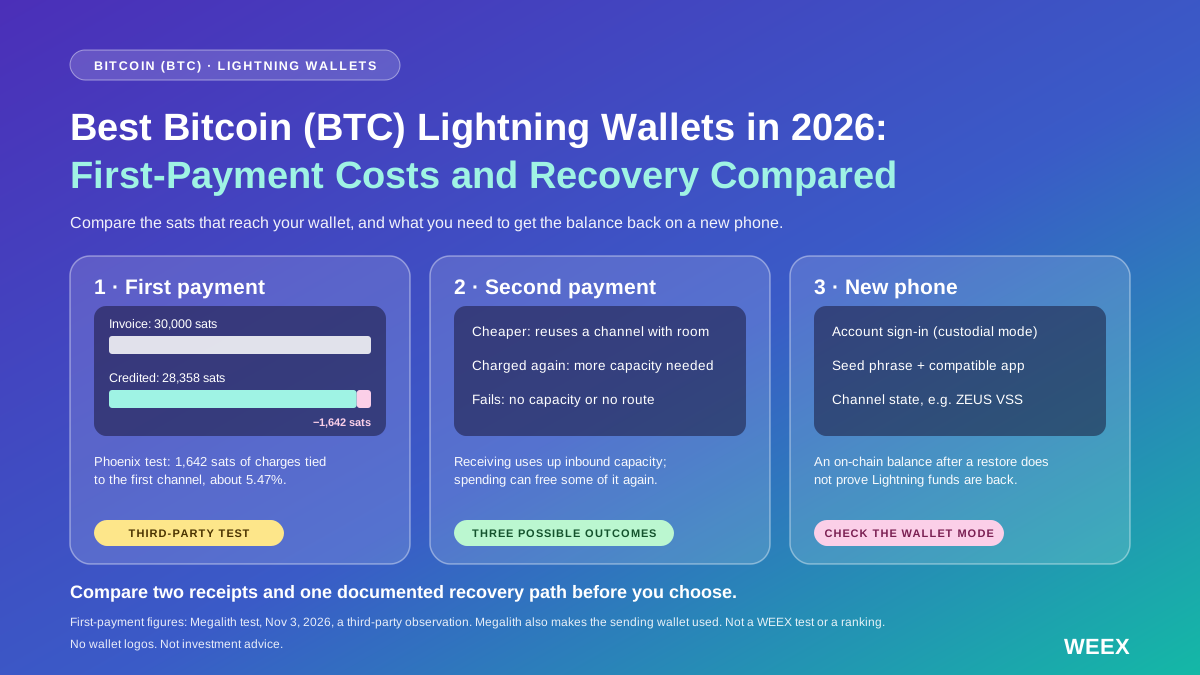
Best Bitcoin (BTC) Lightning Wallets in 2026: First-Payment Costs and Recovery Compared
Key Takeaways Lightning Network wallets enable fast and cost-effective Bitcoin transactions by using off-chain channels. A variety of…

SEC Enforcement Actions Decrease by 23.7% to 348 in Fiscal Year 2026
BlackRock Loses $1.735 Billion in Cryptocurrency Funds

Ethereum’s Joseph Lubin explains why ETH could rival Bitcoin and gold

BitGo Posts $44M Quarterly Profit as Platform Assets Grow, But Adjusted EBITDA Stays Negative
Bitcoin: A Thief Sentenced in China for Memorizing a Seed Phrase

Bitcoin loses status as main risk asset amid stock market lag
Crypto ATM Fees: How Much Bitcoin (BTC) Do You Get for $100?
See how much Bitcoin $100 buys at a crypto ATM. Compare two sample quotes, calculate the all-in cost, and learn which fees not to count twice.
Israel Discount Bank to Open Bitcoin and Ethereum Trading in App Starting November 26
Israel Discount Bank to Open Bitcoin and Ethereum Trading in App from November 26
Thousands of Bitcoin nodes gave anonymous strangers a pass around security limits
Bitcoin Core Addresses Three Security Vulnerabilities in October
Peter Brent: The Yield on 30-Year U.S. Bonds May Reach 7%
Glassnode reports stablecoin supply fell by 14.2 billion
Latest articles





Latest coin listings on WEEX


