
Coinbase Investor Class Action Can Move Forward, Federal Judge Rules

 Prefer us on Google


A federal judge has allowed parts of an investor class-action lawsuit against Coinbase and certain executives to proceed, keeping allegations over risk disclosures alive in court.
US District Judge Katherine Polk Failla ruled on August 20 that some claims could move into discovery. The court dismissed several claims but allowed allegations that Coinbase misled investors by concealing potential bankruptcy risks and downplaying SEC scrutiny to proceed.
The ruling is procedural.
It does not mean Coinbase has been found liable. It does not prove wrongdoing. It means the plaintiffs cleared enough of an early legal hurdle for certain claims to continue.
Coinbase is one of the most important public companies in crypto.
Its disclosures, risk factors, regulatory statements, and investor communications are watched closely by both traditional markets and digital asset investors. A securities class action against the company therefore has broader relevance.
The case goes to a familiar question.
How much risk must crypto companies disclose, and how clearly must they explain regulatory uncertainty to investors?
That question has become more important as crypto firms operate in public markets, face agency scrutiny, and deal with fast-changing rules.
The surviving claims reportedly concern whether Coinbase adequately disclosed certain risks.
Investors say the company concealed or downplayed potential bankruptcy-related concerns and regulatory scrutiny. Coinbase can still defend itself, and the facts remain contested.
But the court's decision means those claims can proceed into discovery.
Discovery matters because it can force production of documents, communications, internal analysis, and testimony. That process can be expensive and revealing, even if a company ultimately wins.
Private crypto firms can often operate with limited disclosure.
Public companies cannot. They must file risk factors, financial statements, management discussion, legal updates, and material event disclosures. Investors rely on those filings when buying shares.
That creates legal exposure.
If plaintiffs believe a company misrepresented risks or omitted material information, they may bring securities claims. Courts then decide which claims are strong enough to proceed.
Coinbase is not alone in facing this type of scrutiny, but its position makes the case especially visible.
The caution is essential.
A motion-stage ruling is not a verdict. The court did not conclude that Coinbase misled investors. It only allowed certain allegations to continue.
Many class actions narrow over time.
Claims can be dismissed later, settled, or defeated after discovery. Coinbase can still challenge the allegations and defend its disclosures.
Markets should not treat the ruling as proof of wrongdoing.
The case also shows how regulatory uncertainty can become a securities-law issue.
If a crypto company's business depends heavily on regulatory treatment, investors may argue that regulatory risk is material. Companies then need to describe that risk clearly enough that investors understand the potential impact.
That is difficult in crypto because rules can shift quickly.
SEC scrutiny, exchange registration questions, custody concerns, staking services, token listings, and bankruptcy treatment can all affect business models.
Coinbase operates directly inside that uncertainty.
The case now moves forward on the surviving claims.
Discovery will determine what evidence the plaintiffs can obtain and how Coinbase responds. The company may later seek dismissal, summary judgment, settlement, or trial depending on how the case develops.
For now, the key takeaway is narrow but important.
Coinbase has not been found liable, but it must continue defending parts of an investor lawsuit over risk disclosures.
That keeps public-company crypto disclosure standards in the spotlight.
-- Price
This content is provided for general informational purposes only and doesn't constitute financial, investment, legal, or tax advice. Any events, rewards, online promotions, or related information mentioned herein should not be considered a recommendation, solicitation, or invitation to purchase, sell, trade, or otherwise deal in any crypto assets. Crypto assets are highly volatile and may result in loss. The availability of WEEX services, products, and related events may vary by region. You are responsible for ensuring that your participation is in accordance with applicable local laws and regulations.
You may also like

Unity and NVIDIA NVentures Join Emulate's $700 Million Funding Round

How Far Can AI Trading Go Amid the Anti-Data Center Wave? It Depends on GPU Leasing Prices

Tech Veteran: Anthropic IPO Will Be the Peak of AI Market in US Stocks, Will 'Aggressively Buy Chinese AI' If Conditions Allow

Moody's Projects Global Credit Deterioration by 2027 and Warns of the Impact of Rates and AI

Artificial Intelligence Drives a Quarter of UK Economic Growth, Faces Global Tech Stock Sell-off Risk

CryptoQuant: Bitcoin Analyst Sentiment Significantly Bearish, Index Drops to -1.8σ
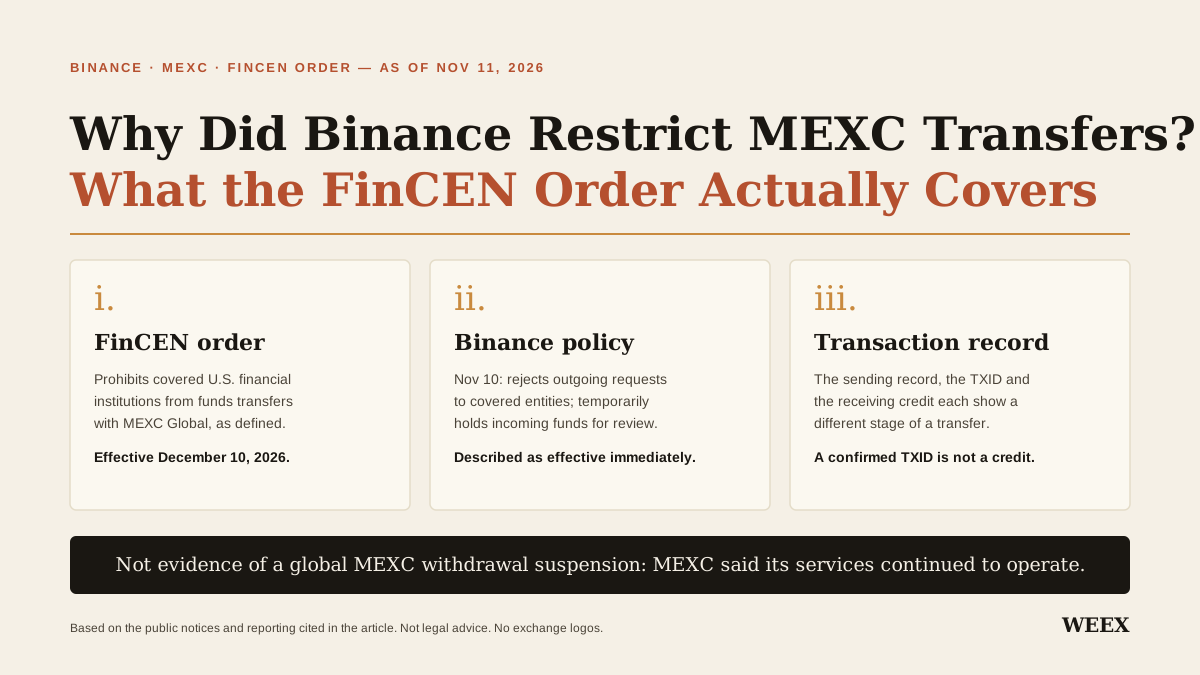
Why Did Binance Restrict MEXC Transfers? What the FinCEN Order Actually Covers
Find out why Binance restricted MEXC transfers, when the FinCEN order takes effect, and what to check if your crypto deposit is held for review.
Why Did Binance Restrict MEXC Transfers? What the FinCEN Order Actually Covers
Find out why Binance restricted MEXC transfers, when the FinCEN order takes effect, and what to check if your crypto deposit is held for review.

BitcoinHabebe Shares ARIA Rises 1000% in a Month

Booz Allen Switches to NVIDIA's Nemotron Large Model
LNbits Security Patch Released After Bitcoin Wallet Theft

Former Employee Sues Ethereum Foundation, Claims Retaliatory Dismissal After Protesting 'Seppuku' Clause

European Natural Gas Futures Prices Exceed €85

Abu Dhabi Investment Authority Seeks $7.5 Billion Loan to Diversify Portfolio

India Bans Export of Lithium-Ion Battery Recycling Materials

BitGo Posts $44M Quarterly Profit as Platform Assets Grow, But Adjusted EBITDA Stays Negative

Rhein Group and KKR Invest $16 Billion in UK Offshore Wind Project
U.S. Treasury Secretary Besant Transferred to Military Base Due to 'Life Threats'

NEAR AI Discloses SGLang Security Incident and Revokes Exposed API Keys

Did Claude breach NVIDIA's 20-year CUDA moat in three days? Anthropic lets Mythos port GPU low-level code by itself

Robinhood's Latest Earnings Report Tells You All You Need to Know About the Future of Crypto. These 2 Numbers Really Stood Out.

Malware Discovered in Telegram Trading Program, GRAM Stolen
Wall Street's Panic Gauge Just Broke a 13-Year Record. Goldman Says History Favors a Rebound

21 banks allocate 270 million dollars for Project Faro
OpenAI Acquires Odessia to Expand AI Travel Agent Business

DeepMind says its AI agents ran a four-day cryptography test with about 20 human messages
Stablecoin venture draws $270M backing from Goldman, Citi and peers

Strategy spent more than twice as much on preferred buybacks as Bitcoin last week

Europe Prepares Common Standards for Tokenized Securities
Enza Closes $6 Million Funding Round to Develop Payment Infrastructure
Unity and NVIDIA NVentures Join Emulate's $700 Million Funding Round
How Far Can AI Trading Go Amid the Anti-Data Center Wave? It Depends on GPU Leasing Prices
Tech Veteran: Anthropic IPO Will Be the Peak of AI Market in US Stocks, Will 'Aggressively Buy Chinese AI' If Conditions Allow
Moody's Projects Global Credit Deterioration by 2027 and Warns of the Impact of Rates and AI
Artificial Intelligence Drives a Quarter of UK Economic Growth, Faces Global Tech Stock Sell-off Risk
CryptoQuant: Bitcoin Analyst Sentiment Significantly Bearish, Index Drops to -1.8σ
Latest articles


Latest coin listings on WEEX


