
Bitcoin: Why JPMorgan Reports an Average Return of 20.9% but Only 10% Per Year

 Prefer us on Google


Two returns for a single bitcoin. In its long-term assumptions published on October 19, J.P. Morgan Asset Management attributes an average return of 20.9% per year to BTC, followed by a compound return of 10%. Nearly eleven points separate the two figures, and every bitcoin holder pays the price, often without realizing it.
Key Points
- The average annual performance overestimates what actually remains in the portfolio.
- The gap widens with the square of volatility, which the bank sets at 55% for BTC.
- For U.S. listed real estate, which is much calmer, the loss does not exceed 1.4 points.
- Bitwise considers the volatility assumption too pessimistic, and Grayscale's reports give it credit.
Average Return and Compound Return of Bitcoin
Try the experiment with 100 euros. In the first year, your investment gains 50%, making it worth 150 euros. In the second year, it loses 50% and falls back to 75 euros. The average of the two years is zero, yet you have lost a quarter of your investment.
Bitcoin has played out this scenario in reality. At the end of 2021, it was worth about $46,300. It ended 2022 around $16,500, a -64% drop, before closing 2023 around $42,300, a jump of 155%. The arithmetic average of these two years gives +45% per year. However, someone who held from start to finish lost about 9%.
The compound return, also known as annualized, corrects this bias. It answers a single question: What fixed rate, applied each year, leads from the initial investment to the final amount? This is what JPMorgan retains in its Long-Term Capital Market Assumptions, and it gives 10% to bitcoin.
The calculation can be done on a phone calculator. Divide the final amount by the initial investment, take the square root if there are two years (the cube root for three), then subtract 1. For bitcoin between the end of 2021 and the end of 2023, $42,300 divided by $46,300 gives 0.91, or -4.4% per year once the operation is done. With our 100 euros becoming 75, we drop to -13.4% per year, far from the zero displayed by the average.
The Drag of Volatility on Bitcoin
Financiers talk about volatility drag. The more prices rise and fall sharply, the more the arithmetic average diverges from what you actually receive in the end. And this drag increases with the square of volatility, meaning that doubling the shocks quadruples the loss.
JPMorgan's table, relayed by Matt Hougan of Bitwise, allows for comparison. U.S. listed real estate shows 17.3% volatility, an average return of 9.55%, and a compound return of 8.2%. The gap is 1.35 points. Small-cap U.S. stocks, with 21% volatility, lose about two points. Bitcoin, at 55%, loses 10.9.
The rule from textbooks subtracts half the square of volatility from the average return. It almost exactly matches the figures for listed real estate. Applied to BTC, it would yield less than 6% per year. JPMorgan did not detail the method used for this asset, which remains outside its main portfolio matrices.
A Bitcoin Volatility of 55% Challenged by Bitwise
The entire forecast thus relies on this 55% volatility. Matt Hougan, Chief Investment Officer of Bitwise, believes JPMorgan overestimates the shocks and underestimates the returns. Recent measurements support his view. Grayscale calculates a realized volatility of 43% over the last twelve months, compared to 81% five years ago.
The stakes are far from cosmetic. If the drag follows the square of volatility, reducing from 55% to 43% decreases it by about 40%, with equal average returns, and the compound return would mechanically rise. Zach Pandl, Grayscale's research director, also shifts the debate towards the size of the position. A small line of bitcoin regularly rebalanced experiences much less of this drag than a portfolio fully invested in it.
JPMorgan, however, does not suggest any percentage. Its portfolio of 60% stocks and 40% bonds yields 7% per year, and 7.5% with 30% alternative assets, without a trace of cryptocurrency.
Applied mechanically to the price on October 20, 2026, around $81,340, JPMorgan's rate would lead BTC to $340,000 by 2041. However, the bank does not set any price target, even as it was already exposed to bitcoin ETFs while disparaging the asset.
-- Price
This content is provided for general informational purposes only and doesn't constitute financial, investment, legal, or tax advice. Any events, rewards, online promotions, or related information mentioned herein should not be considered a recommendation, solicitation, or invitation to purchase, sell, trade, or otherwise deal in any crypto assets. Crypto assets are highly volatile and may result in loss. The availability of WEEX services, products, and related events may vary by region. You are responsible for ensuring that your participation is in accordance with applicable local laws and regulations.
You may also like

Peter Brent: The Yield on 30-Year U.S. Bonds May Reach 7%

Glassnode reports stablecoin supply fell by 14.2 billion

10x Research: Bitcoin's One-Year Return After Midterm Elections is 53.9%

Decrypt Becomes First News Publisher to Offer Perps Trading, Powered by Solana's Phoenix

Bitcoin Scam on Shaadi.com, User Solicited for a $500 Deposit

Ignas: HYPE and AVAX Face Value Capture Challenges

CPI Higher Than Expected in the U.S.: What It Means for Investors

Bloomberg analyst warns BTC, Nasdaq, commodities may face year-end declines

Barclays Increases Stake in BlackRock Bitcoin ETF by 48% in Q3, Citigroup Establishes $119 Million FBTC Position

Something strange is happening with Bitcoin. It is neither digital gold nor a tech company for Wall Street

US card debt hits $1.29 trillion as Bitcoin loans expose a collateral divide

CryptoQuant: Bitcoin Analyst Sentiment Significantly Bearish, Index Drops to -1.8σ

CoinShares Survey Shows Fund Managers' Digital Asset Allocation Rises to 1.3%

From Sidechains to zk-Rollups: Tacit Chain Aims to Redefine Payments with Default Privacy

Treasury Discusses Bitcoin Acquisition Pathways, Government Holdings Undergo Second Round of Review

Trump Still Interested in Increasing Bitcoin Holdings Amid Legal Hurdles

LNbits Security Patch Released After Bitcoin Wallet Theft

Deutsche Bank launches crypto custody for Bitcoin, Ethereum, stablecoins
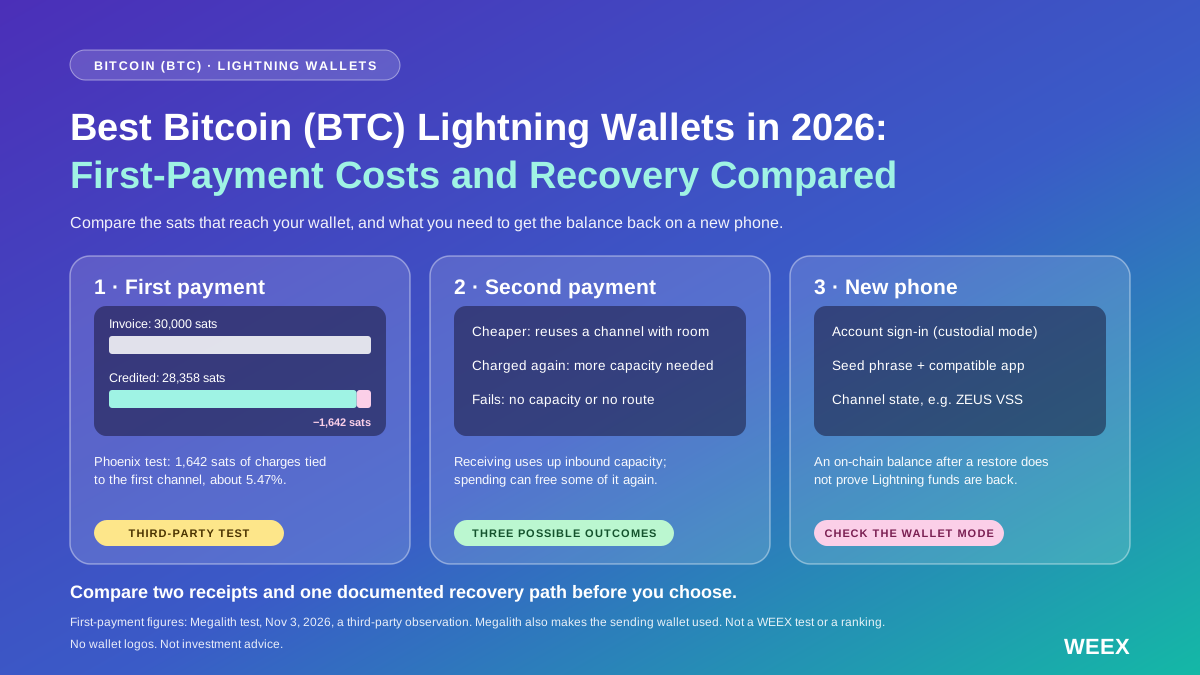
Best Bitcoin (BTC) Lightning Wallets in 2026: First-Payment Costs and Recovery Compared
Key Takeaways Lightning Network wallets enable fast and cost-effective Bitcoin transactions by using off-chain channels. A variety of…

SEC Enforcement Actions Decrease by 23.7% to 348 in Fiscal Year 2026
BlackRock Loses $1.735 Billion in Cryptocurrency Funds

Ethereum’s Joseph Lubin explains why ETH could rival Bitcoin and gold

BitGo Posts $44M Quarterly Profit as Platform Assets Grow, But Adjusted EBITDA Stays Negative
Bitcoin: A Thief Sentenced in China for Memorizing a Seed Phrase

Bitcoin loses status as main risk asset amid stock market lag

Crypto ATM Fees: How Much Bitcoin (BTC) Do You Get for $100?
See how much Bitcoin $100 buys at a crypto ATM. Compare two sample quotes, calculate the all-in cost, and learn which fees not to count twice.

WEEX 11.11 Shopping Fest: Buy BTC and Unlock Up to 888 USDT in Rewards

WEEX Exclusive:CPI Exceeds Expectations, Three Major Indexes and Bitcoin Lower | WEEX Daily Market Brief (November 11, 2026)
October CPI rose 0.4% month over month, above expectations. Bond yields climbed, and the three major indexes all closed lower. Bitcoin briefly fell below $73,000. CoreWeave’s third-quarter revenue beat expectations. TSMC’s October revenue was strong. The bond market is closed on November 11; watch for Rumble’s earnings report.

CPI Exceeds Expectations, Three Major Indexes and Bitcoin Lower | WEEX Daily Market Brief (November 11, 2026)
October CPI rose 0.4% month over month, above expectations. Bond yields climbed, and the three major indexes all closed lower. Bitcoin briefly fell below $73,000. CoreWeave’s third-quarter revenue beat expectations. TSMC’s October revenue was strong. The bond market is closed on November 11; watch for Rumble’s earnings report.

24X Expands Collaboration with Standard Chartered Bank to Support Bitcoin and Ethereum Trading
Peter Brent: The Yield on 30-Year U.S. Bonds May Reach 7%
Glassnode reports stablecoin supply fell by 14.2 billion
10x Research: Bitcoin's One-Year Return After Midterm Elections is 53.9%
Decrypt Becomes First News Publisher to Offer Perps Trading, Powered by Solana's Phoenix
Bitcoin Scam on Shaadi.com, User Solicited for a $500 Deposit
Ignas: HYPE and AVAX Face Value Capture Challenges
Latest articles





Latest coin listings on WEEX


