
Bitcoin Finance: The New Institutional Custodian is the Code

 Prefer us on Google


- The Genesis Bond is a new financial instrument that operates on Stacks, a Layer 2 solution for Bitcoin.
- The yield in BTC comes from the consensus mechanism of Stacks.
<<Not your keys, not your bitcoin>> was born as a warning for the individual user. It names the distrust towards exchanges and custodians that manage other people's funds, summarizing a simple idea: those who do not control their private keys do not, in fact, control their bitcoin.
Institutional finance has been built on the opposite logic. For a bank, a fund, or a treasury to earn yield on an asset, that asset usually passes through the hands of a third party—a custodian, a broker, or a lending platform—that manages it on behalf of the original owner.
A new type of financial instrument on bitcoin (BTC) questions that assumption. It separates two operations that, until now, have traveled together: generating yield and delivering custody of the asset.
The most recent and largest-scale institutional case is the instrument called Genesis Bond, launched on September 10, 2026, by Stacks, a Layer 2 network that extends Bitcoin's functions without modifying the protocol, as reported by CriptoNoticias.
The mechanism of the Genesis Bond locks BTC from the investor on the main network, without that bitcoin ever passing through the hands of a custodian.
However, the fact that the capital does not change hands does not mean that the operation functions without relying on anything external. The question that this nuance leaves open is what the yield depends on, then.
Bitcoin Coins Locked in the Base Layer
The answer lies in the design of the Genesis Bond instrument. There, bitcoin coins are locked in the main network through a timelock (native commands of the Bitcoin protocol that function as a time lock that blocks BTC and cannot be spent until a certain date or block), without passing through the hands of a custodian, while the investor immobilizes STX tokens, the native token of Stacks, to reserve their place.
The yield, paid in bitcoin, does not come from a loan, but from Proof of Transfer, the consensus in which Stacks miners contribute real BTC to validate blocks. Operation of the yield generation of Stacks' Genesis Bond. Source: Stacks.
At its launch, the program locked 250 bitcoin from four institutions, including 21Shares and HashKey, and three of them executed the process with their keys under their own control throughout the journey. The bitcoin principle, so far, has reached the institutional world intact. But the case itself contains a nuance that is worth looking at closely.
Self-Custody is Not All or Nothing
Of the four institutions that participated, three, 21Shares, HashKey, and UTXO Management, executed the process directly, with their keys under their own control throughout the journey. The fourth, Sypher Capital, delegated the operation to StackingDAO, a liquid staking protocol that combines STX and bitcoin on behalf of the participant.
That difference matters. Delegating the operation does not mean handing over the bitcoin to a custodian, but it does mean relying on an external protocol to execute that process correctly. Within the same product, then, two different versions of what is now called institutional self-custody coexist.
Fireblocks, which offers custody and compliance tools to thousands of institutions, announced the integration of its platform with Stacks so that its clients can access this type of yield. Its arrival shows that institutional infrastructure does not disappear with self-custody, but rather reorganizes around it.
This coexistence of models leaves a fundamental question. If bitcoin never changes hands, what exactly is the institution relying on when participating in this product? The answer is not <
The New Place of Trust
When the custodian disappears, trust does not evaporate; it shifts. It moves from the third party that holds the funds to the infrastructure that produces the yield, that is, to the protocol, its consensus mechanism, and the code rules that determine how much is paid and when.
This displacement does not make the operation safer or riskier by definition. It changes its nature. The risk of a custodian going bankrupt or withholding funds is replaced by the risk of the protocol failing, having a code error, or not being able to validate blocks at the expected rate.
The case, for now, is small. It is a pilot program with four participants and limited capacity, not a consolidated standard. But it anticipates a question that the rest of the institutional Bitcoin market will have to answer with increasing frequency.
That is why <
Tags: Bitcoin (BTC)Investment FundPrivate KeyLatest
-- Price
This content is provided for general informational purposes only and doesn't constitute financial, investment, legal, or tax advice. Any events, rewards, online promotions, or related information mentioned herein should not be considered a recommendation, solicitation, or invitation to purchase, sell, trade, or otherwise deal in any crypto assets. Crypto assets are highly volatile and may result in loss. The availability of WEEX services, products, and related events may vary by region. You are responsible for ensuring that your participation is in accordance with applicable local laws and regulations.
You may also like

Bitcoin Scam on Shaadi.com, User Solicited for a $500 Deposit

Ignas: HYPE and AVAX Face Value Capture Challenges

CPI Higher Than Expected in the U.S.: What It Means for Investors

Bloomberg analyst warns BTC, Nasdaq, commodities may face year-end declines

Barclays Increases Stake in BlackRock Bitcoin ETF by 48% in Q3, Citigroup Establishes $119 Million FBTC Position

Something strange is happening with Bitcoin. It is neither digital gold nor a tech company for Wall Street

US card debt hits $1.29 trillion as Bitcoin loans expose a collateral divide

CryptoQuant: Bitcoin Analyst Sentiment Significantly Bearish, Index Drops to -1.8σ

CoinShares Survey Shows Fund Managers' Digital Asset Allocation Rises to 1.3%

From Sidechains to zk-Rollups: Tacit Chain Aims to Redefine Payments with Default Privacy

Treasury Discusses Bitcoin Acquisition Pathways, Government Holdings Undergo Second Round of Review

Trump Still Interested in Increasing Bitcoin Holdings Amid Legal Hurdles

LNbits Security Patch Released After Bitcoin Wallet Theft

Deutsche Bank launches crypto custody for Bitcoin, Ethereum, stablecoins
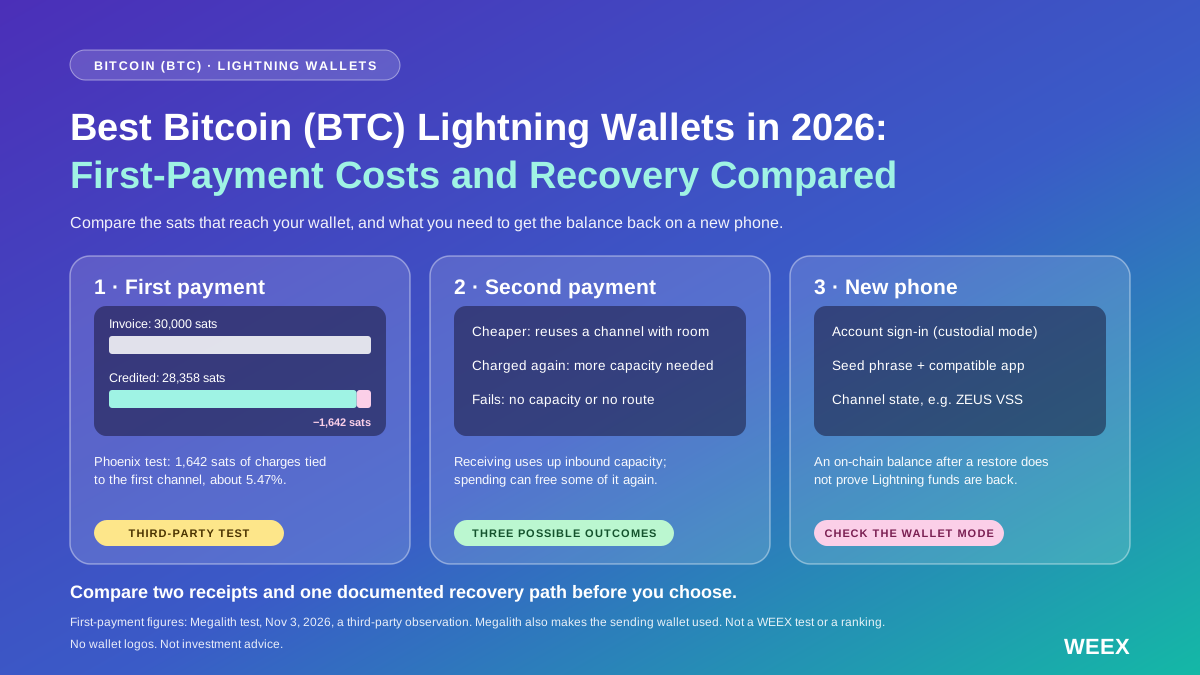
Best Bitcoin (BTC) Lightning Wallets in 2026: First-Payment Costs and Recovery Compared
Key Takeaways Lightning Network wallets enable fast and cost-effective Bitcoin transactions by using off-chain channels. A variety of…

SEC Enforcement Actions Decrease by 23.7% to 348 in Fiscal Year 2026

BlackRock Loses $1.735 Billion in Cryptocurrency Funds

Ethereum’s Joseph Lubin explains why ETH could rival Bitcoin and gold

BitGo Posts $44M Quarterly Profit as Platform Assets Grow, But Adjusted EBITDA Stays Negative
Bitcoin: A Thief Sentenced in China for Memorizing a Seed Phrase

Bitcoin loses status as main risk asset amid stock market lag

Crypto ATM Fees: How Much Bitcoin (BTC) Do You Get for $100?
See how much Bitcoin $100 buys at a crypto ATM. Compare two sample quotes, calculate the all-in cost, and learn which fees not to count twice.

WEEX 11.11 Shopping Fest: Buy BTC and Unlock Up to 888 USDT in Rewards

WEEX Exclusive:CPI Exceeds Expectations, Three Major Indexes and Bitcoin Lower | WEEX Daily Market Brief (November 11, 2026)
October CPI rose 0.4% month over month, above expectations. Bond yields climbed, and the three major indexes all closed lower. Bitcoin briefly fell below $73,000. CoreWeave’s third-quarter revenue beat expectations. TSMC’s October revenue was strong. The bond market is closed on November 11; watch for Rumble’s earnings report.

CPI Exceeds Expectations, Three Major Indexes and Bitcoin Lower | WEEX Daily Market Brief (November 11, 2026)
October CPI rose 0.4% month over month, above expectations. Bond yields climbed, and the three major indexes all closed lower. Bitcoin briefly fell below $73,000. CoreWeave’s third-quarter revenue beat expectations. TSMC’s October revenue was strong. The bond market is closed on November 11; watch for Rumble’s earnings report.

24X Expands Collaboration with Standard Chartered Bank to Support Bitcoin and Ethereum Trading
Robinhood's Latest Earnings Report Tells You All You Need to Know About the Future of Crypto. These 2 Numbers Really Stood Out.
Bitcoin Spot ETF Sees Net Outflow of $95.0012 Million Yesterday, Continuing for 4 Days

From Shorting Stablecoins to Building Chains: The Shift of Airwallex Founder Jack Zhang and the Battle for Payment Settlement Layers

Stablecoins: French People Stock Up on Self-Custody According to Chainalysis
Bitcoin Scam on Shaadi.com, User Solicited for a $500 Deposit
Ignas: HYPE and AVAX Face Value Capture Challenges
CPI Higher Than Expected in the U.S.: What It Means for Investors
Bloomberg analyst warns BTC, Nasdaq, commodities may face year-end declines
Barclays Increases Stake in BlackRock Bitcoin ETF by 48% in Q3, Citigroup Establishes $119 Million FBTC Position
Something strange is happening with Bitcoin. It is neither digital gold nor a tech company for Wall Street
Latest articles





Latest coin listings on WEEX


