
Anthropic CEO Dines with Trump: What's at Stake in AI

 Prefer us on Google


The most talked-about dinner in Silicon Valley this weekend did not take place in Palo Alto or San Francisco. It happened at the White House. Dario Amodei, co-founder and CEO of Anthropic, sat down with President Donald Trump for their first one-on-one meeting. The context is anything but trivial: both represent opposing sides of a debate that will define how artificial intelligence will be regulated in the world's largest economy.
For those following the evolution of the tech industry, this meeting serves as a thermometer. The relationship between the Trump administration and Anthropic has been marked by concrete friction, and the fact that a dinner was made possible signals something important: neither side can afford to ignore the other.
Why Amodei and Trump Are on Opposite Sides
Anthropic positions itself as the AI company most concerned with safety among American big techs. Dario Amodei recently published a plan to slow the pace of artificial intelligence development, or at least proceed with more caution. The proposal involves rigorous testing before releasing more powerful models and a risk classification system.
Trump, on the other hand, has adopted a radically opposite stance. The president has labeled concerns about AI safety as a "Democrat hoax," without providing evidence to support the claim. More than that, he suggested that the technology should be rebranded as "superintelligence," in an attempt to frame the issue as one of enthusiasm rather than caution.
This divergence is more than rhetoric. It reflects a real schism within the American tech ecosystem: on one side, companies advocating for regulatory brakes and safety testing; on the other, a government faction that sees any regulation as an obstacle to U.S. competitiveness against China.
The Pentagon Has Already Treated Anthropic as a Risk
The tension between Anthropic and the Trump administration did not start with this dinner. Earlier this year, the Pentagon classified the company as a "risk to the supply chain." The reason? Anthropic's own attempt to impose usage restrictions on its AI models, including limits for military and surveillance applications.
The designation is not symbolic. Companies classified as risks face barriers in government contracts and lose access to a significant portion of the U.S. federal market, which moves hundreds of billions of dollars a year in technology. Anthropic is contesting the classification in court.
At the same time, not all of the Trump administration is hostile to the company. Other members of the government maintain friendlier relations with Anthropic, which helps explain why the dinner at the White House became possible. As we discussed in our coverage of the clash between big techs and governments, AI policy in the U.S. is not monolithic: there are internal disputes that create negotiation windows.
What's at Stake for the AI Market
The meeting between Amodei and Trump is not just a matter of political diplomacy. It could set the tone for AI regulation in the United States for the coming years, directly affecting investors, startups, and the entire global tech ecosystem.
Currently, the U.S. does not have comprehensive federal legislation on artificial intelligence. What exists is a patchwork: executive orders, sector guidelines, and case-by-case decisions. Europe has taken the lead with the AI Act, and the pressure for Americans to define clear rules is growing as models become more powerful.
For companies like Anthropic, which compete directly with OpenAI, Google DeepMind, and Meta AI, regulation can be both a threat and a competitive advantage. If the rules favor mandatory safety testing, Anthropic gains ground, as it has built its brand around this differentiator. If the government opts for a total laissez-faire model, less cautious companies may advance more quickly.
Investors in the sector are also paying attention. Anthropic has raised over $7 billion in funding over the past two years, with a valuation exceeding $60 billion. Any sign that the relationship with the government has improved or worsened has a direct impact on the company's perceived risk.
-- Price
The Irony of Amodei's Weekend
In a detail that illustrates how AI has become a cultural topic and not just a technical one, Dario Amodei was satirized in the season premiere of Saturday Night Live this same weekend. Going from a national joke to a presidential dinner in less than 24 hours is the kind of trajectory that only happens when a technology truly hits the mainstream.
This is a point we often highlight when analyzing the impact of artificial intelligence on markets: AI has ceased to be the exclusive domain of engineers and has become a matter of economic policy, national security, and pop culture, all at once.
So What? What This Means for Investors
The dinner between Amodei and Trump is a political event, but with real consequences for those exposed to the technology sector. If the dialogue evolves into a more constructive government position regarding AI safety, the regulatory landscape becomes more predictable, something that markets value.
On the other hand, if the Pentagon's designation remains and the government continues to treat caution as a weakness, the market may price in more risk for companies with a profile similar to Anthropic's. In both scenarios, investors need to monitor political developments as closely as product launches.
AI regulation in the U.S. is being written now, in real time, at dinners like this. And the outcome will affect everything from the stock prices of big techs to the speed at which new AI tools reach the Brazilian market.
This content is informational and educational and does not constitute investment advice. Past performance is not indicative of future results.
This content is provided for general informational purposes only and doesn't constitute financial, investment, legal, or tax advice. Any events, rewards, online promotions, or related information mentioned herein should not be considered a recommendation, solicitation, or invitation to purchase, sell, trade, or otherwise deal in any crypto assets. Crypto assets are highly volatile and may result in loss. The availability of WEEX services, products, and related events may vary by region. You are responsible for ensuring that your participation is in accordance with applicable local laws and regulations.
You may also like

Market Neutral: The Art of Earning Without Betting on Market Direction

Balancer fork’s 6 million BAL ask could cut holders’ redemption value

Swiss bank shields Bitget institutions while retail funds freeze
The Zondacrypto Scandal Expands: This Time Involving Notable MPs

Two obscure pools fuel 2.8B XRPL volume, but only 185 trades caused it

The Stronger the AI, the Lower the Wages: Your Education is Becoming the Most Expensive Devalued Asset
xStocks adds Ledger hardware wallet support for tokenized shares

IMF Calls for Fewer but Deeper Reforms to Address a More Vulnerable Global Economy

LTC Airdrop 2026: How to Claim 50,000 USDT Rewards on WEEX

Privy Expands Support for TRON with Enhanced Wallet and Payment Infrastructure for Developers
Treasury at Highest in 18 Years: Federal Reserve Set for New Rate Hikes
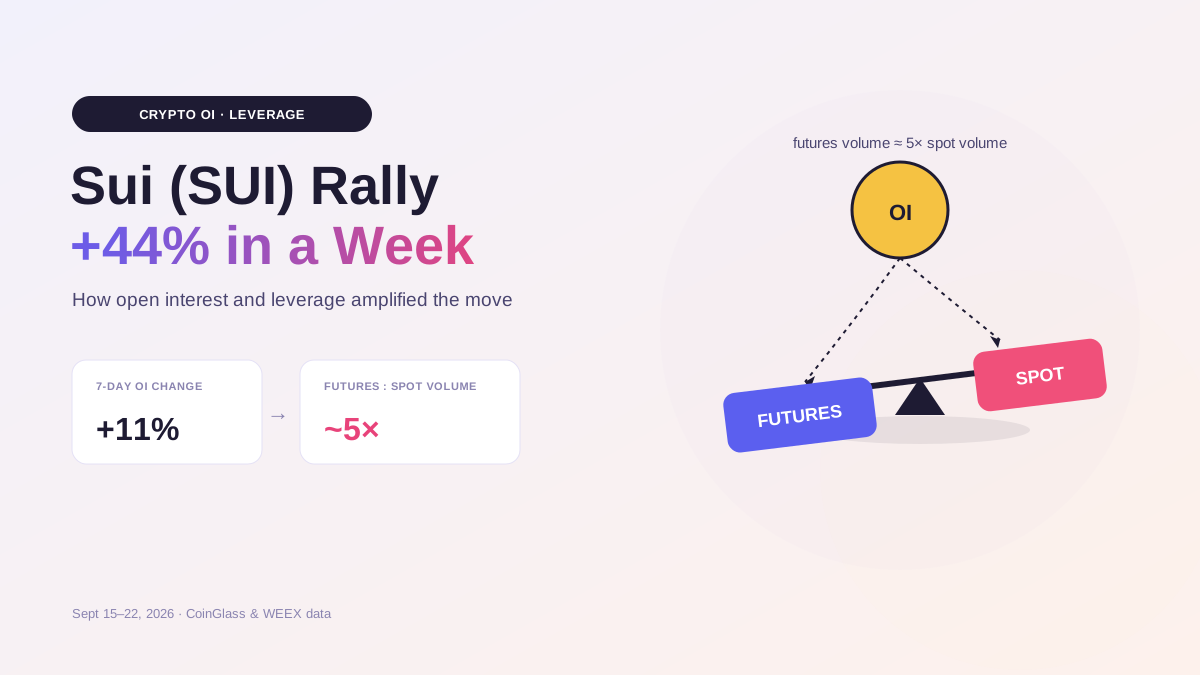
Why Did Sui (SUI) Crypto Price Jump 44%? Crypto OI and Leverage Explain the Rally
See why Sui (SUI) jumped 44%, how crypto OI and leverage amplified the rally, what the pullback means, and how to trade SUI on WEEX.

唐华斑竹 reports that BNB Chain will return to Seoul on October 2

Nearly $20 million in XRP drained from 6,678 wallets across six attack waves

Coinbase traced $1.1 million crypto trail behind AI phishing service EvilTokens

Hack Coldcard: 52 BTC Saved by Ethical Hackers

Yield Curve Approaches Inversion, TGA and Fed Tools Become New Focus in US Treasury Market

Brevo Hacking: After Trezor, Paymium Customer Data Leaked

Inside Coinbase’s $250 Billion Playbook for Post-Quantum Bitcoin Custody
NVDA Stock Rose for a Fifth Straight Day: Jensen Huang Says Sales Will Double Next Year
WEEX P2P now supports XOF, XAF & CDF—Merchant Recruitment Now Open
EURC scam: Dutch police arrest 2 over fake Rolex deals

What is Fast? Understanding the Parallel Payment Infrastructure for AI Agents

Elon Musk’s X adds Bitcoin trading links for U.S. users
Robinhood CEO Says Crypto Will Beat Sports at Prediction Markets' Own Game

ZEC's Largest Mining Company Moves to US Stock Market After Mining 70,000 ZEC in Six Months

U.S. Banks Face $326.7 Billion in Unrealized Losses
MU Stock Retail Sentiment Just Turned Sour: The CEO Sold Shares Right Before Earnings
MU retail sentiment is souring ahead of September 30 earnings, and the CEO just sold $39 million in shares but the sale traces back to a plan set eight months ago.

Cardano x402: the official integration that allows AI agents to pay APIs in ADA
SEC Takes Action: Who Can Handle "Compliant ICOs"?
Market Neutral: The Art of Earning Without Betting on Market Direction
Balancer fork’s 6 million BAL ask could cut holders’ redemption value
Swiss bank shields Bitget institutions while retail funds freeze
The Zondacrypto Scandal Expands: This Time Involving Notable MPs
Two obscure pools fuel 2.8B XRPL volume, but only 185 trades caused it
The Stronger the AI, the Lower the Wages: Your Education is Becoming the Most Expensive Devalued Asset


