
Inside Coinbase’s $250 Billion Playbook for Post-Quantum Bitcoin Custody

 Prefer us on Google


If a cryptographically relevant quantum computer eventually becomes an active threat to Bitcoin's security, Coinbase wants to have protections in place that are prepared for whatever direction Bitcoin and other digital assets take, according to Yehuda Lindell.
In a recent appearance on MARA Foundation TV, the crypto exchange's head of cryptography told host Isabel Foxen Duke that the company's post-quantum safeguards are being designed to support any potential forms of technical retooling. At the moment, it is unclear what kind of post-quantum signature scheme Bitcoin will use in practice.
"It's unlikely that there will be a single signing scheme that everybody will use," Lindell said in reference to the standards that various networks will ultimately adopt. "That means we have to be prepared and ready for the different outcomes on different blockchains."
Safeguarding roughly $250 billion in assets on behalf of institutions such as BlackRock, Coinbase has spent years refining associated procedures. Now it is preparing for a world where a cornerstone of that arrangement becomes more challenging---or even unfeasible in Bitcoin's case: Multi-Party Computation (MPC).
Similar in function to Bitcoin multi-signature setups, MPC allows different parties to hold distinct "shares" of a private key, enabling multiple signers to execute transactions without making whole private keys vulnerable on a single device.
While Bitcoin's native scripting language allows users to create multi-signature setups by enforcing quorum rules directly on-chain, MPC operates off-chain using specific cryptographic functions. Because a certain quorum of key shares is required to sign a single transaction, the complete key is never assembled in one location, effectively eliminating a single point of failure.
But as Bitcoin prepares for the post-quantum era, there is growing concern among experts that not all post-quantum signature schemes will be "MPC-friendly." Specifically, hash-based signatures may lack the underlying arithmetic structure that makes traditional cryptographic key-splitting possible. While this lack of mathematical structure is why hash-based signatures are presumed to be secure against quantum threats, it also makes them difficult to work with when building infrastructure for MPC.
"MPC-friendliness or non-MPC-friendliness makes a very big difference," Lindell explained. While executing MPC with hash-based signatures was presumed impossible up until recently, leading cryptographers like Dan Boneh are actively researching potential solutions, as detailed in the recent "PRAWNS" paper. However, because this research is in a highly experimental phase, it is still unclear if a viable MPC-like scheme can be developed for hash-based signatures.
Concerns about hash-based signatures have also been raised by wallet developers including Ledger CTO Charles Guillemet.
The hardware fallback
In the event that Bitcoin adopts a post-quantum scheme incompatible with MPC, Coinbase is researching a fallback architecture centered on programmable Hardware Security Modules (HSMs)---digital vaults for encrypted keys inside private data centers.
Under this arrangement, private keys would be encrypted with post-quantum cryptography and only assembled within the confines of a physically secure HSM.
Although keeping a complete key in one place---even momentarily---is theoretically less secure than traditional MPC, an HSM provides strong protection within these constraints. Lindell noted that the rigorous physical side-channel protections and strict code-upload controls support his comfort with the setup.
Given the uncertainty around a potential post-quantum upgrade for Bitcoin, Coinbase is designing its custody architecture to be agnostic and adaptable to whatever signing scheme Bitcoin adopts in the coming years, Lindell said.
Although the timeline to complete Coinbase's post-quantum security measures is still uncertain, Lindell added that, once it is complete, "I will be able to say, 'I can support anything.' We don't have the fear that some blockchain [is going to] decide to use something that we just won't be able to support."
André Beganski is a Senior Content Manager at MARA Foundation, producing content on topics including the intersection of quantum computing and cryptography. He has previously worked for Decrypt.
-- Price
This content is provided for general informational purposes only and doesn't constitute financial, investment, legal, or tax advice. Any events, rewards, online promotions, or related information mentioned herein should not be considered a recommendation, solicitation, or invitation to purchase, sell, trade, or otherwise deal in any crypto assets. Crypto assets are highly volatile and may result in loss. The availability of WEEX services, products, and related events may vary by region. You are responsible for ensuring that your participation is in accordance with applicable local laws and regulations.
You may also like

Balancer fork’s 6 million BAL ask could cut holders’ redemption value

Swiss bank shields Bitget institutions while retail funds freeze
The Zondacrypto Scandal Expands: This Time Involving Notable MPs

Two obscure pools fuel 2.8B XRPL volume, but only 185 trades caused it

The Stronger the AI, the Lower the Wages: Your Education is Becoming the Most Expensive Devalued Asset
xStocks adds Ledger hardware wallet support for tokenized shares

IMF Calls for Fewer but Deeper Reforms to Address a More Vulnerable Global Economy

LTC Airdrop 2026: How to Claim 50,000 USDT Rewards on WEEX

Privy Expands Support for TRON with Enhanced Wallet and Payment Infrastructure for Developers
Treasury at Highest in 18 Years: Federal Reserve Set for New Rate Hikes
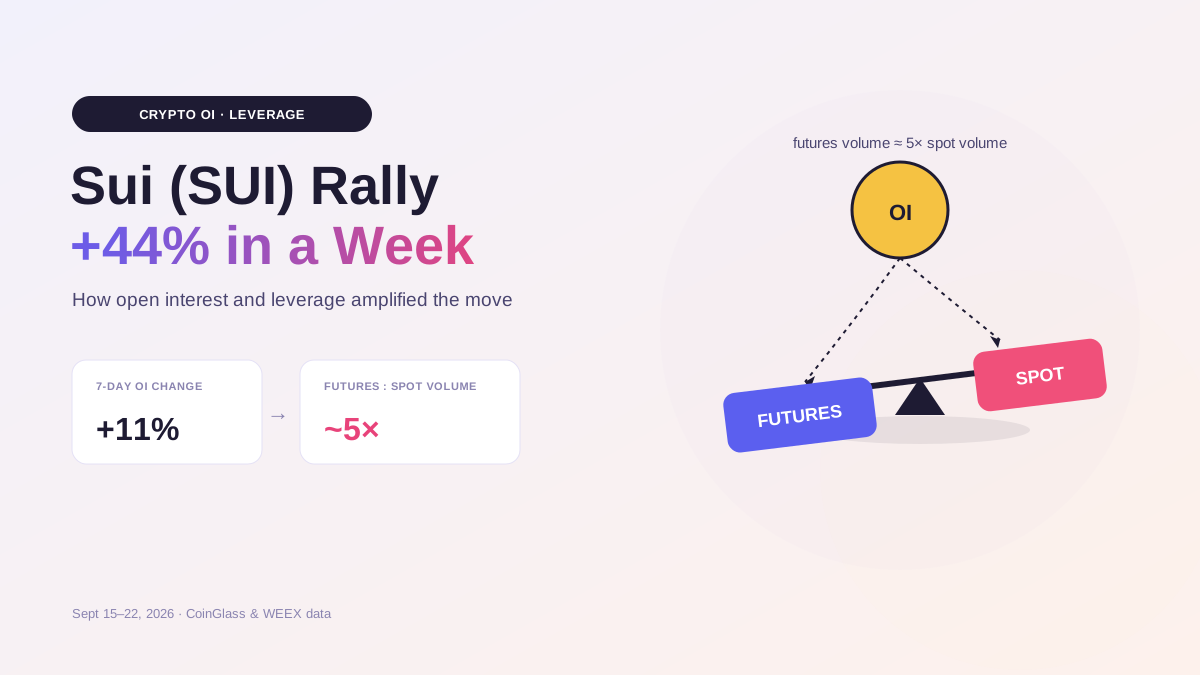
Why Did Sui (SUI) Crypto Price Jump 44%? Crypto OI and Leverage Explain the Rally
See why Sui (SUI) jumped 44%, how crypto OI and leverage amplified the rally, what the pullback means, and how to trade SUI on WEEX.

唐华斑竹 reports that BNB Chain will return to Seoul on October 2

Nearly $20 million in XRP drained from 6,678 wallets across six attack waves

Coinbase traced $1.1 million crypto trail behind AI phishing service EvilTokens

Hack Coldcard: 52 BTC Saved by Ethical Hackers

Yield Curve Approaches Inversion, TGA and Fed Tools Become New Focus in US Treasury Market

Brevo Hacking: After Trezor, Paymium Customer Data Leaked
NVDA Stock Rose for a Fifth Straight Day: Jensen Huang Says Sales Will Double Next Year

WEEX P2P now supports XOF, XAF & CDF—Merchant Recruitment Now Open
EURC scam: Dutch police arrest 2 over fake Rolex deals

What is Fast? Understanding the Parallel Payment Infrastructure for AI Agents

Elon Musk’s X adds Bitcoin trading links for U.S. users
Robinhood CEO Says Crypto Will Beat Sports at Prediction Markets' Own Game

ZEC's Largest Mining Company Moves to US Stock Market After Mining 70,000 ZEC in Six Months

U.S. Banks Face $326.7 Billion in Unrealized Losses

MU Stock Retail Sentiment Just Turned Sour: The CEO Sold Shares Right Before Earnings
MU retail sentiment is souring ahead of September 30 earnings, and the CEO just sold $39 million in shares but the sale traces back to a plan set eight months ago.

Cardano x402: the official integration that allows AI agents to pay APIs in ADA
SEC Takes Action: Who Can Handle "Compliant ICOs"?
Circle wants you to love USDC a little like you love Chelsea

Ethereum and Base Abandon Common Standard for Crypto Wallets
Balancer fork’s 6 million BAL ask could cut holders’ redemption value
Swiss bank shields Bitget institutions while retail funds freeze
The Zondacrypto Scandal Expands: This Time Involving Notable MPs
Two obscure pools fuel 2.8B XRPL volume, but only 185 trades caused it
The Stronger the AI, the Lower the Wages: Your Education is Becoming the Most Expensive Devalued Asset
xStocks adds Ledger hardware wallet support for tokenized shares





