
What Does the Fed's Hawkish Rate Hike Mean for the Dollar?

 Prefer us on Google


In the absence of new information, the dollar lacks significant downward drivers in the short term.
Written by: Xu Chao, Wall Street Insights
The Fed's unexpectedly hawkish stance has provided the dollar with strong short-term support, but ongoing geopolitical conflicts and political pressures from the upcoming midterm elections keep market uncertainty high, resulting in low confidence in directional judgments in the foreign exchange market.
The Fed's September meeting released strong hawkish signals, and the market's reaction was stronger than previously expected. According to Citigroup research, the results of the September meeting have turned the October meeting into an "active meeting," with the market currently pricing in an additional rate hike of about 13 basis points in October. The dollar index (DXY) has strengthened technically, confirming a double bottom pattern, with a target level pointing to 101.15.
Citigroup research points out that the current macro combination for the dollar—high yields combined with pressured stocks—is historically the most favorable market condition for the dollar. Meanwhile, the euro, Swiss franc, Swedish krona, and New Zealand dollar are all facing downward pressure, with the euro potentially retesting the low of 1.13 against the dollar.
Hawkish Surprises, Rising Expectations for October Rate Hike
Citigroup's previous baseline judgment was that the Fed would struggle to "outpace" the market's hawkish pricing of its policy path, posing a risk of disappointing the market. However, the recent meeting led by Waller completely broke this expectation.
This meeting not only confirmed the rate hike but also the firmness of its forward guidance prompted the market to reassess the subsequent path. The probability of a rate hike in October has significantly increased, with the market pricing in about 13 basis points of additional tightening expectations.
Citigroup believes that although there is a risk of pricing ahead of reality, this tightening expectation may continue to support U.S. Treasury yields and the dollar until the geopolitical conflicts clarify.
Geopolitical Conflicts and Midterm Elections as Ongoing Variables
The geopolitical situation is another core variable in the current foreign exchange market.
According to a Reuters report on September 9, Trump stated that the war with Iran may end after the U.S. midterm elections, which aligns with Citigroup's research team's previous judgment: the November midterm elections could become a trigger point for the situation, and the Iranian leadership may have motives to raise energy prices before the elections.
The spot premium signals in the energy market confirm this judgment. Citigroup states that the spread between spot Brent crude and futures contracts for Brent (the spot premium) has widened significantly again, indicating tight supply in the physical market. As the conflict extends towards the Strait of Hormuz and east-west pipelines, this tense situation is unlikely to ease in the short term. Analysts point out that if the situation shows significant easing, this premium may narrow quickly, but the likelihood of that happening before the midterm elections is relatively low.
Dollar Confirms Double Bottom Technically, but Key Resistance Is Near
From a technical perspective, the DXY's movement provides support for dollar bulls. Citigroup points out that the current price pattern has confirmed a double bottom structure, with a target level pointing to 101.15, similar to the double bottom pattern from April to May—when the DXY overshot to 101.80 after completing the double bottom. If this round of movement replicates the same path, the euro against the dollar will subsequently fall back to the low range of 1.13.
However, the upward space is not without obstacles. Citigroup has marked the range of 102.20 to 102.50 as a key resistance zone, which coincides with the 200-week moving average and historically significant long-term trend lines. Analysts clearly state that this is not a target price but a reminder for investors to pay attention to the potential resistance wall after a possible dollar overextension.
-- Price
Stock Market Pressure Combined with Cooling AI Narrative Provides Additional Support for the Dollar
The performance of the equity market provides additional support for the dollar.
Citigroup points out that it is historically common for the stock market to experience volatility at the beginning of a rate hike cycle, and the U.S. stock market has begun to show signs of this. Looking longer term, social and political resistance surrounding artificial intelligence, as well as uncertainties in model development, may continue to suppress market sentiment before the midterm elections.
Citigroup's U.S. equity strategy team maintains an upward judgment driven by earnings before the end of the year but acknowledges that during the window period before the earnings season, the triple pressure of negative AI narratives, high interest rates, and geopolitical risks may keep the market in a state of high volatility.
Citigroup emphasizes that the combination of rising yields and falling stocks is historically the most favorable macro state for the dollar, and the current market is in this state, with further follow-up space likely in the coming days.
Beware of Rapid Reversal of the Situation
Although the logic for a bullish dollar in the short term is clear, Citigroup's research team repeatedly emphasizes that there is a risk of reversal in the overall judgment. First, the market has already priced in a lot for this FOMC, and the marginal bullish effect is diminishing; second, the adjustment of the PCE statistical method remains a potential variable to be digested; third, the price movements on the Fed's decision day have historically been volatile, making it unwise to overinterpret the movements of that day.
Citigroup concludes that in the absence of new information, the dollar lacks significant downward drivers in the short term, and the path for the euro against the dollar to retest the low of 1.13 remains open. However, under the current market conditions, the situation can fundamentally change in a very short time, and investors should avoid overcommitting to a single direction.
This content is provided for general informational purposes only and doesn't constitute financial, investment, legal, or tax advice. Any events, rewards, online promotions, or related information mentioned herein should not be considered a recommendation, solicitation, or invitation to purchase, sell, trade, or otherwise deal in any crypto assets. Crypto assets are highly volatile and may result in loss. The availability of WEEX services, products, and related events may vary by region. You are responsible for ensuring that your participation is in accordance with applicable local laws and regulations.
You may also like

What is CBDC? Governments Push for Development of Central Bank Digital Currencies

Bitcoin Has Not Fallen Below Realized Price During the Bear Market

The Clearing House Selects Quant for US Tokenized Deposit Network

4500 Bitcoins Moved to New Addresses, Sale Status Unconfirmed
![[New York Gold, Bonds, Dollar] Interest Rates and Dollar Strength Pause... Oil Prices Drop, Won and Gold Prices Rebound](/public-static/29_4631d65680.png?format=avif)
[New York Gold, Bonds, Dollar] Interest Rates and Dollar Strength Pause... Oil Prices Drop, Won and Gold Prices Rebound

Trump Expresses Concern Over Yen Depreciation, Japanese Finance Minister Says Coordination with U.S. Will Continue

Treasuries at 21-Year High: Impact on Stocks and Interest Rates

Solana DEX volume spike hides circular trades, and automated bots are blamed

Oracle Stock vs. KRAFTON Stock: Why Are Investors Questioning Two Growing Companies?
Compare Oracle and KRAFTON stocks through their latest results, share-price questions and the different growth tests investors face in 2026.

John Templeton: "Bull markets are born in pessimism"

The Death of Hsin-Ju: A Prelude to Conspiracy

LTC Airdrop 2026: How to Claim 50,000 USDT Rewards on WEEX

Raiffeisen’s crypto deal could reach 18 million customers. How many can actually trade?

TRON Surpasses $30T in Total Transaction Volume as it Secures its Place as Leading Chain for Stablecoins

HTX DeepThink: Opportunities Concentrate on Profitable and Fund-Supported Assets, BTC Still Has Room for Recovery After Consolidation
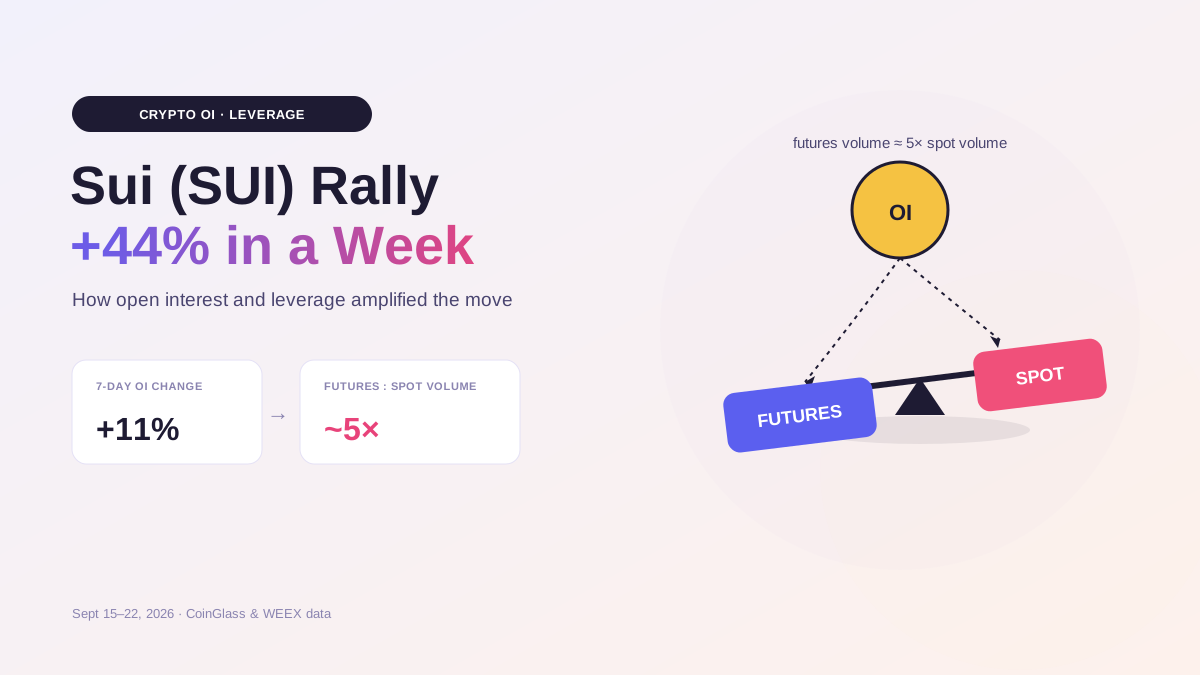
Why Did Sui (SUI) Crypto Price Jump 44%? Crypto OI and Leverage Explain the Rally
See why Sui (SUI) jumped 44%, how crypto OI and leverage amplified the rally, what the pullback means, and how to trade SUI on WEEX.

Circle expands CCTP to EURC and cirBTC on Arc

Bitcoin, Sports, and Politics: Predictive Markets Target $10 Trillion

AI Agent Jev Expects On-Chain Innovation Through Automated Judgment
The End of the Blank Prompt: Why Trading AI Needs a Playbook

Stablecoins hold nearly $200 billion in US debt, but money funds bought the surge
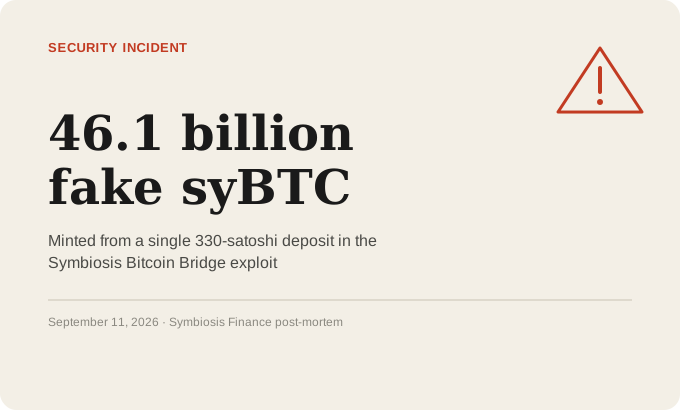
How Did a Hacker Create 46 Billion Fake Bitcoin in the Symbiosis Exploit? Decodes Bitcoin Hacker With WEEX Now
How two Symbiosis bridge bugs let a hacker mint 46.1 billion unbacked syBTC, drain Bitcoin pools and expose critical bridge risks.

CFTC's Selig Emphasizes the Need to Prepare for the Era of Large-Scale Tokenization in the U.S.

The IMF opens an office in Venezuela to supervise an economy that has already migrated to USDT

SOXL Stock Jumped 12% Yesterday: Three Companies Explain the Entire Move

Bitcoin's Hashrate Rises as Miners Reactivate Their Machines

Bitcoin 2x Leveraged ETF Launches on Cboe, But Doesn't Buy Bitcoin: Here's Why

Crypto: The ECB Enters the Tokenized Bond Market
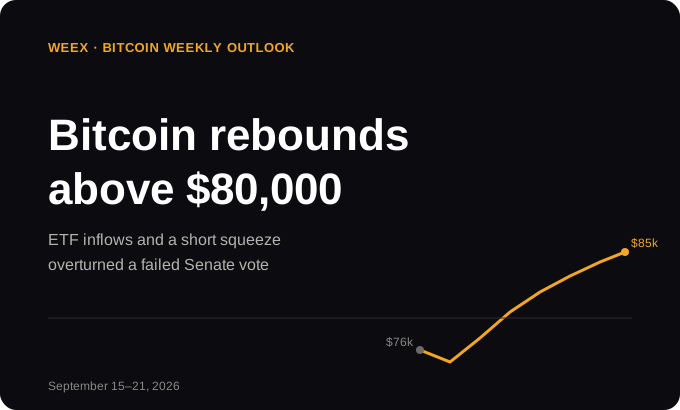
WEEX Bitcoin Weekly Outlook: Why Did Bitcoin Rebound Above $80,000 After the CLARITY Act Vote?
Bitcoin rebounded above $80,000 as SEC and CFTC action, renewed ETF inflows, and a short squeeze outweighed the failed CLARITY Act vote.
Coldcard whitehats move 52.37 BTC to recovery trust
What is CBDC? Governments Push for Development of Central Bank Digital Currencies
Bitcoin Has Not Fallen Below Realized Price During the Bear Market
The Clearing House Selects Quant for US Tokenized Deposit Network
4500 Bitcoins Moved to New Addresses, Sale Status Unconfirmed
[New York Gold, Bonds, Dollar] Interest Rates and Dollar Strength Pause... Oil Prices Drop, Won and Gold Prices Rebound
Trump Expresses Concern Over Yen Depreciation, Japanese Finance Minister Says Coordination with U.S. Will Continue



