
Treasuries at Highest Level in 24 Years: What Changes for Investors

 Prefer us on Google



10-Year Treasury Yield Surpasses 5.3% and Reaches 2002 Levels
The yield on 10-year U.S. Treasury bonds reached 5.342% on Thursday, surpassing the peak recorded in 2007 and hitting the highest level since early 2002. This is not an isolated data point: the global benchmark has accumulated its largest quarterly increase this century during the third quarter of 2026.
For those following the markets, the reading is straightforward. When Treasury rates rise at this speed, the opportunity cost of holding money in risk assets increases proportionally. If a bond considered the safest in the world pays more than 5.3% per year, the bar for stocks, cryptocurrencies, and other assets to justify their risk becomes much higher.
Futures for the Dow Jones and S&P 500 already reflected this pressure at the opening on Thursday, trading lower. The Nasdaq, on the other hand, found some support from positive corporate results in the technology sector, specifically from memory chip maker Micron, which reported numbers above expectations.
Why Long-Term Rates Are Rising So Strongly
The rise in long-term Treasuries is due to a combination of factors that have been accumulating over the past few months. The U.S. labor market remains resilient, inflation has not eased at the expected pace, and the Federal Reserve maintains its stance on keeping interest rates high for longer. As we analyzed in our global finance coverage, this scenario has been consolidating quarter by quarter.
The phenomenon is not exclusive to the United States. In the UK, yields on 30-year government bonds touched 6% for the first time since 1998. In continental Europe, stock markets operated with widespread declines, pressured by the same logic: more persistent inflation, higher interest rates for longer, and a less favorable environment for risk assets.
This is a structural movement, not a one-off event. When sovereign bonds from major economies offer nominal returns of this magnitude, the global capital flow reconfigures. Pension funds, insurers, and institutional managers find less reason to seek returns in more volatile assets.
The Role of AI Demand in Supporting the Nasdaq
While the weight of interest rates drags most indices down, the technology sector linked to artificial intelligence remains a partial exception. Micron, one of the largest global memory chip manufacturers, reported quarterly results above market consensus. The company has directly benefited from the growing demand for AI infrastructure, which requires massive volumes of high-performance memory.
This result helped sustain the Nasdaq in slightly positive territory even on a day of widespread pressure. This is not the first time that the AI theme has acted as a shield for the technology sector during times of macroeconomic stress. As we discussed in our technology section, the race for AI infrastructure has created its own investment cycle that, for now, resists the gravity of high-interest rates.
Still, caution is warranted. Even companies with solid fundamentals face multiple compression when the risk-free rate rises. A government bond paying 5.3% with no relevant credit risk is a direct competitor to any stock trading at high multiples.
-- Price
What to Watch in the Coming Days: Payroll and Nike
This week's economic calendar adds two layers of relevant information. On Thursday, U.S. unemployment claims data will be released. On Friday, the September jobs report, the payroll, will provide a more complete picture of the U.S. labor market.
A strong payroll tends to reinforce the narrative of high interest rates for a longer period, which would push Treasuries even higher. A weaker figure could provide some relief, but it would need to be significantly below expectations to alter the current trajectory. As we have discussed in previous analyses regarding the impact of employment data on the markets, payroll has consistently been one of the triggers for the highest intraday volatility.
On the corporate front, Nike will release its earnings after the market closes. The result will be read as a thermometer of American consumption and the effectiveness of the company's restructuring efforts. In a high-interest environment, companies dependent on discretionary spending face stronger headwinds.
What This Means for Investors in Brazil
For Brazilian investors, the rise in Treasuries has implications on multiple fronts. The first is currency-related: higher interest rates in the U.S. attract capital to American bonds and tend to strengthen the dollar against emerging market currencies, including the real. The second is flow-related: when American fixed income pays more, the relative attractiveness of emerging markets decreases.
The third, less obvious, is about the Selic rate. A global scenario of persistently high interest rates limits the Brazilian Central Bank's room to cut the basic interest rate, even if domestic inflation shows signs of easing. Brazilian monetary policy does not operate in a vacuum, and the interest rate differential between Brazil and the United States is a variable that the Copom closely monitors.
In Asia, markets closed mostly higher on Thursday, led by Japanese stocks. The markets in mainland China and Hong Kong remained closed for a holiday. Oil prices rose, with investors digesting the recovery of Middle Eastern exports amid the impasse in negotiations between the U.S. and Iran.
The global scenario, in summary, is increasingly defined by the gravitation of long-term interest rates. And with Treasuries at levels not seen in nearly a quarter of a century, the cost of ignoring this variable has never been higher.
This content is informational and educational and does not constitute investment advice. Past performance is not indicative of future results.
This content is provided for general informational purposes only and doesn't constitute financial, investment, legal, or tax advice. Any events, rewards, online promotions, or related information mentioned herein should not be considered a recommendation, solicitation, or invitation to purchase, sell, trade, or otherwise deal in any crypto assets. Crypto assets are highly volatile and may result in loss. The availability of WEEX services, products, and related events may vary by region. You are responsible for ensuring that your participation is in accordance with applicable local laws and regulations.
You may also like

Sui collaborates with OpenAssets on OTAS tokenized asset standard

Trump Calls for Jerome Powell's 'Forced' Resignation After Fed Inspector General Report

Bitcoin Cash: The History of Its Emergence, BCH Technology, Risks and Opportunities for Investors
![[Block Festa 2026] "To Enhance Korea's STO Competitiveness... Attracting Foreign Capital and Investment Products is Key"](/public-static/045_a32863e010.png?format=avif)
[Block Festa 2026] "To Enhance Korea's STO Competitiveness... Attracting Foreign Capital and Investment Products is Key"

Lloyds uses USDC to settle $750,000 with Visa in under an hour

Strong Dollar and High Interest Rates! What is the Latest Situation in the Critical Equation for Bitcoin?

Prosecutors Call for Amendments to Special Financial Transaction Act to Early Freeze Criminal Proceeds in Virtual Assets

Bank of Korea Announces South Korean Virtual Asset Market is More Sensitive to U.S. Stock Market

Cryptocurrency Law in Russia: What Has Changed for Investors
Stellar Releases Soroban SDK v28 with Protocol 28 Support

US Senator Blumenthal Calls Tether's USDT a 'Superhighway' for Iranian Sanctions Evasion

MU Stock Options Are Pricing In a Big Move Before Earnings: Why Open Interest Is Piling Into Micron and Not Its Rivals
MU stock heads into its September 30 earnings report with contract open interest up 7.7% this week, while rival memory names SanDisk and SK Hynix saw open interest fall. That divergence, on top of a "perfect record" of earnings beats, is what's actually being priced in tonight.
Bitcoin: Bukele's El Salvador Shifts to Stablecoins
Tom Lee Announces Entry into Digital Asset Bull Market and Four Bullish Signals

Block Festa 2026 to Open Tomorrow in Yeouido: Digital Asset Investment Institutions and Domestic and International Leaders Gather

Tokenized RWA usage should be judged asset by asset, says Falcon exec

3.568 Bitcoin Outflow from Strategy Wallet Raises Sale Concerns

The Economic Landscape of TCG in the Crypto Space
Now Accepting Bitcoin: Coljac Café Bitcoin Hub With 40+ Nearby Missouri Merchants
Why Bitcoin Rises with Inflows into ETFs. How It Actually Works

MoonPay targets won stablecoins as it expands into South Korea

BCRA reserves fell below $48 billion for the first time in two months, dragged down by the collapse of gold

D'CENT Wallet Hack Steals Over 12.4 Million XRP from 7,000 Users
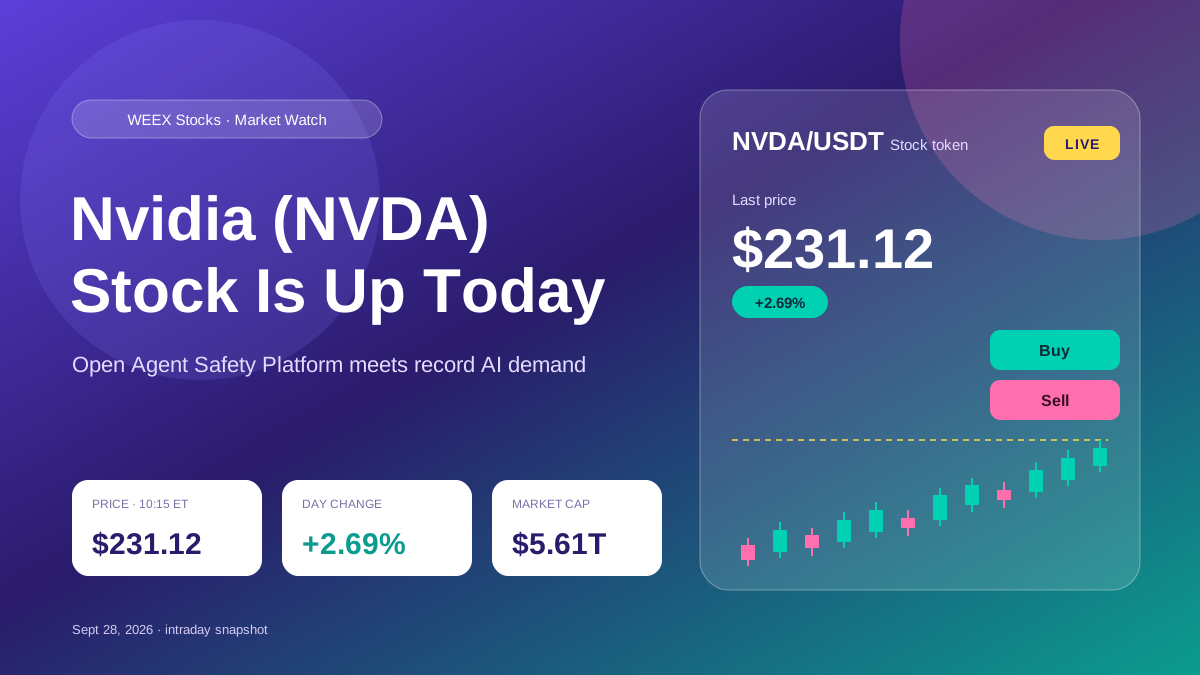
Why Is Nvidia (NVDA) Stock Up Today? New AI Agent Safety Platform Fuels the Rally
Why is Nvidia stock up today? Explore the AI agent safety launch, Nvidia’s growth outlook, key risks and how the NVDA token works on WEEX.

Central Bank Tightens Regulations on Crypto: What Changes for Users of Self-Custody Wallets

Billion-Dollar Inflow Pushes American Bitcoin ETFs Back into the Green

Wintermute’s Hyperliquid shorts reach $126M across ETH, BTC and SOL
Acurast brings real time AI decision model Laya to smartphone network

QQQ Price Prediction for October 2026: Can It Break $750?
Bitwise Keeps XRP ETF Filing Updated, But Green Light Still Missing
Sui collaborates with OpenAssets on OTAS tokenized asset standard
Trump Calls for Jerome Powell's 'Forced' Resignation After Fed Inspector General Report
Bitcoin Cash: The History of Its Emergence, BCH Technology, Risks and Opportunities for Investors
[Block Festa 2026] "To Enhance Korea's STO Competitiveness... Attracting Foreign Capital and Investment Products is Key"
Lloyds uses USDC to settle $750,000 with Visa in under an hour
Strong Dollar and High Interest Rates! What is the Latest Situation in the Critical Equation for Bitcoin?
Contents
Latest articles


Latest coin listings on WEEX


