
Taiwan's Financial Supervisory Commission Plans Nine Regulations for Virtual Assets, Expected to Launch in Q1 2027

 Prefer us on Google



Taiwan's regulatory framework for virtual assets has entered the stage of drafting subsidiary regulations. The Chairman of the Financial Supervisory Commission (FSC), Peng Chin-long, stated that after the completion of the "Virtual Asset Service Act," the FSC is actively drafting nine authorized subsidiary regulations, including the highly anticipated stablecoin regulations. The parent law and related subsidiary regulations are expected to be officially announced and implemented in the first quarter of 2027 at the earliest.
During his attendance at the FinTechOn 2026 and Asia FinTech Alliance Summit on September 2, Peng noted that global discussions on virtual assets and stablecoins have shifted from "whether to develop" to "how to develop and regulate effectively." The FSC aims to promote the parallel development of traditional finance, digital finance, and blockchain finance under controllable risks.
The "Virtual Asset Service Act" was passed by the Legislative Yuan on June 30 and was promulgated by the President on July 22, officially becoming Taiwan's first comprehensive law regulating the virtual asset service industry. The new law expands the current anti-money laundering-focused regulatory framework to include areas such as operator operations, customer asset protection, information security, market order, and stablecoin issuance.
However, the promulgation of the law does not mean that all provisions take effect immediately. The FSC plans to synchronize the implementation of the parent law and subsidiary regulations after completing the authorized subsidiary regulations, with the goal of achieving this by the first quarter of 2027, although the exact date will be announced separately by the Executive Yuan.
Nine Subsidiary Regulations Cover VASP Establishment, Internal Control, and Abnormal Transactions
The nine authorized subsidiary regulations planned by the FSC cover standards for virtual asset service providers (VASP), qualifications for responsible persons and business personnel, financial and business management, internal control systems, outsourcing of business, and management of virtual asset accounts and suspected illegal or obviously abnormal transactions.
Other regulations include management of VASP industry associations, preparation and reporting of financial statements, and issuance permits and management of stablecoins. These subsidiary regulations will determine the capital, organization, personnel, cybersecurity, internal control, and asset management requirements for operators when applying for licenses, which are key to the successful implementation of the new system.
The parent law categorizes VASP businesses into seven types: exchanges, trading platforms, transfer agents, custodians, underwriters, lenders, and other service providers. In the future, operators must obtain FSC approval and licenses based on their business activities and cannot provide services solely based on existing anti-money laundering registrations.
Domestic Stablecoin Issuance Requires Dual Review
Stablecoins are a major focus of the subsidiary regulations. According to the "Virtual Asset Service Act," any operator wishing to issue stablecoins in Taiwan must first obtain consent from the central bank and then obtain approval from the FSC.
Issuers must also maintain sufficient reserve assets and place these assets in trust, while undergoing regular audits and fulfilling information disclosure obligations. Subsequent subsidiary regulations will further specify issuer qualifications, application procedures, capital requirements, types of stablecoins that can be issued, usage scenarios, management of reserve assets, and issuance and redemption procedures.
Therefore, the implementation of the specialized law does not mean that market participants can immediately issue "New Taiwan Dollar stablecoins" on their own. Operators must still wait for the subsidiary regulations to be announced and complete the review procedures of the central bank and the FSC before they can officially issue stablecoins.
Existing stablecoins like USDT and USDC are issued overseas and are not issued domestically based on the approval of Taiwan's "Virtual Asset Service Act." The FSC previously explained that overseas stablecoins still fall under the category of virtual assets; if Taiwan's VASP wants to provide related trading services, they must follow the virtual asset listing and delisting review mechanism, which will be reviewed by the association and reported to the FSC for approval.
Central Bank Governor Yang Chin-long also stated that the issuance of New Taiwan Dollar stablecoins by domestic institutions would be subject to more direct regulation; however, foreign currency stablecoins like the US dollar involve foreign exchange capital flows, and initial plans may mirror the foreign exchange management model of designated banks, establishing a reporting mechanism for stablecoin transfer data.
Existing VASP Have Up to Two Years to Complete License Transition
After the new law takes effect, existing VASP will transition from an anti-money laundering registration system to a business licensing system. Operators who have completed anti-money laundering registration before the law takes effect, as well as financial institutions providing related services according to FSC regulations, must submit their license applications within 12 months after the new law takes effect.
Operators must obtain FSC approval and licenses within 21 months after the new law takes effect; if necessary, this period can be extended by three months at a time. In other words, existing operators have up to two years to complete the transition of the system, but during this period, they must still invest in compliance construction related to capital, internal control, cybersecurity, financial reporting, and customer asset protection.
The new law also allows banks and other financial institutions to apply for concurrent VASP business operations, meaning that in the future, virtual asset custody, trading, stablecoins, and tokenization of real-world assets may not only involve crypto-native operators, but traditional financial institutions can also enter the market after obtaining approval.
Derivative Products Not Included in the Core Scope of the First Nine Subsidiary Regulations
Market concerns regarding perpetual contracts, dual currency wealth management, and other virtual asset derivative products will not be fully opened immediately after the nine subsidiary regulations take effect. The Legislative Yuan has requested that the FSC submit relevant plans within one year after the implementation of the specialized law. The competent authority previously estimated that the policy plan could be completed as early as the first quarter of 2028.
The nine subsidiary regulations will determine how Taiwan's virtual asset specialized law transitions from a legal framework to practical operations. For operators, the key is not only to obtain a license but also to consider ongoing costs such as capital thresholds, separation of customer assets, wallet and cybersecurity management, abnormal transaction monitoring, and financial disclosure.
As for stablecoins, it is currently confirmed that issuance must undergo dual scrutiny by the central bank and the FSC, adopting a system of full reserves and trust custody; which institutions can be the first to obtain approval, whether they can issue New Taiwan Dollar or foreign currency stablecoins, and in which payment or cross-border scenarios they can be used, still await the formal announcement of the subsidiary regulations.
-- Price
This content is provided for general informational purposes only and doesn't constitute financial, investment, legal, or tax advice. Any events, rewards, online promotions, or related information mentioned herein should not be considered a recommendation, solicitation, or invitation to purchase, sell, trade, or otherwise deal in any crypto assets. Crypto assets are highly volatile and may result in loss. The availability of WEEX services, products, and related events may vary by region. You are responsible for ensuring that your participation is in accordance with applicable local laws and regulations.
You may also like
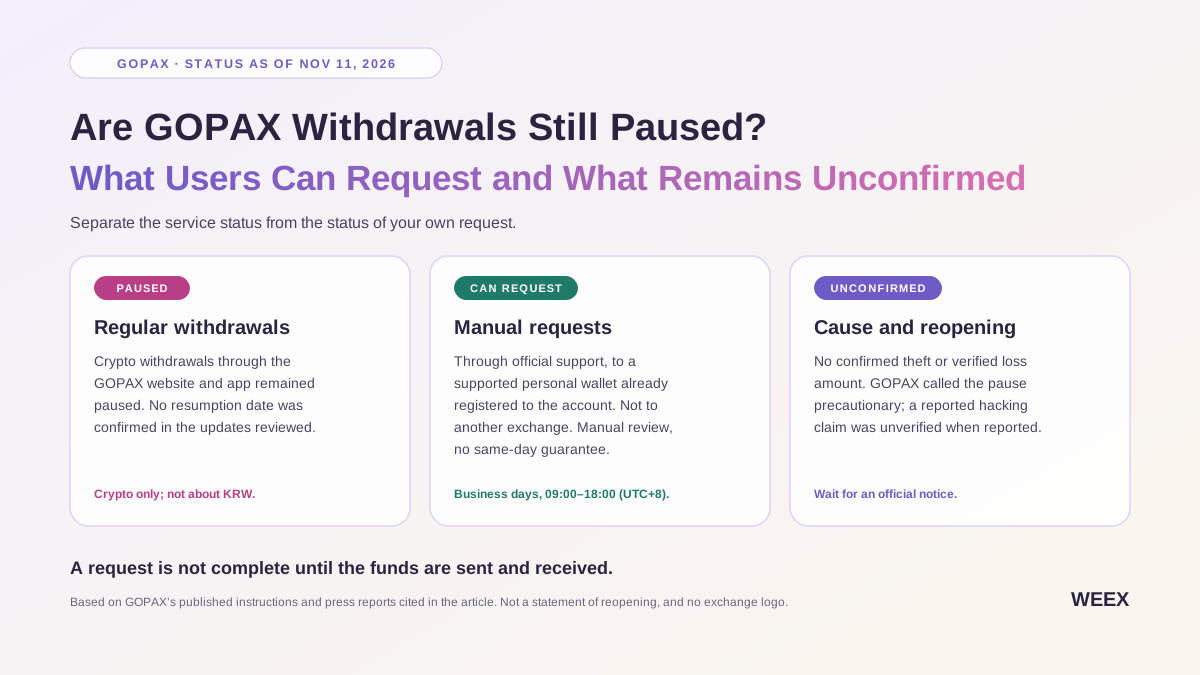
Are GOPAX Withdrawals Still Paused? What Users Can Request and What Remains Unconfirmed
Check the latest GOPAX withdrawal status, which wallets qualify for manual requests, and how to tell whether your crypto withdrawal has been sent.

Peter Brent: The Yield on 30-Year U.S. Bonds May Reach 7%

Google DeepMind Releases Gene Prediction Model AlphaGenome 2

Why Pronostyx Is Building Prediction Markets for Questions the Big Platforms Ignore

10x Research: Bitcoin's One-Year Return After Midterm Elections is 53.9%

Unity and NVIDIA NVentures Join Emulate's $700 Million Funding Round
How Far Can AI Trading Go Amid the Anti-Data Center Wave? It Depends on GPU Leasing Prices

Tech Veteran: Anthropic IPO Will Be the Peak of AI Market in US Stocks, Will 'Aggressively Buy Chinese AI' If Conditions Allow

Moody's Projects Global Credit Deterioration by 2027 and Warns of the Impact of Rates and AI

Artificial Intelligence Drives a Quarter of UK Economic Growth, Faces Global Tech Stock Sell-off Risk

CryptoQuant: Bitcoin Analyst Sentiment Significantly Bearish, Index Drops to -1.8σ
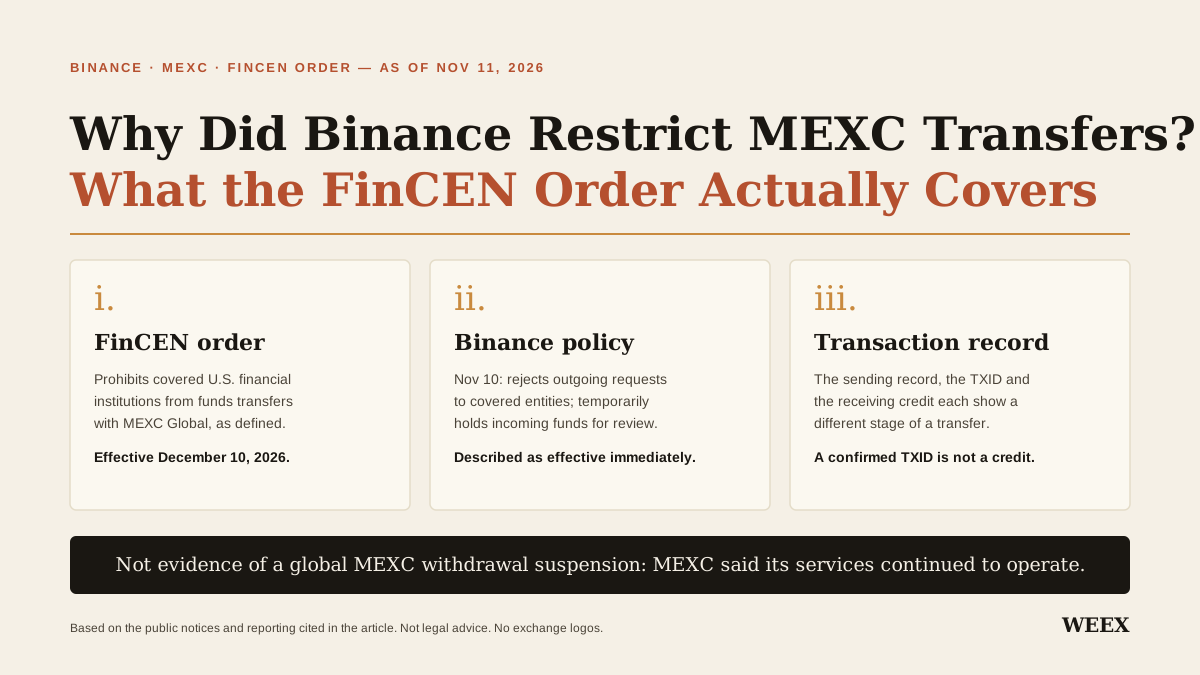
Why Did Binance Restrict MEXC Transfers? What the FinCEN Order Actually Covers
Find out why Binance restricted MEXC transfers, when the FinCEN order takes effect, and what to check if your crypto deposit is held for review.

BitcoinHabebe Shares ARIA Rises 1000% in a Month

Booz Allen Switches to NVIDIA's Nemotron Large Model
LNbits Security Patch Released After Bitcoin Wallet Theft

Former Employee Sues Ethereum Foundation, Claims Retaliatory Dismissal After Protesting 'Seppuku' Clause

European Natural Gas Futures Prices Exceed €85

Abu Dhabi Investment Authority Seeks $7.5 Billion Loan to Diversify Portfolio

India Bans Export of Lithium-Ion Battery Recycling Materials

BitGo Posts $44M Quarterly Profit as Platform Assets Grow, But Adjusted EBITDA Stays Negative

Rhein Group and KKR Invest $16 Billion in UK Offshore Wind Project
U.S. Treasury Secretary Besant Transferred to Military Base Due to 'Life Threats'

NEAR AI Discloses SGLang Security Incident and Revokes Exposed API Keys

Did Claude breach NVIDIA's 20-year CUDA moat in three days? Anthropic lets Mythos port GPU low-level code by itself

Robinhood's Latest Earnings Report Tells You All You Need to Know About the Future of Crypto. These 2 Numbers Really Stood Out.

Malware Discovered in Telegram Trading Program, GRAM Stolen
Wall Street's Panic Gauge Just Broke a 13-Year Record. Goldman Says History Favors a Rebound

21 banks allocate 270 million dollars for Project Faro
OpenAI Acquires Odessia to Expand AI Travel Agent Business

DeepMind says its AI agents ran a four-day cryptography test with about 20 human messages
Are GOPAX Withdrawals Still Paused? What Users Can Request and What Remains Unconfirmed
Check the latest GOPAX withdrawal status, which wallets qualify for manual requests, and how to tell whether your crypto withdrawal has been sent.
Peter Brent: The Yield on 30-Year U.S. Bonds May Reach 7%
Google DeepMind Releases Gene Prediction Model AlphaGenome 2
Why Pronostyx Is Building Prediction Markets for Questions the Big Platforms Ignore
10x Research: Bitcoin's One-Year Return After Midterm Elections is 53.9%
Unity and NVIDIA NVentures Join Emulate's $700 Million Funding Round
Latest articles


Latest coin listings on WEEX


