
Stablecoins offer sub-cent payments, Armstrong says, as critics flag risks

 Prefer us on Google


Coinbase CEO Brian Armstrong has praised stablecoins for enabling instant global dollar transfers for under one cent, while critics have raised concerns about privacy and frozen funds.
Summary
- Armstrong says stablecoins let users hold major currencies and send money globally for under one cent.
- Responses questioned public transaction visibility and centralized issuers' ability to restrict access to funds.
- Tether's sanctions policy and Circle's USDC terms document circumstances in which transfers can be blocked.
- Coinbase's payment partnerships and Polygon's privacy tools show how companies are addressing everyday payment needs.
Brian Armstrong, writing on X on Nov. 6, said stablecoins give people access to dollars and other major fiat currencies, alongside the ability to send them instantly across borders.
His post described an existing use of the technology without announcing a new Coinbase product, supported market, or change to transaction fees. The statement focused on holding and transferring money, leaving the steps involved in buying stablecoins or converting them into local currency unaddressed.
Stablecoins give everyone in the world the ability to hold dollars (and many other major fiat currencies), and send them instantly anywhere in the world for less than 1 cent. --- Brian Armstrong (@brian_armstrong) November 6, 2026
Stablecoin transfers are one part of the payment process
Coinbase-built network Base describes its payment infrastructure as supporting continuous stablecoin settlement without banking-hour cutoffs. Its listed uses include international payroll, remittances, merchant payments, and accounts that let customers hold stablecoin balances.
The same page separates a payment into four steps: funding through a bank account, card or another provider; converting into stablecoins; settling across Base; and delivering funds to a recipient who can hold the tokens or use a supported cash-out service.
Armstrong's post did not specify a blockchain or payment provider, or say whether the sub-cent figure included conversion and withdrawal charges.
A live commercial example comes from Nium, which announced its Coinbase integration in April. Nium said clients could send and receive stablecoins and convert them into traditional currencies for payouts, with Coinbase supplying payment infrastructure, liquidity, wallets and custody.
According to Nium, the arrangement connects stablecoin payments with its network serving more than 190 countries. Its announcement described a service for banks, fintech companies and enterprises.
Public stablecoin payments can expose financial activity
One response to Armstrong's statement, posted by the account using the name 0xAye, accepted the speed and cost argument but questioned whether transparent blockchains provide the privacy people expect when using money.
His claim about speed and cost is right, but there's one part he hasn't mentioned. Dollars have indeed made it onchain, but on a transparent chain, everyone can see who holds how much and who is paying whom
this is where the test comes for @SeismicSys . Stablecoins solved the... https://t.co/7EIzdysgTY --- 0xAye (@0xayeee) November 6, 2026
The respondent argued that visible balances and payment relationships can make digital dollars resemble an open bank statement. The post promoted Seismic, placing its privacy criticism alongside support for a particular project.
Ethereum's privacy documentation describes the underlying issue: activity on its public ledger is visible, while addresses provide pseudonymity rather than an automatic guarantee of anonymity. Transaction patterns can expose sensitive information and potentially identify users.
Privacy features are already being offered for some stablecoin payments. As crypto.news previously reported, Polygon introduced private stablecoin transfers through Hinkal in May.
Polygon's announcement said the feature lets users send USDC and USDT without publicly displaying the sender, recipient, or amount. Transfers undergo transaction screening before execution, with privacy intended to limit public visibility while supporting compliance and audit capabilities.
Stablecoin issuers retain powers to block transfers
A separate response from the account named Grand Inquisitor Cicero called for decentralized, permissionless stablecoins, criticizing USDT because its issuer can freeze assets.
Tether's documented policy ties its freezing powers to sanctions enforcement. In December 2023, the company announced a wallet-freezing policy covering people on the U.S. Treasury's Office of Foreign Assets Control sanctions list, extending controls to secondary-market activity.
Circle's USDC terms similarly reserve the right to block transfers involving certain addresses. The terms describe restrictions connected with suspected illegal activity, breaches of its conditions, and valid government orders.
Circle states that its terms apply to people holding USDC even when they do not have a Circle Mint account. The provisions therefore cover holders outside its direct customer base.
-- Price
Coinbase's merchant payment rollout began in the U.S.
Coinbase has pursued stablecoin use at checkout through its PPRO partnership, announced May 27.
The company said eligible merchants could enable stablecoin acceptance through their existing payment provider and dashboard. Its announcement described payments from hundreds of wallets, with no gas fees for buyers and round-the-clock settlement for merchants.
Coinbase identified the United States as the collaboration's launch market, with expansion into other regions planned. Merchants were instructed to contact their payment service provider to enable the integration.
This content is provided for general informational purposes only and doesn't constitute financial, investment, legal, or tax advice. Any events, rewards, online promotions, or related information mentioned herein should not be considered a recommendation, solicitation, or invitation to purchase, sell, trade, or otherwise deal in any crypto assets. Crypto assets are highly volatile and may result in loss. The availability of WEEX services, products, and related events may vary by region. You are responsible for ensuring that your participation is in accordance with applicable local laws and regulations.
You may also like

Aave V3.8 Launches, Covering 15 Markets with Reentrancy Protection

唐华斑竹: Avalanche Chain May Become the Standard for Security Tokenization

Decrypt Becomes First News Publisher to Offer Perps Trading, Powered by Solana's Phoenix

Moody's Projects Global Credit Deterioration by 2027 and Warns of the Impact of Rates and AI

What Is Elysium Crypto? The Hyperliquid Layer 2, Gas Fees, and Token Confusion Explained
Learn what Elysium is, why it uses HYPE for gas, how KNTQ buybacks are designed, and how to distinguish bridge TVL from actual DeFi activity.

From Sidechains to zk-Rollups: Tacit Chain Aims to Redefine Payments with Default Privacy

Midterm Election Risks Disrupt Helix AI Infrastructure Project, Increasing Uncertainty for Samsung Investments

European Natural Gas Futures Prices Exceed €85

Moody's Raises India's Economic Growth Forecast to 7%

Immutable Chain's Transition to OP Stack: What Changes for Users

Two Carbon Capture Standards Released

US Absence from UN Climate Summit, Trump Calls Global Warming a Hoax

ETH Burn Rate Fails to Keep Up with Issuance, Is Vitalik Starting to Discuss Value Storage?

Ethlabs Suggests Delaying Hoodi Testnet Fork Date, External Audit Expected to be Released Before November 16
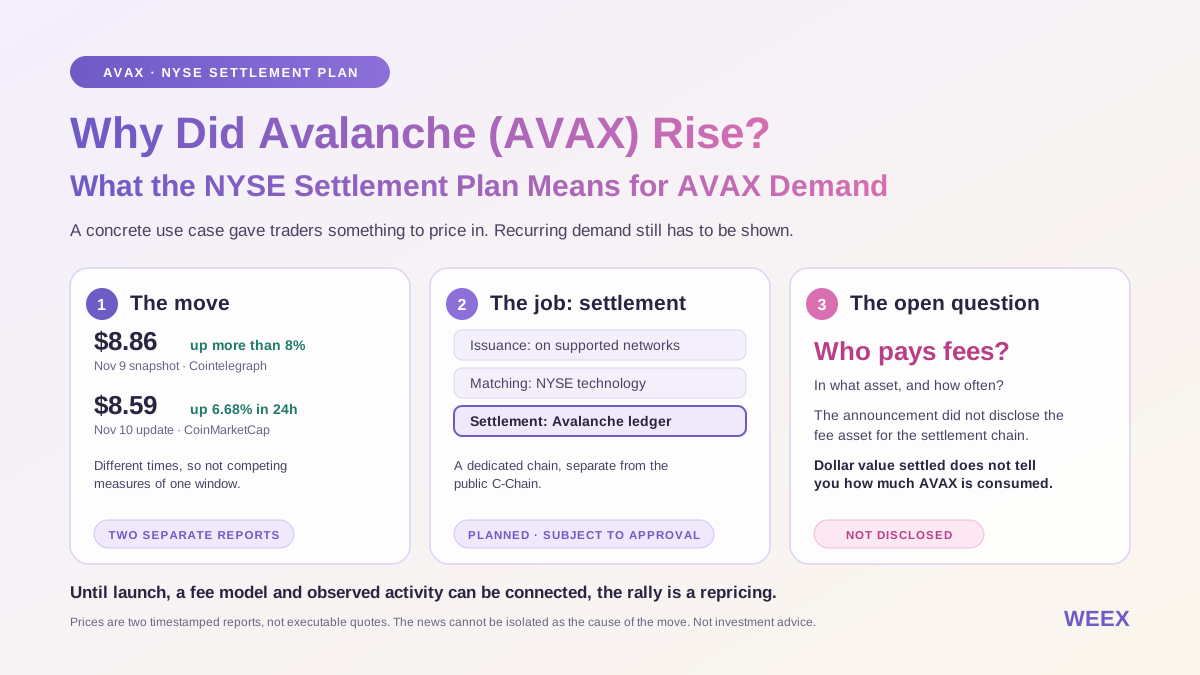
Why Did Avalanche (AVAX) Rise? What the NYSE Settlement Plan Means for AVAX Demand
See why Avalanche (AVAX) rallied after the NYSE settlement announcement, how the dedicated chain would work, and what could create demand for AVAX.

How to Resolve Data Center Controversies? This U.S. State Wants to Tokenize Computing Power to Share Benefits with Residents

Wall Street Morning Briefing: Market Soars on Oil Prices and AI Recovery, Nvidia Falls Alone, Data Centers Become Political Regulation Focus, CPI Lacks Year-on-Year Comparison Adds Variables

Ethereum's 2028 Challenge: Quantum Resistance Roadmap Hits Release Bottleneck

Understanding the DEX 'Hyperliquid': A Practical Workshop|Japan Digital Economy Federation

Envision Star River Base Completed in One Year with 120MW Capacity at One-Fifth the Cost of Similar U.S. Projects

AI Data Centers Are Buying Used Jet Engines as New Power Turbines Take Six Years

Crypto: Ethereum Prepares Two Solutions to Protect Its Smart Contracts

Heating by Mining Bitcoin? Finnish Families Are Trying This 'Free' Heating

Elysium Mainnet Launches with Block Time of 100 Milliseconds and Arrival Time of Approximately 300 Milliseconds

Samsung Etching Process Formulas Flow to Lam Research Korea

Raycash Launches on Ethereum Mainnet, Offering Privacy Stablecoin Payments and Yield Features

South Korean Deputy Prime Minister Says AI Data Center Regulation Needs Observation After U.S. Midterm Elections
Ave.ai Supports Elysium Ecosystem, Opens Cross-Chain and On-Chain Trading Capabilities
Who Will Bear the Cost of Delays in AI Data Centers?

Ethereum Releases Gas Repricing EIP Draft
Aave V3.8 Launches, Covering 15 Markets with Reentrancy Protection
唐华斑竹: Avalanche Chain May Become the Standard for Security Tokenization
Decrypt Becomes First News Publisher to Offer Perps Trading, Powered by Solana's Phoenix
Moody's Projects Global Credit Deterioration by 2027 and Warns of the Impact of Rates and AI
What Is Elysium Crypto? The Hyperliquid Layer 2, Gas Fees, and Token Confusion Explained
Learn what Elysium is, why it uses HYPE for gas, how KNTQ buybacks are designed, and how to distinguish bridge TVL from actual DeFi activity.
From Sidechains to zk-Rollups: Tacit Chain Aims to Redefine Payments with Default Privacy
Latest articles


Latest coin listings on WEEX


