
Major Global Banks Launch Their Own Stablecoins to Compete with Tether and Circle

 Prefer us on Google


In recent days, it was announced that a consortium of 21 international banks --- including Bank of America, Citi, Goldman Sachs, Santander, BBVA --- have joined forces to create a company that will issue a stablecoin starting next year. This marks the third initiative of its kind that has emerged recently and represents a shift in the approach that traditional financial institutions have taken towards stablecoins.{#p-1789054933927-50147}
Two months prior, a consortium of 140 companies (including Visa, Mastercard, and Google) had presented their own initiative, Open USD, while in Europe, a group of 37 entities is advancing with a similar project called Qivalis. Thus, a new generation of competitors from traditional banking is beginning to emerge in the stablecoin market, which is currently dominated by Tether (USDT) and Circle (USDC).{#p-1789058966674-90764}
The director of the Center for Alternative Finance at UCA, Ignacio Carballo, explained to Ámbito that the entry of major banks into this sector of the crypto market is a result of the maturation of international regulations on the subject, highlighting the Genius Law in the US and the Mica Law in the European Union. "This encourages the major players to do something they have been planning and analyzing for a long time," he stated.{#p-1789060469292-64532}
Similarly, the representative of Cardano in Argentina, Lucas Macchiavelli, pointed out to this media outlet that these recent announcements show that "the big players have already made their move." In this sense, he stated that the crypto ecosystem "forced an evolution within the financial market by necessity, as a sort of revolution, something that was unthinkable just a few years ago."{#p-1789060761823-77814}
The expert affirmed that the ecosystem "influenced with the crypto values of traceability and a technology that works 24/7 without borders." However, he also acknowledged that "much of the innovation that was expected from the crypto ecosystem has not yet been validated," as is the case with decentralization. "We have been able to impact the traditional system, but it is not a traditional system that is so different," he added.{#p-1789061091589-1548}
The Opportunity for Banks
Earlier this year, major banks operating in the US opposed the approval of the Clarity Law in Congress, arguing that the benefits offered by exchanges to stablecoin holders were far superior to those that the traditional financial system could provide. This could pose a risk to financial intermediation, as if American customers exchanged their dollars for stablecoins, banks would lose the capacity to grant loans.{#p-1789061543771-11176}
"Banks may still be concerned about the risks that stablecoins present in general, especially those issued by entities with much lighter regulatory burdens," suggested Martin Chorzempa, an economist at the Peterson Institute of International Economics (PIIE) to Ámbito, one of the American think tanks that pointed out this risk.{#p-1789061948796-62239}
However, it was pointed out that traditional financial institutions "see an even greater risk in not participating if these (stablecoins) become popular". For example, USDT handles a daily volume of $57 billion. No other cryptocurrency, not even Bitcoin --- with $32 billion ---, has those numbers. Meanwhile, USDC has a volume of $16 billion, placing it in third place.{#p-1789062094334-74689}
Despite the existence of dozens of stablecoins, the bulk of the market is dominated by only two: USDT and USDC.{#p-1789128040837-68202}
Chorzempa noted that one of the attractions for banks is that "whoever issues the stablecoin earns the interest on the assets backing it," such as U.S. Treasury bonds. "Most stablecoins do not pay directly to holders, so issuers can keep a good portion (of that interest)."{#p-1789062400277-9686}
He added that "if customers start demanding the use of stablecoins in transactions, banks can still make money with them instead of losing deposits altogether and handing this 'float' over to Circle or Tether."{#p-1789062612312-23694}
Rafael de Ambrosi, CEO of Twin, a platform that provides blockchain infrastructure to companies, explained to Ámbito that "banks are adapting and moving towards where capital is moving." In this sense, he pointed out that while this capital movement "directly impacts their lending capacity," launching their own stablecoin "is the way to keep the money, but make it programmable on blockchain".{#p-1789128382981-56296}
Carballo reached a similar conclusion: "A stablecoin is backed by a dollar, and that dollar is placed in the U.S. Treasury, earning a return on that reserve. It is a bit of the natural evolution."{#p-1789062557140-9147}
Risks and Competition
The UCA economist commented that the use of stablecoins "is much more efficient in exotic corridors", because in "very evolved corridors," the movement of money "is almost immediate". He highlighted that banks can compete with Circle and Tether "mainly at the institutional and corporate level," although he doubted it would happen at the retail level. "I also don't think it will be an immediate replacement," he commented.{#p-1789062832657-88888}
The economist stated that banks have some advantages, such as, for example, "the distribution and trust they already have", and they "can generate cross-incentive models because they offer a lot of other services."{#p-1789063010439-71220}
Similarly, Ambrosi pointed out to this medium that in trading, exchanges, and DeFi, Tether and Circle "already have a large portion of the market and users are accustomed to trading with them."{#p-1789128089151-31726}
And he stated that the area where banks have a huge opportunity is another: "Wholesale payments, settlement of tokenized assets, and institutional transactions, businesses where the client needs robust compliance, governance, and a counterparty with which they already have a banking relationship of years."{#p-1789128128118-25368}
Carballo maintained that a stablecoin with banking scale "is not equivalent to a private entity printing dollars," so it should not impact global liquidity, "but it can change the quality and stability of funds." However, there is indeed the possibility of it impacting through "indirect channels".{#p-1789063157049-53596}
He explained: "They will facilitate payments and that can increase the speed of circulation. If money moves faster, in theory, it could put pressure on prices, unless there is a corresponding supply."{#p-1789063343647-78721}
For his part, Chorzempa pointed out to this medium that "if stablecoins really take off, there is a risk, especially for banks outside of the USA, that their deposits will be withdrawn and directed to the largest issuers of those assets."
-- Price
This content is provided for general informational purposes only and doesn't constitute financial, investment, legal, or tax advice. Any events, rewards, online promotions, or related information mentioned herein should not be considered a recommendation, solicitation, or invitation to purchase, sell, trade, or otherwise deal in any crypto assets. Crypto assets are highly volatile and may result in loss. The availability of WEEX services, products, and related events may vary by region. You are responsible for ensuring that your participation is in accordance with applicable local laws and regulations.
You may also like

FTX and AI Apocalypse: The End of Calm Times for Anthropic

What is CBDC? Governments Push for Development of Central Bank Digital Currencies
Bitcoin Has Not Fallen Below Realized Price During the Bear Market

The Clearing House Selects Quant for US Tokenized Deposit Network

4500 Bitcoins Moved to New Addresses, Sale Status Unconfirmed
![[New York Gold, Bonds, Dollar] Interest Rates and Dollar Strength Pause... Oil Prices Drop, Won and Gold Prices Rebound](/public-static/29_4631d65680.png?format=avif)
[New York Gold, Bonds, Dollar] Interest Rates and Dollar Strength Pause... Oil Prices Drop, Won and Gold Prices Rebound

Trump Expresses Concern Over Yen Depreciation, Japanese Finance Minister Says Coordination with U.S. Will Continue

Treasuries at 21-Year High: Impact on Stocks and Interest Rates

Solana DEX volume spike hides circular trades, and automated bots are blamed

Oracle Stock vs. KRAFTON Stock: Why Are Investors Questioning Two Growing Companies?
Compare Oracle and KRAFTON stocks through their latest results, share-price questions and the different growth tests investors face in 2026.

John Templeton: "Bull markets are born in pessimism"

The Death of Hsin-Ju: A Prelude to Conspiracy

LTC Airdrop 2026: How to Claim 50,000 USDT Rewards on WEEX

Raiffeisen’s crypto deal could reach 18 million customers. How many can actually trade?

TRON Surpasses $30T in Total Transaction Volume as it Secures its Place as Leading Chain for Stablecoins

HTX DeepThink: Opportunities Concentrate on Profitable and Fund-Supported Assets, BTC Still Has Room for Recovery After Consolidation

Why Did Sui (SUI) Crypto Price Jump 44%? Crypto OI and Leverage Explain the Rally
See why Sui (SUI) jumped 44%, how crypto OI and leverage amplified the rally, what the pullback means, and how to trade SUI on WEEX.

Circle expands CCTP to EURC and cirBTC on Arc

Bitcoin, Sports, and Politics: Predictive Markets Target $10 Trillion

AI Agent Jev Expects On-Chain Innovation Through Automated Judgment
The End of the Blank Prompt: Why Trading AI Needs a Playbook

Stablecoins hold nearly $200 billion in US debt, but money funds bought the surge
How Did a Hacker Create 46 Billion Fake Bitcoin in the Symbiosis Exploit? Decodes Bitcoin Hacker With WEEX Now
How two Symbiosis bridge bugs let a hacker mint 46.1 billion unbacked syBTC, drain Bitcoin pools and expose critical bridge risks.

CFTC's Selig Emphasizes the Need to Prepare for the Era of Large-Scale Tokenization in the U.S.

The IMF opens an office in Venezuela to supervise an economy that has already migrated to USDT

SOXL Stock Jumped 12% Yesterday: Three Companies Explain the Entire Move

Bitcoin's Hashrate Rises as Miners Reactivate Their Machines

Bitcoin 2x Leveraged ETF Launches on Cboe, But Doesn't Buy Bitcoin: Here's Why

Crypto: The ECB Enters the Tokenized Bond Market
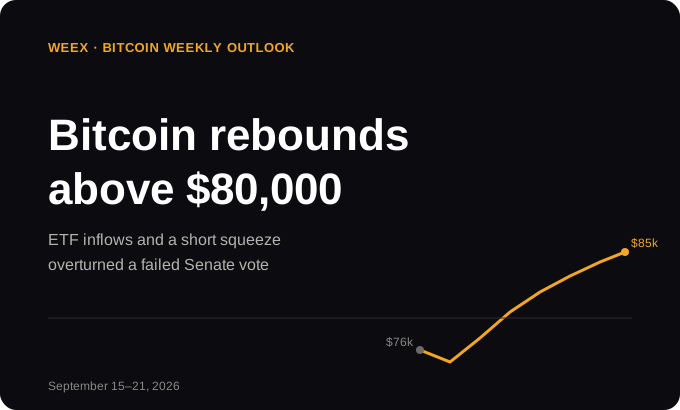
WEEX Bitcoin Weekly Outlook: Why Did Bitcoin Rebound Above $80,000 After the CLARITY Act Vote?
Bitcoin rebounded above $80,000 as SEC and CFTC action, renewed ETF inflows, and a short squeeze outweighed the failed CLARITY Act vote.
FTX and AI Apocalypse: The End of Calm Times for Anthropic
What is CBDC? Governments Push for Development of Central Bank Digital Currencies
Bitcoin Has Not Fallen Below Realized Price During the Bear Market
The Clearing House Selects Quant for US Tokenized Deposit Network
4500 Bitcoins Moved to New Addresses, Sale Status Unconfirmed
[New York Gold, Bonds, Dollar] Interest Rates and Dollar Strength Pause... Oil Prices Drop, Won and Gold Prices Rebound



