
Lazarus Moves 121.5 BTC: The North Korean Laundering Machine is Still Running

 Prefer us on Google


A transfer, not a hack. Lookonchain has detected the transfer of 121.5 BTC, approximately $7.74 million at the time of the operation, from an address attributed to Lazarus Group to two unidentified wallets. However, this on-chain movement does not reveal either the ultimate owner of the funds or their destination. The amount remains modest compared to the over $6 billion in cryptocurrencies that North Korea-linked groups are believed to have stolen since 2017. Nonetheless, it serves as a reminder that Pyongyang continues to move old loot under the constant watch of blockchain analysts.
Key Points
- Lookonchain identified a unique transfer of 121.5 BTC, about $7.74 million, from an address attributed to Lazarus Group.
- The North Korean circuit follows four steps: conversion to bitcoin, splitting the loot, passing through mixers, and cashing out via Chinese OTC desks.
- Two attacks in April, Drift Protocol ($285 million) and KelpDAO ($292 million), account for 90% of North Korean revenues for the semester.
- With bitcoin at around $64,000, half of the peak in October 2025, the stock diverted by Pyongyang is losing value during the laundering process.
121.5 BTC Moved by Lazarus, but No Origin Established Yet
According to Lookonchain, the 121.5 BTC have thus left an address labeled as belonging to Lazarus Group to join two new addresses. The attribution relies on transaction history and address clustering conducted by on-chain analysis firms. It constitutes a solid set of clues but not judicial proof of ownership.
Moreover, nothing at this stage allows linking these bitcoins to a specific hack. Their transfer may correspond to internal redistribution, a laundering phase, or preparation for conversion. Claiming they originate from the attacks on Drift Protocol or KelpDAO would therefore be speculative.
The method employed by North Korean groups is, however, well documented. After a theft, assets are generally converted into liquid cryptocurrencies, distributed among numerous addresses, and then moved between blockchains, exchanges, and sometimes mixers. The goal is to multiply intermediaries to complicate the work of investigators.
The last link often remains the conversion to fiat currencies. In 2020, the U.S. Treasury notably sanctioned Tian Yinyin and Li Jiadong, two Chinese nationals accused of laundering cryptocurrencies from a hack attributed to Lazarus Group. The OFAC already described the role of Chinese intermediaries in the outflow of funds.
North Korea Still Concentrates the Largest Bitcoin and Crypto Thefts
This transfer comes after a first semester dominated by two attacks attributed to North Korean actors. According to TRM Labs, Drift Protocol lost about $285 million on April 1, followed by KelpDAO losing $292 million on April 18.
Together, these incidents represent $577 million. TRM estimates that groups linked to Pyongyang have diverted about $643 million in the first half of 2026, accounting for 66% of the $972 million stolen across the entire ecosystem. The company, however, recorded 207 attacks during the period, with a median loss limited to $219,000: North Korea strikes less often than opportunistic hackers but targets infrastructures capable of releasing hundreds of millions.
TRM's Beacon Network now brings together more than 70 platforms and protocols capable of quickly sharing addresses associated with attackers. This cooperation accelerates freezes, without eliminating the problem: a blockchain allows tracking funds but not always identifying the intermediary who ultimately converts them.
The transfer of 121.5 BTC has hardly affected the price of bitcoin, which remains close to $64,000. Its significance lies elsewhere: each movement exposes a new segment of Lazarus's financial circuit, up to the point where the funds will eventually leave the blockchain.
-- Price
This content is provided for general informational purposes only and doesn't constitute financial, investment, legal, or tax advice. Any events, rewards, online promotions, or related information mentioned herein should not be considered a recommendation, solicitation, or invitation to purchase, sell, trade, or otherwise deal in any crypto assets. Crypto assets are highly volatile and may result in loss. The availability of WEEX services, products, and related events may vary by region. You are responsible for ensuring that your participation is in accordance with applicable local laws and regulations.
You may also like

What is CBDC? Governments Push for Development of Central Bank Digital Currencies
Bitcoin Has Not Fallen Below Realized Price During the Bear Market

The Clearing House Selects Quant for US Tokenized Deposit Network

4500 Bitcoins Moved to New Addresses, Sale Status Unconfirmed
![[New York Gold, Bonds, Dollar] Interest Rates and Dollar Strength Pause... Oil Prices Drop, Won and Gold Prices Rebound](/public-static/29_4631d65680.png?format=avif)
[New York Gold, Bonds, Dollar] Interest Rates and Dollar Strength Pause... Oil Prices Drop, Won and Gold Prices Rebound

Trump Expresses Concern Over Yen Depreciation, Japanese Finance Minister Says Coordination with U.S. Will Continue

Treasuries at 21-Year High: Impact on Stocks and Interest Rates

Solana DEX volume spike hides circular trades, and automated bots are blamed

Oracle Stock vs. KRAFTON Stock: Why Are Investors Questioning Two Growing Companies?
Compare Oracle and KRAFTON stocks through their latest results, share-price questions and the different growth tests investors face in 2026.

John Templeton: "Bull markets are born in pessimism"

The Death of Hsin-Ju: A Prelude to Conspiracy

LTC Airdrop 2026: How to Claim 50,000 USDT Rewards on WEEX

Raiffeisen’s crypto deal could reach 18 million customers. How many can actually trade?

TRON Surpasses $30T in Total Transaction Volume as it Secures its Place as Leading Chain for Stablecoins

HTX DeepThink: Opportunities Concentrate on Profitable and Fund-Supported Assets, BTC Still Has Room for Recovery After Consolidation
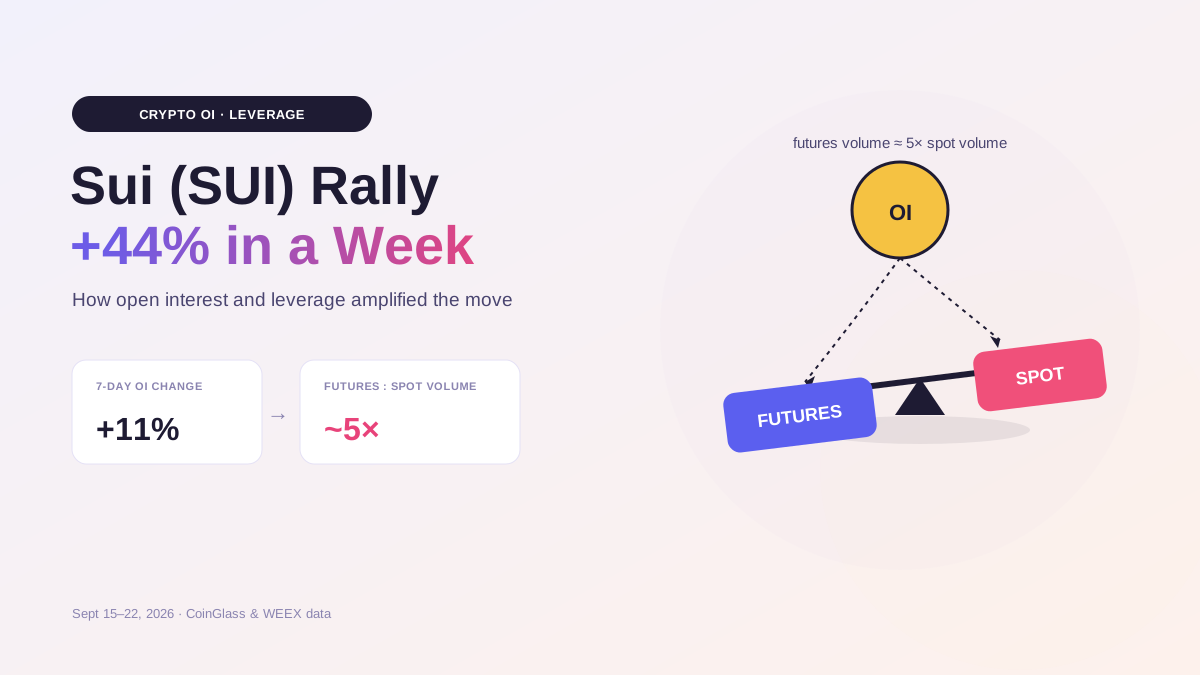
Why Did Sui (SUI) Crypto Price Jump 44%? Crypto OI and Leverage Explain the Rally
See why Sui (SUI) jumped 44%, how crypto OI and leverage amplified the rally, what the pullback means, and how to trade SUI on WEEX.

Circle expands CCTP to EURC and cirBTC on Arc

Bitcoin, Sports, and Politics: Predictive Markets Target $10 Trillion

AI Agent Jev Expects On-Chain Innovation Through Automated Judgment
The End of the Blank Prompt: Why Trading AI Needs a Playbook

Stablecoins hold nearly $200 billion in US debt, but money funds bought the surge
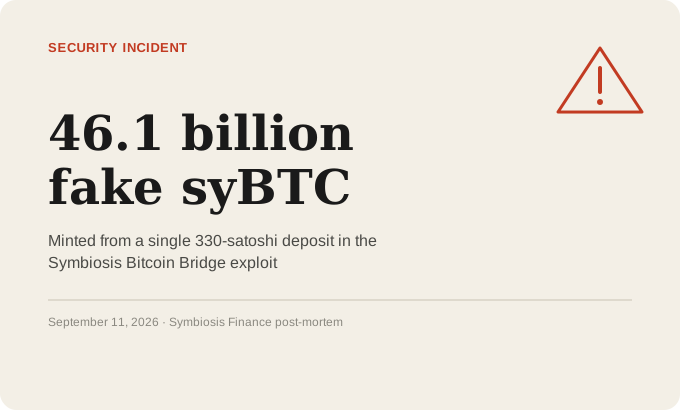
How Did a Hacker Create 46 Billion Fake Bitcoin in the Symbiosis Exploit? Decodes Bitcoin Hacker With WEEX Now
How two Symbiosis bridge bugs let a hacker mint 46.1 billion unbacked syBTC, drain Bitcoin pools and expose critical bridge risks.
CFTC's Selig Emphasizes the Need to Prepare for the Era of Large-Scale Tokenization in the U.S.

The IMF opens an office in Venezuela to supervise an economy that has already migrated to USDT

SOXL Stock Jumped 12% Yesterday: Three Companies Explain the Entire Move

Bitcoin's Hashrate Rises as Miners Reactivate Their Machines

Bitcoin 2x Leveraged ETF Launches on Cboe, But Doesn't Buy Bitcoin: Here's Why

Crypto: The ECB Enters the Tokenized Bond Market
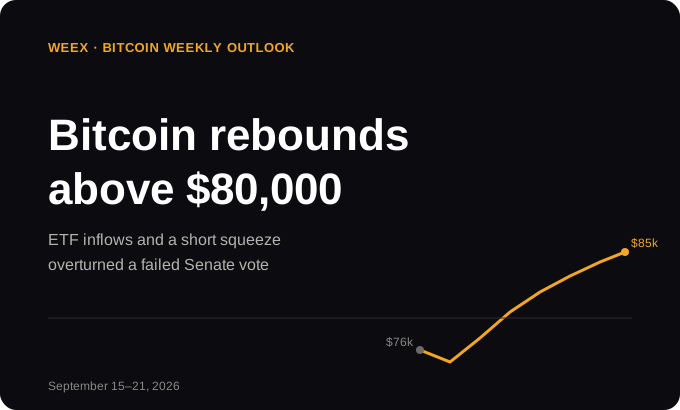
WEEX Bitcoin Weekly Outlook: Why Did Bitcoin Rebound Above $80,000 After the CLARITY Act Vote?
Bitcoin rebounded above $80,000 as SEC and CFTC action, renewed ETF inflows, and a short squeeze outweighed the failed CLARITY Act vote.
Coldcard whitehats move 52.37 BTC to recovery trust
What is CBDC? Governments Push for Development of Central Bank Digital Currencies
Bitcoin Has Not Fallen Below Realized Price During the Bear Market
The Clearing House Selects Quant for US Tokenized Deposit Network
4500 Bitcoins Moved to New Addresses, Sale Status Unconfirmed
[New York Gold, Bonds, Dollar] Interest Rates and Dollar Strength Pause... Oil Prices Drop, Won and Gold Prices Rebound
Trump Expresses Concern Over Yen Depreciation, Japanese Finance Minister Says Coordination with U.S. Will Continue



