
FBI Agent and $1 Million Cryptocurrency Theft: What We Know About the Case

 Prefer us on Google


The case, centered around the theft of approximately $1 million in cryptocurrency, has led to the arrest of senior FBI special agent Patrick Stephen Yarmoh. According to investigators, the employee, who had access to information classified as "Top Secret," transferred digital assets from the wallets of individuals linked to investigations by the bureau itself.
Patrick Stephen Yarmoh worked at the FBI headquarters in Washington, D.C., and was involved in counterintelligence. Court documents link him to a unit that was handling cases against an unnamed hostile state. After an internal review, he was suspended for several days, then fired, and arrested on July 31 in Alexandria, Virginia.
Key Points of the Case
- Accused: Senior FBI agent with access to classified information.
- Amount: He is accused of stealing cryptocurrency worth over $1 million.
- Method: According to investigators, he obtained cryptographic keys from FBI systems and transferred assets to his own accounts.
- Wallets: The accounts in question belong to foreign individuals that Patrick Stephen Yarmoh's unit was investigating.
- Scale: The investigation believes there may have been up to twelve such transfers.
How the Transfers Occurred, According to Investigators
Patrick Stephen Yarmoh, a resident of Ashburn, Virginia, previously worked for several years in Boston in the national security service. There, he was involved in investigations related to the same hostile country mentioned in court documents.
While working with digital assets, he allegedly used accounts on Kraken and Suilend, a decentralized finance ecosystem for the Sui blockchain. Access to the operations was through the Slush wallet. The online digital currency exchange becomes a crucial point of verification in this scheme, as it is where investigators can trace the movement of the stolen assets.
In this case, cryptocurrency is not just an object of theft. For investigators, the keys, addresses, transaction chains, and how the employee's internal access could become a tool for withdrawing funds are important. This crime differs from typical attacks on users, where phishing, fraud, or malware often take center stage.
Digital Footprints and Travel Plans
Investigators examined Patrick Stephen Yarmoh's computer and phone records. Among the found queries to AI-based applications was a question about what a person with a "bucket of money" worth approximately $1 million should do if they want to leave the U.S. to obtain residency or citizenship in an EU country. The AI reportedly suggested Portugal as one of the most suitable options.
Patrick Stephen Yarmoh also had travel plans to Portugal with his family for the following month. Additionally, the investigation pointed to recent trips to Germany, Portugal, and Grenada, which, according to FBI rules, he was supposed to register within the agency but did not.
-- Price
Why the Case Matters for the Crypto Market
Crimes in the field of information technology have long transcended ordinary hacking. When access to digital assets is obtained by someone within the law enforcement system, the security question becomes much broader. Here, not only authentication, multi-factor authentication, and device control are important, but also strict oversight of who is authorized to work with keys and wallets.
For security services, this is not just a technical vulnerability but a risk of abuse of trusted access.
- Trusted access itself becomes a weak point if key control is not stringent enough.
- Blockchain helps trace operations and search for transaction chains.
- The human factor remains decisive.
- The risk is relevant for any digital assets, including Bitcoin, Ethereum, and other tokens.
When working with cryptocurrency, internal control is just as important as technology: access to keys must be limited and constantly monitored.
In Russia, similar issues are usually discussed through the lens of how criminal legislation responds to digital thefts, what position the Bank of Russia takes, and how the Investigative Committee of the Russian Federation approaches cases of internet crimes. After high-profile crises like the FTX incident, the market pays particular attention to asset storage, internal control, and access verification to wallets.
This content is provided for general informational purposes only and doesn't constitute financial, investment, legal, or tax advice. Any events, rewards, online promotions, or related information mentioned herein should not be considered a recommendation, solicitation, or invitation to purchase, sell, trade, or otherwise deal in any crypto assets. Crypto assets are highly volatile and may result in loss. The availability of WEEX services, products, and related events may vary by region. You are responsible for ensuring that your participation is in accordance with applicable local laws and regulations.
You may also like

FTX and AI Apocalypse: The End of Calm Times for Anthropic

What is CBDC? Governments Push for Development of Central Bank Digital Currencies
Bitcoin Has Not Fallen Below Realized Price During the Bear Market

The Clearing House Selects Quant for US Tokenized Deposit Network

4500 Bitcoins Moved to New Addresses, Sale Status Unconfirmed
![[New York Gold, Bonds, Dollar] Interest Rates and Dollar Strength Pause... Oil Prices Drop, Won and Gold Prices Rebound](/public-static/29_4631d65680.png?format=avif)
[New York Gold, Bonds, Dollar] Interest Rates and Dollar Strength Pause... Oil Prices Drop, Won and Gold Prices Rebound
Trump Expresses Concern Over Yen Depreciation, Japanese Finance Minister Says Coordination with U.S. Will Continue

Treasuries at 21-Year High: Impact on Stocks and Interest Rates

Solana DEX volume spike hides circular trades, and automated bots are blamed

Oracle Stock vs. KRAFTON Stock: Why Are Investors Questioning Two Growing Companies?
Compare Oracle and KRAFTON stocks through their latest results, share-price questions and the different growth tests investors face in 2026.

John Templeton: "Bull markets are born in pessimism"

The Death of Hsin-Ju: A Prelude to Conspiracy

LTC Airdrop 2026: How to Claim 50,000 USDT Rewards on WEEX

Raiffeisen’s crypto deal could reach 18 million customers. How many can actually trade?

TRON Surpasses $30T in Total Transaction Volume as it Secures its Place as Leading Chain for Stablecoins

HTX DeepThink: Opportunities Concentrate on Profitable and Fund-Supported Assets, BTC Still Has Room for Recovery After Consolidation
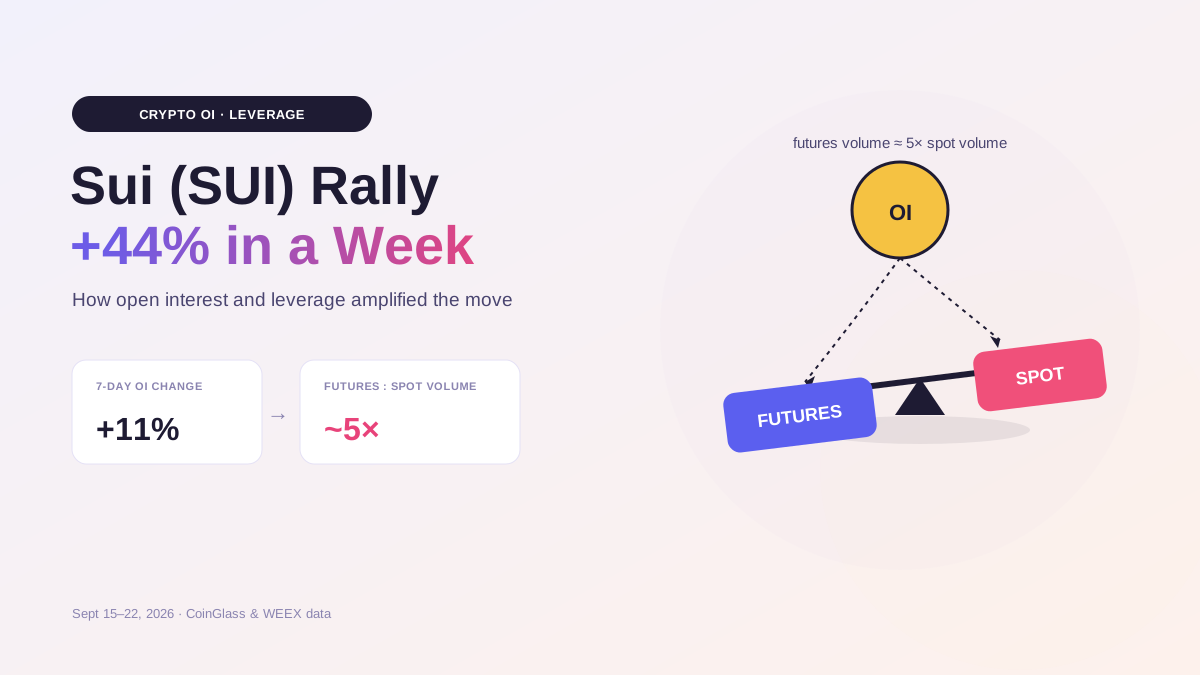
Why Did Sui (SUI) Crypto Price Jump 44%? Crypto OI and Leverage Explain the Rally
See why Sui (SUI) jumped 44%, how crypto OI and leverage amplified the rally, what the pullback means, and how to trade SUI on WEEX.

Circle expands CCTP to EURC and cirBTC on Arc

Bitcoin, Sports, and Politics: Predictive Markets Target $10 Trillion

AI Agent Jev Expects On-Chain Innovation Through Automated Judgment
The End of the Blank Prompt: Why Trading AI Needs a Playbook

Stablecoins hold nearly $200 billion in US debt, but money funds bought the surge
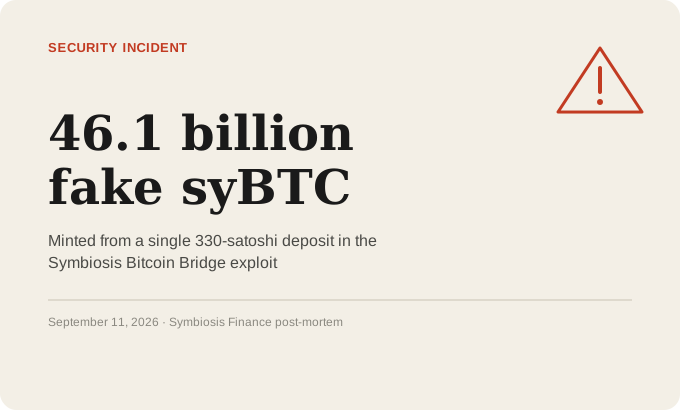
How Did a Hacker Create 46 Billion Fake Bitcoin in the Symbiosis Exploit? Decodes Bitcoin Hacker With WEEX Now
How two Symbiosis bridge bugs let a hacker mint 46.1 billion unbacked syBTC, drain Bitcoin pools and expose critical bridge risks.

CFTC's Selig Emphasizes the Need to Prepare for the Era of Large-Scale Tokenization in the U.S.

The IMF opens an office in Venezuela to supervise an economy that has already migrated to USDT

SOXL Stock Jumped 12% Yesterday: Three Companies Explain the Entire Move

Bitcoin's Hashrate Rises as Miners Reactivate Their Machines

Bitcoin 2x Leveraged ETF Launches on Cboe, But Doesn't Buy Bitcoin: Here's Why

Crypto: The ECB Enters the Tokenized Bond Market
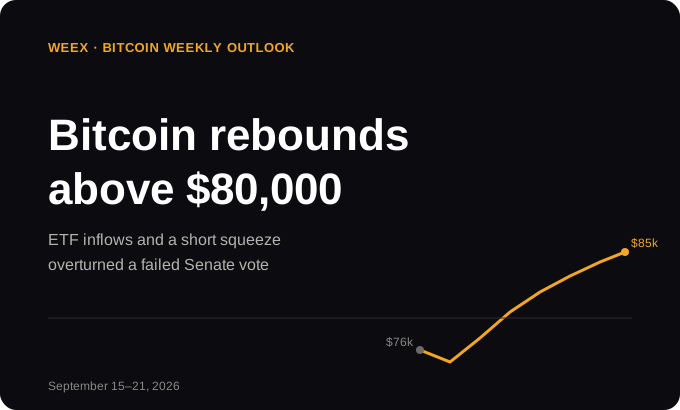
WEEX Bitcoin Weekly Outlook: Why Did Bitcoin Rebound Above $80,000 After the CLARITY Act Vote?
Bitcoin rebounded above $80,000 as SEC and CFTC action, renewed ETF inflows, and a short squeeze outweighed the failed CLARITY Act vote.
FTX and AI Apocalypse: The End of Calm Times for Anthropic
What is CBDC? Governments Push for Development of Central Bank Digital Currencies
Bitcoin Has Not Fallen Below Realized Price During the Bear Market
The Clearing House Selects Quant for US Tokenized Deposit Network
4500 Bitcoins Moved to New Addresses, Sale Status Unconfirmed
[New York Gold, Bonds, Dollar] Interest Rates and Dollar Strength Pause... Oil Prices Drop, Won and Gold Prices Rebound



