
Deutsche Bank: Markets May Underestimate Rate Peaks After Central Banks' Coordinated Rate Hikes

 Prefer us on Google


Historical experience shows that markets often underestimate the peak of interest rate hikes.
Written by: Li Jia, Wall Street Insights
Deutsche Bank points out that as the central banks of the U.S., Europe, and Japan tighten their policies simultaneously, the market may still be underpricing the final interest rate. With high oil prices, inflation may transmit to core inflation and wages; meanwhile, financial conditions have not tightened in sync, potentially weakening the effects of rate hikes. Deutsche Bank cites the experience from 2022, when the market expected the Federal Reserve to raise rates by about 200 basis points in the first year, but the actual increase exceeded 400 basis points, indicating that the market often underestimates the peak of rate hikes.
In the past two weeks, the Federal Reserve, the European Central Bank, and the Bank of Japan have all raised interest rates, marking a phase of synchronized tightening in global monetary policy. Henry Allen, a macro strategist at Deutsche Bank, warned on Monday that although the market has priced in further rate hikes, the pricing for the final interest rate level in this tightening cycle may still be too low.
Deutsche Bank believes that a key risk currently facing the market is that inflationary pressures may last longer than expected, while financial conditions have not deteriorated in sync with policy tightening. In this scenario, central banks may need to keep interest rates at higher levels for a longer time to achieve the desired tightening effect.
Energy prices are an important basis for this judgment. Although oil prices have fallen for four consecutive trading days recently, Brent crude still hovers around $96 per barrel, and the overall rise in commodities has not been fully reflected in inflation data and market surveys. Deutsche Bank points out that the impact of energy shocks extends beyond oil prices; if price pressures further transmit to core inflation and wage expectations, the pace of inflation decline may be slower than the market currently expects.
Meanwhile, asset market performance indicates that financial conditions remain relatively loose. The S&P 500 index is close to historical highs, credit spreads remain narrow, and the corporate financing environment has not tightened significantly due to rising policy rates. Deutsche Bank believes this may weaken the demand-suppressing effect of rate hikes, putting pressure on central banks to further tighten policies.
Historical Experience Shows That Markets Often Underestimate Rate Peaks
Allen specifically reminds that the market underestimating the extent of tightening is not a new occurrence. Deutsche Bank cites the experience from 2022, when investors initially expected the Federal Reserve to raise rates by about 200 basis points in the first year, but the actual increase exceeded 400 basis points. In other words, the market often fails to fully account for subsequent policy adjustments at the beginning of a tightening cycle.
This experience is particularly noteworthy in the current environment. Compared to 2022, when inflation surged above 8% before significant policy tightening, major central banks are now responding to price pressures much more quickly. Allen believes that after experiencing the last round of inflation shocks, central banks may be more inclined to prevent inflation from spiraling out of control again, thus potentially bringing forward their policy response functions.
However, higher interest rates do not necessarily mean that the economy or stock market will weaken. Allen points out that in 1999, while the Federal Reserve raised rates and bond yields increased, the S&P 500 index still rose nearly 20% for the year. Therefore, Deutsche Bank's core concern is not whether rate hikes will end growth, but whether the market has left enough room for further upward movement in interest rate paths.
If high oil prices persist, the second-round effects of inflation gradually become apparent, and loose financial conditions continue to weaken the effects of rate hikes, then the market's previous bets on rate cuts may need to be reassessed. At that time, bond yields, the dollar, and the valuations of risk assets may face new pricing pressures.
-- Price
This content is provided for general informational purposes only and doesn't constitute financial, investment, legal, or tax advice. Any events, rewards, online promotions, or related information mentioned herein should not be considered a recommendation, solicitation, or invitation to purchase, sell, trade, or otherwise deal in any crypto assets. Crypto assets are highly volatile and may result in loss. The availability of WEEX services, products, and related events may vary by region. You are responsible for ensuring that your participation is in accordance with applicable local laws and regulations.
You may also like

What is CBDC? Governments Push for Development of Central Bank Digital Currencies
Bitcoin Has Not Fallen Below Realized Price During the Bear Market
The Clearing House Selects Quant for US Tokenized Deposit Network

4500 Bitcoins Moved to New Addresses, Sale Status Unconfirmed
![[New York Gold, Bonds, Dollar] Interest Rates and Dollar Strength Pause... Oil Prices Drop, Won and Gold Prices Rebound](/public-static/29_4631d65680.png?format=avif)
[New York Gold, Bonds, Dollar] Interest Rates and Dollar Strength Pause... Oil Prices Drop, Won and Gold Prices Rebound
Trump Expresses Concern Over Yen Depreciation, Japanese Finance Minister Says Coordination with U.S. Will Continue

Treasuries at 21-Year High: Impact on Stocks and Interest Rates

Solana DEX volume spike hides circular trades, and automated bots are blamed
Oracle Stock vs. KRAFTON Stock: Why Are Investors Questioning Two Growing Companies?
Compare Oracle and KRAFTON stocks through their latest results, share-price questions and the different growth tests investors face in 2026.

John Templeton: "Bull markets are born in pessimism"

The Death of Hsin-Ju: A Prelude to Conspiracy

LTC Airdrop 2026: How to Claim 50,000 USDT Rewards on WEEX

Raiffeisen’s crypto deal could reach 18 million customers. How many can actually trade?
TRON Surpasses $30T in Total Transaction Volume as it Secures its Place as Leading Chain for Stablecoins
HTX DeepThink: Opportunities Concentrate on Profitable and Fund-Supported Assets, BTC Still Has Room for Recovery After Consolidation
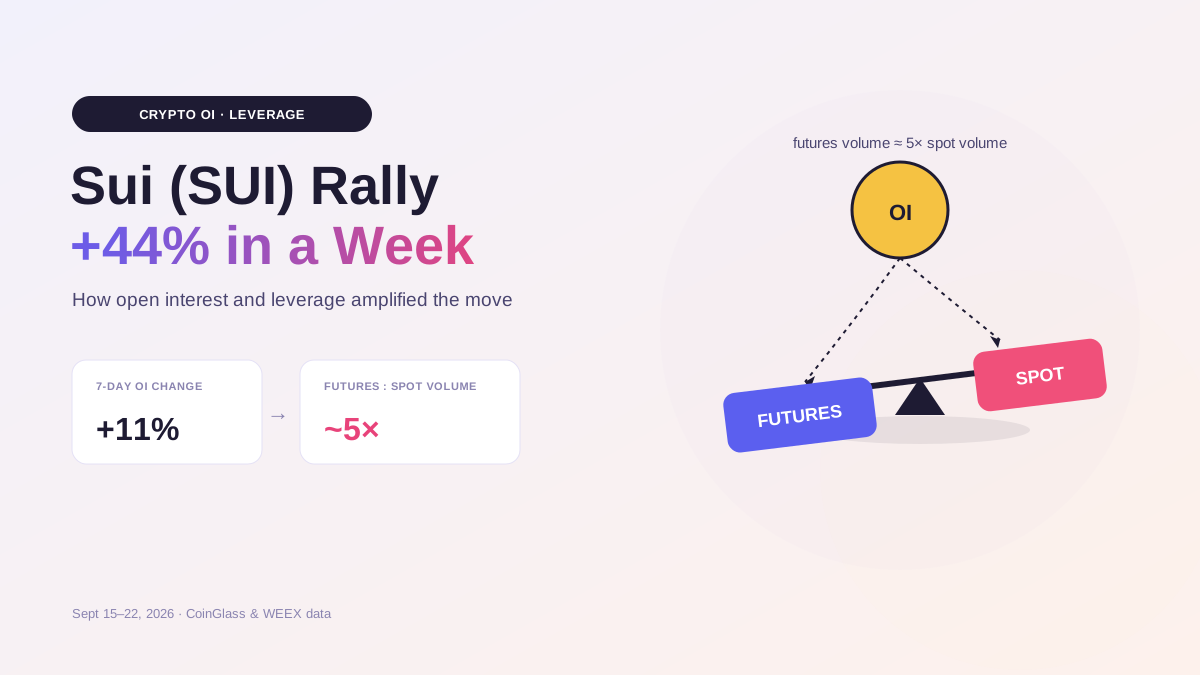
Why Did Sui (SUI) Crypto Price Jump 44%? Crypto OI and Leverage Explain the Rally
See why Sui (SUI) jumped 44%, how crypto OI and leverage amplified the rally, what the pullback means, and how to trade SUI on WEEX.

Circle expands CCTP to EURC and cirBTC on Arc
Bitcoin, Sports, and Politics: Predictive Markets Target $10 Trillion

AI Agent Jev Expects On-Chain Innovation Through Automated Judgment
The End of the Blank Prompt: Why Trading AI Needs a Playbook

Stablecoins hold nearly $200 billion in US debt, but money funds bought the surge
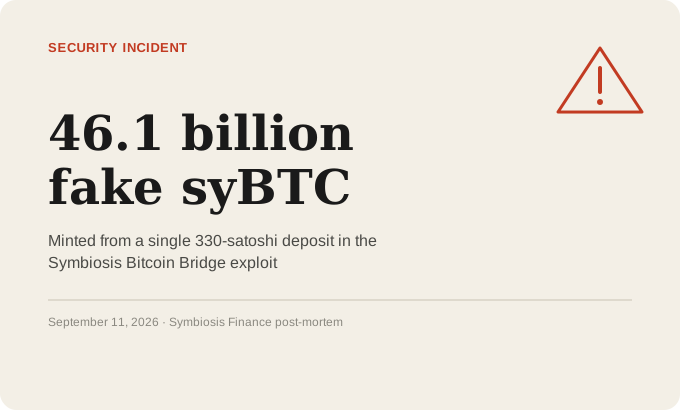
How Did a Hacker Create 46 Billion Fake Bitcoin in the Symbiosis Exploit? Decodes Bitcoin Hacker With WEEX Now
How two Symbiosis bridge bugs let a hacker mint 46.1 billion unbacked syBTC, drain Bitcoin pools and expose critical bridge risks.

CFTC's Selig Emphasizes the Need to Prepare for the Era of Large-Scale Tokenization in the U.S.
The IMF opens an office in Venezuela to supervise an economy that has already migrated to USDT

SOXL Stock Jumped 12% Yesterday: Three Companies Explain the Entire Move

Bitcoin's Hashrate Rises as Miners Reactivate Their Machines

Bitcoin 2x Leveraged ETF Launches on Cboe, But Doesn't Buy Bitcoin: Here's Why

Crypto: The ECB Enters the Tokenized Bond Market
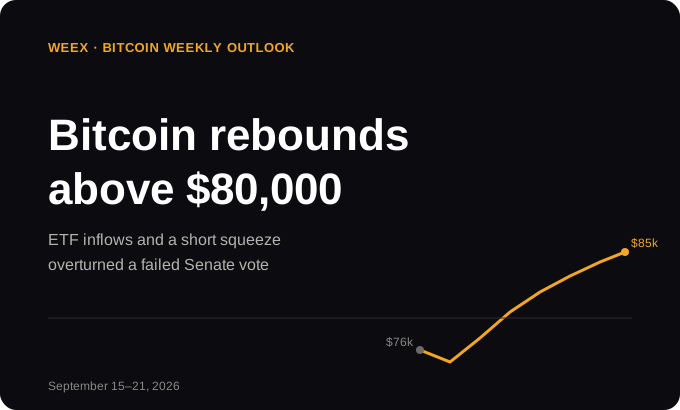
WEEX Bitcoin Weekly Outlook: Why Did Bitcoin Rebound Above $80,000 After the CLARITY Act Vote?
Bitcoin rebounded above $80,000 as SEC and CFTC action, renewed ETF inflows, and a short squeeze outweighed the failed CLARITY Act vote.
Coldcard whitehats move 52.37 BTC to recovery trust
What is CBDC? Governments Push for Development of Central Bank Digital Currencies
Bitcoin Has Not Fallen Below Realized Price During the Bear Market
The Clearing House Selects Quant for US Tokenized Deposit Network
4500 Bitcoins Moved to New Addresses, Sale Status Unconfirmed
[New York Gold, Bonds, Dollar] Interest Rates and Dollar Strength Pause... Oil Prices Drop, Won and Gold Prices Rebound
Trump Expresses Concern Over Yen Depreciation, Japanese Finance Minister Says Coordination with U.S. Will Continue



