
Caterpillar invests $100 million to train employees in AI

 Prefer us on Google


Caterpillar, a heavy equipment manufacturer with a record quarterly revenue of $20.5 billion in the second quarter, is translating decades of experience in mining automation into a broad artificial intelligence strategy. The plan involves $100 million over five years to empower its 118,000 employees in AI, autonomy, and robotics.
The bet is not just technological. It is organizational. And this may be the most relevant detail for any company trying to make AI work in the real world: the bottleneck is rarely the algorithm. It is the change in processes, workflows, and internal culture.
Caterpillar's history with autonomy began in the mines, where labor shortages and dangerous conditions make automation not just desirable but necessary. Today, the company sells autonomous transport trucks, drillers, underground loaders, tractors, and remotely operated construction equipment. Along with the hardware, it offers a software command center, fleet management, and even remote terrain intelligence.
The company's technology director, Jaime Mineart, described the moment as a window to take all this accumulated mining knowledge to more dynamic environments: construction sites, quarries, and civil construction locations. As we have analyzed in our coverage of industrial technology, the transition from controlled environments to unpredictable scenarios is one of the biggest challenges of so-called physical AI.
Caterpillar's competitive edge in this race is the volume of proprietary data. The company has about 1.6 million connected assets globally, generating over 16 petabytes of structured data. To put it in perspective, this is equivalent to approximately 16 trillion bytes, the kind of repository that AI models need to function accurately in specific industrial contexts.
A concrete example of this application is the Cat AI Assistant, a tool that allows field technicians, positioned next to a machine, to use voice commands to access repair procedures, diagnose problems, and identify necessary parts before starting maintenance. According to Mineart, the tool is already in use by customers, operators, and technicians.
The company also uses AI to scan operational sites, generate digital twins in manufacturing, and analyze operations in real-time. And, like virtually every large corporation, it applies the technology internally: AI agents modernize legacy code, generate and test new software, and identify defects earlier in the development cycle.
The most interesting part of Caterpillar's strategy lies in what Mineart calls "the hard part." Implementing an autonomous machine is not the same as transforming an entire workplace to operate with AI. It requires rethinking how people work alongside technology and how existing processes need to change.
This is a lesson that applies equally to the financial market and virtually any sector. The adoption of AI rarely fails due to technical limitations. It fails due to organizational resistance, lack of training, and misalignment between what technology can do and what the workflow allows.
Caterpillar bets on an approach that combines institutional knowledge with technology. Experienced operators help train AI systems, transferring decades of tacit knowledge to the models. As machines gain autonomy, some operators are migrating from direct control of a single piece of equipment to remote supervision of multiple machines from command centers.
The commitment of $100 million for training in AI, autonomy, and robotics needs to be read in the context of the infrastructure boom for artificial intelligence. Caterpillar's power generation division recorded a 72% increase in sales, reaching $3.10 billion, driven by demand for equipment used in data centers. CEO Joe Creed stated that "no one is slowing down" when it comes to demand for cloud computing and generative AI infrastructure.
In relative terms, $100 million spread over five years represents about $170 per employee per year. It is a modest investment compared to the company's revenue, but it signals something deeper: the industrialization of AI does not happen without the workforce keeping pace. As we discussed in our coverage of AI and employability, reskilling is perhaps the weakest link in the chain of technological adoption.
Caterpillar's movement illustrates a trend that goes beyond the heavy equipment sector. Companies that dominate large volumes of proprietary data and have decades of operational experience are in a privileged position to capture value with AI. It is not about building the most sophisticated model, but about having the right data and organizational processes to make the technology work on the shop floor, in the mine, or at the construction site.
For investors and analysts, the record revenue of $20.5 billion in the quarter suggests that the demand for AI infrastructure is feeding back into companies that, at first glance, seem distant from the technology sector. Power generators, equipment manufacturers, and industrial component suppliers are riding this wave just as much as the big techs.
Caterpillar's case reinforces an increasingly evident thesis: the next phase of the AI revolution will be defined not by who creates the models, but by who can integrate them into the physical world at scale and safely.
-- Price
This content is provided for general informational purposes only and doesn't constitute financial, investment, legal, or tax advice. Any events, rewards, online promotions, or related information mentioned herein should not be considered a recommendation, solicitation, or invitation to purchase, sell, trade, or otherwise deal in any crypto assets. Crypto assets are highly volatile and may result in loss. The availability of WEEX services, products, and related events may vary by region. You are responsible for ensuring that your participation is in accordance with applicable local laws and regulations.
You may also like

What is CBDC? Governments Push for Development of Central Bank Digital Currencies
Bitcoin Has Not Fallen Below Realized Price During the Bear Market

The Clearing House Selects Quant for US Tokenized Deposit Network

4500 Bitcoins Moved to New Addresses, Sale Status Unconfirmed
![[New York Gold, Bonds, Dollar] Interest Rates and Dollar Strength Pause... Oil Prices Drop, Won and Gold Prices Rebound](/public-static/29_4631d65680.png?format=avif)
[New York Gold, Bonds, Dollar] Interest Rates and Dollar Strength Pause... Oil Prices Drop, Won and Gold Prices Rebound

Trump Expresses Concern Over Yen Depreciation, Japanese Finance Minister Says Coordination with U.S. Will Continue

Treasuries at 21-Year High: Impact on Stocks and Interest Rates

Solana DEX volume spike hides circular trades, and automated bots are blamed
Oracle Stock vs. KRAFTON Stock: Why Are Investors Questioning Two Growing Companies?
Compare Oracle and KRAFTON stocks through their latest results, share-price questions and the different growth tests investors face in 2026.

John Templeton: "Bull markets are born in pessimism"

The Death of Hsin-Ju: A Prelude to Conspiracy

LTC Airdrop 2026: How to Claim 50,000 USDT Rewards on WEEX

Raiffeisen’s crypto deal could reach 18 million customers. How many can actually trade?

TRON Surpasses $30T in Total Transaction Volume as it Secures its Place as Leading Chain for Stablecoins

HTX DeepThink: Opportunities Concentrate on Profitable and Fund-Supported Assets, BTC Still Has Room for Recovery After Consolidation
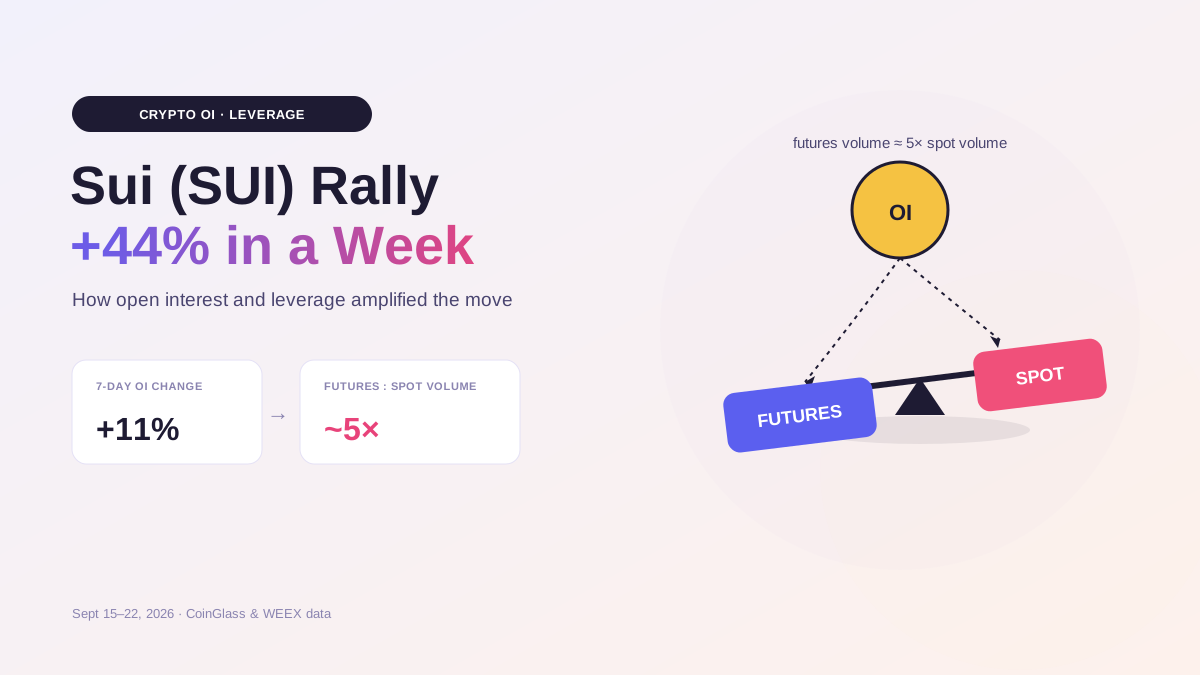
Why Did Sui (SUI) Crypto Price Jump 44%? Crypto OI and Leverage Explain the Rally
See why Sui (SUI) jumped 44%, how crypto OI and leverage amplified the rally, what the pullback means, and how to trade SUI on WEEX.

Circle expands CCTP to EURC and cirBTC on Arc

Bitcoin, Sports, and Politics: Predictive Markets Target $10 Trillion

AI Agent Jev Expects On-Chain Innovation Through Automated Judgment
The End of the Blank Prompt: Why Trading AI Needs a Playbook
Stablecoins hold nearly $200 billion in US debt, but money funds bought the surge
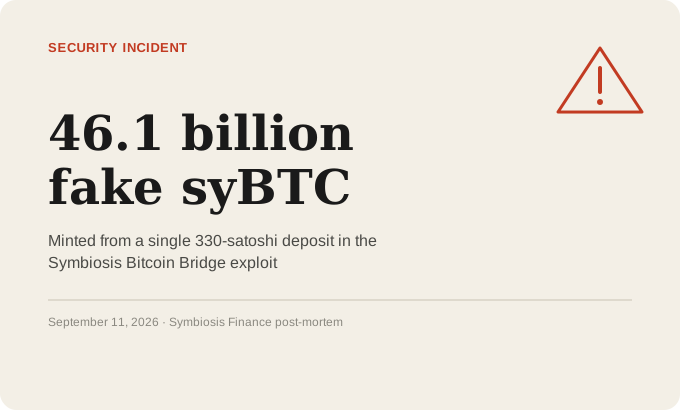
How Did a Hacker Create 46 Billion Fake Bitcoin in the Symbiosis Exploit? Decodes Bitcoin Hacker With WEEX Now
How two Symbiosis bridge bugs let a hacker mint 46.1 billion unbacked syBTC, drain Bitcoin pools and expose critical bridge risks.

CFTC's Selig Emphasizes the Need to Prepare for the Era of Large-Scale Tokenization in the U.S.

The IMF opens an office in Venezuela to supervise an economy that has already migrated to USDT

SOXL Stock Jumped 12% Yesterday: Three Companies Explain the Entire Move

Bitcoin's Hashrate Rises as Miners Reactivate Their Machines

Bitcoin 2x Leveraged ETF Launches on Cboe, But Doesn't Buy Bitcoin: Here's Why

Crypto: The ECB Enters the Tokenized Bond Market
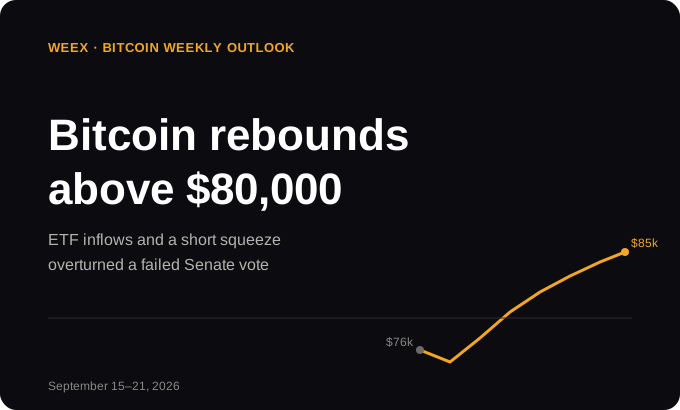
WEEX Bitcoin Weekly Outlook: Why Did Bitcoin Rebound Above $80,000 After the CLARITY Act Vote?
Bitcoin rebounded above $80,000 as SEC and CFTC action, renewed ETF inflows, and a short squeeze outweighed the failed CLARITY Act vote.
Coldcard whitehats move 52.37 BTC to recovery trust
What is CBDC? Governments Push for Development of Central Bank Digital Currencies
Bitcoin Has Not Fallen Below Realized Price During the Bear Market
The Clearing House Selects Quant for US Tokenized Deposit Network
4500 Bitcoins Moved to New Addresses, Sale Status Unconfirmed
[New York Gold, Bonds, Dollar] Interest Rates and Dollar Strength Pause... Oil Prices Drop, Won and Gold Prices Rebound
Trump Expresses Concern Over Yen Depreciation, Japanese Finance Minister Says Coordination with U.S. Will Continue



