
Bitcoin: JPMorgan Sees BTC Outperforming Gold

 Prefer us on Google


Doctrinal shift on Wall Street. JPMorgan, the largest American bank by balance sheet size, is changing its position. It now believes that Bitcoin can outperform gold in the coming months. This argument is not just a whim. In other words, at equivalent risk levels, the bank's strategists consider the yellow metal to be more expensive than its digital rival. Therefore, Bitcoin would offer a better long-term entry point.
The reasoning comes from the office of Nikolaos Panigirtzoglou, the chief global markets strategist. His team compares the two assets on a volatility-adjusted basis over several cycles. Ultimately, his successive notes have placed the theoretical value of BTC significantly above its current price.
Key Points
- JPMorgan believes Bitcoin can outperform gold in the coming months
- On a volatility-adjusted basis, the bank's model places the theoretical value of BTC near $170,000
- The debasement trade initially benefited gold, which has a global supply exceeding $25 trillion
- JPMorgan accepts Bitcoin ETFs as collateral and has deployed its JPMD deposit token on Base
Bitcoin vs Gold, JPMorgan's Volatility-Adjusted Calculation
The mechanics boil down to a simple idea. Bitcoin moves more than gold, so a portfolio seeking the same risk level holds less of it. Specifically, JPMorgan quantifies this relationship. The volatility of BTC can be twice that of the metal. In this case, one dollar of Bitcoin carries as much risk as two dollars of gold. Then, it suffices to apply this coefficient to the value of gold held as an investment, excluding jewelry and industrial uses. The result yields a theoretical price for Bitcoin.
The exercise yielded $126,000 by the summer of 2025. It rose to nearly $170,000 in a November note, over six to twelve months. The assumption made: a volatility ratio converging towards 2. Furthermore, gold crossing $4,000 an ounce, a historic first, mechanically inflated this target. The higher the metal rises, the more the model demands an expensive Bitcoin to restore risk parity.
The significant gap between the two markets fuels the asymmetry the bank invokes. The global supply of gold exceeds $25 trillion. Bitcoin's market capitalization, however, remains below 10% of this total. Even a partial shift of defensive savings towards BTC would thus move its price in unprecedented proportions. In short, gold, due to its mass, will never experience such a movement.
Gold Has Already Run, the Debasement Trade Seeks a Relay
The surge in the metal owes much to central banks. The World Gold Council records over 1,000 tons purchased each year by monetary institutions. Moreover, this pace has held for three consecutive years. The other driver bears a name that has become common on desks, the debasement trade. This bet relies on the erosion of the value of fiat currencies. In practice, it feeds off U.S. public deficits and political pressures on the Federal Reserve.
When this bet becomes consensus, gold loses its ability to surprise. JPMorgan sees a congested queue. The bank is therefore looking for a relay in Bitcoin, whose institutional base remains young. U.S. spot ETFs, opened in January 2024, have captured several tens of billions of dollars in net flows. Nevertheless, this amount remains modest compared to the public reserves of metal accumulated over decades.
From "Pet Rock" to Bitcoin ETFs as Collateral, JPMorgan Has Changed Its Stance
The research position contrasts with the statements of the bank's CEO. Jamie Dimon indeed compared BTC to a 1970s gadget, the pet rock sold in a box.
"It does nothing. I call it the pet rock."
Jamie Dimon, CEO of JPMorgan, at Davos in January 2024
The discourse has not slowed the firm. Subsequently, JPMorgan launched JPMD, a deposit token deployed on Base, the layer 2 blockchain developed by Coinbase. It then allowed its wealthy clients to use shares of Bitcoin ETFs as loan collateral globally. Dimon himself had confirmed the opening to his shareholders in May 2025: "We will let you buy it. We will not ensure its custody."
Two conditions could close the gap between Bitcoin's price and the model's target. The first is a volatility sustainably close to that of gold. The second hinges on incoming flows capable of taking over from the central banks buying metal. Moreover, the first is already advancing. The annualized volatility of BTC exceeded 80% during the 2021 cycle. It fell to an unprecedented low of around 30% by the summer of 2025. JPMorgan then described this level as the lowest ever recorded. Each point lost on this indicator increases the amount of Bitcoin a manager is allowed to hold at constant risk. This is precisely what Panigirtzoglou's office measures.
This compression has further intensified since. In a note dated February 5, 2026, JPMorgan raised its long-term Bitcoin target to $266,000. This level is deemed "unrealistic" for 2026 but achievable in the long term if market sentiment improves. The BTC/gold volatility ratio used in the model has dropped to 1.5. This is thus a new low after the 2 retained in November. The calculation is based on private investment in gold outside central bank reserves, estimated at $8 trillion. It also follows the upward revision of its long-term gold target to $8,000-$8,500 an ounce.
-- Price
This content is provided for general informational purposes only and doesn't constitute financial, investment, legal, or tax advice. Any events, rewards, online promotions, or related information mentioned herein should not be considered a recommendation, solicitation, or invitation to purchase, sell, trade, or otherwise deal in any crypto assets. Crypto assets are highly volatile and may result in loss. The availability of WEEX services, products, and related events may vary by region. You are responsible for ensuring that your participation is in accordance with applicable local laws and regulations.
You may also like

FTX and AI Apocalypse: The End of Calm Times for Anthropic

What is CBDC? Governments Push for Development of Central Bank Digital Currencies

Bitcoin Has Not Fallen Below Realized Price During the Bear Market

The Clearing House Selects Quant for US Tokenized Deposit Network

4500 Bitcoins Moved to New Addresses, Sale Status Unconfirmed
![[New York Gold, Bonds, Dollar] Interest Rates and Dollar Strength Pause... Oil Prices Drop, Won and Gold Prices Rebound](/public-static/29_4631d65680.png?format=avif)
[New York Gold, Bonds, Dollar] Interest Rates and Dollar Strength Pause... Oil Prices Drop, Won and Gold Prices Rebound

Trump Expresses Concern Over Yen Depreciation, Japanese Finance Minister Says Coordination with U.S. Will Continue

Treasuries at 21-Year High: Impact on Stocks and Interest Rates

Solana DEX volume spike hides circular trades, and automated bots are blamed

Oracle Stock vs. KRAFTON Stock: Why Are Investors Questioning Two Growing Companies?
Compare Oracle and KRAFTON stocks through their latest results, share-price questions and the different growth tests investors face in 2026.

John Templeton: "Bull markets are born in pessimism"

The Death of Hsin-Ju: A Prelude to Conspiracy

LTC Airdrop 2026: How to Claim 50,000 USDT Rewards on WEEX

Raiffeisen’s crypto deal could reach 18 million customers. How many can actually trade?

TRON Surpasses $30T in Total Transaction Volume as it Secures its Place as Leading Chain for Stablecoins

HTX DeepThink: Opportunities Concentrate on Profitable and Fund-Supported Assets, BTC Still Has Room for Recovery After Consolidation
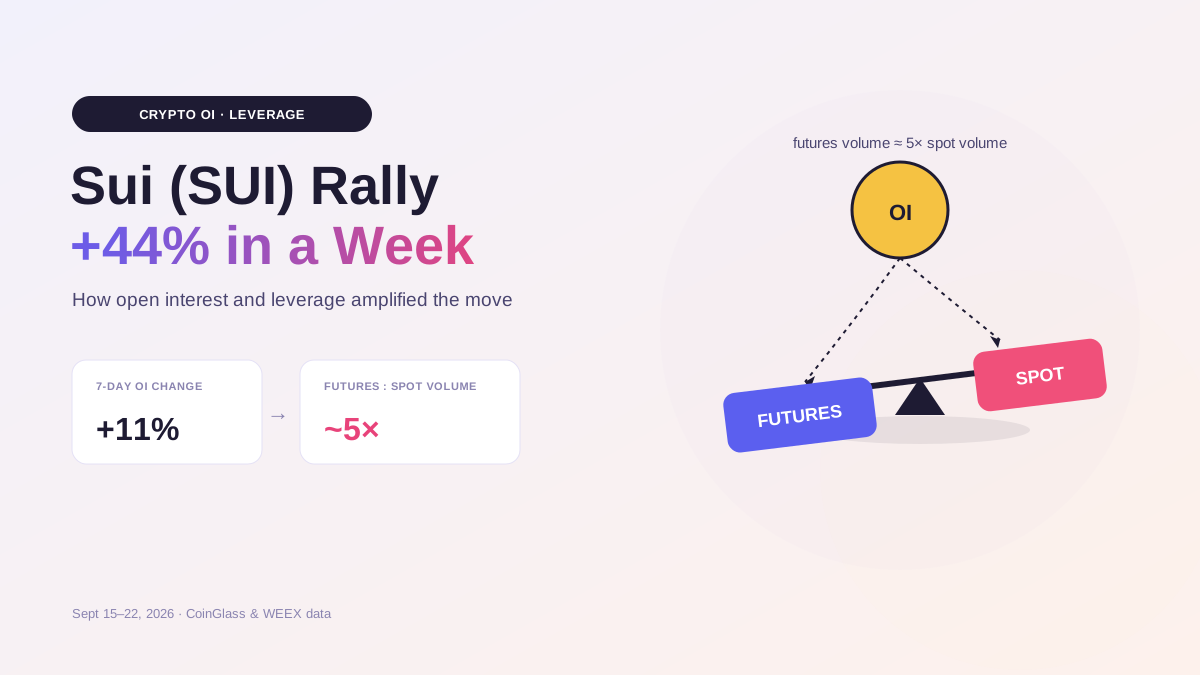
Why Did Sui (SUI) Crypto Price Jump 44%? Crypto OI and Leverage Explain the Rally
See why Sui (SUI) jumped 44%, how crypto OI and leverage amplified the rally, what the pullback means, and how to trade SUI on WEEX.

Circle expands CCTP to EURC and cirBTC on Arc

Bitcoin, Sports, and Politics: Predictive Markets Target $10 Trillion

AI Agent Jev Expects On-Chain Innovation Through Automated Judgment
The End of the Blank Prompt: Why Trading AI Needs a Playbook

Stablecoins hold nearly $200 billion in US debt, but money funds bought the surge
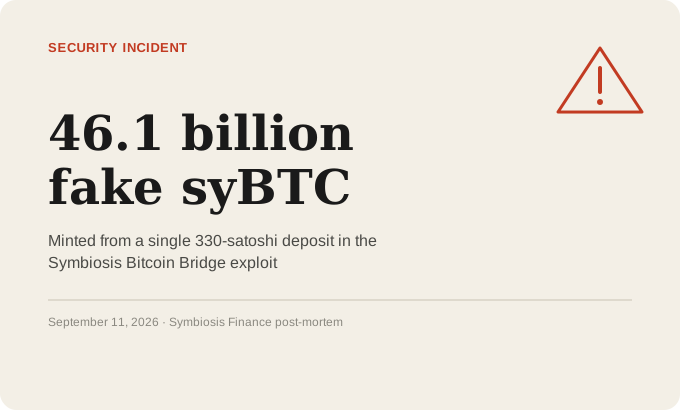
How Did a Hacker Create 46 Billion Fake Bitcoin in the Symbiosis Exploit? Decodes Bitcoin Hacker With WEEX Now
How two Symbiosis bridge bugs let a hacker mint 46.1 billion unbacked syBTC, drain Bitcoin pools and expose critical bridge risks.

CFTC's Selig Emphasizes the Need to Prepare for the Era of Large-Scale Tokenization in the U.S.

The IMF opens an office in Venezuela to supervise an economy that has already migrated to USDT

SOXL Stock Jumped 12% Yesterday: Three Companies Explain the Entire Move

Bitcoin's Hashrate Rises as Miners Reactivate Their Machines

Bitcoin 2x Leveraged ETF Launches on Cboe, But Doesn't Buy Bitcoin: Here's Why

Crypto: The ECB Enters the Tokenized Bond Market
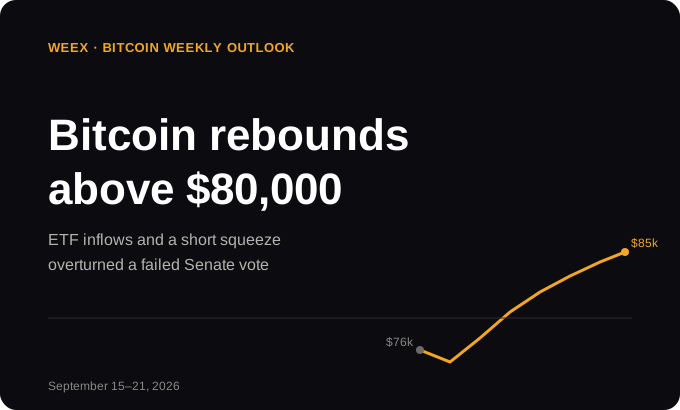
WEEX Bitcoin Weekly Outlook: Why Did Bitcoin Rebound Above $80,000 After the CLARITY Act Vote?
Bitcoin rebounded above $80,000 as SEC and CFTC action, renewed ETF inflows, and a short squeeze outweighed the failed CLARITY Act vote.
FTX and AI Apocalypse: The End of Calm Times for Anthropic
What is CBDC? Governments Push for Development of Central Bank Digital Currencies
Bitcoin Has Not Fallen Below Realized Price During the Bear Market
The Clearing House Selects Quant for US Tokenized Deposit Network
4500 Bitcoins Moved to New Addresses, Sale Status Unconfirmed
[New York Gold, Bonds, Dollar] Interest Rates and Dollar Strength Pause... Oil Prices Drop, Won and Gold Prices Rebound



