
US government moves Bitcoin seized from Alameda

 Prefer us on Google


The U.S. government has transferred a small amount of Bitcoin seized from Alameda Research's Binance.US accounts three years ago, renewing attention on how federal agencies will handle the remaining assets.
Arkham Intelligence reported the transaction on Aug. 26, describing the amount as small and tracing the Bitcoin to Alameda accounts on Binance.US that U.S. authorities seized three years earlier.
The blockchain analytics firm did not publish the amount in its indexed post or identify the receiving address. Arkham also did not say that officials had sold the Bitcoin, leaving the transaction's purpose unconfirmed.
"The US Government just moved a small amount of Bitcoin that had been seized from Alameda accounts on Binance US, 3 years ago," Arkham said.
The Bitcoin transfer does not confirm a sale
Moving Bitcoin between addresses records a change in custody or location on the blockchain, but the transaction alone does not show whether the asset has been sold. A transfer to another government wallet may involve custody, accounting, or security management, while movement to an exchange can make a future sale possible without proving one occurred.
In July, U.S. government-linked wallets transferred nearly $297 million in seized Bitcoin and Ether to Coinbase Prime. The transaction included about 3,940 BTC and 30,014 ETH tied to separate enforcement cases, according to earlier transaction coverage.
No public blockchain record can show whether an exchange deposit resulted in an executed trade unless additional evidence reveals a conversion or movement of the sale proceeds. The same limitation applies to the latest Alameda-linked Bitcoin transaction.
Alameda assets have moved several times in 2026
Federal wallets have processed other seized assets tied to Alameda and FTX during 2026, providing a record of how authorities have handled smaller token holdings.
In May, Arkham said the government moved about $1.89 million in Render, Uniswap, The Sandbox, Mask Network, and Axie Infinity tokens to Coinbase Prime. The analytics firm traced the tokens to approximately $13 million in Alameda assets seized from Binance accounts more than three years earlier.
Another transaction followed in June, when government-controlled wallets transferred nearly $984,000 in FTX- and Alameda-linked cryptocurrency. At least $768,000 of the total went to Coinbase Prime, as crypto.news reported at the time.
Federal wallets had also moved more than $33 million in Alameda-linked cryptocurrency in December 2024. According to an Arkham report, the batch included about $18 million in Ether, $13 million in BUSD, and smaller amounts of Wrapped Bitcoin, Shiba Inu, and Axie Infinity.
U.S. reserve rules limit some Bitcoin sales
President Donald Trump's March 2025 executive order established the Strategic Bitcoin Reserve and directed the Treasury Department to fund it with Bitcoin finally forfeited through criminal or civil proceedings.
Under the order, Bitcoin deposited into the reserve cannot be sold and must remain a U.S. reserve asset. A recent Bitcoin reserve explainer estimated that the federal government held approximately 198,000 BTC as of mid-2026, although public trackers produce different totals based on the addresses and legal categories they include.
The White House order does not place every seized coin under an absolute ban on disposal. It allows agencies to return assets to verified victims, comply with court orders, support law enforcement operations, and meet requirements under federal forfeiture laws.
Legal status, therefore, determines how a particular holding can be handled. Bitcoin that has been finally forfeited and transferred into the reserve receives different treatment from property still involved in a court case, creditor recovery process, or victim compensation plan.
-- Price
FTX creditors remain tied to the seized assets
Alameda Research operated as the trading firm associated with FTX before the exchange collapsed in November 2022. Federal prosecutors later said FTX founder Sam Bankman-Fried used customer deposits to finance Alameda's operations, investments and loan repayments.
The Justice Department said Bankman-Fried misappropriated billions of dollars deposited by FTX customers and gave Alameda access to the funds. A federal jury convicted him in November 2023 on seven counts, including wire fraud, securities fraud conspiracy, commodities fraud conspiracy, and money laundering conspiracy.
In March 2024, U.S. District Judge Lewis Kaplan sentenced Bankman-Fried to 25 years in prison. The Justice Department said the sentence included forfeiture of more than $11 billion, while prosecutors placed FTX customer losses at more than $8 billion.
This content is provided for general informational purposes only and doesn't constitute financial, investment, legal, or tax advice. Any events, rewards, online promotions, or related information mentioned herein should not be considered a recommendation, solicitation, or invitation to purchase, sell, trade, or otherwise deal in any crypto assets. Crypto assets are highly volatile and may result in loss. The availability of WEEX services, products, and related events may vary by region. You are responsible for ensuring that your participation is in accordance with applicable local laws and regulations.
You may also like

What is CBDC? Governments Push for Development of Central Bank Digital Currencies

Bitcoin Has Not Fallen Below Realized Price During the Bear Market

The Clearing House Selects Quant for US Tokenized Deposit Network

4500 Bitcoins Moved to New Addresses, Sale Status Unconfirmed
![[New York Gold, Bonds, Dollar] Interest Rates and Dollar Strength Pause... Oil Prices Drop, Won and Gold Prices Rebound](/public-static/29_4631d65680.png?format=avif)
[New York Gold, Bonds, Dollar] Interest Rates and Dollar Strength Pause... Oil Prices Drop, Won and Gold Prices Rebound

Trump Expresses Concern Over Yen Depreciation, Japanese Finance Minister Says Coordination with U.S. Will Continue

Treasuries at 21-Year High: Impact on Stocks and Interest Rates

Solana DEX volume spike hides circular trades, and automated bots are blamed

Oracle Stock vs. KRAFTON Stock: Why Are Investors Questioning Two Growing Companies?
Compare Oracle and KRAFTON stocks through their latest results, share-price questions and the different growth tests investors face in 2026.

John Templeton: "Bull markets are born in pessimism"

The Death of Hsin-Ju: A Prelude to Conspiracy

LTC Airdrop 2026: How to Claim 50,000 USDT Rewards on WEEX

Raiffeisen’s crypto deal could reach 18 million customers. How many can actually trade?

TRON Surpasses $30T in Total Transaction Volume as it Secures its Place as Leading Chain for Stablecoins

HTX DeepThink: Opportunities Concentrate on Profitable and Fund-Supported Assets, BTC Still Has Room for Recovery After Consolidation
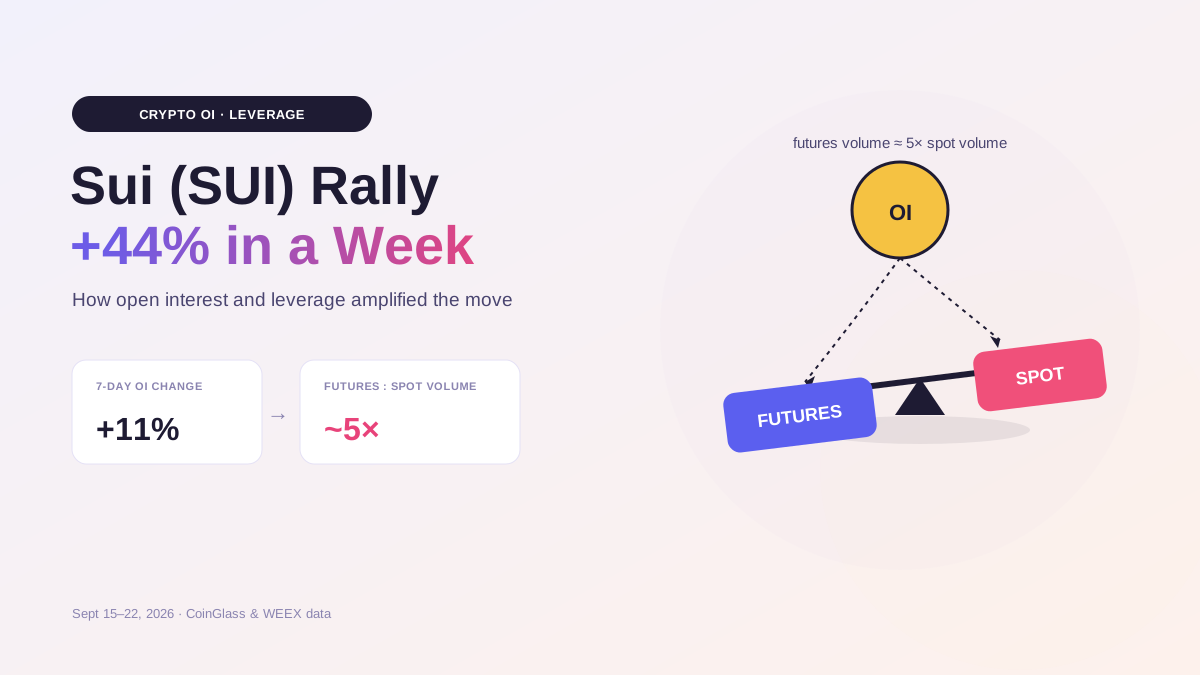
Why Did Sui (SUI) Crypto Price Jump 44%? Crypto OI and Leverage Explain the Rally
See why Sui (SUI) jumped 44%, how crypto OI and leverage amplified the rally, what the pullback means, and how to trade SUI on WEEX.

Circle expands CCTP to EURC and cirBTC on Arc

Bitcoin, Sports, and Politics: Predictive Markets Target $10 Trillion

AI Agent Jev Expects On-Chain Innovation Through Automated Judgment
The End of the Blank Prompt: Why Trading AI Needs a Playbook

Stablecoins hold nearly $200 billion in US debt, but money funds bought the surge
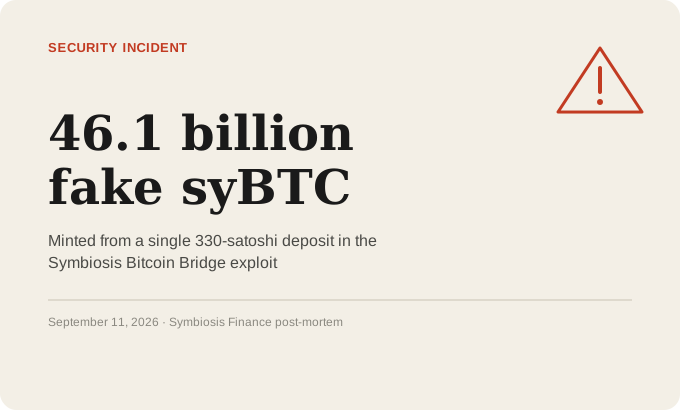
How Did a Hacker Create 46 Billion Fake Bitcoin in the Symbiosis Exploit? Decodes Bitcoin Hacker With WEEX Now
How two Symbiosis bridge bugs let a hacker mint 46.1 billion unbacked syBTC, drain Bitcoin pools and expose critical bridge risks.

CFTC's Selig Emphasizes the Need to Prepare for the Era of Large-Scale Tokenization in the U.S.

The IMF opens an office in Venezuela to supervise an economy that has already migrated to USDT

SOXL Stock Jumped 12% Yesterday: Three Companies Explain the Entire Move

Bitcoin's Hashrate Rises as Miners Reactivate Their Machines

Bitcoin 2x Leveraged ETF Launches on Cboe, But Doesn't Buy Bitcoin: Here's Why

Crypto: The ECB Enters the Tokenized Bond Market
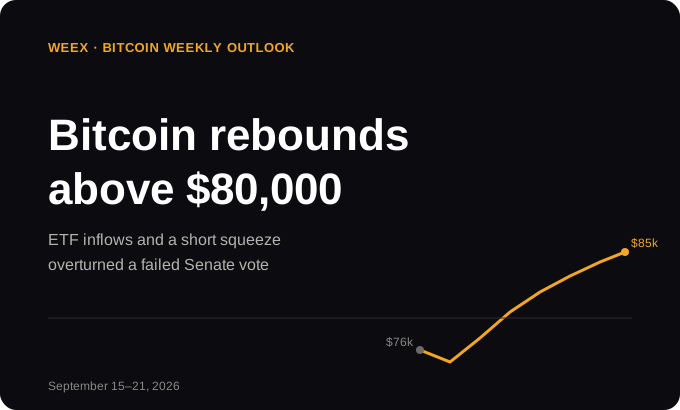
WEEX Bitcoin Weekly Outlook: Why Did Bitcoin Rebound Above $80,000 After the CLARITY Act Vote?
Bitcoin rebounded above $80,000 as SEC and CFTC action, renewed ETF inflows, and a short squeeze outweighed the failed CLARITY Act vote.
Coldcard whitehats move 52.37 BTC to recovery trust
What is CBDC? Governments Push for Development of Central Bank Digital Currencies
Bitcoin Has Not Fallen Below Realized Price During the Bear Market
The Clearing House Selects Quant for US Tokenized Deposit Network
4500 Bitcoins Moved to New Addresses, Sale Status Unconfirmed
[New York Gold, Bonds, Dollar] Interest Rates and Dollar Strength Pause... Oil Prices Drop, Won and Gold Prices Rebound
Trump Expresses Concern Over Yen Depreciation, Japanese Finance Minister Says Coordination with U.S. Will Continue



