
Security and fees hold back deeper crypto use among wealthy investors: Nexo report

 Prefer us on Google


Nearly 67% of affluent investors across the United States, United Kingdom and Argentina have owned crypto, but only 4.7% have integrated digital assets deeply into long term financial planning, according to new research from Nexo.
- Nearly 67% of affluent investors surveyed by Nexo own crypto, but the average Crypto Integration Index score was only 4.83 out of 10.
- Only 4.7% scored 7 or higher, indicating that relatively few respondents had incorporated crypto deeply into long term financial and retirement planning.
- Security concerns, high fees and platform complexity were the main sources of friction among investors with the highest levels of crypto integration.
- The U.S. recorded the deepest crypto integration despite having the lowest ownership rate among the three markets surveyed.
According to Nexo's "The Future of Digital Wealth 2026" report, operational issues such as security, fees and platform complexity remain among the main obstacles for wealthy investors who already have exposure to digital assets.
The survey covered 1,000 affluent investors and was conducted through research platform Attest in February and March 2026. Participants needed at least $100,000 in liquid assets in the U.S. and U.K. or $40,000 in Argentina, thresholds Nexo said were designed to capture the top 25% to 30% of investors by investable wealth in each market.
Ownership was relatively common across the surveyed group, with roughly two thirds holding digital assets. Their average score on Nexo's new Crypto Integration Index, however, stood at 4.83 out of 10.
High net worth investors own crypto but integration remains limited
Nexo created the Crypto Integration Index to measure how digital assets fit into an investor's finances beyond simply owning them. Five factors receive equal weight: allocation size, holding period, retirement integration, replacement of traditional assets and perceived risk.
An investor near the 4.83 survey average typically held a relatively small crypto position over a shorter period and had not incorporated it into retirement planning, according to the report.
Only 4.7% of respondents scored 7 or higher. Nexo classified investors above that threshold as "Structurally Integrated," meaning their crypto positions had generally been held for longer, had replaced part of a traditional asset allocation and had become part of long term financial planning.
Conviction appeared stronger than the integration figures suggested. Just under 20% of surveyed investors expected crypto to become their biggest source of personal wealth creation over the coming decade, ahead of salary, equities and real estate.
Nexo analyst Iliya Kalchev said perceived risk showed little difference between investors who had deeply incorporated crypto into their finances and those who had not.
"What actually divides them is whether they've substituted crypto for a traditional asset and folded it into retirement planning," Kalchev said.
Interest in incorporating crypto into managed portfolios has appeared elsewhere in the wealth industry. A September poll shared by Bitwise found that 60% of participating wealth managers planned to allocate to crypto within a year, even though 67% said they were not currently allocating client portfolios to digital assets.
Security and fees remain hurdles for deeper crypto use
Operational concerns became more prominent among investors who had already reached higher levels of crypto integration.
Among respondents with Crypto Integration Index scores of 7 or above, 36% cited security concerns as a source of friction. High fees were identified by 34%, while 28% pointed to platform complexity.
Neil Steinhardt, chief operating officer of Nexo US, said investors who had moved beyond concerns about crypto risk were left dealing with security, fees and the usability and capabilities of platforms.
"That's the gap between owning crypto and actually building wealth with it," Steinhardt said.
Nexo has a commercial interest in digital asset adoption and acknowledged that relationship in disclosures accompanying the research. The company said its index is intended as a descriptive measure of reported investor behavior and that a higher score should not be interpreted as representing a better investment strategy.
The findings come after Nexo returned to the U.S. market in February 2026 with investment, trading and crypto backed credit products. As crypto.news previously reported, the relaunch followed the company's earlier withdrawal from the country and a $45 million settlement with U.S. regulators over its Earn Interest Product.
Nexo said at the time that its U.S. services would operate through a compliance focused framework. CryptoQuant data cited around the relaunch showed the platform had issued approximately $863 million in loans during the preceding year.
Crypto integration differs across the U.S., U.K. and Argentina
Nexo's survey found a gap between the number of people holding crypto in each market and the extent to which those holdings had become part of their financial planning.
Argentina recorded the highest ownership rate at 74%, but its average Crypto Integration Index score was 4.62, the lowest of the three markets surveyed.
The United States produced the opposite pattern. Crypto ownership among U.S. respondents stood at 62%, below Argentina and the U.K., while its average integration score of 5.07 was the highest.
U.K. respondents sat between the two markets, with 65% reporting crypto ownership and an average index score of 4.75.
Argentina has become a growing market for Nexo itself. The company launched a crypto card in the country in July, allowing eligible clients to make purchases in Argentine pesos and U.S. dollars while using digital assets through the platform. Nexo appointed Andres Ondarra as general manager for Argentina as part of the same expansion.
The country's relatively high ownership rate comes as the number of people holding crypto worldwide continues to grow. Henley & Partners estimated in September that global crypto ownership had reached 742 million people, even as the number of crypto millionaires fell to 135,694 during a contraction in the digital asset market.
-- Price
Retirement use peaks among investors aged 35 to 44
Age produced another gap between crypto ownership and its use in long term financial planning.
Investors between 35 and 44 recorded the deepest retirement integration in Nexo's survey, with 28% treating crypto as a core retirement asset.
Respondents between 18 and 25 showed the highest ownership and conviction. More than 90% in the age group reported holding crypto, but only 2% said they had an investment horizon of at least 10 years.
Retirement products have gradually begun opening additional routes for digital asset exposure in some markets. Coinbase Australia, for example, added support for self managed super funds in May, allowing eligible trustees to incorporate crypto exposure into self directed retirement portfolios.
Institutional surveys have shown a similar willingness to consider larger allocations. A Coinbase and EY Parthenon survey of 351 institutional investors conducted in January found 73% planned to raise their digital asset allocations during 2026, while 74% expected crypto prices to rise.
Nexo cautioned that its own findings apply specifically to the surveyed group of affluent investors and are not representative of the general population. The company described crypto assets as speculative and high risk instruments whose value can fall rapidly, while advising investors to seek independent financial, legal and tax advice before making investment decisions.
This content is provided for general informational purposes only and doesn't constitute financial, investment, legal, or tax advice. Any events, rewards, online promotions, or related information mentioned herein should not be considered a recommendation, solicitation, or invitation to purchase, sell, trade, or otherwise deal in any crypto assets. Crypto assets are highly volatile and may result in loss. The availability of WEEX services, products, and related events may vary by region. You are responsible for ensuring that your participation is in accordance with applicable local laws and regulations.
You may also like

XRPL lending protocol gains validator support as vault vote advances

US card debt hits $1.29 trillion as Bitcoin loans expose a collateral divide

CryptoQuant: Bitcoin Analyst Sentiment Significantly Bearish, Index Drops to -1.8σ

How Much CPO Demand Will NVIDIA's Rubin Ultra Generate? Bernstein: Optical Value of Single Pod Increases Fivefold

Pump.fun Data Review: Why the Current Meme Market Has Become a 'Harvesting Game'?

As Protocols Move Back to the Mainnet, How Does Ethereum's Value Logic Change?

As Whales Embrace ETFs, Security Anxiety in the Crypto World is Spreading
How Much Revenue Can Anthropic Generate for Every $1 Spent on Computing Power?

WEEX 11.11 Shopping Fest: Buy BTC and Unlock Up to 888 USDT in Rewards

Bitget UEX Daily Report | Inflation Surprises and Pressures US Stocks; Nvidia Falls Over 5%; Gold Drops Below $4100 (November 11, 2026)

How Much Net Buying Power Will ETH Lose When Bitmine Stops Buying?
LlamaRisk Proposes to Narrow Aave V3 Core Collateral Asset Range, Involving $1.33 Billion in Collateral

Algorithmic Trading and Cryptocurrencies: How Do Robots React to Volatility?

Cardano’s police evidence system could bring 1.5 million annual transactions

Confidence at Zero! Goldman Sachs Interprets Hedge Fund Positions: 'Surrender Liquidation', Largest Loss Since the Pandemic

47% Top Tax Rate Approaches: Seven Tax Reduction Strategies for Australian Crypto Investors
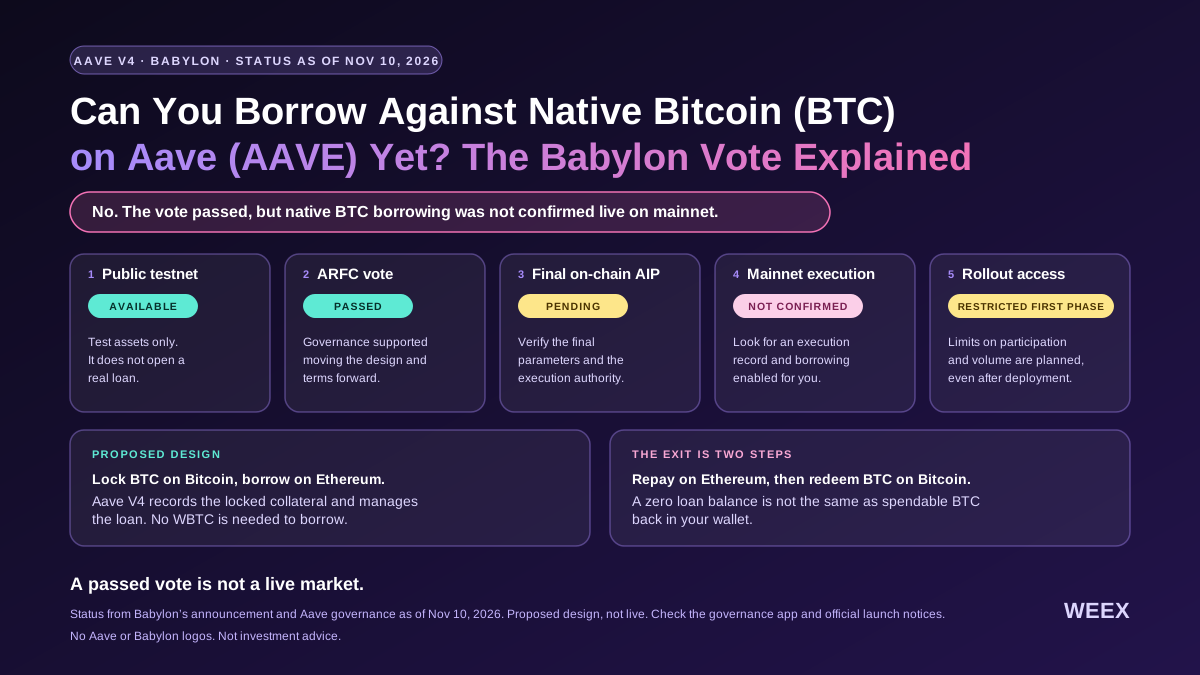
Can You Borrow Against Native Bitcoin (BTC) on Aave (AAVE) Yet? The Babylon Vote Explained
Can you borrow against native Bitcoin on Aave yet? See what the Babylon vote approved, what still needs to launch, and how BTC liquidation would work.

PIEVERSE Price Up Nearly 80% in a Week: Futures Activity, the November 14 Unlock and What Is Confirmed
PIEVERSE rose about 79% in seven days with futures volume far above spot. See what is confirmed about the November 14 unlock and the WEEX Lucky Eggs campaign.

Hong Kong Approves Crypto Asset Reporting Rules - Fintech World

NVDA Stock Falls 4.3% After Board Opens Investigation: What Is Confirmed and What Is Not
NVDA closed at $178.67 on November 9, 2026, down about 4.3%, after Nvidia’s board confirmed an independent investigation. Other claims come from media reports. WEEX’s Lucky Eggs campaign runs until November 25.

Chainalysis Report: Why Did Western Europe Withstand the Global Crypto Market Chill?

Four Security Strategies from the Wallet Theft Incident

Global Outage: Your Cryptos Are Not Disappearing

Did Strategy buy Bitcoin? Saylor reignites speculation

A New Chapter in the History of Rug Pulls in Crypto

From Binance Incubator to Nasdaq: Injective's Eight Years

tBTC Cross-Chain Bridge Resumes On-Chain Operations, Threshold Network Confirms Adequate Reserves
FinCEN Withdraws Proposed Crypto Travel Rule Expansion in Separate November Move

Finnish Startup Uses Heat from Bitcoin Miners to Heat 30 Homes

Analysis: The Logic of BTC's Periodic Recovery Remains Unshaken, Losses and Panic Have Been Fully Released
XRPL lending protocol gains validator support as vault vote advances
US card debt hits $1.29 trillion as Bitcoin loans expose a collateral divide
CryptoQuant: Bitcoin Analyst Sentiment Significantly Bearish, Index Drops to -1.8σ
How Much CPO Demand Will NVIDIA's Rubin Ultra Generate? Bernstein: Optical Value of Single Pod Increases Fivefold
Pump.fun Data Review: Why the Current Meme Market Has Become a 'Harvesting Game'?
As Protocols Move Back to the Mainnet, How Does Ethereum's Value Logic Change?
Latest articles


Latest coin listings on WEEX


