
Ripple co-founder Chris Larsen faces Flock protest

 Prefer us on Google


San Francisco protesters gathered outside Ripple co-founder Chris Larsen's home on Aug. 21, challenging his financial support for police surveillance systems, including automated license plate readers supplied by Flock Safety.
Sunrise Movement Bay Area organized the demonstration as part of a national campaign calling on cities to cancel Flock contracts and remove the company's cameras. Protesters distributed flyers and displayed a mock camera carrying the message, "Does this make you feel safer, Chris?"
Larsen co-founded Ripple and serves as its executive chairman. Brad Garlinghouse, not Larsen, is the company's chief executive.
Sunrise organizer Luc Bouchard argued that cities should direct public-safety funding toward housing, employment and social services. He also questioned whether Flock cameras materially reduce crime.
"There's not much evidence that Flock cameras significantly impact crime rates," Bouchard claimed.
The demonstration focused on Larsen because he has financed several San Francisco public-safety programs. The protesters did not accuse Ripple, XRP or Larsen of violating any law. No arrests or property damage were reported during the event.
The dispute instead centers on whether a wealthy private donor should play such a large role in funding public surveillance infrastructure. It adds a local civil-liberties issue to broader scrutiny of political and civic spending by crypto executives.
The San Francisco Police Community Foundation, founded by Larsen, committed $7.25 million toward relocating and upgrading the police department's Real-Time Investigations Center. Ripple also provided office space at 315 Montgomery Street rent-free through December 2026.
The lease represented approximately $2.15 million of the overall $9.4 million package, according to the foundation's account. The Police Commission, Board of Supervisors and Mayor Daniel Lurie approved the arrangement in 2025.
The center integrates information from emergency calls, police cameras, drones and automated license plate readers. A city statement said the technology helped officers coordinate more than 500 arrests. City officials also associated the program with falling auto theft, although the figures do not establish that surveillance technology alone caused the decline.
San Francisco operates roughly 400 Flock automated license plate readers. The cameras photograph visible plates and record information including the vehicle, location, date and time.
Privacy concerns intensified after a compliance audit found nearly 300 improper searches of San Francisco plate data conducted for federal and out-of-state agencies. California law restricts sharing automated license plate information with those agencies.
SFPD subsequently removed the Northern California Regional Intelligence Center's access to its Flock data. Police said they would strengthen oversight and review data-sharing practices. The improper searches represented a small portion of total queries, but opponents argue that the incident demonstrated how access can extend beyond the original local purpose.
Flock maintains that its customers own their data and control sharing permissions. It also says every search is recorded and connected to an identified user.
Flock announced new safeguards on Aug. 13. The company reduced its recommended default retention period from 30 days to seven days for new deployments, according to its update.
Existing customers can retain previously approved periods. Flock is also introducing Evidence Mode, which allows investigators to preserve selected records connected to active cases.
Other changes include mandatory misuse detection, required case codes, multifactor authentication and controls allowing agencies to restrict data sharing by offense type. Flock said the measures would improve accountability, but their effectiveness will depend on adoption and enforcement by participating agencies.
Organizers are expected to continue pressing Bay Area cities to end their Flock contracts. San Francisco officials have not announced plans to remove the cameras, while Larsen has not issued a public response to the protest.
-- Price
This content is provided for general informational purposes only and doesn't constitute financial, investment, legal, or tax advice. Any events, rewards, online promotions, or related information mentioned herein should not be considered a recommendation, solicitation, or invitation to purchase, sell, trade, or otherwise deal in any crypto assets. Crypto assets are highly volatile and may result in loss. The availability of WEEX services, products, and related events may vary by region. You are responsible for ensuring that your participation is in accordance with applicable local laws and regulations.
You may also like

Bitget hacker routes 4 BTC through Wasabi CoinJoin

Citi says 77% of institutions eye tokenized collateral

FTX and AI Apocalypse: The End of Calm Times for Anthropic

What is CBDC? Governments Push for Development of Central Bank Digital Currencies

Bitcoin Has Not Fallen Below Realized Price During the Bear Market

The Clearing House Selects Quant for US Tokenized Deposit Network

4500 Bitcoins Moved to New Addresses, Sale Status Unconfirmed
![[New York Gold, Bonds, Dollar] Interest Rates and Dollar Strength Pause... Oil Prices Drop, Won and Gold Prices Rebound](/public-static/29_4631d65680.png?format=avif)
[New York Gold, Bonds, Dollar] Interest Rates and Dollar Strength Pause... Oil Prices Drop, Won and Gold Prices Rebound

Trump Expresses Concern Over Yen Depreciation, Japanese Finance Minister Says Coordination with U.S. Will Continue

Treasuries at 21-Year High: Impact on Stocks and Interest Rates

Solana DEX volume spike hides circular trades, and automated bots are blamed

Oracle Stock vs. KRAFTON Stock: Why Are Investors Questioning Two Growing Companies?
Compare Oracle and KRAFTON stocks through their latest results, share-price questions and the different growth tests investors face in 2026.

John Templeton: "Bull markets are born in pessimism"

The Death of Hsin-Ju: A Prelude to Conspiracy

LTC Airdrop 2026: How to Claim 50,000 USDT Rewards on WEEX

Raiffeisen’s crypto deal could reach 18 million customers. How many can actually trade?

TRON Surpasses $30T in Total Transaction Volume as it Secures its Place as Leading Chain for Stablecoins

HTX DeepThink: Opportunities Concentrate on Profitable and Fund-Supported Assets, BTC Still Has Room for Recovery After Consolidation
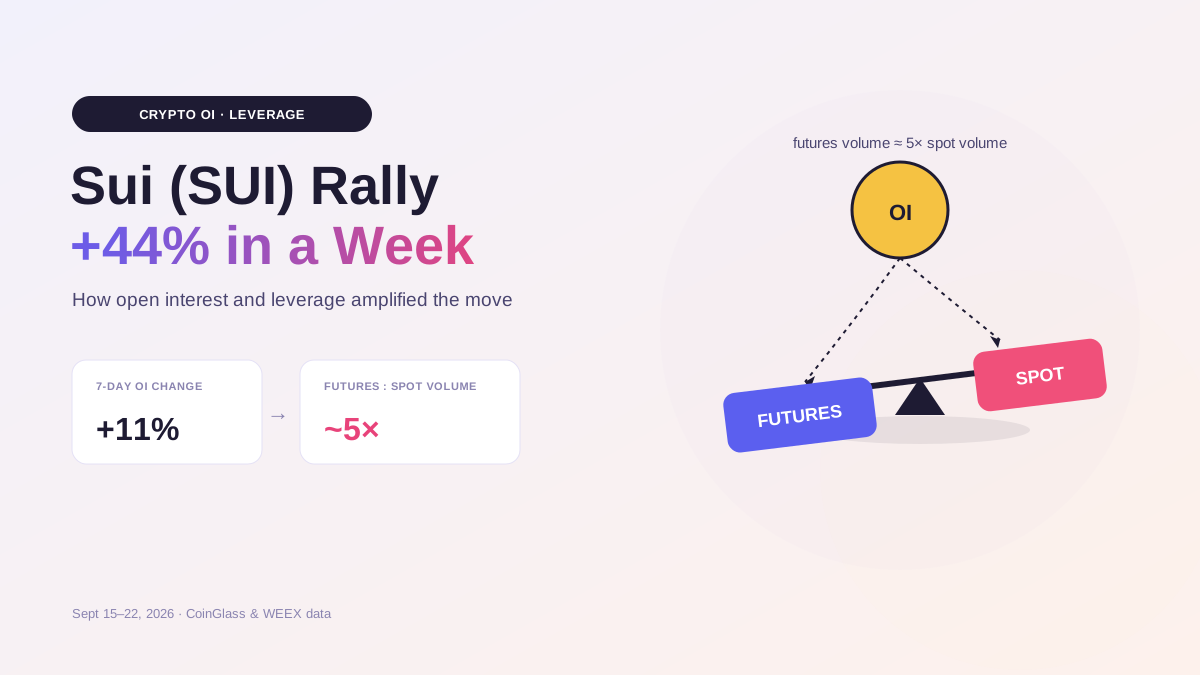
Why Did Sui (SUI) Crypto Price Jump 44%? Crypto OI and Leverage Explain the Rally
See why Sui (SUI) jumped 44%, how crypto OI and leverage amplified the rally, what the pullback means, and how to trade SUI on WEEX.

Circle expands CCTP to EURC and cirBTC on Arc

Bitcoin, Sports, and Politics: Predictive Markets Target $10 Trillion

AI Agent Jev Expects On-Chain Innovation Through Automated Judgment
The End of the Blank Prompt: Why Trading AI Needs a Playbook
Stablecoins hold nearly $200 billion in US debt, but money funds bought the surge
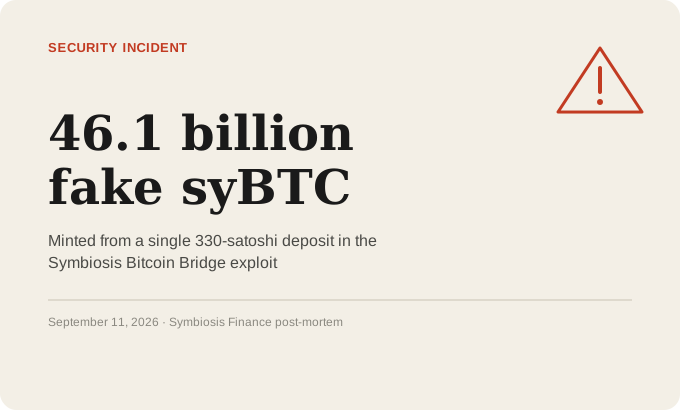
How Did a Hacker Create 46 Billion Fake Bitcoin in the Symbiosis Exploit? Decodes Bitcoin Hacker With WEEX Now
How two Symbiosis bridge bugs let a hacker mint 46.1 billion unbacked syBTC, drain Bitcoin pools and expose critical bridge risks.

CFTC's Selig Emphasizes the Need to Prepare for the Era of Large-Scale Tokenization in the U.S.

The IMF opens an office in Venezuela to supervise an economy that has already migrated to USDT

SOXL Stock Jumped 12% Yesterday: Three Companies Explain the Entire Move

Bitcoin's Hashrate Rises as Miners Reactivate Their Machines

Bitcoin 2x Leveraged ETF Launches on Cboe, But Doesn't Buy Bitcoin: Here's Why
Bitget hacker routes 4 BTC through Wasabi CoinJoin
Citi says 77% of institutions eye tokenized collateral
FTX and AI Apocalypse: The End of Calm Times for Anthropic
What is CBDC? Governments Push for Development of Central Bank Digital Currencies
Bitcoin Has Not Fallen Below Realized Price During the Bear Market
The Clearing House Selects Quant for US Tokenized Deposit Network




