
Polygon: burning 100 million POL and pivoting towards stablecoins, where is the project now?

 Prefer us on Google


Illustration generated with OpenAI
Read in the app Share this article
Listen to the article Give my opinionReact Add to your favoritesAdd us
September 21, 2026Rémy Rencurel
100 million POL soon to go up in smoke?
Sandeep Nailwal, the CEO of the Polygon Foundation, recently unveiled a massive burn plan aimed at destroying 100 million POL tokens. The uniqueness of the mechanism lies in its openness. Once the smart contracts are validated by the Polygon Security Council, any community member can trigger the destruction of the tokens.
The operation relies on a collector wallet that accumulates the network's base fees. This collector already holds 121 million POL, worth approximately 13 million dollars at the current rate. After the first burn is executed, quarterly operations will follow according to the same community logic.
On paper, the announcement fits into a deflationary dynamic that has been in place since January 2026, according to Nailwal. However, there remains a recurring criticism from the community, which is evident in the responses to the original tweet: the POL supply is experiencing an annual inflation of 2%, which translates to about 200 million tokens issued each year. Therefore, the burn of 100 million is not mechanically sufficient to make the net supply deflationary over twelve months. This frustration has already been expressed by holders, as highlighted by the previous backlash regarding POL's tokenomics at the end of 2025.
BIG UPDATE: 100M POL ready to be permanently BURNED.
Polygon is printing revenue. $24.5m YTD. We are deploying a change that lets anyone in the community trigger its burn.
2026YTD Revenue
Super happy about $NEAR and $ARB getting much deserved love, but in terms of revenue, my... pic.twitter.com/NRvsGUA7YD
--- Sandeep | CEO, Polygon Foundation (※,※) (@sandeepnailwal) September 18, 2026
€20 offered after your registration
the creation of a virtual or physical card and €0.01 spent
at Revolut · ★ 4.8 · +280 cryptos
Take advantage of itAffiliate link -- Advertisement
Revolut: the value of crypto-assets can fluctuate; you risk losing your capital.
Revolut
€20 offered after your registration the creation of a virtual or physical card and €0.01 spent
Take advantage of itAffiliate link -- Advertisement
Revolut: the value of crypto-assets can fluctuate; you risk losing your capital.
An on-chain health improving since the beginning of the year
Sandeep Nailwal highlights protocol revenues of $24.5 million for Polygon since the beginning of 2026, a figure he compares to those of Arbitrum and NEAR, which would be $8.41 million and $5.6 million respectively. Polygon would thus generate << 3 times more revenue than Arbitrum and 5 times more than NEAR >> during this period. But be careful, Nailwal himself says that it is his << ChatGPT analyst >> (an AI analysis) that provided him with these figures, so take them with a grain of salt.
Data from DefiLlama confirms a good dynamic on the on-chain fees side for Polygon, with more than $1 million in daily App fees since April. And even $1.32 million in the last 24 hours, with a total of 355,873 active addresses during this period.
On the side of its TVL (total value locked), the Polygon network has nearly $788 million in locked assets, which is still quite far behind Arbitrum, which has $1.43 billion in TVL.
The dynamics of App fees (fees paid by users across all protocols/applications) on Polygon have been on the rise since the beginning of the year. (DefiLlama)
Polygon's Shift to Stablecoins and Payments is Fully Embraced
Initially designed as a scalability solution for the Ethereum (ETH) network, Polygon had to diversify in response to the declining transaction costs on the ETH network and the low costs of competitors like L2 Base or Arbitrum, as its cost of use was initially its strongest selling point.
For several months, Polygon has clearly shifted towards payments, particularly through stablecoins. The official documentation of the network highlights a finality of 2 to 5 seconds thanks to the Heimdall v2 upgrade, fees around $0.0001 per transaction, and integrations with Stripe, Shopify, Revolut, and MoonPay.
This strategy has been reinforced by several major announcements, notably at the end of 2025, with the choice of the neobank Revolut to use Polygon as its main crypto infrastructure and Mastercard's extension of its verified aliases on the POL network.
-- Price
Polymarket: The Predictive Market is a Central Driver of Activity on Polygon
It is impossible to discuss activity on the Polygon blockchain without mentioning Polymarket. The predictive markets platform, which has become a global phenomenon since the 2024 U.S. elections, operates entirely on the Polygon network and represents a significant share of the network's exchanges. Indeed, according to data from DefiLlama, of the $1.32 million in App fees in 24 hours that we previously mentioned, Polymarket alone accounts for $998,428, or 76% of all protocol fees!
This dependence on the famous predictive market is, of course, a double-edged sword. On one hand, Polymarket has provided Polygon with a unique showcase and a constant flow of active users, contributing to the growth of active addresses and exchanges on the network. On the other hand, it exposes the blockchain to very real regulatory risks, such as the total blocking of Polymarket ordered by French authorities, against which the platform has since filed an appeal.
For the Polygon Foundation, the challenge now is to diversify high-value use cases, particularly between stablecoin payments and tokenization, to prevent a regulatory shock on Polymarket from leading to a sharp decline in on-chain activity.
A Market That Remains Generally Skeptical Despite a Small Increase in POL
The announcement of the upcoming burn of 100 million tokens by CEO Sandeep Nailwal has caused a slight increase in the price of POL, which rose from below $0.10 before the tweet to about $0.108 at the time of writing, representing an increase of around 8%.
However, POL still shows a decrease of 91.6% compared to its ATH (all-time high) of March 2024, when it reached $1.29. Will the Polygon Foundation's decision to accelerate deflationary mechanisms succeed in pushing POL back up? The coming months should provide a good indication of this question, although the health of the leading cryptocurrency Bitcoin (BTC) will also be essential for a sustainable recovery in POL prices.
Sources: Sandeep Nailwal on X, DefiLlama, Polygon Documentation
Rémy Rencurel76 articles
Intrigued by Bitcoin and blockchain technology since 2013, I became a professional in the sector by becoming, since 2018, a specialized writer in crypto news. I have followed the crypto sphere through its cycles, from amateur mining in the early days to the gradual structuring of the sector. Now independent, I cover crypto news, financial markets, and regulation.
This content is provided for general informational purposes only and doesn't constitute financial, investment, legal, or tax advice. Any events, rewards, online promotions, or related information mentioned herein should not be considered a recommendation, solicitation, or invitation to purchase, sell, trade, or otherwise deal in any crypto assets. Crypto assets are highly volatile and may result in loss. The availability of WEEX services, products, and related events may vary by region. You are responsible for ensuring that your participation is in accordance with applicable local laws and regulations.
You may also like

OKX Star Points Out THORChain TSS + Validator Model Lacks Decentralization

Payward, the parent company of Kraken, invests billions in financial infrastructure

Bloomberg analyst warns 5% U.S. 10-year yield may reduce Bitcoin appeal

Shielded Bitcoin: the proposal that aims to bring privacy without changing BTC's code
What is CBDC? Governments Push for Development of Central Bank Digital Currencies

Backpack CEO Plans to Bring the Entire Stock Market to Solana

Use of Stablecoins Grew 75% in Bear Market
![[New York Gold, Bonds, Dollar] Interest Rates and Dollar Strength Pause... Oil Prices Drop, Won and Gold Prices Rebound](/public-static/29_4631d65680.png?format=avif)
[New York Gold, Bonds, Dollar] Interest Rates and Dollar Strength Pause... Oil Prices Drop, Won and Gold Prices Rebound

Polymarket partners with OpenWorlds on AI trading agents

Former New York Governor Cuomo: Tokenization Surpasses U.S. Regulation, Regulatory Clarity Affects Capital Flow

US-Iran Negotiations Signal Easing Energy Tensions, but Diesel Crisis Complicates Inflation Risks
Thailand Stock Market News: SET and NYSE Explore Dual Listings and New Investment Products

Compute Finance: The Financial Layer Being Built by the AI Economy, 0G is Constructing a New Paradigm for Computing Assets
Wall Street Legend Bill Miller: Why Did I Bet Half My Fortune on Bitcoin?

The Stronger the AI, the Lower the Wages: Your Education is Becoming the Most Expensive Devalued Asset

Oracle Stock vs. KRAFTON Stock: Why Are Investors Questioning Two Growing Companies?
Compare Oracle and KRAFTON stocks through their latest results, share-price questions and the different growth tests investors face in 2026.
What Happens When the AI Bubble Bursts? MIT University Responds

The Value of Ethereum and the Jevons Paradox

The Real Bottleneck of Midnight's Slow Growth: It's Not the Product, It's Market Formation

IonQ Stock Surges 5%: Nvidia Just Agreed to Host Its New Quantum System

HIFI Completes $37 Million Series A Funding Led by Left Lane Capital

HIFI Completes $37 Million Series A Funding Led by Left Lane Capital
Ethereum's 'Two-Track Update': Glamsterdam Public Testnet and Hegotá Initial Validation

Exclusive Interview with Frontier Technology Investor Zheng Di: SEC's 'Innovation Exemption' Opens the Door to a Compliant Bull Market, Which Assets Are Potential Stocks?

HTX DeepThink: Opportunities Concentrate on Profitable and Fund-Supported Assets, BTC Still Has Room for Recovery After Consolidation
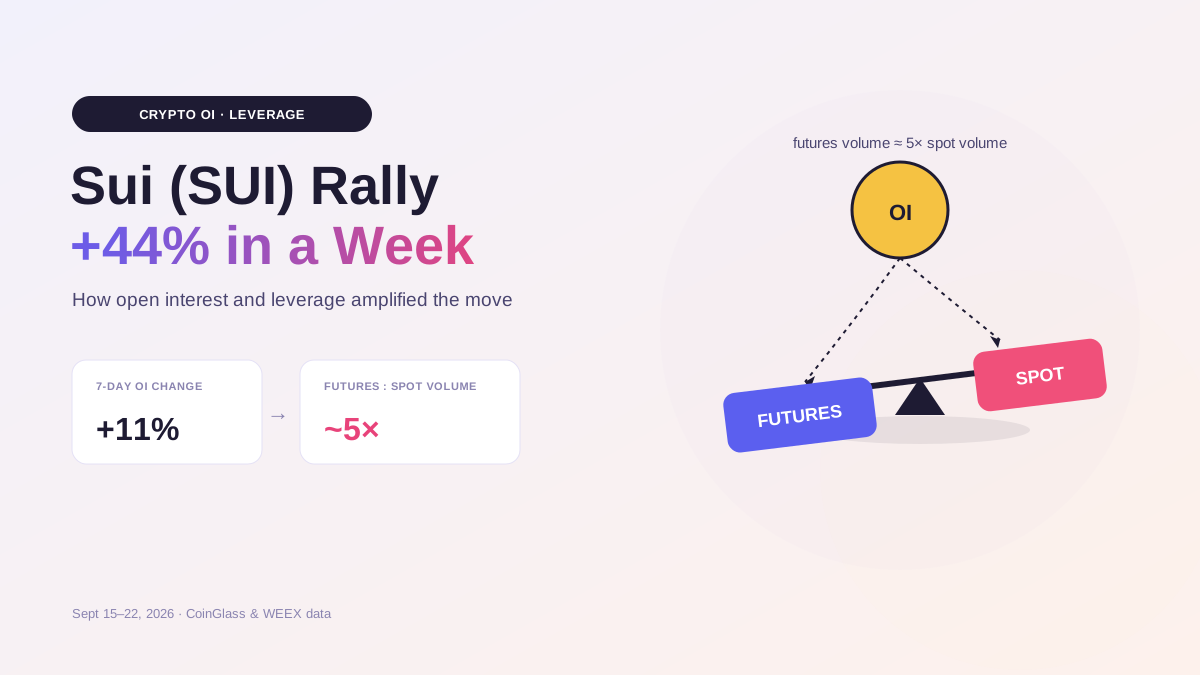
Why Did Sui (SUI) Crypto Price Jump 44%? Crypto OI and Leverage Explain the Rally
See why Sui (SUI) jumped 44%, how crypto OI and leverage amplified the rally, what the pullback means, and how to trade SUI on WEEX.

CFTC Chair Calls for "Mass Tokenization"! Wall Street Faces Three Barriers to Full On-Chain Adoption
Is the 1 Billion POL Burn Just a Joke?
WEEX Exclusive:Bitcoin Pulls Back From $87,000| WEEX TradFi Daily Brief (September 24, 2026)

Bitcoin Pulls Back From $87,000| WEEX TradFi Daily Brief (September 24, 2026)
Bitcoin pulled back from about $87,000 to about $84,000, with Ethereum near $2,680. S&P Global PMI on September 23 ET far exceeded forecasts. The 10-year yield broke above 5.00%, while the 5-year and 30-year touched highs last seen in 2007 and 2004. The S&P 500 and Nasdaq slipped. Energy moved with oil and crypto-treasury stocks followed bitcoin lower. Investors await earnings from COST, BB, and others.
OKX Star Points Out THORChain TSS + Validator Model Lacks Decentralization
Payward, the parent company of Kraken, invests billions in financial infrastructure
Bloomberg analyst warns 5% U.S. 10-year yield may reduce Bitcoin appeal
Shielded Bitcoin: the proposal that aims to bring privacy without changing BTC's code
What is CBDC? Governments Push for Development of Central Bank Digital Currencies
Backpack CEO Plans to Bring the Entire Stock Market to Solana


