
Papertrade Revenue Surpasses Circle? It's Just a 'Liquidation Harvesting Machine'

 Prefer us on Google


Author: Shenchao TechFlow
On October 16, 2026, according to revenue statistics from the decentralized finance data platform DefiLlama, the derivatives gaming protocol Papertrade recorded a daily protocol revenue of $7.49 million, surpassing the stablecoin issuer Circle for two consecutive days, ranking second among all protocols and public chains, only behind Tether. Data shows that within the first seven days of its launch, the protocol accumulated a nominal revenue of $57.16 million and allocated approximately $52.76 million to stakers of the platform token PAPER, with a dividend distribution ratio as high as 92.30%. Unlike traditional decentralized exchanges that rely on trading volume to extract channel fees, the striking revenue scale of this protocol stems from its unique liquidity pool (LP) liquidation redistribution mechanism.
The Illusion of Book Income Constructed by Excessive LP Transfers
Under DefiLlama's statistical framework, the funds classified as "protocol revenue" for Papertrade consist of three distinctly different components: a 2% fee charged when traders close positions to realize profits or losses, a 2% liquidation fee deducted from users' margin when they are liquidated, and overflow funds directly allocated to stakers once the liquidity pool balance exceeds the $5 million threshold.
This statistical approach implies that the so-called record-breaking protocol revenue is largely detached from the conventional service fees generated by matched trades, instead directly composed of the lost principal accumulated from counterpart traders during extreme leveraged gaming liquidations. When retail or leveraged traders frequently encounter long and short liquidations on the platform, the lost funds are directly injected into the platform's underlying liquidity; once the total scale of this underlying pool exceeds the $5 million cap, all overflow principal is deemed "revenue" for the current period and transferred to the dividend pool.
From the data ratio calculation, of the total revenue of $57.16 million generated within the first seven days, $52.76 million, at an average daily return of $7.54 million, flowed back to the staking end, accounting for 92.30% of the total, while the protocol developers retained only about 7.70% (approximately $4.4 million) as their share. The high concentration of these figures reflects a specific book characteristic where high-turnover speculative principal is rapidly converted into dividends.
The Dividend Closed Loop of Losers Exchanging Equity and Winners Extracting Fees
According to Papertrade's official mechanism design, the protocol has constructed a closed-loop negative-sum gaming flywheel through token economics.
At the trading level, losing users, while losing their margin, proportionally receive the protocol governance token PAPER based on their loss amount. This setup provides a psychological buffer expectation of "losers gaining equity in the platform" for speculators, stimulating losers to transfer tokens into the staking pool in hopes of recovering their principal through subsequent dividends.
On the funding allocation side, profitable traders withdraw counterpart funds from the liquidity pool, and the protocol charges a fixed 2% fee on all profitable portions, half (1%) of which is allocated to developers, while the other half (1%) along with all excess liquidity funds exceeding the $5 million cap is indiscriminately distributed to all stakers locking PAPER. This mechanism forms a funding redistribution cycle where "winners take the liquidity from losers, the platform extracts fees from winners' profits to subsidize stakers, and stakers share in the subsequent liquidation losses."
Mechanism Vulnerability Under Exhausted Gaming Liquidity
The model relying on continuous trader liquidations as the main source of dividends is highly dependent on a constant influx of new trading principal. During market one-sided trends or extreme unilateral positions, if the platform experiences concentrated profit withdrawals, the fixed $5 million underlying liquidity pool will bear extremely high pressure from liquidation payouts.
When market trading sentiment recedes, and the frequency of liquidations decreases, causing the liquidity pool to fall below the $5 million threshold, the funding pump delivering excess dividends to stakers will immediately halt, directly leading to a cliff-like plunge in the previously high annualized yield. Once the yield drops to zero, holders who previously obtained and staked PAPER through loss compensation will face a stampede-like un-staking and sell-off, exposing the inherent vulnerability of decentralized derivatives gaming in the absence of real trading counterparties.
As on-chain arbitrage gaming deepens, whether Papertrade can maintain daily overflow dividends in the millions will be revealed in the on-chain trading trajectories after this week.
-- Price
This content is provided for general informational purposes only and doesn't constitute financial, investment, legal, or tax advice. Any events, rewards, online promotions, or related information mentioned herein should not be considered a recommendation, solicitation, or invitation to purchase, sell, trade, or otherwise deal in any crypto assets. Crypto assets are highly volatile and may result in loss. The availability of WEEX services, products, and related events may vary by region. You are responsible for ensuring that your participation is in accordance with applicable local laws and regulations.
You may also like

Kaspa developer targets ownerless prediction market by end-2026

XRPL lending protocol gains validator support as vault vote advances

US card debt hits $1.29 trillion as Bitcoin loans expose a collateral divide

CryptoQuant: Bitcoin Analyst Sentiment Significantly Bearish, Index Drops to -1.8σ

How Much CPO Demand Will NVIDIA's Rubin Ultra Generate? Bernstein: Optical Value of Single Pod Increases Fivefold

Pump.fun Data Review: Why the Current Meme Market Has Become a 'Harvesting Game'?

As Protocols Move Back to the Mainnet, How Does Ethereum's Value Logic Change?

As Whales Embrace ETFs, Security Anxiety in the Crypto World is Spreading
How Much Revenue Can Anthropic Generate for Every $1 Spent on Computing Power?

WEEX 11.11 Shopping Fest: Buy BTC and Unlock Up to 888 USDT in Rewards

Bitget UEX Daily Report | Inflation Surprises and Pressures US Stocks; Nvidia Falls Over 5%; Gold Drops Below $4100 (November 11, 2026)

How Much Net Buying Power Will ETH Lose When Bitmine Stops Buying?
LlamaRisk Proposes to Narrow Aave V3 Core Collateral Asset Range, Involving $1.33 Billion in Collateral

Algorithmic Trading and Cryptocurrencies: How Do Robots React to Volatility?

Cardano’s police evidence system could bring 1.5 million annual transactions

Confidence at Zero! Goldman Sachs Interprets Hedge Fund Positions: 'Surrender Liquidation', Largest Loss Since the Pandemic

47% Top Tax Rate Approaches: Seven Tax Reduction Strategies for Australian Crypto Investors
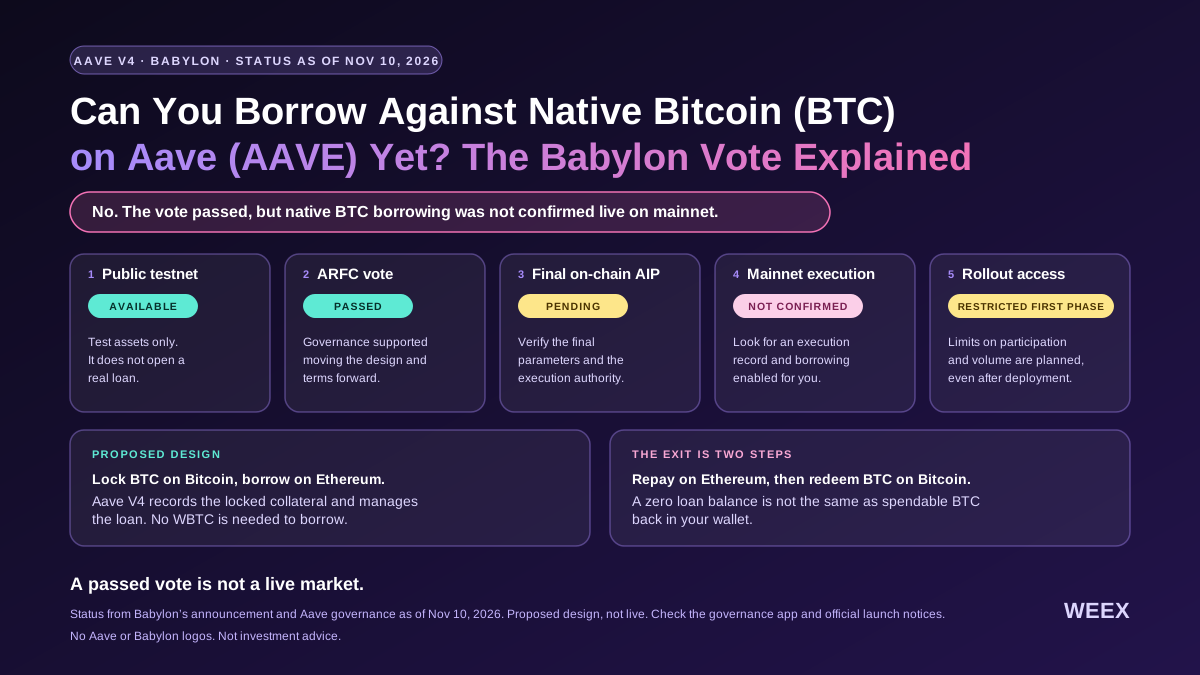
Can You Borrow Against Native Bitcoin (BTC) on Aave (AAVE) Yet? The Babylon Vote Explained
Can you borrow against native Bitcoin on Aave yet? See what the Babylon vote approved, what still needs to launch, and how BTC liquidation would work.

PIEVERSE Price Up Nearly 80% in a Week: Futures Activity, the November 14 Unlock and What Is Confirmed
PIEVERSE rose about 79% in seven days with futures volume far above spot. See what is confirmed about the November 14 unlock and the WEEX Lucky Eggs campaign.

Hong Kong Approves Crypto Asset Reporting Rules - Fintech World

NVDA Stock Falls 4.3% After Board Opens Investigation: What Is Confirmed and What Is Not
NVDA closed at $178.67 on November 9, 2026, down about 4.3%, after Nvidia’s board confirmed an independent investigation. Other claims come from media reports. WEEX’s Lucky Eggs campaign runs until November 25.

Chainalysis Report: Why Did Western Europe Withstand the Global Crypto Market Chill?

Four Security Strategies from the Wallet Theft Incident

Global Outage: Your Cryptos Are Not Disappearing

Did Strategy buy Bitcoin? Saylor reignites speculation

A New Chapter in the History of Rug Pulls in Crypto

From Binance Incubator to Nasdaq: Injective's Eight Years

tBTC Cross-Chain Bridge Resumes On-Chain Operations, Threshold Network Confirms Adequate Reserves
FinCEN Withdraws Proposed Crypto Travel Rule Expansion in Separate November Move

Finnish Startup Uses Heat from Bitcoin Miners to Heat 30 Homes
Kaspa developer targets ownerless prediction market by end-2026
XRPL lending protocol gains validator support as vault vote advances
US card debt hits $1.29 trillion as Bitcoin loans expose a collateral divide
CryptoQuant: Bitcoin Analyst Sentiment Significantly Bearish, Index Drops to -1.8σ
How Much CPO Demand Will NVIDIA's Rubin Ultra Generate? Bernstein: Optical Value of Single Pod Increases Fivefold
Pump.fun Data Review: Why the Current Meme Market Has Become a 'Harvesting Game'?
Latest articles


Latest coin listings on WEEX


