
MSCI New Rules Implemented, 14 Crypto Companies Enter Potential Impact List

 Prefer us on Google



Written by: angelilu, Foresight News
On October 16, MSCI finalized a new index admission rule, which first impacts crypto treasury companies.
The new rule will begin with the index review in November. Companies that primarily rely on holding assets for value and lack actual operational activities may be classified as "non-operating companies" and will no longer qualify for inclusion in the MSCI Global Investable Market Index. This means that companies like Strategy, Metaplanet, and Upexi, which rely on capital markets to finance cryptocurrency purchases, may no longer be considered ordinary operating enterprises by MSCI.
MSCI also released a list of potential affected companies. Out of 22 companies, 14 are directly related to cryptocurrencies: Strategy, Metaplanet, and the SOL treasury company Upexi are proposed for deletion, while SharpLink, Solana Company, and 11 other companies have entered the watch list. Based on the free float market capitalization in the table, crypto companies account for 94.5% of the entire list, with the majority coming from Strategy.
The new rule first assesses whether a company's asset structure contains sufficient operating assets. Companies that do not pass this threshold will undergo checks on five financial indicators: operating expenses, operating cash flow, fair value changes, and reliance on external financing. If four or more of these indicators are triggered, the company may lose its index qualification. For companies already in the index, MSCI requires that they fail the screening in both of the last two reporting periods before being deleted.
This is not the final deletion result. MSCI will officially announce the list on November 11, and the new rules will take effect after the market closes on November 30. However, this debate has shifted from "Does a company hold too many crypto assets?" to a more fundamental question: When a listed company's main work becomes financing and buying cryptocurrencies, is it still an operating company?
14 Crypto Companies on the List
Among the five proposed for deletion, three are digital asset treasury companies:
- Bitcoin treasury company Strategy;
- Bitcoin treasury company Metaplanet;
- SOL treasury company Upexi.
The other two are the UK uranium investment company Yellow Cake and the Icelandic investment holding company SKEL, indicating that the rules are not solely targeting crypto assets.
The other 11 crypto-related companies placed on the watch list include:
- ETH treasury company SharpLink;
- CC (Canton) treasury company Canton Strategic Holdings;
- ZEC treasury company Cypherpunk Technologies;
- SUI treasury company SUI Group;
- TON treasury company TON Strategy;
- BTC treasury company Capital B;
- SOL treasury company Solana Company;
- SOL treasury company DeFi Development;
- WLFI treasury company AI Financial;
- RAIN treasury company Enlivex;
- Company GD Culture, which holds BTC and has announced allocation to TRUMP.
According to the data in the MSCI table, the total free float market capitalization of these 14 companies is approximately $42.016 billion, accounting for 94.5% of the free float market capitalization of the 22 potential affected companies.
However, this figure is almost entirely supported by Strategy alone: its free float market capitalization is approximately $40.291 billion, accounting for 95.9% of the 14 crypto companies. Most of the remaining companies are still illiquid micro-cap stocks.
MSCI No Longer Just Counts How Many Coins Companies Hold
This is not the first time MSCI has dealt with digital asset treasury companies.
In October 2025, MSCI proposed a much more straightforward standard: if digital assets account for 50% or more of a company's total assets, it will be considered a digital asset treasury company. Relevant securities were not immediately deleted at that time, but the adjustments to equity quantity, foreign investor inclusion factors, and domestic inclusion factors were frozen, and new index qualifications and scale level migrations were also postponed.
This standard quickly encountered a problem. Why can companies holding large amounts of Bitcoin be treated like investment funds, while those holding large amounts of gold, uranium, securities, or other non-operating assets can continue to remain in ordinary stock indices?
In January 2026, MSCI decided to temporarily suspend the deletion plan for digital asset treasury companies and instead study all listed companies that "primarily engage in investment rather than operational activities." The new plan announced in August no longer specifically names Bitcoin or other tokens, but instead assesses whether a company is engaged in business operations or accumulating assets based on its assets, cash flow, and financing methods.
Thus, this change is not an ordinary quarterly rebalancing. General index reviews primarily deal with market capitalization, liquidity, free float ratio, and changes in scale levels; this new rule addresses more fundamental qualification issues. Even if a stock is still trading and meets the requirements for scale and liquidity, as long as its financial structure increasingly resembles that of an investment tool, it may no longer be included as an ordinary operating company in the index.
The August simulation list only had 3 proposed deletions and 3 watch list companies. The latest document has expanded to 5 proposed deletions and 17 watch list companies. The digital treasury companies have also expanded from a few cases like Strategy, Metaplanet, and SharpLink to various assets like BTC, ETH, SOL, SUI, and ZEC.
If Removed, Stocks Will Be Sold First
If Strategy is ultimately removed from the relevant MSCI index, the most direct action will occur in the stock market: passive funds tracking these indices will need to sell Strategy shares and reallocate the funds to other component stocks. The Bitcoin held by the company will not automatically enter the market due to index adjustments.
There is a clear divergence in the market regarding potential selling pressure. JPMorgan previously estimated that Strategy's removal from the relevant MSCI index could correspond to about $2.8 billion in passive fund outflows. Strategy's own calculations indicate that funds tracking MSCI GIMI hold about 13 million shares, approximately 3.1% of its basic share count, equivalent to 60% of its 30-day average trading volume. The former figure emphasizes concentrated selling pressure, while the latter emphasizes the market's ability to absorb these shares; both cannot be directly equated to final losses.
According to Strategy's own figures, the relevant index holdings are less than its trading volume for one day; for the micro-cap companies on the list, the problem may be more severe. Their daily trading volume is small, and although the index funds are limited in amount, they may occupy a higher marginal demand. Being placed on the watch list itself may also prompt investors to adjust valuations and positions in advance.
Index adjustments will not directly force treasury companies to sell BTC, ETH, or SOL, but may weaken their ability to continue buying coins. Digital asset treasury companies typically issue stocks or bonds when their stock prices exceed the net asset value of the assets held, using the funds raised to purchase more tokens. If index funds exit and depress stock prices and valuation premiums, the company's financing costs will rise, and the future scale of coin purchases may shrink accordingly. For the crypto market, what may truly decrease is the subsequent incremental buying, rather than immediate forced selling.
-- Price
Who Decides What a Company Is
During MSCI's consultation period, Strategy publicly opposed this boundary. The company believes that "operating" and "non-operating" are not established classifications in U.S. GAAP, International Financial Reporting Standards, or existing legal frameworks, and its Bitcoin business has already appeared as an operating segment in its financial reports. According to Strategy, MSCI is merely rephrasing the previous rules targeted at digital asset treasury companies.
MSCI's rationale is that global stock indices originally exclude ETFs, investment funds, business development companies, and other passive investment tools. The new financial indicators are simply to identify issuers whose legal form remains a listed company, but whose economic characteristics are already similar to investment tools.
Yellow Cake is also included in the list, indicating that MSCI's new rules are not solely targeting digital assets. However, among the 22 potential affected companies, 14 are directly related to cryptocurrencies, with a free float market capitalization ratio exceeding 90%. The rules use a set of asset-neutral financial standards, but the actual pressure mainly falls on digital treasury companies.
Therefore, the final list that MSCI will announce on November 11 is not just a component adjustment. Whether Strategy and Upexi are deleted, and whether companies like SharpLink and Solana Company remain on the watch list, will all show where MSCI is prepared to draw the line between "operating companies" and "investment tools."
This content is provided for general informational purposes only and doesn't constitute financial, investment, legal, or tax advice. Any events, rewards, online promotions, or related information mentioned herein should not be considered a recommendation, solicitation, or invitation to purchase, sell, trade, or otherwise deal in any crypto assets. Crypto assets are highly volatile and may result in loss. The availability of WEEX services, products, and related events may vary by region. You are responsible for ensuring that your participation is in accordance with applicable local laws and regulations.
You may also like

Kaspa developer targets ownerless prediction market by end-2026

XRPL lending protocol gains validator support as vault vote advances

US card debt hits $1.29 trillion as Bitcoin loans expose a collateral divide

CryptoQuant: Bitcoin Analyst Sentiment Significantly Bearish, Index Drops to -1.8σ

How Much CPO Demand Will NVIDIA's Rubin Ultra Generate? Bernstein: Optical Value of Single Pod Increases Fivefold

Pump.fun Data Review: Why the Current Meme Market Has Become a 'Harvesting Game'?

As Protocols Move Back to the Mainnet, How Does Ethereum's Value Logic Change?

As Whales Embrace ETFs, Security Anxiety in the Crypto World is Spreading
How Much Revenue Can Anthropic Generate for Every $1 Spent on Computing Power?

WEEX 11.11 Shopping Fest: Buy BTC and Unlock Up to 888 USDT in Rewards

Bitget UEX Daily Report | Inflation Surprises and Pressures US Stocks; Nvidia Falls Over 5%; Gold Drops Below $4100 (November 11, 2026)

How Much Net Buying Power Will ETH Lose When Bitmine Stops Buying?
LlamaRisk Proposes to Narrow Aave V3 Core Collateral Asset Range, Involving $1.33 Billion in Collateral

Algorithmic Trading and Cryptocurrencies: How Do Robots React to Volatility?

Cardano’s police evidence system could bring 1.5 million annual transactions

Confidence at Zero! Goldman Sachs Interprets Hedge Fund Positions: 'Surrender Liquidation', Largest Loss Since the Pandemic

47% Top Tax Rate Approaches: Seven Tax Reduction Strategies for Australian Crypto Investors
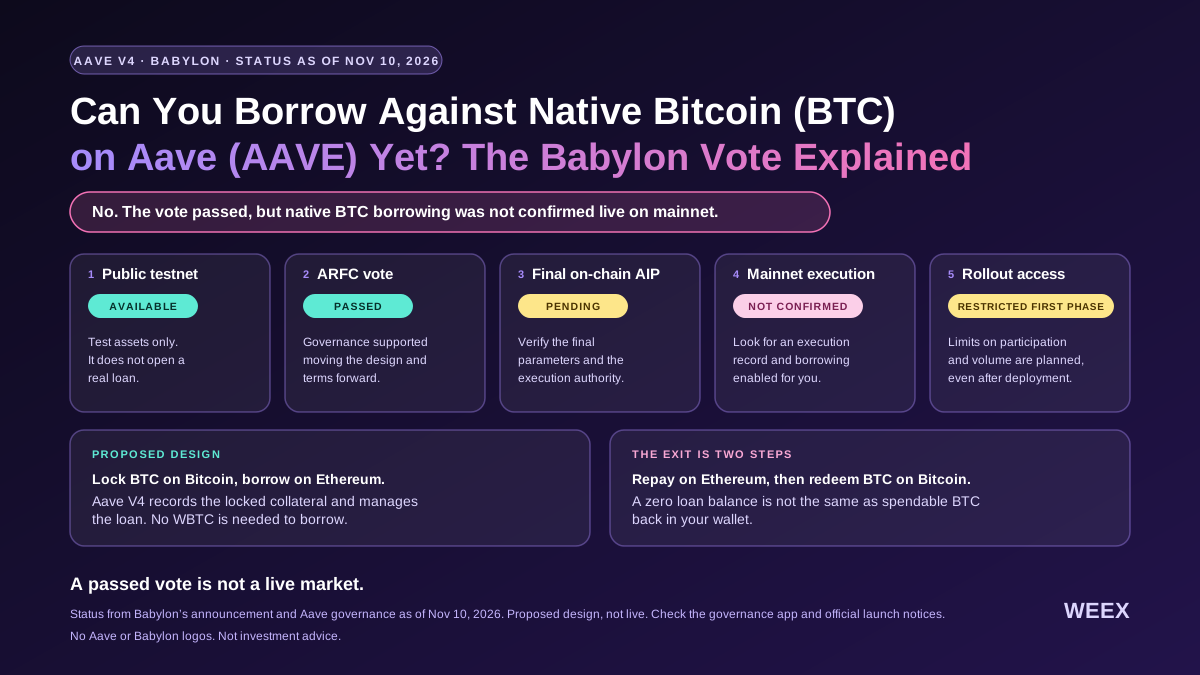
Can You Borrow Against Native Bitcoin (BTC) on Aave (AAVE) Yet? The Babylon Vote Explained
Can you borrow against native Bitcoin on Aave yet? See what the Babylon vote approved, what still needs to launch, and how BTC liquidation would work.

PIEVERSE Price Up Nearly 80% in a Week: Futures Activity, the November 14 Unlock and What Is Confirmed
PIEVERSE rose about 79% in seven days with futures volume far above spot. See what is confirmed about the November 14 unlock and the WEEX Lucky Eggs campaign.

Hong Kong Approves Crypto Asset Reporting Rules - Fintech World

NVDA Stock Falls 4.3% After Board Opens Investigation: What Is Confirmed and What Is Not
NVDA closed at $178.67 on November 9, 2026, down about 4.3%, after Nvidia’s board confirmed an independent investigation. Other claims come from media reports. WEEX’s Lucky Eggs campaign runs until November 25.

Chainalysis Report: Why Did Western Europe Withstand the Global Crypto Market Chill?

Four Security Strategies from the Wallet Theft Incident

Global Outage: Your Cryptos Are Not Disappearing

Did Strategy buy Bitcoin? Saylor reignites speculation

A New Chapter in the History of Rug Pulls in Crypto

From Binance Incubator to Nasdaq: Injective's Eight Years

tBTC Cross-Chain Bridge Resumes On-Chain Operations, Threshold Network Confirms Adequate Reserves
FinCEN Withdraws Proposed Crypto Travel Rule Expansion in Separate November Move

Finnish Startup Uses Heat from Bitcoin Miners to Heat 30 Homes
Kaspa developer targets ownerless prediction market by end-2026
XRPL lending protocol gains validator support as vault vote advances
US card debt hits $1.29 trillion as Bitcoin loans expose a collateral divide
CryptoQuant: Bitcoin Analyst Sentiment Significantly Bearish, Index Drops to -1.8σ
How Much CPO Demand Will NVIDIA's Rubin Ultra Generate? Bernstein: Optical Value of Single Pod Increases Fivefold
Pump.fun Data Review: Why the Current Meme Market Has Become a 'Harvesting Game'?
Latest articles


Latest coin listings on WEEX


