
Horizen Holders Face November 4 Bridge Cutoff Before L3 Wind-Down

 Prefer us on Google



TL;DR
- The official bridge cutoff is November 4 at 13:00 UTC.
- The published recovery process has asset-specific limits.
- Base is set to become the ecosystem's primary chain.
Horizen users have a near-term operational deadline as the project winds down its layer-three network. Its official migration notice sets November 4 at 13:00 UTC as the bridge cutoff and directs holders to review the instructions for their particular assets.
The migration plan includes a later recovery process for certain remaining balances. That is not a universal guarantee for every token or wallet arrangement, making the difference between an ordinary withdrawal and a delayed recovery especially important.
The deadline concerns access to assets
A chain shutdown is different from a token being removed from an exchange. In the exchange case, the underlying network may continue to function normally. A network wind-down changes the infrastructure through which users can submit instructions and applications can update state.
That makes the location of an asset consequential. A token bearing the same name can exist in more than one environment, and the procedure for moving it depends on where the balance is actually recorded. A holder should not infer their position from a ticker in a portfolio tracker alone.
There is also a timing distinction between initiating an exit and receiving its result. Bridging can involve stages that finish after the first transaction. A successful submission is useful evidence, but the recipient-side balance and the bridge's own status determine whether the transfer has completed.
The recovery plan has specific boundaries
Horizen says its later DAO return covers ZEN and qualifying ETH balances, while USDC.e is outside that process. The notice also flags special handling for smart-contract wallets and a minimum ETH balance threshold. Readers with affected holdings need the current official instructions rather than a generic assumption that all balances will be returned automatically.
These distinctions reflect an important feature of blockchain accounting: recognizing an address on two networks does not establish that the same kind of account exists on both. A simple wallet and a contract-controlled account can require different treatment when balances are reconstructed elsewhere.
Similarly, a bridged asset may be operated through infrastructure with obligations separate from those of the chain's own project. A recovery programme can only make reliable promises about assets and processes within its stated scope.
A dependent network meets a parent-chain change
The project attributes the accelerated transition to compatibility issues connected to Base's Denim upgrade. Base's published specification introduces a different block cadence and associated data changes, illustrating why infrastructure built on another chain must track its dependencies.
A layered system can borrow useful components and reduce development work. It can also inherit assumptions about how the underlying network behaves. When those assumptions change, the dependent service may need a migration rather than a routine version update.
This is a broader architectural lesson rather than evidence that all layer-three networks face the same outcome. The relevant question is which exact dependencies a system has and whether its operators can adapt them before an upstream change takes effect.
-- Price
Continuity depends on the transition itself
Moving activity to an established network can simplify the number of places where an ecosystem must maintain infrastructure. For users, however, the immediate benefit depends on successful balance transfers, working applications and clear communication about what happens to existing positions.
A staking interface being unavailable, for example, would not by itself establish that funds have disappeared. Equally, a roadmap promising future staking would not prove that a particular balance has already migrated. Transaction records and official recovery notices answer those different questions.
The November 4 cutoff is therefore the central fact for this week. The broader move to Base can be evaluated over time, but the asset-specific exit and recovery instructions deserve attention before the operating environment changes.
Written by the News Desk and edited by Samuel Rae.
This content is provided for general informational purposes only and doesn't constitute financial, investment, legal, or tax advice. Any events, rewards, online promotions, or related information mentioned herein should not be considered a recommendation, solicitation, or invitation to purchase, sell, trade, or otherwise deal in any crypto assets. Crypto assets are highly volatile and may result in loss. The availability of WEEX services, products, and related events may vary by region. You are responsible for ensuring that your participation is in accordance with applicable local laws and regulations.
You may also like

Kaspa developer targets ownerless prediction market by end-2026

XRPL lending protocol gains validator support as vault vote advances

US card debt hits $1.29 trillion as Bitcoin loans expose a collateral divide

CryptoQuant: Bitcoin Analyst Sentiment Significantly Bearish, Index Drops to -1.8σ

How Much CPO Demand Will NVIDIA's Rubin Ultra Generate? Bernstein: Optical Value of Single Pod Increases Fivefold

Pump.fun Data Review: Why the Current Meme Market Has Become a 'Harvesting Game'?

As Protocols Move Back to the Mainnet, How Does Ethereum's Value Logic Change?

As Whales Embrace ETFs, Security Anxiety in the Crypto World is Spreading
How Much Revenue Can Anthropic Generate for Every $1 Spent on Computing Power?

WEEX 11.11 Shopping Fest: Buy BTC and Unlock Up to 888 USDT in Rewards

Bitget UEX Daily Report | Inflation Surprises and Pressures US Stocks; Nvidia Falls Over 5%; Gold Drops Below $4100 (November 11, 2026)

How Much Net Buying Power Will ETH Lose When Bitmine Stops Buying?
LlamaRisk Proposes to Narrow Aave V3 Core Collateral Asset Range, Involving $1.33 Billion in Collateral

Algorithmic Trading and Cryptocurrencies: How Do Robots React to Volatility?

Cardano’s police evidence system could bring 1.5 million annual transactions

Confidence at Zero! Goldman Sachs Interprets Hedge Fund Positions: 'Surrender Liquidation', Largest Loss Since the Pandemic

47% Top Tax Rate Approaches: Seven Tax Reduction Strategies for Australian Crypto Investors
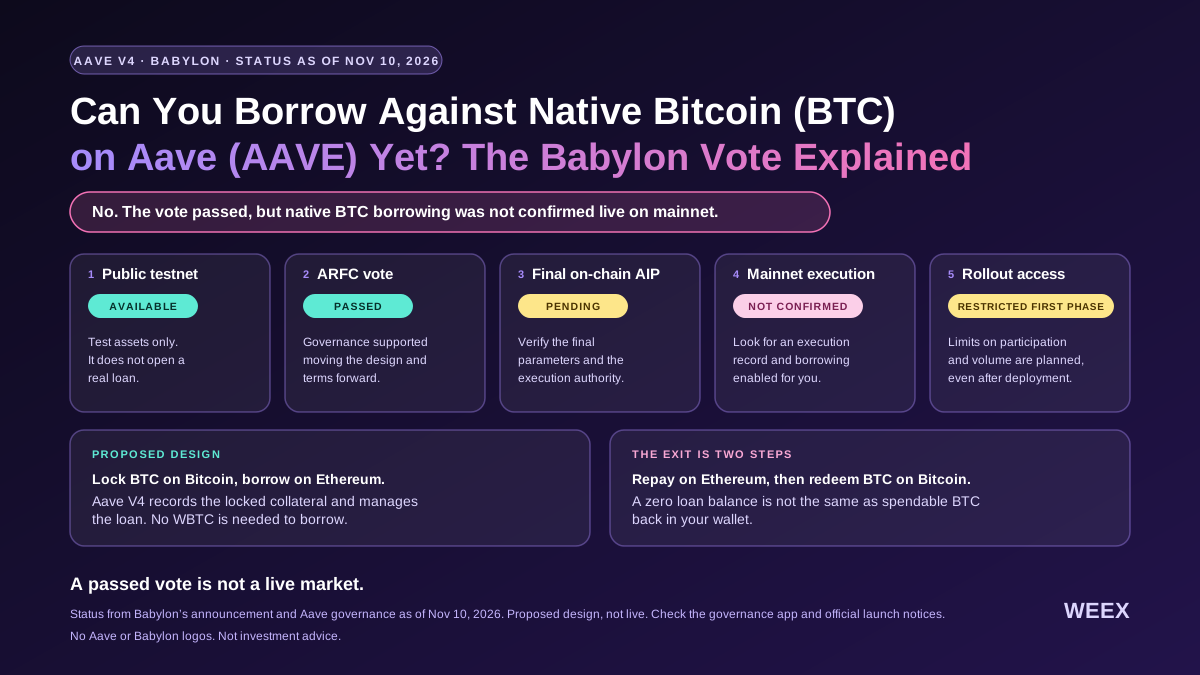
Can You Borrow Against Native Bitcoin (BTC) on Aave (AAVE) Yet? The Babylon Vote Explained
Can you borrow against native Bitcoin on Aave yet? See what the Babylon vote approved, what still needs to launch, and how BTC liquidation would work.

PIEVERSE Price Up Nearly 80% in a Week: Futures Activity, the November 14 Unlock and What Is Confirmed
PIEVERSE rose about 79% in seven days with futures volume far above spot. See what is confirmed about the November 14 unlock and the WEEX Lucky Eggs campaign.

Hong Kong Approves Crypto Asset Reporting Rules - Fintech World

NVDA Stock Falls 4.3% After Board Opens Investigation: What Is Confirmed and What Is Not
NVDA closed at $178.67 on November 9, 2026, down about 4.3%, after Nvidia’s board confirmed an independent investigation. Other claims come from media reports. WEEX’s Lucky Eggs campaign runs until November 25.

Chainalysis Report: Why Did Western Europe Withstand the Global Crypto Market Chill?

Four Security Strategies from the Wallet Theft Incident

Global Outage: Your Cryptos Are Not Disappearing

Did Strategy buy Bitcoin? Saylor reignites speculation

A New Chapter in the History of Rug Pulls in Crypto

From Binance Incubator to Nasdaq: Injective's Eight Years

tBTC Cross-Chain Bridge Resumes On-Chain Operations, Threshold Network Confirms Adequate Reserves
FinCEN Withdraws Proposed Crypto Travel Rule Expansion in Separate November Move

Finnish Startup Uses Heat from Bitcoin Miners to Heat 30 Homes
Kaspa developer targets ownerless prediction market by end-2026
XRPL lending protocol gains validator support as vault vote advances
US card debt hits $1.29 trillion as Bitcoin loans expose a collateral divide
CryptoQuant: Bitcoin Analyst Sentiment Significantly Bearish, Index Drops to -1.8σ
How Much CPO Demand Will NVIDIA's Rubin Ultra Generate? Bernstein: Optical Value of Single Pod Increases Fivefold
Pump.fun Data Review: Why the Current Meme Market Has Become a 'Harvesting Game'?
Latest articles


Latest coin listings on WEEX


