
Greece ends years of crypto tax uncertainty with new 10% levy on Bitcoin profits

 Prefer us on Google


Greece has approved a 10% cryptocurrency capital gains tax and a separate 15% levy on staking and decentralized finance (DeFi) income.
The legislation, passed by parliament on Nov. 5, establishes the country's first comprehensive framework for taxing digital assets, with the new rules scheduled to take effect on Jan. 1, 2027.
According to Reuters, annual cryptocurrency gains of up to €500 will be exempt, while investors exceeding that threshold will face taxation on their profits.
The framework also allows qualifying losses to be carried forward for five years to offset future gains.
Under the finance ministry's October proposal, staking, lending and DeFi liquidity rewards would attract a 15% tax as interest income, separating those earnings from trading profits.
Greece's crypto tax: the vote and the next step
Reuters reports a 10% capital-gains tax with annual gains up to €500 exempt; implementation directives are forthcoming.
Parliamentary approval and implementation are distinct steps REUTERS • 5 NOV 2026 10% Capital-gains tax Annual gains up to €500 exempt Parliament approves 5 November Directives forthcoming In the coming weeks Transparency Audit rules
Approved rate with directives still to follow REUTERS • 5 NOV 2026 10% Capital-gains tax Annual gains up to €500 exempt under the bill Parliament approves 5 November Directives forthcoming In the coming weeks Transparency Audit rules
Historical proposal: October 7
Historical proposal: October 7Transfer gainsStaking and yield
The consultation proposed 10% on individuals' transfer gains, generally transfer price minus acquisition price.
October consultation proposal: transfer gains OCTOBER 7 • CONSULTATION PROPOSAL Asset transfer Individuals' gains Transfer price minus acquisition price 10% Proposed rate Final enacted treatment needs confirmation
October consultation proposal: transfer gains OCTOBER 7 • CONSULTATION PROPOSAL Transfer an asset Transfer price minus acquisition price Proposed transfer gain 10% Proposed rate Final enacted treatment needs confirmation
The consultation proposed treating staking, lending and liquidity returns as interest at 15%.
October consultation proposal: staking and yield OCTOBER 7 • CONSULTATION PROPOSAL Staking / yield Lending • liquidity • staking Interest income under the proposal 15% Proposed rate Final enacted treatment needs confirmation
October consultation proposal: staking and yield OCTOBER 7 • CONSULTATION PROPOSAL Earn staking or yield Lending, liquidity or staking returns Proposed interest income 15% Proposed rate Final enacted treatment needs confirmation
Parliament's approval settles the headline framework, while the promised directives address transparency and audit rules.
The graphic does not establish commencement, filing deadlines or the operation of the exemption above €500. The panel describes an October proposal, not final enacted staking or transfer-calculation rules.
Sources and evidence
Sources
- Reuters via Euronext, November 5
- Finance ministry consultation, October 7
Supporting facts
- Reuters reported that Greece's parliament approved a bill imposing a 10% capital-gains tax on cryptocurrencies on November 5, 2026. [1]
- Cryptocurrency capital gains of up to €500 per year will be exempt under the approved bill, according to Reuters. [1]
- A senior finance ministry official told Reuters that implementation directives, including transparency and audit rules, would be published in the coming weeks. [1]
- The finance ministry's October 7 consultation proposal described a 10% tax on individuals' gains from transferring crypto assets, generally based on transfer price minus acquisition price. [2]
- The October ministry proposal treated returns from staking, lending and liquidity provision as interest subject to 15%, separately from the proposed 10% transfer-gains tax. [2]
Method
Qualitative milestone map, not a time scale or a probability forecast. The selectable panel contrasts activity classifications in the October 7 consultation proposal. No tax-liability calculation is made.
Scope
The graphic does not establish commencement, filing deadlines or the operation of the exemption above €500. The panel describes an October proposal, not final enacted staking or transfer-calculation rules.
Infographic by CryptoSlate
The ministry also proposed exempting crypto-to-crypto swaps from immediate taxation, although parliamentary concerns about the final wording leave their treatment unresolved.
Meanwhile, the legislation provides a 12-month window for investors to voluntarily declare cryptocurrency gains from previous years without late-filing penalties or interest, subject to specified conditions.
The measure comes as Greek authorities struggle to monitor cryptocurrency activity conducted through overseas platforms.
A senior finance ministry official reportedly said that the government could not estimate potential tax revenue because most domestic investors use foreign exchanges, making the market difficult to measure.
Further directives covering transparency requirements and tax audits are expected in the coming weeks.
Greece joins Europe's widening crypto tax divide
Greece's new rate places it among Europe's lower-tax jurisdictions for cryptocurrency investors, even as several countries have increased taxes on digital asset profits.
According to a Nov. 6 analysis by CryptoDiffer, Cyprus taxes crypto gains at 8%, while Belgium and Bulgaria apply 10% rates and Croatia charges 12%.
Other European countries have moved in the opposite direction.
Italy increased its standard cryptocurrency capital-gains tax to 33% in 2026, while Romania raised its rate to 16%. Sweden imposes a 30% capital-gains tax on qualifying crypto profits.
However, some European jurisdictions offer investors exemptions based on how long they hold their assets.
CryptoDiffer identified Germany and Portugal as exempting qualifying cryptocurrency gains after one year of holding, while Luxembourg applies a six-month threshold. Croatia offers an exemption after two years and Czechia after three.
Switzerland, Slovenia and Malta were also identified as jurisdictions where qualifying private-investor crypto gains can be exempt from capital-gains tax.
These differences reflect Europe's fragmented approach to crypto taxation, with investors facing substantially different liabilities depending on their country, holding period and classification of investment activity.
-- Price
This content is provided for general informational purposes only and doesn't constitute financial, investment, legal, or tax advice. Any events, rewards, online promotions, or related information mentioned herein should not be considered a recommendation, solicitation, or invitation to purchase, sell, trade, or otherwise deal in any crypto assets. Crypto assets are highly volatile and may result in loss. The availability of WEEX services, products, and related events may vary by region. You are responsible for ensuring that your participation is in accordance with applicable local laws and regulations.
You may also like

Kaspa developer targets ownerless prediction market by end-2026

XRPL lending protocol gains validator support as vault vote advances

US card debt hits $1.29 trillion as Bitcoin loans expose a collateral divide

CryptoQuant: Bitcoin Analyst Sentiment Significantly Bearish, Index Drops to -1.8σ

How Much CPO Demand Will NVIDIA's Rubin Ultra Generate? Bernstein: Optical Value of Single Pod Increases Fivefold

Pump.fun Data Review: Why the Current Meme Market Has Become a 'Harvesting Game'?

As Protocols Move Back to the Mainnet, How Does Ethereum's Value Logic Change?

As Whales Embrace ETFs, Security Anxiety in the Crypto World is Spreading
How Much Revenue Can Anthropic Generate for Every $1 Spent on Computing Power?

WEEX 11.11 Shopping Fest: Buy BTC and Unlock Up to 888 USDT in Rewards

Bitget UEX Daily Report | Inflation Surprises and Pressures US Stocks; Nvidia Falls Over 5%; Gold Drops Below $4100 (November 11, 2026)

How Much Net Buying Power Will ETH Lose When Bitmine Stops Buying?
LlamaRisk Proposes to Narrow Aave V3 Core Collateral Asset Range, Involving $1.33 Billion in Collateral

Algorithmic Trading and Cryptocurrencies: How Do Robots React to Volatility?

Cardano’s police evidence system could bring 1.5 million annual transactions

Confidence at Zero! Goldman Sachs Interprets Hedge Fund Positions: 'Surrender Liquidation', Largest Loss Since the Pandemic

47% Top Tax Rate Approaches: Seven Tax Reduction Strategies for Australian Crypto Investors
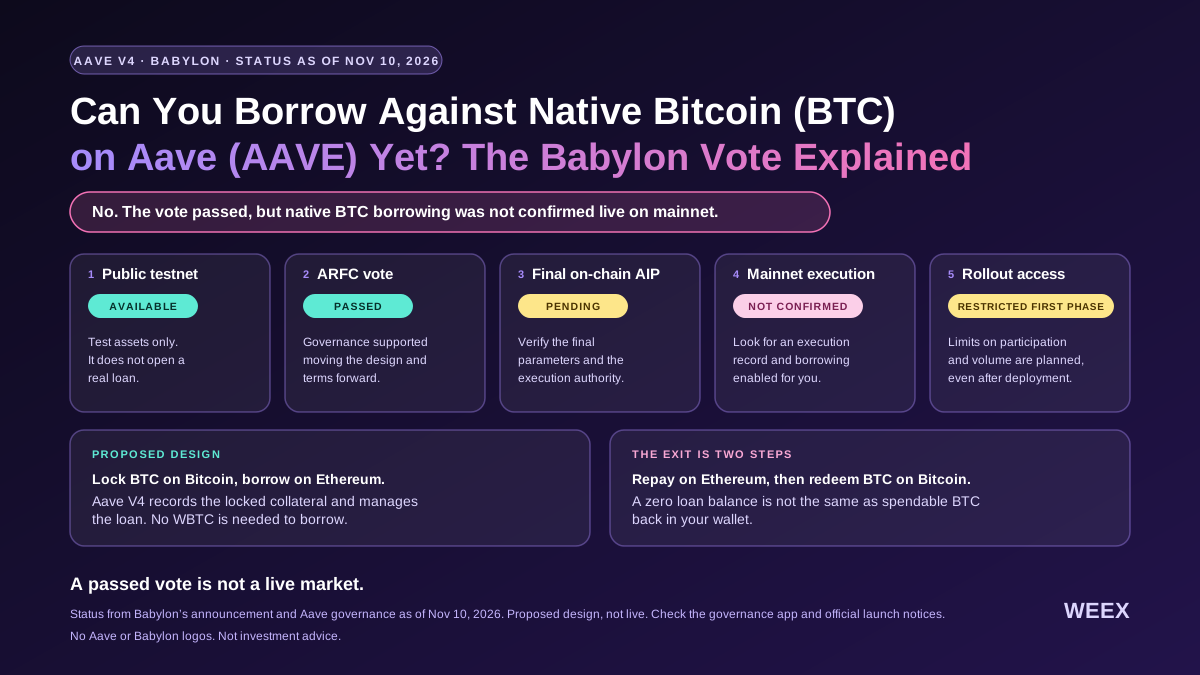
Can You Borrow Against Native Bitcoin (BTC) on Aave (AAVE) Yet? The Babylon Vote Explained
Can you borrow against native Bitcoin on Aave yet? See what the Babylon vote approved, what still needs to launch, and how BTC liquidation would work.

PIEVERSE Price Up Nearly 80% in a Week: Futures Activity, the November 14 Unlock and What Is Confirmed
PIEVERSE rose about 79% in seven days with futures volume far above spot. See what is confirmed about the November 14 unlock and the WEEX Lucky Eggs campaign.

Hong Kong Approves Crypto Asset Reporting Rules - Fintech World

NVDA Stock Falls 4.3% After Board Opens Investigation: What Is Confirmed and What Is Not
NVDA closed at $178.67 on November 9, 2026, down about 4.3%, after Nvidia’s board confirmed an independent investigation. Other claims come from media reports. WEEX’s Lucky Eggs campaign runs until November 25.

Chainalysis Report: Why Did Western Europe Withstand the Global Crypto Market Chill?

Four Security Strategies from the Wallet Theft Incident

Global Outage: Your Cryptos Are Not Disappearing

Did Strategy buy Bitcoin? Saylor reignites speculation

A New Chapter in the History of Rug Pulls in Crypto

From Binance Incubator to Nasdaq: Injective's Eight Years

tBTC Cross-Chain Bridge Resumes On-Chain Operations, Threshold Network Confirms Adequate Reserves
FinCEN Withdraws Proposed Crypto Travel Rule Expansion in Separate November Move

Finnish Startup Uses Heat from Bitcoin Miners to Heat 30 Homes
Kaspa developer targets ownerless prediction market by end-2026
XRPL lending protocol gains validator support as vault vote advances
US card debt hits $1.29 trillion as Bitcoin loans expose a collateral divide
CryptoQuant: Bitcoin Analyst Sentiment Significantly Bearish, Index Drops to -1.8σ
How Much CPO Demand Will NVIDIA's Rubin Ultra Generate? Bernstein: Optical Value of Single Pod Increases Fivefold
Pump.fun Data Review: Why the Current Meme Market Has Become a 'Harvesting Game'?
Latest articles


Latest coin listings on WEEX


